• REVISIT: Calling In with Loretta Ross
    May 6 2026

    We're revisiting our conversation with Dr. Loretta Ross because her book, Calling In: How to Start Making Change with Those You’d Rather Cancel, is the Integrated Schools book club pick for this month. You can register for one of our amazing, free book club sessions here.

    We’re joined by MacArthur “Genius” and legendary activist Dr. Loretta Ross for a conversation that left us grounded, challenged, and deeply moved. From her early work in reproductive justice and anti-violence movements, to her current mission disrupting “call-out culture,” Dr. Ross offers us a path forward rooted in grace, accountability, and radical love.

    We explore what it means to “call in” rather than call out—especially in an era where public shaming feels ever-present and social media rewards outrage. Dr. Ross shares her personal story of trauma, healing, and transformation, and helps us understand how real change happens not through perfection or purity, but through connection and curiosity.

    Together we unpack the power of holding ourselves and others accountable without dehumanizing. We talk parenting, public schools, and what it means to stay in the struggle without breaking our link in the “chain of freedom.”

    Whether you’re navigating tricky conversations in your school community or trying to show up better in the fight for justice, this episode is for you.

    LINKS:
    • Register for book club!
    • Calling In: How to Start Making Change with Those You’d Rather Cancel – Dr. Ross’s new book
    • What If Instead of Calling People Out, We Called Them In? – NY Times Article about Dr. Ross’s work
    • What Is A Good Parent? Blog post by NY Chapter member, Meredith Winfrey
    • Mothers of Massive Resistance: White Women and the Politics of White Supremacy – Dr. Elizabeth McRae
    • Ep 11 – White Women and the Politics of White Supremacy – Dr. McRae’s 1st time on our show
    • S5E14 – White Supremacy and Black Educational Excellence – Dr. McRae’s 2nd time on our show

    Send us a voice memo: speakpipe.com/integratedschools

    Check out our Bookshop.org storefront to support local bookstores, and send a portion of the proceeds back to us.

    Join our Patreon to support this work, and connect with us and other listeners to discuss these issues even further.

    Subscribe to our YouTube Channel for video versions of our episodes.

    Let us know what you think of this episode, suggest future topics, or share your story with us – IntegratedSchools on Facebook, @integratedschools on Instagram and TikTok, or email us podcast@integratedschools.org.

    The Integrated Schools Podcast was created by Courtney Mykytyn and Andrew Lefkowits.d

    This episode was produced by Andrew Lefkowits and Val Brown. It was edited, and mixed by Andrew Lefkowits.

    Music by Kevin Casey.


    Advertising Inquiries: https://redcircle.com/brands

    Privacy & Opt-Out: https://redcircle.com/privacy
    Mostra di più Mostra meno
    1 ora e 12 min
  • REVISIT: Finding Hope in Solidarity with Heather McGhee
    Apr 22 2026

    We’re going back to the archives today to revisit a conversation with Heather McGhee. In February of 2021, Heather McGhee’s book, The Sum of Us came out. With a focus on the ways in which racism harms everyone, and the potential good that can come from cross-racial coalitions, the book was exciting to us. When we realized that Integrated Schools was featured prominently in the chapter about education, we were blown away.

    The book is based around three main concepts. The first is the “zero-sum lie of racial hierarchy”, or the idea that progress for people of color necessarily has to come at White folks’ expense. The second is the idea of the “drained pool,” the disinvestment by White people in public goods simply because they have to share them with people of color. And finally, the “solidarity dividend,” the idea of gains that we can unlock, but only when we come together across lines of difference.

    This last idea, the most hopeful, inspired Ms. McGhee to go back on the road and make a podcast documenting examples of the Solidarity Dividend in action. She joins us to discuss the podcast, what it means to be a good ally, the power of relationships in sustaining movements, and what role the Integrated Schools community should play in participating in the current, cross-racial movement for public education.

    LINKS

    • Ms. McGhee’s first appearance on our show
    • The Sum of Us Podcast
    • The Sum of Us Book
    • James Haslem from HEAL Together
    • Ms. McGhee and Victor Ray’s Op-Ed in the NYT
    • California Calls – organizing in California
    • Ms. McGhee’s mother – Dr. Gail Christopher
    • Truth, Racial Healing, and Transformation

    ACTION STEPS

    • Listen to The Sum of Us Podcast
    • Read The Sum of Us Book
    • Get involved locally – find organizations that align with your values, and just show up!
    • Take opportunities to share space with folks – school pick up/ drop off is a great place to start
    • Share stories off cross racial solidarity with others. Stories from The Sum of Us, from our podcast, or from your own life.

    Use these links or start at our Bookshop.org storefront to support local bookstores, and send a portion of the proceeds back to us.

    Join our Patreon to support this work, and connect with us and other listeners to discuss these issues even further.

    Let us know what you think of this episode, suggest future topics, or share your story with us – @integratedschls on twitter, IntegratedSchools on Facebook, or email us podcast@integratedschools.org.

    The Integrated Schools Podcast was created by Courtney Mykytyn and Andrew Lefkowits.

    This episode was produced by Andrew Lefkowits and Val Brown. It was edited, and mixed by Andrew Lefkowits.

    Music by Kevin Casey.


    Advertising Inquiries: https://redcircle.com/brands

    Privacy & Opt-Out: https://redcircle.com/privacy
    Mostra di più Mostra meno
    1 ora e 1 min
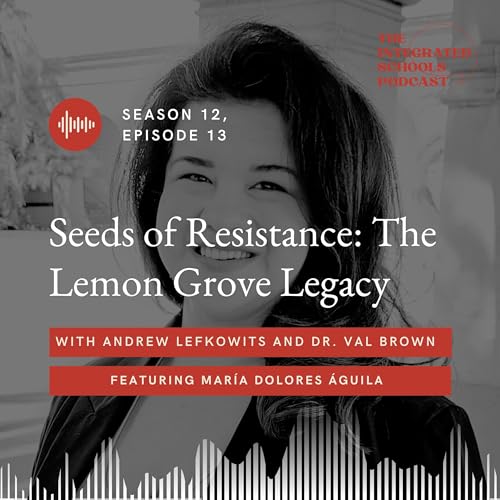
  • Seeds of Resistance: The Lemon Grove Legacy
    Apr 8 2026
    We're joined by YA author, María Dolores Águila to uncover the largely untold story of the 1931 Lemon Grove Incident—the first successful school desegregation case in California, led by Mexican and Mexican American families.Through her book A Sea of Lemon Trees, Maria invites us into the world of 12-year-old Roberto Alvarez, a child asked to carry the weight of his community’s fight for educational justice.Together, we explore what it looks like when communities organize, when young people lead, and when stories become a form of power.We can’t be what we don’t see.Maria shares how her work is rooted in creating “social capital” for young readers—especially those who have not seen themselves reflected in books or history. When our kids see communities like theirs organizing and winning, it expands what feels possible.The Lemon Grove case unfolded during a time of anti-Mexican sentiment and mass deportations. The parallels to today are hard to ignore. What we don’t know about our history can make the present feel confusing—but these stories remind us: we’ve been here before. While Roberto Alvarez was the named plaintiff, this was never a story about one hero. It was about a community—families organizing, neighbors supporting, people taking risks together. Every role mattered.Resistance is real—and it costs something.This wasn’t a clean or easy victory. Families faced threats, pressure, and even deportation. Telling the full story—including the hard parts—matters, especially for our kids. Through a 12-year-old’s perspective, the absurdity of segregation becomes clear. Kids often see injustice plainly—before we, as adults, complicate it.We keep coming back to this:All of our kids are watching.They’re watching how we talk about history.They’re watching how we respond to injustice.They’re watching whether we stay—or walk away.What might shift if we saw ourselves not as individuals navigating systems, but as part of a community shaping them—together?LINKS:A Sea of Lemon Trees: The Corrido of Roberto AlvarezBarrio Rising: The Protest that Built Chicano ParkMenudo Sunday: A Spanglish Counting BookThe Lemon Grove Incident Mexican RepatriationS11E10 – Micro Activism: Making a Difference One Step at a Time Send us a voice memo: speakpipe.com/integratedschoolsCheck out our Bookshop.org storefront to support local bookstores, and send a portion of the proceeds back to us.Join our Patreon to support this work, and connect with us and other listeners to discuss these issues even further.Subscribe to our YouTube Channel for video versions of our episodes.Let us know what you think of this episode, suggest future topics, or share your story with us – IntegratedSchools on Facebook, @integratedschools on Instagram and TikTok, or email us podcast@integratedschools.org.The Integrated Schools Podcast was created by Courtney Mykytyn and Andrew Lefkowits.This episode was produced by Andrew Lefkowits and Val Brown. It was edited, and mixed by Andrew Lefkowits.Music by Kevin Casey. Advertising Inquiries: https://redcircle.com/brandsPrivacy & Opt-Out: https://redcircle.com/privacy
    Mostra di più Mostra meno
    50 min
  • Spatial Injustice: School Closures as a Form of Educational Redlining
    Mar 25 2026
    What happens when we stop thinking about schools as buildings—and start seeing them as the ecosystems that hold our communities together?In this episode, we sit with Dr. Mara Tieken to explore school closures not as isolated decisions, but as part of a broader pattern of spatial injustice—where resources, opportunities, and care are unevenly distributed based on where we live.Together, we wrestle with a hard truth: school closures are often framed as inevitable… but what if they’re actually the result of choices—policies, priorities, and patterns of disinvestment—that we can question?We grapple with several key ideas:Schools are more than buildings—they are social, cultural, and economic anchors in our communitiesClosures disproportionately impact Black, Brown, and low-income communitiesThe most common justifications (cost savings, academic improvement, “efficiency”) often don’t hold up under scrutinyWhat gets labeled as a “failing school” is often a school that has been failed—by policy, funding, and systemic neglectSchool closures don’t just disrupt students—they create lasting grief, loss, and disconnection across generationsThis conversation also reminds us that we are not powerless. Across the country, communities are:Organizing and building multiracial, cross-class coalitionsQuestioning the data and narratives used to justify closuresRunning for school board, advocating for policy change, and showing up for each other’s schools—not just our ownWe are left wondering, what would it look like to treat every school as our school? Not just when it’s under threat—but all the time.Because if public schools are foundational to our democracy, then caring for them can’t be an individual act. It has to be collective.LINKS:Dr. Tieken's Hechinger Report Op-Ed - Shuttering public schools is a strategy that rarely saves much money and often leads to test score declinesAnd from The Washington Monthly - Don't Fall for the School Closure TemptationRural Schools Open - Dr. Tieken's guide to fighting school closures and doing it well, when needed. Dr. Eve L Ewing - Ghosts in the SchoolyardAnd Dr. Ewing on our show - S11E12: Schools and Race: Eve Ewing on the Construction of American Racism Send us a voice memo: speakpipe.com/integratedschoolsCheck out our Bookshop.org storefront to support local bookstores, and send a portion of the proceeds back to us.Join our Patreon to support this work, and connect with us and other listeners to discuss these issues even further.Subscribe to our YouTube Channel for video versions of our episodes.Let us know what you think of this episode, suggest future topics, or share your story with us – IntegratedSchools on Facebook, @integratedschools on Instagram and TikTok, or email us podcast@integratedschools.org.The Integrated Schools Podcast was created by Courtney Mykytyn and Andrew Lefkowits.This episode was produced by Andrew Lefkowits and Val Brown. It was edited, and mixed by Andrew Lefkowits.Music by Kevin Casey.Advertising Inquiries: https://redcircle.com/brandsPrivacy & Opt-Out: https://redcircle.com/privacy
    Mostra di più Mostra meno
    1 ora e 1 min
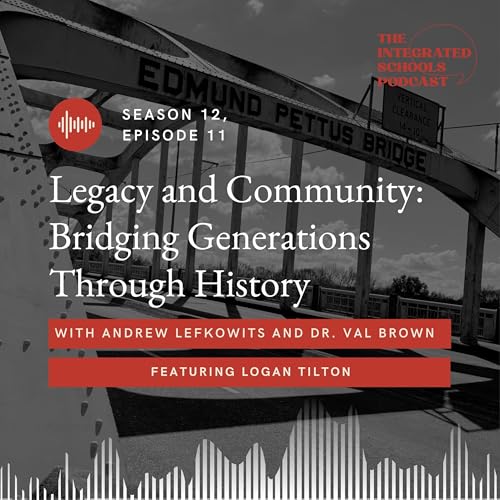
  • Legacy and Community: Bridging Generations through History
    Mar 11 2026

    In this episode, Andrew and Dr. Val are joined by Logan Tilton, a history student at North Carolina Central University and one of the Levine Museum of the New South’s fellowship students. Together, they reflect on what it means to learn history not as a list of dates and names, but as a living story shaped by community, struggle, resilience, and collective memory.

    Drawing from a powerful fellowship trip to Montgomery and Selma, Logan shares how visiting the Equal Justice Initiative sites and hearing directly from a Selma foot soldier deepened her understanding of history, accountability, and the ongoing connections between past and present. This conversation explores the emotional weight of historical truth, the importance of learning from young people, and the role community plays in sustaining hope.

    This episode reminds us that history is not over. The patterns of inequality, exclusion, and violence that shaped the past are still with us. But so are the patterns of resistance, courage, care, and collective action. Logan’s reflections offer a powerful reminder that when young people are trusted with truth, they can carry it forward with clarity, insight, and hope.

    LINKS
    • The Levine Museum of The New South
    • The Levine Museum's Catalyst Fellowship Program
    • The Equal Justice Initiative's Legacy Sites
    • Foot Soldier Park - Selma, AL
    • Bryan Stevenson
    • Just Mercy: A Story of Justice and Redemption - by Bryan Stevenson
    • S11E15 – Unearthing Joy: Gholdy Muhammad on Teaching with Love
    • The Old South: A Psychohistory - by Earl E. Thorpe

    Send us a voice memo: speakpipe.com/integratedschools

    Check out our Bookshop.org storefront to support local bookstores, and send a portion of the proceeds back to us.

    Join our Patreon to support this work, and connect with us and other listeners to discuss these issues even further.

    Subscribe to our YouTube Channel for video versions of our episodes.

    Let us know what you think of this episode, suggest future topics, or share your story with us – IntegratedSchools on Facebook, @integratedschools on Instagram and TikTok, or email us podcast@integratedschools.org.

    The Integrated Schools Podcast was created by Courtney Mykytyn and Andrew Lefkowits.

    This episode was produced by Andrew Lefkowits and Val Brown. It was edited, and mixed by Andrew Lefkowits.

    Music by Kevin Casey.


    Advertising Inquiries: https://redcircle.com/brands

    Privacy & Opt-Out: https://redcircle.com/privacy
    Mostra di più Mostra meno
    51 min
  • Caring for Your Community in a Time of Crisis: On the Ground in Minneapolis
    Feb 25 2026

    When crisis comes for one of us, it comes for all of us.

    In this powerful and deeply moving episode, Dr. Val and Andrew sit down with two parent leaders in Minneapolis—Carina (a White mom and longtime bridge-builder in dual language spaces) and Cisne (a Spanish-speaking immigrant mom and vice president of their dual language parent organization)—to talk about what it means to care for our community when ICE arrives at your doorstep.

    What unfolds is a story about more than fear. It’s a story about relationships built long before crisis hit. About language justice. About sharing power. About mutual aid that moves in both directions. About what happens when Latino leadership is centered—not as an afterthought, but as the foundation.

    We also hear from the professional interpreter who made this conversation possible in real time—offering a powerful reflection on interpretation as social justice work.

    This conversation is heavy. And it is also filled with hope.

    Because what we’re reminded of again and again is this: systems may fail us. Relationships keep us safe.

    This episode reminds us that integration work is not theoretical. It is not performative. It is not about optics.

    • It is about who gets to make decisions.
    • Whose language is spoken first.
    • Whose safety is prioritized.
    • Whose children are protected.


    It asks those of us—especially those of us who are White, documented, resourced—to reflect on how we are using proximity to power. Are we holding it tightly? Or are we sharing it?

    It reminds us that bilingual education is not enrichment for some and marginalization for others—it is an opportunity to build bridges, leadership, and collective strength.

    And it underscores something we’ve said for years: public schools are one of the few remaining places where we canbuild the kind of cross-racial, cross-class relationships that sustain us in crisis.

    If we choose to.

    The children missing from classrooms in Minneapolis are our children.

    The parents afraid to leave their homes are part of our communities.

    The mental health impacts will ripple far beyond one city.

    Integration is not just about where our children sit in class.

    It is about whether we are willing to stand together when it matters most.

    Thank you for being part of this work. Thank you for staying in it—even when it’s heavy.

    Send us a voice memo: speakpipe.com/integratedschools

    Check out our Bookshop.org storefront to support local bookstores, and send a portion of the proceeds back to us.

    Join our Patreon to support this work, and connect with us and other listeners to discuss these issues even further.

    Subscribe to our YouTube Channel for video versions of our episodes.

    Let us know what you think of this episode, suggest future topics, or share your story with us – IntegratedSchools on Facebook, @integratedschools on Instagram and TikTok, or email us podcast@integratedschools.org.

    The Integrated Schools Podcast was created by Courtney Mykytyn and Andrew Lefkowits.

    This episode was produced by Andrew Lefkowits and Val Brown. It was edited, and mixed by Andrew Lefkowits.

    Music by Kevin Casey.


    Advertising Inquiries: https://redcircle.com/brands

    Privacy & Opt-Out: https://redcircle.com/privacy
    Mostra di più Mostra meno
    1 ora e 7 min
  • Staying Power with Danielle Wingfield
    Feb 11 2026

    What does it mean to outlast backlash?

    In this episode, we’re joined by Dr. Danielle Wingfield—legal historian, law professor, and public education advocate—whose work sits at the intersection of history, civil rights, democracy, and family. Together, we trace the long arc of resistance to public education, from enslavement and segregation to today’s fights over curriculum, parental rights, and school privatization.

    Dr. Wingfield helps us see that what feels overwhelming right now isn’t new—it’s cyclical. And that clarity matters. When we understand the playbook, we can respond with intention instead of panic.

    We talk about:

    • The history of massive resistance—and why today’s attacks on public education are part of a much longer project
    • How curriculum control, “parental rights,” and privatization have been used before to maintain racial hierarchy
    • Why public schools remain essential to democracy—and why they’re being targeted so aggressively
    • What “home place” looks like: community care, shared responsibility, mutual aid, and kinship beyond bloodlines
    • Why progress always brings backlash—and why staying power is how movements win

    This conversation is both grounding and galvanizing. It reminds us that we don’t have to solve everything—but we dohave to hold our link in the chain.

    Because when we know our history, we’re harder to divide.

    And when we stay together long enough, we change what’s possible.

    LINKS:
    • The Resurgence of Massive Resistance - Washington and Lee Law Journal
    • Teachers in the Movement - Oral history project
    • First Class Project - documentary series
    • Homeplace (A Site of Resistance) - bell hooks
    • Henry L. Marsh III - First Black mayor of Richmond, VA & civil rights attorney
    • Oliver W. Hill - Civil rights attorney
    • Barbara Rose Johns


    Send us a voice memo: speakpipe.com/integratedschools

    Check out our Bookshop.org storefront to support local bookstores, and send a portion of the proceeds back to us.

    Join our Patreon to support this work, and connect with us and other listeners to discuss these issues even further.

    Subscribe to our YouTube Channel for video versions of our episodes.

    Let us know what you think of this episode, suggest future topics, or share your story with us – IntegratedSchools on Facebook, @integratedschools on Instagram and TikTok, or email us podcast@integratedschools.org.

    The Integrated Schools Podcast was created by Courtney Mykytyn and Andrew Lefkowits.

    This episode was produced by Andrew Lefkowits and Val Brown. It was edited, and mixed by Andrew Lefkowits.

    Music by Kevin Casey.


    Advertising Inquiries: https://redcircle.com/brands

    Privacy & Opt-Out: https://redcircle.com/privacy
    Mostra di più Mostra meno
    52 min
  • Demystifying Disability with Emily Ladau
    Jan 28 2026
    Join the conversation by registering for one of our upcoming Book Club sessions! The Integrated Schools Podcast returns with a great conversation with Emily Ladau, disability rights activist and author of Demystifying Disability: What to Know, What to Say, and How to be an Ally.Ladau describes herself as "passionate about having conversations about disability and really engaging people to talk about a topic that they might otherwise feel uncomfortable with and really making it approachable and accessible to them." In the spirit of Dr. Loretta Ross, she models what it means to call people in: to meet other people where they are and offer them a bridge to understanding the lived reality - or rather, realities - of the over a billion people around the world who have some type of disability.Ladau takes an approach that is at once gracious and practical. "In order to be effective advocates for any kind of social justice, we first need the tools and the resources and the understanding, but often we are not socialized to think about disability at all... I don't want people to feel so worried about making a mistake that they don't get involved in the conversation in the first place; [nor] to get bogged down in specific rules, but… to have a working knowledge so that you feel like you belong in the broader work.”This conversation brings up the parallels between combating White supremacy and combating ableism, and the interplay between the two. Ladau points out that we can't fight back against either racism or ableism by keeping these issues siloed -especially because disability is an identity that cuts across all other identity groups."It's also pretty much one of the only marginalized communities that anybody can join at any time. And I always say, you know, that's not a threat. We're cool, we're fun."LINKS:Join Book Club!!Demystifying Disability: What to Know, What to Say, and How to be an AllyEmily's website - emilyladau.comWords I Wheel By - Emily's SubstackThe 504 Sit InS12E6 - Calling In with Loretta RossCalling In - Dr. Loretta Ross's book Send us a voice memo: speakpipe.com/integratedschoolsCheck out our Bookshop.org storefront to support local bookstores, and send a portion of the proceeds back to us.Join our Patreon to support this work, and connect with us and other listeners to discuss these issues even further.Subscribe to our YouTube Channel for video versions of our episodes.Let us know what you think of this episode, suggest future topics, or share your story with us – IntegratedSchools on Facebook, @integratedschools on Instagram and TikTok, or email us podcast@integratedschools.org.The Integrated Schools Podcast was created by Courtney Mykytyn and Andrew Lefkowits.This episode was produced by Andrew Lefkowits and Val Brown. It was edited, and mixed by Andrew Lefkowits.Music by Kevin Casey.Advertising Inquiries: https://redcircle.com/brandsPrivacy & Opt-Out: https://redcircle.com/privacy
    Mostra di più Mostra meno
    57 min