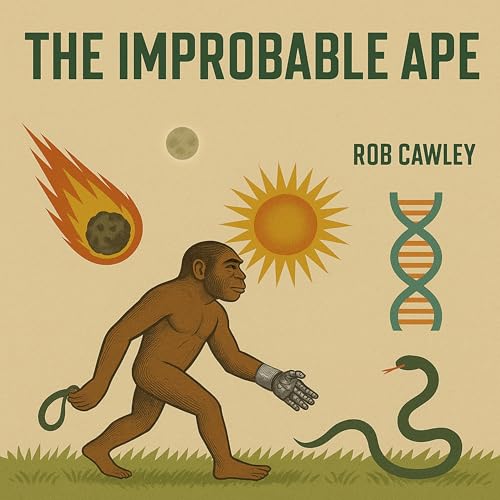
The Improbable Ape - A Journey Through the Astronomical Odds of Human Existence. copertina

The Improbable Ape - A Journey Through the Astronomical Odds of Human Existence.

The Improbable Ape - A Journey Through the Astronomical Odds of Human Existence.

Di: Rob Cawley
Ascolta gratuitamente

A proposito di questo titolo

What are the odds of you being here? Not just alive — but you. The Improbable Ape is a serialized audio journey through the staggering unlikeliness of human existence. Told with the voice of a storyteller — not a scientist — Rob Cawley explores how chance, chaos, and time somehow conspired to create consciousness, memory, identity, and meaning. Each episode unfolds like a conversation you didn’t know you needed: curious, skeptical, occasionally funny, and quietly profound. Science and philosophy combined in an accessible way.Rob Cawley Scienza
  • When The Doomsday Clock Gets Closer to Midnight: The Improbable Ape, Jan 2026
    Jan 28 2026

    When the Clock Strikes Closer: The Fragility of Our Improbable Existence

    After billions of years of cosmic luck and countless near-extinctions, humanity exists against astronomical odds. But on January 27, 2026, the Doomsday Clock moved to 85 seconds to midnight—the closest we've ever been to self-annihilation.In this episode, we explore what the Doomsday Clock actually is, why it's closer to catastrophe than ever before, and what it means for our species' improbable journey. From nuclear escalation and climate crisis to AI-driven misinformation, the threats are mounting. But the clock can still move backward—if we act now.

    This is a companion piece to "The Improbable Ape: A Journey Through the Astronomical Odds of Human Existence" by Rob Cawley, examining how everything that made us improbable could be undone in less time than it takes to boil an egg.The question is: Will we use the time we have left?

    Mostra di più Mostra meno
    5 min
  • Episode Thirteen: Exiles
    Jan 13 2026

    As Earth grows hotter and more fragile, we look to the stars and imagine escape.


    In Episode Thirteen, that dream collides with a brutal reality: space is not a new Eden. It is an environment actively hostile to human life—one that strips away bone, muscle, immunity, sanity, and time itself. Beyond Earth’s gravity, atmosphere, and magnetic shield, the human body begins to fail almost immediately.


    This episode dismantles the romance of space colonization and replaces it with the lived truth. Astronauts don’t explore space—they endure it. Mars is not a second home waiting to be terraformed; it is a dead world that kills unprotected humans in seconds. Space habitats are not frontiers, but fragile life-support bubbles where every breath, every drop of water, every degree of heat must be manufactured and defended.


    We follow the slow dissolution of the human body in microgravity, the invisible assault of cosmic radiation, and the psychological toll of isolation so extreme it fractures identity itself. To survive beyond Earth for generations, humans would need to change—biologically, psychologically, irreversibly.


    And that leads to the episode’s most unsettling insight:


    To become a spacefaring species, we would have to stop being human.


    True colonization of space would not be humanity spreading outward—it would be humanity splitting in two. One branch remaining tied to Earth. The other evolving into something new, something adapted to vacuum, radiation, confinement, and exile.


    This episode reframes the cosmic dream as a question of identity rather than ambition:


    Are we explorers seeking new worlds…

    or refugees fleeing a world we no longer know how to care for?


    Because the stars will not save us from the consequences of what we do here.

    Mostra di più Mostra meno
    33 min
  • Episode Twelve: The Unraveling Eden
    Jan 12 2026

    The countdown never stopped.

    It just changed what it was counting.


    In Episode Twelve, we arrive at the most consequential moment in the human story—not a sudden apocalypse, but a slow, accelerating unraveling of the planetary systems that made us possible.


    For billions of years, Earth regulated itself. Atmosphere, oceans, ice, and life formed a resilient, self-correcting system that survived asteroid impacts, ice ages, and mass extinctions. That stability gave rise to agriculture, cities, and civilization.


    Now, for the first time, a single species has become powerful enough to destabilize that equilibrium.


    This episode explores the Great Acceleration—the explosive growth in human population, energy use, consumption, and technological reach that began in the mid-20th century. In just a few generations, we have altered the composition of the atmosphere, rewired the chemistry of the oceans, reshaped ecosystems, and pushed Earth into a new geological epoch: the Anthropocene.


    We follow the invisible changes unfolding around us:


    • An atmosphere transformed faster than at any time in deep history

    • Oceans absorbing heat and acid at planetary scale

    • Ice sheets melting, feedback loops awakening, and stability slipping


    What makes this moment unprecedented is not just the scale of change—but awareness. We are the first species to understand the systems we are destabilizing. The first to see the data, trace the consequences, and know that the future is being decided in real time.


    This is not a story of inevitable collapse.

    It is a story of responsibility arriving faster than wisdom.


    We inherited an Eden that took billions of years to assemble.

    And we are testing—perhaps for the first time—whether intelligence can coexist with restraint.


    The question is no longer what will happen to the planet.


    It is what kind of species we choose to be while it is still responding.

    Mostra di più Mostra meno
    32 min
Ancora nessuna recensione