• EP9 Inspiring Talk Series with Ugo Amaldi
    Feb 9 2026

    OVERVIEW

    In this episode of The Global Lens, host Daniella Sussman speaks with Professor Ugo Amaldi about science diplomacy and international scientific collaboration through the lens of CERN and global research cooperation. Drawing on decades of leadership in large-scale experiments, Amaldi reflects on how sustained partnerships shape the future of research, from quantum technologies to medical innovation. The conversation highlights how collaborative science advances discovery while building trust across geopolitical boundaries.

    EPISODE SUMMARY

    From Cold War collaborations with Soviet scientists to pioneering CERN experiments and advancing cancer therapy with hadron beams, this episode traces the evolution of global scientific cooperation. Amaldi shares lessons learned from managing large international teams, translating fundamental physics into life-saving treatments, and establishing durable networks across nations. The conversation also examines disparities in research investment within Europe and advocates for sustained, long-term commitment to science as a foundation for diplomacy and progress. Throughout, collaboration is presented not just as an ideal, but as a practical necessity for advancing knowledge and fostering peace.

    In this episode, we discuss:

    01:41 – Introduction to the importance of international scientific collaboration

    03:30 – Cold War era science and cross-cultural cooperation with Soviet physicists

    04:10 – Building large-scale international collaborations at CERN

    05:54 – Balancing innovation and stability in complex experiments

    09:08 – Transition from work in particle physics to pioneering cancer therapy

    18:20 – European disparities in research funding and investment

    21:35 – Advice to future scientists: curiosity, optimism, and collaboration


    ABOUT THE GUEST

    Ugo Amaldi is a particle physicist and pioneer in hadron therapy. A CERN Scientist Emeritus, he co-discovered the rising proton-proton cross section in 1973, founded and led the 500-member DELPHI collaboration at LEP, and proposed the cyc-linac accelerator for cancer treatment. In 1992 he created the TERA Foundation, leading to Italy’s CNAO center and influencing facilities worldwide. As Scientific Director of the Tera-Care Foundation, he now advances clinical helium facilities with CERN. Author of more than 600 papers (h-index 83), accelerator physics textbooks, and popular science books including Particle Accelerators: From Big Bang Physics to Hadron Therapy (Springer). Co-author of ~40 physics textbooks used by millions of students globally.


    MENTIONED IN THE EPISODE:

    ⚉ (Reference) European Organization for Nuclear Research (CERN) - https://home.cern/

    ⚉ (Studies or Research) DELPHI experiment - https://home.cern/science/experiments/delphi

    ⚉ (Reference) National Center for Oncological Hadrontherapy (CNAO) - https://fondazionecnao.it/en/

    ⚉ (Reference) European Network for Hadron Therapy (ENLIGHT) - https://enlight.web.cern.ch/


    CONNECT WITH UGO AMALDI:

    ⚉ Inspire HEP: https://inspirehep.net/


    CONNECT WITH DANIELLA:

    ⚉ Podcast Website: https://glsd.ai/

    ⚉ LinkedIn: https://www.linkedin.com/in/daniellasussman/

    ⚉ Instagram: https://www.instagram.com/daniellasussmanglobal/

    Mostra di più Mostra meno
    29 min
  • EP8 AI and Higher Education: Dakota State's Cyber Vision with Dr. José-Marie Griffiths
    Jan 26 2026

    OVERVIEW

    This episode of The Global Lens explores the intersection of artificial intelligence, cybersecurity, and science diplomacy, and how these forces are transforming national security and global cooperation. Daniella Sussman and Dr. José-Marie Griffiths explore Dakota State University’s role in turning applied AI research into real-world impact. Education emerges as a strategic force and soft power in the evolving AI landscape.

    EPISODE SUMMARY

    Dr. Griffiths reflects on transforming Dakota State University into a cyber and AI powerhouse by aligning research, policy, and workforce development. She outlines how applied labs, global partnerships, and inclusive education models help translate innovation into real-world impact. The episode also explores how higher education can function as science diplomacy by building trust, shared standards, and ethical AI frameworks across borders. Throughout, Dr. Griffiths stresses the responsibility educators and policymakers share in shaping AI to benefit society rather than control it.

    In this episode, we discuss:

    01:39 - Building Dakota State’s strong and advanced cyber-AI foundation

    04:08 - AI's transformative and evolving impact on higher education

    07:16 - Empowering accessible and ethical global AI innovation through inclusion

    09:32 - Higher education driving real-world global impact and discovery

    15:00 - Shaping ethical global AI standards and open data sharing

    17:37 - Policymakers learning from DSU's integrated AI education approach

    24:31 - Ensuring responsible AI design, development, and collaboration

    ABOUT THE GUEST

    Dr. José-Marie Griffiths is President of Dakota State University, where she has led transformational growth since 2015. Her leadership and contributions have earned her more than 20 major awards, including recognition as a USA Today Woman of the Year and one of InspiredMinds!’ 50 Influential Women in AI.

    A physicist and information scientist by training, Dr. Griffiths has held leadership roles across research, government, and higher education, with a special focus on STEM and cyber fields. She has served on the National Science Board, the U.S. President’s Information Technology Advisory Committee, and the National Security Commission on Artificial Intelligence. Today, she continues this work as an advisor to the Special Competitive Studies Project (SCSP).

    Dr. Griffiths has led projects with more than 28 federal agencies, including NASA and the Department of Energy, collaborated with major corporations such as IBM and Apple, and partnered with international organizations including NATO and the United Nations.


    MENTIONED IN THE EPISODE:

    ⚉ (Reference) Madison Cyber Labs (MAD Labs) - https://dsu.edu/research/madison-cyber-labs/

    ⚉ (Reference) Google Cybersecurity Clinics Fund - https://cyberclinics.withgoogle.com/

    ⚉ (Reference) Dakota State's Governors Cyber Academy - https://dsu.edu/admissions/undergraduate/cyber-academy.html

    ⚉ (Reference) Dakota State Applied Research Corporation (DARC) - https://dsu-arc.org/


    ————

    This episode is brought to you by Global Signals, a curated bi-weekly paid newsletter for globally minded policymakers, international researchers, strategic industry leaders, and investors.

    Subscribe here: https://tinyurl.com/Global-Lens

    ————


    CONNECT WITH DR. JOSÉ-MARIE GRIFFITHS:

    ⚉ Website: https://dsu.edu/directory/griffiths-jose-marie.html

    ⚉ X (Twitter): https://x.com/josegriffiths

    ⚉ LinkedIn: https://www.linkedin.com/in/jose-marie-griffiths-9106b7b/


    CONNECT WITH DANIELLA:

    ⚉ Podcast Website: https://the-global-lens.captivate.fm/

    ⚉ LinkedIn: https://www.linkedin.com/in/daniellasussman/

    ⚉ Instagram: https://www.instagram.com/daniellasussmanglobal/

    Mostra di più Mostra meno
    27 min
  • EP7 Expanding the U.S.–India Research Corridor with Neetisha Besra
    Dec 22 2025

    OVERVIEW

    Science Diplomacy sits at the center of International Relations and US-India cooperation in this episode of The Global Lens, where host Daniella Sussman speaks with Neetisha Besra about building durable research bridges between the two countries. The conversation examines how academic institutions, policy frameworks, and people-to-people ties are shaping a deeper and more strategic U.S.–India partnership.

    EPISODE SUMMARY

    This episode explores how research collaboration has become a powerful diplomatic tool between the United States and India. Neetisha Besra offers insight into how universities operate as connectors across governments, disciplines, and borders. The discussion highlights the practical work behind sustaining long-term partnerships, from navigating policy environments to aligning institutional priorities. Listeners gain a grounded view of how global challenges are increasingly addressed through collaborative research ecosystems rather than bilateral politics alone.

    In this episode, we discuss:

    00:46 - Setting the stage for the U.S.–India research corridor

    01:48 - Why 2025–2026 marks a critical window for the U.S.–India scientific partnership

    07:15 - The research corridor as a living, operational ecosystem

    10:05 - Institutional programs enabling sustained bilateral collaboration

    13:21 - India RISE Fellowship and supporting women scientists in STEM

    18:58 - Breakthrough grants and catalytic funding for high-risk research

    29:29 - Measuring diplomatic impact beyond papers and patents


    ABOUT THE GUEST

    Neetisha Besra is the Director for the Gupta-Klinsky India Institute in India at Johns Hopkins University. Based in New Delhi, she leads GKII’s India strategy, partnerships, and operations to strengthen U.S.–India collaborations in research, education, and policy. She holds an MPA in International Development from Harvard Kennedy School, a Master’s in Development Practice from the Tata Institute of Social Sciences, and a Bachelor of Technology from IIT Kanpur.


    MENTIONED IN THE EPISODE:

    ⚉ (Website) Gupta-Klinsky India Institute at Johns Hopkins University - https://indiainstitute.jhu.edu/

    ⚉ (Reference) Indo-U.S. Science and Technology Forum - https://iusstf.org/

    ⚉ (Reference) Fulbright-Nehru Scholarship Program - https://www.usief.org.in/fulbright-fellowships/fellowships-for-indian-citizen/

    ⚉ (Reference) The NASA-ISRO Synthetic Aperture Radar - https://science.nasa.gov/mission/nisar/

    ⚉ (Reference) India RISE Fellowship - https://indiainstitute.jhu.edu/our-initiatives/indiarise/

    ⚉ (Reference) TB Free Schools Initiative - https://indiainstitute.jhu.edu/our-initiatives/tb-free-schools-initiative/


    ————

    This episode is brought to you by Global Signals, a curated bi-weekly paid newsletter for globally minded policymakers, international researchers, strategic industry leaders, and investors.

    Subscribe here: https://tinyurl.com/Global-Lens

    ————


    CONNECT WITH NEETISHA BESRA:

    ⚉ Website: https://indiainstitute.jhu.edu/directory/neetisha-besra/

    ⚉ LinkedIn: https://www.linkedin.com/in/neetishabesra/

    ⚉ X (Twitter): https://x.com/NeetishaBesra


    CONNECT WITH DANIELLA:

    ⚉ Podcast Website: https://the-global-lens.captivate.fm/

    ⚉ LinkedIn: https://www.linkedin.com/in/daniellasussman/

    ⚉ Instagram: https://www.instagram.com/daniellasussmanglobal/
    Mostra di più Mostra meno
    41 min
  • EP6 Radical AI: Changing How The World Innovates with Joseph F. Krause
    Dec 15 2025

    OVERVIEW

    As global research ecosystems modernize and AI reshapes scientific infrastructure, host Daniella Sussman and guest Joseph F. Krause examine how science diplomacy, materials science, and AI are converging to redefine how nations and industries pursue technological breakthroughs. Their exchange underscores the accelerating transition toward autonomous discovery, where governments, national labs, and private innovators collaborate to build next-generation research capabilities.

    EPISODE SUMMARY

    This conversation charts Radical AI’s emergence as a technical and strategic force, detailing how autonomous labs, large-scale data generation, and machine-learned simulations are restructuring the scientific process. Joseph outlines the shift from serial to parallel discovery, the role of open-source tools in expanding global participation, and the policy frameworks now shaping AI-native research programs. The discussion illustrates why materials development is becoming a geopolitical priority and how collaboration, infrastructure, and policy alignment are essential to remain competitive. By integrating scientific insight with national-level strategy, the episode positions the future of discovery as both a technological and diplomatic undertaking.

    In this episode, we discuss:

    03:06 – The founding vision behind Radical AI

    07:30 – Redefining the scientific workflow through parallel discovery

    11:18 – How TorchSim and open-source tools expand global access

    17:39 – The intensifying race for scientific leadership and the global stakes of AI-native research

    20:52 – Data availability, global standards, and international collaboration

    23:30 – Who shapes global AI standards and how Radical AI contributes to that future

    39:02 – The future vision of removing materials as a global bottleneck


    ABOUT THE GUEST

    Joseph F. Krause is Co-Founder and CEO of Radical AI, which combines AI and robotics to accelerate the design, development, and discovery of novel materials. A U.S. Army National Guard veteran and trained materials scientist, he pioneered neuromorphic semiconductor research at the Army DEVCOM research lab and later led deep tech investments at AlleyCorp before founding Radical.

    Radical AI is building a unified scientific intelligence platform that autonomously discovers, designs, and manufactures advanced materials - bridging gaps between research, industry, and policy. The company’s work advances how national labs, industry, and international partners collaborate to shape global standards in AI infrastructure and scientific innovation.


    MENTIONED IN THE EPISODE:

    ⚇ (Studies or Research) Materials Project / Materials Genome Initiative - https://www.mgi.gov/content/materials-project

    ⚇ (Website) AI + Science Summit - https://www.scsp.ai/event/ai-science/

    ⚇ (Website / Tool) Torch Sim - https://github.com/TorchSim/torch-sim

    ⚇ (Reference) Open Catalyst Project - https://opencatalystproject.org/


    ————

    This episode is brought to you by Global Signals, a curated bi-weekly paid newsletter for globally minded policymakers, international researchers, strategic industry leaders, and investors.

    Subscribe here: https://tinyurl.com/Global-Lens

    ————


    CONNECT WITH JOSEPH F. KRAUSE:

    Website: https://www.radical-ai.com/

    LinkedIn: https://www.linkedin.com/in/josephfkrause/

    X (Twitter): https://x.com/josephfkrause/


    CONNECT WITH DANIELLA:

    Podcast Website: https://the-global-lens.captivate.fm/

    LinkedIn: https://www.linkedin.com/in/daniellasussman/

    Instagram: https://www.instagram.com/daniellasussmanglobal/

    Mostra di più Mostra meno
    42 min
  • EP5 Axiom Space: Diplomacy, Innovation, and Partnerships with Jared Stout
    Nov 26 2025

    OVERVIEW

    As international partnerships expand and space innovation accelerates, host Daniella Sussman and guest Jared Stout explore how science diplomacy is emerging as a foundation for cooperation in the new space era. Their discussion highlights how government, industry, and global partners are working together to shape the future of human activity in orbit.

    EPISODE SUMMARY

    This wide-ranging conversation traces the evolution of commercial spaceflight, the shifting role of government in space leadership, and the rise of private-sector actors who are now shaping global space norms. Jared offers a grounded look at how Axiom Space is building the world’s first commercial space station while forging international partnerships that expand access and opportunity beyond legacy spacefaring nations.

    The episode also explores the increasing role of diplomacy in a rapidly industrializing space economy, illuminating why cooperation, innovation, and policy must evolve together. By connecting politics, technology, and aspiration, this dialogue reveals how humanity’s next giant leap will depend on collaboration rather than competition.

    In this episode, we discuss:

    01:54 - Axiom Space’s role in opening low Earth orbit to new players

    06:26 - How Axiom’s Global University Alliance empowers worldwide research

    16:00 - Bringing astronauts from India, Poland, and Hungary to the ISS after decades

    20:19 - Navigating international frameworks and domestic governance challenges

    28:50 - Challenges in aligning public goals with private space companies

    33:06 - Fostering innovation and risk tolerance in international collaborations

    36:35 - Advocating global cooperation to navigate geopolitical upheaval and shape the future


    ABOUT THE GUEST

    Jared Stout is a leading voice in space policy, government relations, and international partnerships. At Axiom Space, he directs advocacy, outreach, and policy initiatives that shape the company’s work across global, federal, and regional arenas.

    Before joining Axiom (Axiom Space), Jared served as Deputy Executive Secretary and Chief of Staff for the White House National Space Council, where he helped steer U.S. space policy spanning civil, commercial, and national security priorities. He has also held senior roles at the Federal Aviation Administration’s Office of Commercial Space Transportation and on the House Science, Space, and Technology Committee, where he was directly involved in drafting key NASA and commercial space legislation.

    Today, his deep background in policy and advocacy strengthens Axiom Space’s mission to build the world’s first commercial space station and to develop the first new lunar spacesuits since the Apollo era.


    MENTIONED IN THE EPISODE:

    ⚇ (Reference) NASA’s Commercial Low Earth Orbit Program Office - https://www.nasa.gov/johnson/commercial-low-earth-orbit-program-office/

    ⚇ (Reference) FAA Office of Commercial Space Transportation - https://www.faa.gov/space


    ————

    This episode is brought to you by Global Signals, a curated bi-weekly paid newsletter for globally minded policymakers, international researchers, strategic industry leaders, and investors.

    Subscribe here: https://tinyurl.com/Global-Lens

    ————


    CONNECT WITH JARED STOUT:

    ⚇ Website: https://www.axiomspace.com/

    ⚇ LinkedIn: https://www.linkedin.com/in/jared-m-stout/


    CONNECT WITH DANIELLA:

    ⚇ Podcast Website: https://the-global-lens.captivate.fm/

    ⚇ LinkedIn: https://www.linkedin.com/in/daniellasussman/

    ⚇ Instagram: https://www.instagram.com/daniellasussmanglobal/

    Mostra di più Mostra meno
    40 min
  • EP4 Statecraft 3.0 The Age of AI Diplomacy with Rui Pedro Duarte
    Oct 21 2025

    OVERVIEW

    Science Diplomacy enters uncharted territory in this episode of The Global Lens, as Daniella Sussman and Rui Pedro Duarte discuss how artificial intelligence is emerging as a new geopolitical actor. From the rise of digital twins to the redefinition of statecraft, they explore how technology is transforming power, partnerships, and the practice of diplomacy in the twenty-first century.

    EPISODE SUMMARY

    In this conversation, Rui Pedro Duarte outlines a near-future vision where AI systems actively participate in global governance, crafting and refining treaties in real time. The discussion moves from the need for agile diplomacy and multi-stakeholder collaboration to the idea of machine-readable rights and decentralized governance models.

    As AI becomes a geopolitical force, Duarte argues that innovation, international partnerships, and digital foresight will determine how humanity governs its future. Through vivid examples from his book Statecraft 3.0, the episode challenges listeners to imagine diplomacy that learns, adapts, and co-evolves with technology.

    In this episode, we discuss:

    02:42 – Introducing AI’s transformative role in decision-making

    04:56 – Redefining agility in diplomacy

    06:51 – Power shifting from states to technology platforms

    10:40 – Embracing experimentation and interoperability

    13:25 – How polycentric governance strengthens multilateralism

    20:17 – Modeling the future through simulation

    35:05 – Positioning artificial intelligence as a central force in the next era of statecraft

    ABOUT THE GUEST

    Rui Duarte is the Managing Director of Loop Future Switzerland (DACH) and Director of AI Governance at RegHorizon, home of the AI Policy Summit. He is the author of Statecraft 3.0: The Age of AI Diplomacy, a member of the Diplomatic Courier’s World in 2050 Brain Trust, and serves on the GAFAI Policy & Regulation Executive Office. A former Member of Parliament in Portugal, Rui has over 15 years of experience across government, international organizations, and the private sector. He speaks globally on AI governance, ethics, and the future of diplomacy.

    MENTIONED IN THE EPISODE:

    ⚇ (Book) Statecraft 3.0: The Age of AI Diplomacy - https://www.amazon.com/dp/3215472155

    ⚇ (Studies or Research) Destination Earth - https://destination-earth.eu/

    ⚇ (Studies or Research) European Digital Twin of the Ocean - https://research-and-innovation.ec.europa.eu/funding/funding-opportunities/funding-programmes-and-open-calls/horizon-europe/eu-missions-horizon-europe/restore-our-ocean-and-waters/european-digital-twin-ocean-european-dto_en

    ⚇ (Website) 6th AI Policy Summit (2025) - https://reghorizon.com/ai-policy-summit-2025/

    ————

    This episode is brought to you by Global Signals, a curated bi-weekly paid newsletter for globally minded policymakers, international researchers, strategic industry leaders, and investors.

    Subscribe here: https://tinyurl.com/Global-Lens

    ————


    CONNECT WITH RUI PEDRO DUARTE:

    ⚇ Website: https://theageofaidiplomacy.com/

    ⚇ Website: https://www.reghorizon.com/

    ⚇ LinkedIn: https://www.linkedin.com/in/ruipedroduarte/


    CONNECT WITH DANIELLA:

    ⚇ Podcast Website: https://the-global-lens.captivate.fm/

    ⚇ LinkedIn: https://www.linkedin.com/in/daniellasussman/

    ⚇ Instagram: https://www.instagram.com/daniellasussmanglobal/

    Mostra di più Mostra meno
    39 min
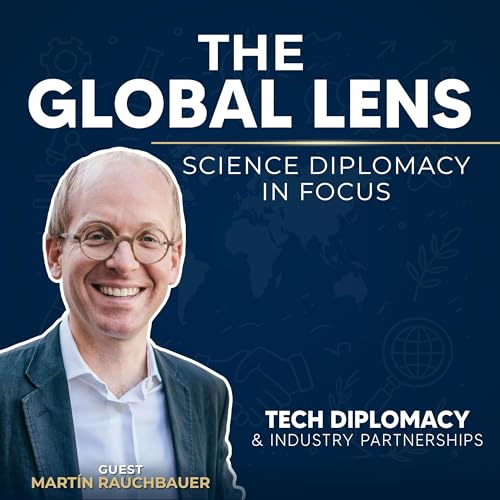
  • Tech Diplomacy & Industry Partnerships with Martin Rauchbauer
    Oct 7 2025

    OVERVIEW

    Science Diplomacy and Tech Diplomacy converge in this episode of The Global Lens where host Daniella Sussman and guest Martin Rauchbauer reflect on Silicon Valley’s growing role in shaping global governance and innovation. Their conversation explores how international partnerships and frontier technologies are influencing diplomacy, industry, and collective global influence in an increasingly interconnected world.

    EPISODE SUMMARY

    Martin Rauchbauer, co-founder of the Tech Diplomacy Network, shares his journey as Austria’s first Tech Ambassador in Silicon Valley, offering rare insights into how governments and tech executives align in a rapidly shifting world.

    From adapting diplomatic skills to AI-driven realities to exploring the risks of monopolies, he emphasizes why innovation and international collaboration require new playbooks.

    Listeners will learn why culture, adaptability, and shared responsibility are key for effective engagement between industry and diplomacy. This conversation is both a guide and a call to embrace experimentation, measured regulation, and cross-sector creativity in addressing global challenges.


    In this episode, we discuss:

    01:19 - The evolution of tech diplomacy and its roots in Silicon Valley

    02:23 - The challenges of navigating global crises while technology acts as both problem and solution

    04:08 - The adaptability required from both diplomats and tech executives in a world of fast transformation

    06:56 - Why pragmatic problem-solving and regulatory clarity are essential for companies and governments

    10:53 - How establishing permanent presence in hubs like Silicon Valley shapes meaningful tech diplomacy

    15:56 - The rise of the Tech Diplomacy Network as a collaborative platform for countries and industries

    19:01 - What other regions can learn from Silicon Valley’s culture of diversity, openness, and risk-taking

    26:55 - Why embracing experimentation, sandboxes, and long-term thinking is crucial for governments

    29:24 - How artists and technologists together push boundaries and inspire innovation

    41:56 - Practical advice for both diplomats and tech founders navigating evolving ecosystems


    ABOUT THE GUEST

    Martin Rauchbauer is a senior diplomat at the Austrian Foreign Ministry in Vienna and co-founder of the Tech Diplomacy Network in Silicon Valley, a platform connecting governments, civil society, and global tech companies to address planetary challenges through frontier technologies. As Austria’s first Tech Ambassador in Silicon Valley, he helped shape the emerging field of tech diplomacy by driving transatlantic digital policy dialogues, advancing digital human rights, and establishing digital humanism as a strategic pillar of Austrian foreign policy. With a passion for bridging diplomacy, technology, the arts, and the environment, Martin has published and lectured internationally on these themes.


    MENTIONED IN THE EPISODE:

    ⚇ (Website) Tech Diplomacy Network – https://www.tech-diplomacy.org/

    ⚇ (Website) Djerassi Residence Artist Program - https://djerassi.org/


    ————

    This episode is brought to you by Global Signals, a curated bi-weekly paid newsletter for globally minded policymakers, international researchers, strategic industry leaders, and investors.

    Subscribe here: https://tinyurl.com/Global-Lens

    ————


    CONNECT WITH MARTIN RAUCHBAUER:

    ⚇ LinkedIn: https://www.linkedin.com/in/martinrauchbauer/en


    CONNECT WITH DANIELLA:

    ⚇ Podcast Website: https://the-global-lens.captivate.fm/

    ⚇ LinkedIn: https://www.linkedin.com/in/daniellasussman/

    ⚇ Instagram: https://www.instagram.com/daniellasussmanglobal/

    Mostra di più Mostra meno
    51 min
  • Science Diplomacy at the Speed of AI and Innovation with Rémi Quirion
    Sep 18 2025

    OVERVIEW

    Science Diplomacy is the centerpiece of this episode of The Global Lens with host Daniella Sussman and guest Rémi Quirion, where they explore how trust, resilience, and governance shape cooperation across borders. Their conversation shows how innovation in AI, quantum, and health is redefining public policy while international collaboration ensures that no country is left behind.

    EPISODE SUMMARY

    Rémi Quirion shares his perspective as Chief Scientist of Quebec and President of the International Network for Governmental Science Advice on how science diplomacy must evolve in a world of fast-moving technology and shifting geopolitics. From the role of trust between governments and scientists to building global networks of advisors, he highlights the urgency of connecting the Global South, academia, industry, and the public.

    The discussion touches on innovation hubs, ethical frameworks, and how cities, universities, and citizens are shaping governance. This episode makes clear that international collaboration is not optional but essential for addressing challenges from AI governance to climate resilience.

    In this episode, we discuss:

    02:36 - What is science diplomacy?

    03:46 - The importance of trust and resilience in science diplomacy

    04:31 - The daily realities of a chief scientist in advising the government

    06:09 - How AI breakthroughs must be shared with the Global South

    07:35 - Balancing innovation with ethics and shared global standards

    08:50 - How city-level or proximity governments can drive science diplomacy 10:35 - Building global science advisory networks through INGSA

    12:10 - Training the next generation of science diplomats through university chairs and scientist-in-residence programs

    17:42 - The role of the private sector and public engagement in science diplomacy

    21:20 - The future opportunities for science diplomacy in AI and quantum

    ABOUT THE GUEST

    Rémi Quirion is the inaugural Chief Scientist of Quebec and President of the International Network for Governmental Science Advice (INGSA). A neurobiologist by training and former Scientific Director at the Douglas Mental Health University Institute, he has held senior academic and policy roles at McGill University and the Canadian Institutes of Health Research. As head of the Fonds de recherche du Québec, he advances science diplomacy and research excellence across health, technology, and society.

    Professor Quirion is an Officer of the Order of Canada and a member of both the Canadian Medical Hall of Fame and the French Académie Nationale de Médecine.


    MENTIONED IN THE EPISODE:

    (Website) International Network for Government Science Advice (INGSA) - https://ingsa.org/

    (Website) Fonds de recherche du Québec - https://frq.gouv.qc.ca/

    (Reference) AAAS Science and Technology Policy Fellowships - https://www.aaas.org/programs/science-technology-policy-fellowships


    ————

    This episode is brought to you by Global Signals, a curated bi-weekly paid newsletter for globally minded policymakers, international researchers, strategic industry leaders, and investors.

    Subscribe here: https://tinyurl.com/Global-Lens

    ————


    CONNECT WITH RÉMI QUIRION:

    Website: https://www.scientifique-en-chef.gouv.qc.ca/

    LinkedIn: https://ca.linkedin.com/in/r%C3%A9mi-quirion-05129644

    X (Twitter): https://twitter.com/SciChefQC


    CONNECT WITH DANIELLA:

    Podcast Website: https://the-global-lens.captivate.fm/

    LinkedIn: https://www.linkedin.com/in/daniellasussman/

    Instagram: https://www.instagram.com/daniellasussmanglobal/

    Mostra di più Mostra meno
    25 min