Episodi

  • Ep 58: How to Give Gen Z Employees Feedback That Actually Lands
    Apr 29 2026

    You gave the feedback carefully. You were constructive. You even thought through every word. And they still shut down.


    If you're a manager or HR leader wondering why feedback conversations keep going sideways, this episode is the one you've been waiting for.


    Tess Brigham breaks down the neuroscience of why feedback feels like a threat, why Gen Z is particularly activated by it (hint: it makes complete psychological sense), and why the feedback models most leaders were trained on were built for a different era.


    You'll walk away with a completely different understanding of what's happening in that room and three concrete shifts you can make starting with your very next conversation.


    In this episode:
    • Why the brain experiences feedback as a social threat, and what that means for your employees
    • David Rock's SCARF model and the five psychological domains a single feedback conversation can trigger simultaneously
    • Why Gen Z carries a higher baseline of anxiety into these conversations than any previous generation, and why that's not the same as being fragile
    • The critical difference between feedback landing as information versus landing as a verdict
    • Why technically correct feedback still fails when the environment isn't psychologically safe
    • Three shifts to make right now: establishing safety first, separating behavior from identity, and giving space to process
    • The fourth shift most managers skip, and why it changes everything

    CHAPTER TIMESTAMPS

    00:00 — The feedback conversation that went sideways — and the question every manager has

    01:00 — "Can't they just take feedback like an adult?" — naming what nobody says out loud

    01:45 — The neuroscience: why feedback is a threat, not just information

    02:27 — The SCARF model: the five domains your brain monitors for safety

    03:30 — What a single feedback conversation triggers simultaneously in the brain

    04:45 — Why this hits Gen Z harder — and why it's not about fragility

    05:30 — How social media turned their adolescence into a constant performance evaluation

    06:15 — Graduating into a pandemic: what Gen Z never got from their first jobs

    07:00 — When criticism lands as a verdict, not information

    07:45 — A real client story: the five-minute feedback that caused four days of dread

    09:00 — Why the old feedback playbook is quietly breaking down

    09:28 — The broken assumptions behind the feedback sandwich and annual reviews

    11:00 — Three shifts to make starting with your next conversation

    11:15 — Shift 1: Establish safety before you say anything critical

    13:00 — Shift 2: Separate behavior from identity — out loud, every single time

    14:30 — Shift 3: Give them time and space to process before expecting a response

    16:20 — Why "closing" a feedback conversation is the wrong instinct

    17:30 — The fourth shift: check your own nervous system before you walk in

    19:00 — Why walking in frustrated defeats the entire conversation

    20:00 — The bottom line: what managers who are getting this right actually understand

    21:00 — Free resources: the Gen Z Playbook + related episodes


    Download Tess's free Gen Z Playbook at TessBrigham.com.


    Related episodes:

    Episode 52 (Why Gen Z Keeps Asking Questions at Work)

    Episode 47 (The Manager Effect | Why Your Boss Impacts Your Mental Health More Than You Think with Ashley Herd)

    Hosted on Acast. See acast.com/privacy for more information.

    Mostra di più Mostra meno
    23 min
  • Ep 57: AI in the Workplace - Will AI Replace Jobs? with Erin Turnmeyer
    Apr 22 2026

    Is AI really replacing jobs, or are we misunderstanding AI's role at work?


    In this episode of The Gen Mess with Tess, Tess Brigham sits down with People Operations executive Erin Turnmeyer to break down what leaders, employees, and organizations are getting wrong about AI in the workplace.


    With 15+ years of experience building talent systems, including time at the Office of the Director of National Intelligence, Erin brings a data-driven perspective on how AI, automation, and analytics are reshaping work.


    💡 In this episode, we cover:

    • Why AI is a force multiplier, not a replacement
    • The real reason companies are making AI-related layoffs
    • What tasks should (and should NOT) be automated
    • How to use AI without losing the human element at work
    • Why resume screening with AI can backfire
    • Practical ways to start using AI without feeling overwhelmed
    • How early-career professionals can stand out in an AI-driven world


    If you’ve been feeling anxious, confused, or curious about AI, this conversation will help you rethink what’s actually happening—and how to adapt without fear.


    Whether you’re a leader, job seeker, or just trying to keep up with the future of work, this episode will give you clarity and practical takeaways.


    Timestamps

    00:00 – Intro: “Fixing the mess vs living in it”

    00:42 – Meet Erin Turnmeyer (People Ops + AI perspective)

    01:05 – From chem bio weapons analyst → HR leader

    03:10 – What people get wrong about AI at work

    04:00 – “AI is a force multiplier, not a replacement”

    05:00 – Fear-based headlines & why they’re misleading

    06:00 – Why fear blocks people from learning AI

    07:30 – How companies fail at AI adoption

    08:15 – Real example: teaching AI internally at work

    09:30 – What AI should NOT replace (human touchpoints)

    10:30 – What to automate vs keep human

    11:10 – Why AI resume screening is flawed

    13:00 – Smart ways to use AI in recruiting (without bias)

    15:00 – Removing “administrative weight” from work

    16:00 – Will AI lead to layoffs—or growth?

    17:00 – The real opportunity: 20% more strategic thinking

    18:10 – Why companies must allow time to learn AI

    19:20 – Advice for early-career professionals

    20:00 – Using AI as a daily learning coach

    21:30 – Don’t outsource your thinking

    23:00 – Could AI finally deliver work-life balance?

    24:00 – The 4-day workweek conversation

    25:00 – Real-world AI use cases (healthcare, systems, etc.)

    26:00 – What happens to jobs AI can fully replace?

    27:00 – What actually gets someone hired today

    28:00 – Why AI-generated resumes are hurting candidates

    30:00 – How to use AI correctly for resumes

    32:00 – Training AI to sound like you

    34:00 – Spotting AI-generated applications instantly

    35:00 – How young professionals can “train” AI on themselves

    37:00 – Using AI as a thinking partner (not a cheerleader)

    38:00 – Trust but verify: why sources matter

    40:00 – First step: how to start using AI today

    41:00 – Unexpected tip: use AI for shopping decisions

    43:00 – Final thoughts + where to find Erin


    Connect with Tess at tessbrigham.com

    Subscribe to Erin's Substack, AI for Human Operators, at hrai.substack.com

    Hosted on Acast. See acast.com/privacy for more information.

    Mostra di più Mostra meno
    45 min
  • Ep 56: Why Work Feels So Personal (Part 2) Early Career Stress: What Young Professionals Are Really Experiencing
    Apr 15 2026

    No one really warns you how psychologically hard early career can be.


    You learn how to write a resume, interview, and get hired, but almost no one explains what it feels like once you’re inside the workplace. You're being evaluated constantly, questioning yourself, guessing the rules, and trying to build confidence without experience.


    In this episode of The Gen Mess with Tess, Tess Brigham explains why the beginning of your career can feel so mentally intense, and why that experience is often misunderstood. She breaks down the psychological weight of uncertainty, self-doubt, comparison, unclear expectations, and why many young professionals incorrectly assume they are the problem when they are often responding normally to a demanding environment.


    Tess also addresses something leaders need to hear clearly: being early career does not mean someone should tolerate unhealthy behavior, poor emotional regulation, or unclear leadership.


    This is Part 2 of Tess’s solo series on the psychology of work and why younger employees need more clarity, not more criticism.


    Chapter Timestamps
    • 00:00 Why early career hits harder than expected
    • 01:05 Learning who you are while being evaluated
    • 02:20 Why young professionals internalize stress
    • 03:05 High expectations, low control, constant comparison
    • 04:20 Why unclear environments create self-doubt
    • 04:50 What young employees should never normalize
    • 05:30 Why yelling at work should not be accepted
    • 06:15 Discomfort vs unhealthy environments
    • 06:50 How to separate mistakes from identity
    • 07:40 What leaders owe early-career employees


    Be sure to subscribe so you never miss a weekly episode. To learn more, or to Shop available resources, visit tessbrigham.com

    Hosted on Acast. See acast.com/privacy for more information.

    Mostra di più Mostra meno
    10 min
  • Ep 55: 3 Ways to Take Back Your Morning Routine with Movement, Mindfulness, and Mastery with Amy Landino
    Apr 8 2026

    Think you're not a morning person? Think again.


    This week, Tess sits down with Amy Landino, bestselling author, content creator, and founder of Vlog Boss Studios. Together, they blow up everything you think you know about morning routines, productivity, and what it actually means to start your day on your own terms.


    Amy's newly expanded book, Good Morning, Good Life, isn't about waking up at 5am or turning your morning into an Instagram aesthetic. It's about reclaiming ownership of your day before the world gets a vote, and her simple three-bucket framework (Movement, Mindfulness, and Mastery) makes that possible for anyone, in any season of life.


    Tess and Amy also get into the messy generational stuff: why Millennials were conditioned to believe "work harder" was always the answer, why a six-figure business might actually be the wrong goal, and the moment Amy told her dad she'd already made $90K that year and watched him go completely speechless.


    In this episode:

    • Why your morning routine is probably built around someone else's agenda
    • The key difference between starting your day "on offense" vs. "on defense"
    • Amy's three-bucket framework: Movement, Mindfulness & Mastery explained simply
    • The real reason you're "not a morning person" (it's not what you think)
    • Why a six-figure business might be the worst goal you're chasing right now
    • The Millennial financial reality: student loans, a broken housing market, and boomer advice that no longer applies
    • How self-compassion and accountability actually work together, not against each other

    Amy Landino's book Good Morning, Good Life is available now. DM Amy on Instagram @AmyLandino the word "Tess" to receive her free Extraordinary Action Framework.


    CHAPTER TIMESTAMPS

    00:00 — Welcome & Amy Landino introduction

    01:00 — Amy's origin story: moving out at 18 and the "there's gotta be a better way" mindset

    04:00 — The wedding video that started everything — and how YouTube changed her life

    07:00 — What people get wrong about morning routines (hint: Instagram flex culture)

    09:30 — Checking email vs. checking your goals: offense vs. defense

    12:00 — Why you apologize for not replying fast enough — and why you need to stop

    13:15 — Is Good Morning, Good Life the Gen Z version of Miracle Morning? Tess makes the case

    16:45 — The three-bucket framework: Movement, Mindfulness & Mastery

    19:20 — Tess's morning confession: sitting with her dogs, and finally giving herself permission

    21:00 — "I'm not a morning person" — the #1 objection, completely reframed

    24:00 — "But I have kids" — excuse #2, and Amy's surprisingly honest answer

    28:45 — The Extraordinary Action Framework: DM Amy on Instagram to get it free

    29:20 — Self-compassion + accountability: why they're not opposites

    33:45 — Screw "realistic" — why shooting for the unrealistic actually makes sense

    34:45 — Hot take: Why Amy tells clients with six-figure businesses to just go get a job

    40:00 — Generational spotlight: Millennials as the internet's guinea pigs

    42:30 — Student loans, the housing market, and what Millennials actually inherited

    47:20 — Boomer advice vs. Millennial reality — a tension that's very, very real

    48:00 — The $90K moment: Amy's dad, and why the people who love you don't always know what's possible for you


    SUBSCRIBE to The Gen Mess with Tess podcast for weekly insights on workplace culture, generational challenges, and relationship advice.

    Hosted on Acast. See acast.com/privacy for more information.

    Mostra di più Mostra meno
    52 min
  • Ep 54: Why Work Feels So Personal (Part 1) The Psychology Behind Stress, Feedback, and Gen Z at Work
    Apr 1 2026

    Why does one vague comment from your boss stay in your head all day? Why does being left off a meeting invite suddenly feel personal? Why can work feel emotionally exhausting even when you’re technically “doing fine”?


    In this episode of The Gen Mess with Tess, Tess Brigham explains why work is never just about tasks, productivity, or performance—it’s psychological.


    From feedback and comparison to belonging, safety, and identity, Tess breaks down what’s happening beneath the surface when work stress feels bigger than the moment itself. She also explains why so many leaders misread performance issues that are actually clarity issues, communication issues, or nervous-system responses.


    If you’ve ever replayed a Slack message, questioned yourself after feedback, or wondered why Gen Z seems to experience work differently, this episode explains why.


    This is part 1 of a 2-part solo series on the emotional reality of work, leadership, and what younger employees are actually experiencing in today’s workplace. Part 2 will be published next week.


    Chapter Timestamps


    00:00 Why work is more psychological than most people realize

    01:10 Why your brain treats work stress like threat

    02:20 Why vague feedback feels personal

    03:15 Work, identity, and self-worth

    04:10 Why comparison intensifies workplace anxiety

    04:45 What leaders misunderstand about Gen Z retention

    06:00 Why Gen Z isn’t “too sensitive”

    07:10 Communication problems are often anxiety problems

    08:05 Why retention is a mental health issue

    09:00 The key question leaders should ask instead


    visit tessbrigham.com to learn more

    Hosted on Acast. See acast.com/privacy for more information.

    Mostra di più Mostra meno
    11 min
  • Ep 53: How High Achievers Burn Out Twice: Stress, Joy at Work, and What Leaders Still Get Wrong with Amy Leneker
    Mar 25 2026

    In Episode 53 of The Gen Mess with Tess, Tess Brigham sits down with Amy Leneker, founder and CEO of the Center for Joyful Work, to explore why burnout keeps happening even to highly successful leaders who know better.


    Amy has helped more than 100,000 leaders and teams, including Fortune 100 companies, rethink leadership, workplace stress, and employee well-being. A former public policy executive and recovering workaholic, Amy shares how burning out twice forced her to confront the internal patterns that kept driving overwork, achievement, and chronic stress.


    Together, Tess and Amy unpack why burnout is not simply about workload; it is often tied to identity, workplace systems, leadership culture, and the stories people tell themselves about success.


    This conversation explores:

    • why high performers often confuse overworking with worth
    • how burnout can repeat even after changing jobs
    • what workplace stress is doing to leadership pipelines
    • why younger employees are redefining ambition
    • how Gen Z experiences stress differently at work
    • why recognition and appreciation matter more than many leaders realize
    • the three conditions that create joy at work: meaning, mattering, and momentum
    • how AI may force a new era of critical thinking in leadership


    Amy also shares findings from her national workforce research showing that employees increasingly need joy at work to perform well, yet many leaders still operate inside systems that reward exhaustion instead of sustainability.


    For HR leaders, managers, and executives, this episode offers a practical framework for understanding employee burnout, generational tension, workplace stress, leadership development, and what healthy ambition may need to look like next.


    If your organization is asking why employees are disengaged, overwhelmed, or pulling back from leadership, this conversation explains what may be underneath it.


    Chapters with Timestamps

    00:00 – Why Amy Leneker Burned Out Twice

    02:14 – The Stress Story High Achievers Carry

    04:12 – Why Leadership Still Rewards Burnout

    06:45 – Why Joy Belongs in the Future of Leadership

    08:21 – Gen Z, Stress, and New Definitions of Work

    11:52 – Are Younger Workers Redefining Ambition?

    16:15 – The Three Conditions That Create Joy at Work

    20:23 – Why Gen Z Needs Appreciation More Than Leaders Think

    25:36 – The Exercise That Changed Amy’s Career

    31:13 – Parenting, Leadership, and Invisible Overwork

    35:01 – Why Workplace Systems Keep Breaking People

    40:13 – AI, Critical Thinking, and the Future of Work

    Hosted on Acast. See acast.com/privacy for more information.

    Mostra di più Mostra meno
    54 min
  • Ep 52: Why Gen Z Keeps Asking Questions at Work
    Mar 18 2026

    In Episode 52 of The Gen Mess with Tess, Tess explores one of the most misunderstood workplace dynamics right now: why younger employees keep asking for transparency, and why many leaders misread that as entitlement.


    While transparency is often described as a Gen Z workplace preference, Tess argues it is something much deeper: a psychological response to growing up in a world where trust has become increasingly fragile.


    From financial instability and public institutional failures to social media fabrication, layoffs over Zoom, and the rise of AI, younger workers have developed a sharper need to understand what is real, what is changing, and what leaders are not saying.


    In this episode, Tess explains why transparency is no longer just a communication style. and is now the foundation of trust in modern organizations.


    • Why Gen Z’s questions are often about safety, not defiance
    • How uncertainty activates worst-case thinking in the brain
    • Why silence from leadership often increases workplace anxiety
    • The difference between transparency and oversharing
    • How honesty improves motivation, engagement, and retention
    • Why every generation benefits when leaders communicate clearly


    For HR leaders and managers, this episode offers a practical lens on why communication gaps create disengagement — and why explaining reality clearly may be one of the most powerful leadership tools available today.


    Because in today’s workplace, transparency is not a bonus. It is how trust gets built.


    Chapters with Timestamps

    00:00 – Why Transparency Keeps Coming Up in Every Workplace Conversation

    02:20 – Why Gen Z Grew Up Distrusting Systems

    04:38 – What the Brain Does When Information Is Missing

    06:15 – Why Transparency Matters More Than Perfection

    07:04 – A CEO’s Silence During Uncertainty

    08:45 – How Honesty Calms the Nervous System

    09:26 – Why Motivation Drops When Trust Is Unclear

    10:45 – Transparency vs Oversharing

    11:46 – Why Every Generation Needs More Clarity

    13:10 – The Leadership Advantage of Honest Communication

    14:04 – Final Takeaway: Transparency Rebuilds Trust

    Hosted on Acast. See acast.com/privacy for more information.

    Mostra di più Mostra meno
    16 min
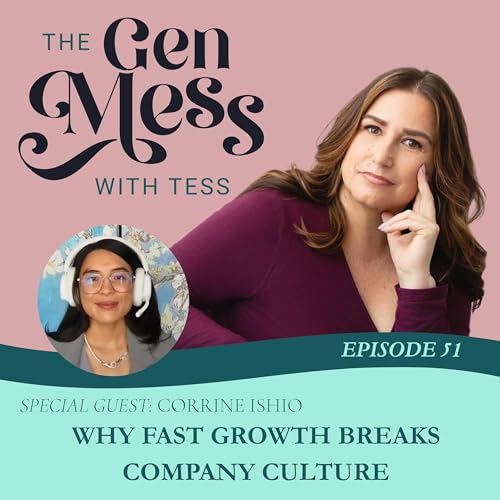
  • Ep 51: Why Fast Growth Breaks Company Culture
    Mar 11 2026

    In Episode 51 of The Gen Mess with Tess, Tess is joined by Corrine Ishio, founder of My Working Soul, to explore a challenge many fast-growing companies face but rarely talk about: scaling the business faster than the culture can keep up.


    When organizations grow quickly, hiring often becomes reactive. Leaders focus on roles and results, while the human side of the company quietly gets lost. The result? Misalignment, disengagement, and teams that no longer feel connected to the mission that once energized them.

    Corrine shares her perspective from years working in talent, recruiting, and HR; helping founders and leadership teams rethink how they hire, communicate, and define culture during periods of rapid growth.


    In this conversation, Tess and Corrine explore:

    • Why companies struggle to maintain culture as they scale
    • The complicated role HR plays between employees and leadership
    • How generational misunderstandings shape today’s workplace
    • Why Gen Z communication patterns are confusing many managers
    • The influence of social media on workplace behavior and identity
    • Why purpose is becoming central to work in the AI era


    They also discuss how leaders can create healthier workplaces by focusing less on rigid definitions of culture and more on communication, self-awareness, and intentional hiring. Because when companies grow quickly, it’s easy to forget the most important part of any organization: the humans building it.


    Chapters (Timestamps)


    00:00 – Introduction to Corrine Ishio & My Working Soul

    01:05 – Corrine’s Path Into HR & Human-Centered Work

    04:00 – What HR Actually Does (vs. what people think it does)

    07:00 – Why HR Often Feels Stuck Between Employees & Companies

    11:00 – The “Human” Lens Inside Business Operations

    13:00 – The Meaning Behind “My Working Soul”

    17:00 – Why Culture Breaks When Companies Grow Quickly

    20:30 – What a Healthy Workplace Actually Looks Like

    23:00 – Communication Differences Across Generations

    29:30 – Why Younger Workers Are Often Misunderstood

    34:30 – Purpose, Work, and the AI Era

    38:30 – Are Younger Employees Harder to Manage?

    43:00 – Millennials, Social Media, and Cultural Fragmentation

    49:00 – Safety, Identity, and the Digital Workplace

    Hosted on Acast. See acast.com/privacy for more information.

    Mostra di più Mostra meno
    59 min