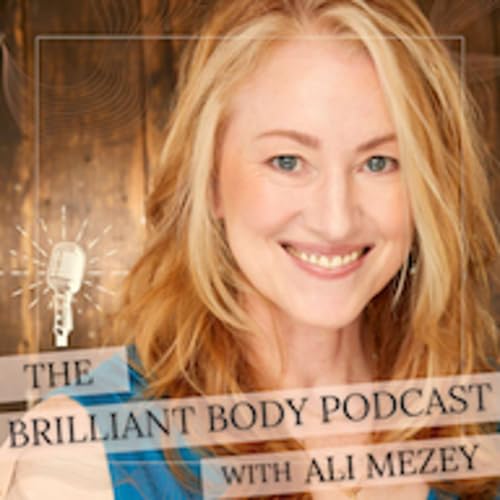
The Brilliant Body Podcast with Ali Mezey copertina

The Brilliant Body Podcast with Ali Mezey

The Brilliant Body Podcast with Ali Mezey

Di: Ali Mezey
Ascolta gratuitamente

Offerte di stagione | 0,99 €/mese per i primi 3 mesi

A seguire 9,99 €/mese – si applicano condizioni. Puoi disdire mensilmente.
The Brilliant Body Podcast with Ali Mezey is a forum to learn about and liberate the brilliance of your body. Join me, Ali Mezey, and other body masters to explore pioneering perspectives on what it actually means – and feels like – to be embodied. Whether you feel disconnected from your body due to trauma, shame, pain, cultural conditioning or lack of education or you already feel at home in your body but want to learn to have more pleasure, awareness and access to your body’s guidance – this is the podcast for you. Each one of my trailblazing guests will share their expertise and unique mission to thrive, as a body. Together, we’ll explore how to access and engage the vast, detailed and useful intelligence contained within our flesh. So join us and reclaim your body’s brilliance!© 2023 Alison Mezey. All rights reserved. Scienze sociali Successo personale Sviluppo personale
  • THE VIGILANT BODY: Fear, Instinct and the Intelligence of Self-Defense with MARK VINCI
    Sep 18 2026
    SYNOPSIS: What does it take to feel safer as a body in the world without becoming consumed by danger?In this episode, Ali talks with Mark Vinci, Director of Model Mugging Self-Defense, about the body's extraordinary capacity to detect threat, mobilize fear, set boundaries and protect itself. Drawing on Mark's decades of work in law enforcement, criminal behavior research and full-force self-defense training, they explore the complicated territory between healthy vigilance and hypervigilance, and what changes when fear becomes information rather than something we simply try to overcome.Their conversation moves from the subtle body language that can signal vulnerability or confidence to the physiology of adrenaline, freezing and defensive action. Ali brings her own recent encounter with a group of drunk men in a Scottish pub into the discussion, asking a deceptively difficult question: if nothing terrible happened, but your body still felt threatened, was your fear and response warranted?They also explore what Mark calls “the Beast,” the fierce protective capacity many people, particularly women, have been taught to suppress; the Hero's Journey underlying Model Mugging's approach; and what can happen when survivors are given the opportunity to experience their own strength in situations that once produced helplessness.Along the way, Ali and Mark consider safety not as the absence of fear, but as a changing relationship between awareness, choice, physical capacity and trust in our own responses. They also discuss the importance of readiness in trauma work, why no single therapeutic or embodied approach is right for everyone at every moment, and how learning to protect ourselves can affect much more than our ability to fight.Ultimately, this is a conversation about vigilance, embodiment and freedom: how we recognize danger without organizing our lives around it, and what becomes possible when the body knows it has options.MORE ALI MEZEY:Website: https://www.alimezey.comPersonal Geometry® and the Magic of Mat Work Course information:FREE Guided Body Mapping Taster: Heart/Sexuality SplitFive-films series (made by Ali Mezey) on renowned Family Constellation Facilitator, Stephan Hausner’s work with transgenerational influences on illnessPersonal Geometry®Ali Mezey’s body-first method for accessing and externalizing the unconscious body maps through which we experience relationships, patterns, addictions and other aspects of our lives. Using spatial relationships such as distance, direction and orientation, Personal Geometry makes these internal relational maps visible and available for exploration. Learn about Personal Geometry®MORE MARK VINCI:Instagram: Model_Mugging Website: https://www.instagram.com/model_mugging/Facebook: Model Mugging Self-Defense https://www.facebook.com/modelmugging/TikTok: Model_MuggingBIO: Mark Vinci has taught Model Mugging full-force self-defense since 1989 and currently serves as Director of Model Mugging Self-Defense. His work combines decades of experience in law enforcement, forensic psychology, criminal-behavior research, military service, and scenario-based self-defense training. He has investigated crimes ranging from burglary to sexual assault and homicide and trained law enforcement personnel in defensive tactics. For decades, Mark has studied sexual assault, criminal behavior, and violence through extensive academic research, training in criminal typologies, and interviews with offenders. His work focuses on preparing the mind, body, and spirit to recognize and respond to danger under fear, stress, and adrenaline.Model Mugging Self-Defense. Information about full-force self-defense training, its history and current programs.Model MuggingModel Mugging: Five Principles of Self-Defense. Mark's framework for understanding threat, options, preparation, mind-body-spirit integration and awareness. I. Crime Is an Emotional and Physical ProblemII. OptionsIII. PreparationIV. Mind-Body-Spirit Are OneV. AwarenessModel Mugging: Five Principles of Self-DefenseRESOURCES / REFERENCES:Grayson, Betty & Morris I. Stein (1981). “Attracting Assault: Victims' Nonverbal Cues.” Journal of Communication, 31(1), 68–75. A fascinating study discussed in the episode examining how incarcerated violent offenders responded to brief films of pedestrians and the nonverbal movement characteristics associated with perceived vulnerability. Read the study informationJoseph Campbell, The Hero with a Thousand Faces. Mark discusses Campbell's Hero's Journey as an influence on the structure and philosophy of Model Mugging.DEFNITIONS:Peripersonal Space: The space immediately surrounding the body, often experienced as a kind of bodily boundary or safety zone. The brain integrates sensory information about objects and people approaching this space in ways relevant to movement, touch and potential threat. You use the term while describing the man approaching you from behind in the Scottish pub: “I ...
    Mostra di più Mostra meno
    59 min
  • The Sober Body: Addiction, Longing & Embodied Recovery
    Sep 4 2026
    SYNOPSIS:What if addiction is not only something to overcome, but an attempt to meet needs we have lost touch with?In this rich and deeply embodied conversation, Ali speaks with somatic healing practitioner, integrative counselor and author Nina Pick about the life force beneath addiction, and what becomes possible when recovery includes not only the mind, but the body.Nina expands the conversation about trauma and addiction beyond obvious traumatic events to include early attachment wounds, ancestral and intergenerational trauma, prenatal experience, and the subtle ways our earliest environments shape our sense of safety, belonging and connection.Together, Ali and Nina explore addiction as an adaptation: an attempt to make the unbearable bearable, create connection, protect sensitivity, or meet needs for safety, soothing and belonging. Rather than shaming the wanting beneath addiction, they ask what our cravings may be trying to tell us about our deeper longings.Their conversation moves into the particular sensitivity often found beneath addiction, the difference between craving and genuine desire, and the challenge of learning to want without shame.And then, sober sex.Nina and Ali explore why sexuality can become one of the most vulnerable territories of recovery, particularly when substances have previously made it possible to bypass sensation, boundaries, communication or fear. What might sex become when we begin again from “square one,” learning to listen to the body’s yes, no and maybe, develop interoception, communicate what we want, and discover pleasure without having to leave ourselves to experience it?They also explore the difference between craving and pleasure, the heart-sexuality split, the relationship between presence and safety, and the possibility that recovery is not about becoming less alive, but becoming capable of inhabiting more of our aliveness.Nina Pick is a somatic healing practitioner and integrative counselor and the author of Sober Secure: An Attachment-Based Guide to Dating, Sex, and Love in Recovery.In this episode:• Addiction as adaptation rather than simply pathology• The life force and integrity beneath addictive behavior• Attachment wounds, ancestral trauma and intergenerational patterns• Why sensitivity can be both a vulnerability and a gift• What addictive substances may reveal about unmet needs• The difference between craving, longing, wanting and pleasure• Reclaiming desire without shame• Why sober sex can feel like starting from square one• Sexuality as a meeting place for attachment wounds• Listening to the body’s yes, no and maybe• Interoception, proprioception and embodied sexuality• Safety, presence, pleasure and the capacity for aliveness• Finding life-giving ways to meet the needs addiction once tried to meetTHE BRILLIANT BODY PODCAST:To subscribe now, click hereTo be an angel to the podcast, click here To read more about the podcast, click here MORE ALI MEZEY:Website: https://www.alimezey.comPersonal Geometry® and the Magic of Mat Work Course information:FREE Guided Body Mapping Taster: Heart/Sexuality SplitFive-films series (made by Ali Mezey) on renowned Family Constellation Facilitator, Stephan Hausner’s work with transgenerational influences on illnessPersonal Geometry®Ali Mezey’s body-first method for accessing and externalizing the unconscious body maps through which we experience relationships, patterns, addictions and other aspects of our lives. Using spatial relationships such as distance, direction and orientation, Personal Geometry makes these internal relational maps visible and available for exploration. Learn about Personal Geometry®FOR MORE NINA PICK:ninapick.comAuthor, The Mind-Body Guide to the Twelve StepsNew book coming soon! Sober Secure now available for purchaseSober SecureSober Secure: An Attachment-Based Guide to Dating, Sex, and Love in Recovery by Nina Pick explores recovery through the lens of attachment, relationships, embodiment, sexuality, nervous-system regulation and pleasure. Nina describes the book as intended for people in recovery, their partners and clinicians working in addiction treatment. Facilitator's Guide to Sober Secure Meetings free downloadLandscape of Trauma AssessmentDEFINITIONS, RESOURCES & INSPIRATION:EpigeneticsThe study of processes that affect how genes are switched on and off without changing the underlying DNA sequence. Environmental exposures and experiences can influence epigenetic processes, and some epigenetic changes can be inherited, although claims about the transgenerational inheritance of specific human traumatic experiences require care. InteroceptionThe processes through which we sense, interpret and integrate signals arising from within ourselves, such as heartbeat, breathing, hunger, temperature and visceral sensation. It contributes to our felt sense of our internal physiological state. NeuroceptionA term developed by Stephen Porges within ...
    Mostra di più Mostra meno
    1 ora e 5 min
  • The Relational Body: The Nervous System Between Us with Dr. Amber Gray
    Aug 20 2026
    SYNOPSIS:What if the autonomic nervous system is more than a mechanism to regulate – and part of the extraordinary way our bodies are in relationship with one another?In this expansive conversation, dance/movement therapist, human rights psychotherapist and author Dr. Amber Elizabeth Gray joins Ali Mezey to explore the autonomic nervous system through the lenses of Polyvagal Theory, movement, trauma, relationship and the lived intelligence of the body. Drawing on nearly three decades of work with survivors of torture, war and human rights abuses – as well as her long collaboration and exchange of ideas with Stephen Porges – Amber takes the conversation beyond simplified notions of sympathetic “bad,” parasympathetic “good,” and regulation as the goal. Instead, she invites listeners into a nervous system that protects, mobilizes, settles, connects, plays, dances, loves – and continually responds to the bodies and world around it. Ali and Amber explore the vagus nerve and the promises and controversies of Polyvagal Theory; why “safety” isn’t equally available to every body; the danger of privileging particular nervous-system states; and what changes when survival responses are understood not as failures, but as expressions of an organism doing its best to remain whole. Amber also shares how movement became central to her work with profoundly traumatized people, and how her own embodied inquiry has led her toward a practice of restoration, reclamation and resistance. Along the way, the conversation wanders – as bodies do – through whales and dolphins, evolution, intuition, pattern recognition, the natural world, and the possibility that our nervous systems may be far less individual than we imagine. Ultimately, this is a conversation about relationship: within our bodies, between bodies, and between ourselves and the larger living world. What becomes possible when we stop trying simply to “regulate” the nervous system and begin listening to the complexity, creativity and intelligence of what it is already doing?To subscribe now, click hereTo be an angel to the podcast, click here To read more about the podcast, click here FOR MORE ALI MEZEY:Website: https://www.alimezey.comPersonal Geometry® and the Magic of Mat Work Course information:FREE Guided Body Mapping Taster: Heart/Sexuality SplitFive-films series (made by Ali Mezey) on renowned Family Constellation Facilitator, Stephan Hausner’s work with transgenerational influences on illnessFOR MORE DR AMBER ELIZABETH GRAY: BIO: Dr. Amber Elizabeth Gray is an award-winning dance movement therapist, human rights psychotherapist, and Continuum teacher. She has worked for 29 years with survivors of human rights abuses, war, torture, natural disasters, and historical and intergenerational trauma. Equally artist, advocate, author, educator, poet, mystic and therapist, she, her clients, Ancestors and mentors co-create, ongoing, survivor- & Spirit-centered, Polyvagal-informed approaches to DMT for trauma and resilience that are holistic and emergent. A lover of all things wild, Amber regularly facilitates eco-somatic and movement retreats for survivors and caregivers. She brings her RightToEmbody human rights and BodyOfChange planetary rights work to survivors, therapists, educators, change agents and advocates worldwide. Her book, Polyvagal-Informed Restorative Movement Psychotherapy: Roots, Rhythm, and Reciprocity will be released August 11, 2026.CLAIM YOUR DISCOUNTED COPY HERE AMBER SOCIALS:Website: | https://ambergray.com/Facebook: | Amber Elizabeth Gray YouTube: | Amber Gray@ambergray127LinkedIn: | Dr. Amber Elizabeth L. GrayInstagram: | Restorativeresources PREVIOUS TBBP EPISODES WITH AMBER:Trauma and the Body with Amber Gray: Regulation, Restoration, & The Patience of Whales...REPRISEDTrauma Healing, Somatic Psychology, and Human Rights Advocacy: LIVE AUDIENCE Q&A RECORDING W/ AMBER GRAYEarth Body Meditation: Rooting into Beloved Ground w/ AMBER GRAYDEFINITIONS, RESOURCES & INSPIRATION:Nervous System & Polyvagal TheoryAutonomic nervous system (ANS): The part of the nervous system that largely regulates involuntary bodily functions – including heart rate, blood pressure, digestion, breathing patterns, temperature regulation and sexual arousal. It continually responds to conditions inside and outside the body, helping us mobilize, rest, protect ourselves, connect and adapt.Somatic nervous system: The part of the peripheral nervous system primarily involved in voluntary movement and in carrying sensory information between the body and central nervous system. It allows us to consciously move skeletal muscles and perceive sensations such as touch, pressure, temperature, pain and body position.Sympathetic and parasympathetic nervous systems: Two major divisions of the autonomic nervous system that work together to continually adjust bodily functions. The sympathetic nervous system is often associated with mobilization ...
    Mostra di più Mostra meno
    1 ora e 9 min
adbl_web_anon_alc_button_suppression_t1
Ancora nessuna recensione