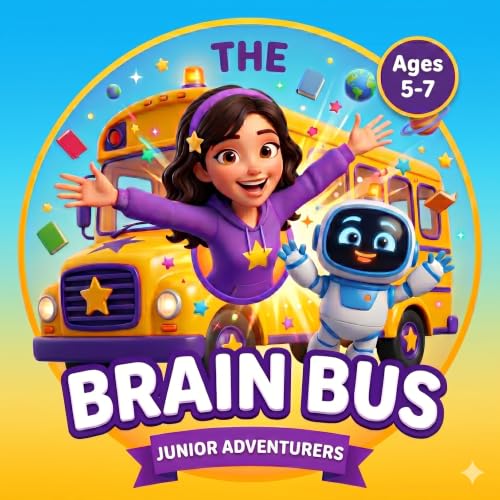
The Brain Bus: Junior Adventurers copertina

The Brain Bus: Junior Adventurers

The Brain Bus: Junior Adventurers

Di: The Brain Bus
Ascolta gratuitamente

The screen-free road trip podcast for kids ages 5–7. Stories, science surprises, brain games & family quizzes — perfect for curious young minds in the back seat. Junior Adventurers is the Little Kids feed from The Brain Bus — the educational podcast purpose-built for road trips and screen-free family time. Nova (your endlessly enthusiastic host) and sidekick Cosmo (the lovably, confidently wrong sidekick) take kids on wild audio adventures through science, nature, history, and the world's most mind-blowing facts. No screens needed. Everything works through audio alone. What kids aged 5–7 will love: - Interactive "pause and guess" puzzles - Amazing science facts about dinosaurs, space, and the ocean - Stories from world cultures and mythology - Cosmo's hilarious wrong answers — and Nova setting the record straight - Vocabulary-building disguised as a really good time What parents will love: - Screen-free entertainment for school runs and long drives - Age-appropriate for 5–7 (vocabulary, topics, energy, pace) - Educational topics: science, history, animals, geography, and more - Episodes run 15–20 minutes — right for real road trips - Part of a whole-family listening ecosystem that grows with your child New episodes weekly. Topics include: dinosaurs, space, ocean creatures, Australian wildlife, ancient Egypt, world foods, volcanoes, weather, human body, and much more. Part of The Brain Bus family. Also look for: Tiny Explorers (ages 2–4), Brain Busters (ages 8–10), and Mind Blowers (ages 11–13). Making drive time discovery time.© 2026 Letteratura e narrativa
  • Volcanoes: Why Mountains Explode & Build New Land
    Jul 18 2026

    Did you know most of Earth's volcanoes are hidden at the bottom of the ocean — and that lava flowing into the sea is slowly building new islands right now? This episode of The Brain Bus: Junior Adventurers walks 5-to-7-year-olds through exactly how volcanoes work, from the melted rock bubbling underground to the lightning storms that erupt inside ash clouds. Each episode runs around 20 minutes — a solid stretch of a longer drive.

    Nova and her robot co-pilot Cosmo guide young listeners through the science of volcanoes in a way that genuinely sticks — kids shout out answers, do a cheek-puffing eruption challenge in their seat, and meet Pele, the Hawaiian volcano goddess whose story is still believed today. This is one of the better kids podcast options for ages 5-7 because every fact comes with a sensory anchor: the fizzy-drink-bottle analogy for pressure, the slow-cooker image for a magma chamber, the satisfying PBBBBT... of their own eruption. It works beautifully as a screen-free car ride activity — no visuals needed, everything lands through sound and imagination. Whether you are planning a long podcast for a 6 year old road trip or just filling a twenty-minute school run, this episode gives kids real science vocabulary — magma, lava, pumice, Ring of Fire — wrapped in a story they want to hear again.

    What You'll Discover:
    • Why melted rock has two different names depending on whether it is underground (magma) or above ground (lava)
    • How pressure builds inside a volcano — and why a shaken fizzy drink bottle is the perfect comparison
    • That most of Earth's volcanoes are underwater, quietly building new seafloor along cracks in the ocean floor
    • How volcanic lava flows cooled and hardened to create the Hawaiian Islands, one layer at a time
    • The story of Pele from Native Hawaiian tradition, and how the Gunditjmara people of southwest Victoria used lava flows from Budj Bim to build one of the oldest eel-farming systems in the world

    All content is pitched warmly and precisely at ages 5-7 — any intense ideas, such as hot ash clouds or loud eruptions, are handled with reassurance that scientists watch volcanoes carefully and help everyone stay safe well in advance.

    The Road Challenge in this episode asks kids to puff their cheeks and hold the air pressure as long as they can before letting it out — a perfectly contained, mess-free eruption that works brilliantly in a car seat.

    Chapters
    • (00:00:00) - Theme Song & Welcome
    • (00:00:55) - Topic Reveal
    • (00:02:07) - Main Content
    • (00:14:10) - Quiz Break
    • (00:18:16) - Fun Fact Blast
    • (00:20:53) - Road Challenge
    • (00:22:44) - Riddle of the Day
    • (00:23:56) - Sign-Off
    Mostra di più Mostra meno
    25 min
  • T. Rex for Kids: Banana Teeth, Tiny Arms & Chicken Cousins
    Jul 8 2026

    Your child will discover that the closest living relative of T. rex is a chicken — and find out exactly why that connection is real science. This episode of The Brain Bus: Junior Adventurers is written for little kids ages 5–7, runs about 20 minutes, and is designed to turn a car ride into a genuine discovery session. Warm, gently funny, and grounded in real palaeontology.

    Nova and her lovably overconfident robot co-pilot Cosmo take young Explorers 66 million years back to meet Tyrannosaurus rex — one tooth, one mystery, one wonderfully wrong Cosmo theory at a time. Kids find out that a single T. rex tooth could be as long as a banana, that its arms were too short to reach its own face, and that its nose — not its speed — was its real superpower. This episode works beautifully as a screen-free car ride activity: there's a hands-on Tiny-Arm Challenge the whole family can do together, a five-question quiz kids shout answers to, and a wondering question with no wrong answers. Whether you're after a kids podcast for ages 5–7 or a podcast for a 6-year-old road trip, the Brain Bus is built for exactly this kind of drive.

    What You'll Discover:
    • A T. rex tooth could grow as long as a banana — and when one broke off, a new one grew straight back in underneath it
    • T. rex was probably a powerful fast-walker, not a sprinter — running at full speed could have snapped its own leg bones
    • T. rex's tiny arms weren't a flaw: its enormous jaws did all the real work, so the arms simply didn't need to be big
    • Birds — including chickens — are the closest living relatives of T. rex, connected through 66 million years of evolution
    • Dinosaur footprints on the Dampier Peninsula in Western Australia have been known and cared for by the Goolarabooloo people for generations, long before Western science began studying them

    All content is pitched gently for ages 5–7 — predator behaviour is discussed in the context of teeth, smell, and body design rather than graphic hunting, and the episode is comfortably safe for independent listening in the car.

    The Tiny-Arm Challenge — elbows glued to your sides, try to touch your own nose — works perfectly at a red light and gets the whole car involved, including the grown-ups.

    Chapters
    • (00:00:00) - Theme Song & Welcome
    • (00:00:55) - Topic Reveal
    • (00:02:36) - Main Content
    • (00:12:38) - Quiz Break
    • (00:15:56) - Fun Fact Blast
    • (00:17:25) - Road Challenge
    • (00:19:09) - Riddle of the Day
    • (00:20:24) - Sign-Off
    Mostra di più Mostra meno
    21 min
  • Junior Adventurers — Official Trailer
    Jun 22 2026

    The Brain Bus is coming. Your first adventure starts here.

    Join Nova and Cosmo on The Brain Bus: Junior Adventurers — the
    interactive, screen-free road trip podcast made for children aged 5 to 7.

    Every episode is one big adventure. Animals, weather, nature, and wild
    science — with I-Spy games, counting challenges, and questions your child
    can shout out from the back seat.

    Your kids won't just listen. They'll participate. Every episode.

    Subscribe now. Your first adventure is waiting.

    Find us at thebrainbus.fm

    Mostra di più Mostra meno
    4 min
adbl_web_anon_alc_button_suppression_t1
Ancora nessuna recensione