Episodi

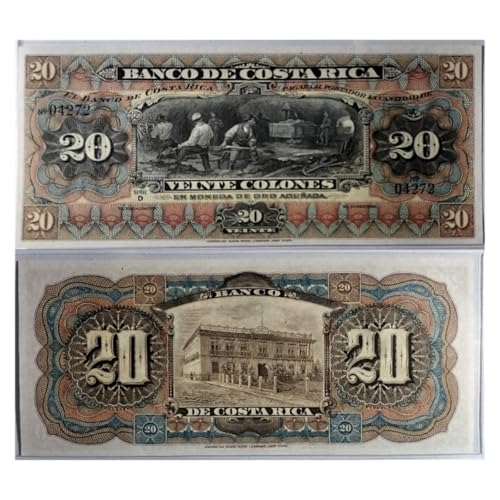
  • Costa Rica: Banco de Costa Rica 20 Colones Series D (1901)
    Feb 17 2026

    The turn of the 20th century marked a definitive inflection point for the Republic of Costa Rica, a period characterized by the ascendancy of the "Liberal State" and the aggressive modernization of its economic infrastructure. The banknote we are looking at—the Banco de Costa Rica 20 Colones, Series D, dated 1901 encapsulates the nation’s aspirations toward industrial progress, financial stability, and architectural grandeur.

    The specific specimen under analysis, identified by Serial Number 04272, belongs to a series of banknotes produced by the American Bank Note Company (ABNC) of New York. By deconstructing its physical composition, iconographic narratives, and institutional origins, we reveal the broader economic tapestry of the "Generation of Olympus" (Generación del Olimpo)—the liberal elite that governed Costa Rica and sought to integrate its coffee-based economy into the gold-standard global markets of Europe and North America.1

    This report asserts that the Series D 20 Colones note was designed to function as a "monument in paper." At a time when the Costa Rican Colón (introduced in 1896) was solidifying its value against gold, the Banco de Costa Rica—the nation's premier financial institution—commissioned a currency that visually equated the extraction of mineral wealth (the obverse mining scene) with the solidity of banking institutions (the reverse architectural portrait). The survival of Serial 04272 as a high-grade remainder allows for a pristine view into the engraving mastery of the late Victorian era, offering numismatists and historians alike a tangible link to the zenith of private bank issuance in Central America.

    Mostra di più Mostra meno
    25 min
  • Costa Rica: Banco de Costa Rica 20 Colones Series C (1906) Banknote
    Feb 16 2026

    A review of the history of the bank, the iconongraphy on the banknote, the Series C, and the market and technical specs. Did you know there was an American who wanted to establish English speaking colonies and slave states in Latin America and who was celebrated in the U.S>? Listen and find out where he fits in to the story.

    Mostra di più Mostra meno
    30 min
  • Costa Rica: PMG 65 EPQ Banco National De Costa Rica 5 Colones 1937-1938 (Pick 198a)
    Feb 15 2026

    The study of Latin American currency provides a unique lens through which to view the economic and political evolution of the region. We are looking at the Costa Rica 5 Colones note of 1937-1938, cataloged in the Standard Catalog of World Paper Money as Pick 198a. This banknote is not merely a medium of exchange; it is a transitional artifact that bridges two distinct eras of Costa Rican banking history: the period of the Banco Internacional de Costa Rica and the subsequent establishment of the Banco Nacional de Costa Rica.

    This report focuses on a specific, high-grade specimen of this issue: a 5 Colones note graded PMG 65 EPQ (Gem Uncirculated), identified as a "Top Pop" (Top Population) rarity. The existence of such a pristine example is a statistical anomaly given the tropical climate of Costa Rica and the heavy circulation these low-denomination notes typically endured. The note is characterized by its provisional nature—a revalidation of an earlier issue via a typographic overprint—and its striking obverse vignette, familiarly known to collectors as the "Banana Train."

    The visual narrative of the note, depicting the loading of bananas onto a railway car, encapsulates the "Green Gold" era of Costa Rica, dominated by the United Fruit Company and the Atlantic Railroad. This report will dissect the historical context, technical specifications, security features, and market dynamics surrounding this numismatic treasure, providing a definitive reference for the advanced collector.

    Mostra di più Mostra meno
    30 min
  • Mexico: Mexican Currency History from Cacao to Polymer
    Feb 11 2026

    Great overview to start with Mexican currency, from pre-Hispanic, to colonial to pre-revolution to revolution to independence to the latest issues, the Series G

    Mostra di più Mostra meno
    31 min
  • Mexico: El Estado de Chihuahua 1 Peso Series Dos Caritas Banknote (1915)
    May 10 2026

    The 1 Peso banknote issued by the State of Chihuahua during the Mexican Revolution, colloquially categorized within the numismatic community as the "Dos Caritas" (Two Little Faces) series, represents a critical intersection of military logistics, fiat monetary policy, and revolutionary propaganda.1 Authorized under the military decree of February 10, 1914, by the Division of the North (División del Norte) commanded by General Francisco "Pancho" Villa,

    This localized currency issue highlights the economic mechanisms utilized to sustain a massive armed rebellion.1 The production, forced circulation, counterfeiting, and eventual demonetization of the Chihuahua 1 Peso note offer a detailed record of the localized monetary policies that defined the Mexican conflict between 1913 and 1915.3 This report provides an evidence-based examination of the specific banknote pictured, integrating its physical characteristics with the broader historical, technical, and market contexts of the series.

    Mostra di più Mostra meno
    41 min
  • Mexico: El Estado de Chihuahua 50 Centavos Dos Caritas Series (1914-1915)
    May 10 2026

    This popdcast provides a comprehensive numismatic and historical analysis of the 50 Centavos banknote issued by the State of Chihuahua under the military decree of February 10, 1914. It explores the economic collapse and regional fragmentation of the Mexican Revolution that necessitated the creation of the "Dos Caritas" series, authorized by General Pancho Villa to pay his Division of the North and sustain regional commerce. The document details the administrative roles of signatories Manuel Chao and Sebastin Vargas hijo, the logistical challenges of contracting American lithographers like Norris Peters Co., and the complex system of military revalidation stamps known as resellos.

    Additionally, the analysis examines the technical specifications and security measures of the banknote, highlighting the absence of modern features like UV reactivity or watermarks in favor of intricate geometric lathe work and secret treasury marks. The report concludes with a market assessment, identifying the specific serial number 4364565 as part of the final 1915 Norris Peters print block and providing a visual grade estimation of Very Fine to Extremely Fine. Through recent sales data and population reports, it establishes a valuation matrix for collectors, underscoring the note's significance as a tangible relic of Mexico's revolutionary monetary history.

    Mostra di più Mostra meno
    20 min
  • Mexico: Constitutionalist Government 5 Pesos Infalsificables Series Banknote (1915)
    May 8 2026

    This podcast provides a comprehensive numismatic and historical analysis of the 1915 Mexican 5 Pesos Constitutionalist Government 'Infalsificables' banknote (P-S685), issued by Venustiano Carranza's faction during the Mexican Revolution.

    It details the banknote's specifications, the macroeconomic context of its creation via the July 21, 1915 decree to replace chaotic provisional currencies, and the use of the American Bank Note Company to ensure advanced anti-counterfeiting security. The analysis further explores the political symbolism in the banknote's design, featuring the Monument to Cuauhtémoc and the Aztec Calendar Stone, the roles of signatories Nicéforo Zambrano and Rafael Nieto, and the ultimate economic demise of the series due to unbacked issuance and subsequent hyperinflation, concluding with a modern market valuation and visual grading of the note.

    Mostra di più Mostra meno
    48 min
  • Switzerland: Swiss National Bank 10 Francs Banknote (9th Series) (2017)
    May 6 2026

    This podcast provides a comprehensive numismatic and technical examination of the 2017 Swiss National Bank 10 Francs banknote from the ninth series. It encompasses a detailed condition assessment and visual analysis of the note, an exploration of Switzerland's legislative and historical monetary framework, and a review of the macroeconomic and political climate during the series' issuance.

    Furthermore, the report details the institutional architecture of the Swiss National Bank, the biographies of the note's signatories, and a thematic breakdown of the abstract iconography used in the series. Technical specifications regarding the Durasafe substrate, advanced security features, and micro-printing are analyzed alongside market data on grading populations and secondary market valuations.

    Mostra di più Mostra meno
    40 min