Episodi

  • Augmenting Care and Strengthening Trust with AI
    Feb 19 2026


    The Big Unlock · Dr. Andrea Willis, SVP & Chief Medical Officer, BlueCross BlueShield of Tennessee

    In this episode, Dr. Andrea Willis, SVP and Chief Medical Officer at BlueCross BlueShield of Tennessee, shares how payers can harness AI to advance affordable, accessible, and more human-centered care.

    From her clinical roots to leading population health, quality, and health equity initiatives, Dr. Willis brings a deeply personal commitment to service. She describes how AI is being deployed across care management and utilization management, not to replace clinicians or deny care, but to augment teams, accelerate evidence-based decisions, and close gaps in care. In care management, AI-powered summarization and prompting help staff stay fully present with members while improving engagement and measurable outcomes. In utilization management, transparency, evidence-based criteria, and clear documentation remain foundational to rebuilding provider trust. She also highlights that relevance matters more than data volume, and that guided self-service must balance automation with timely human escalation.

    Dr. Willis emphasizes transparency in prior authorization, cross-functional governance, AI literacy goals across the enterprise, and strong PHI protections. For here, scaling AI responsibly – through interoperability, collaboration, and measurable impact – is key to rebuilding trust and transforming the healthcare experience. Take a listen.

    Mostra di più Mostra meno
    24 min
  • AI Must Strengthen a Clinician’s “Spidey Sense,” Not Replace It
    Feb 4 2026
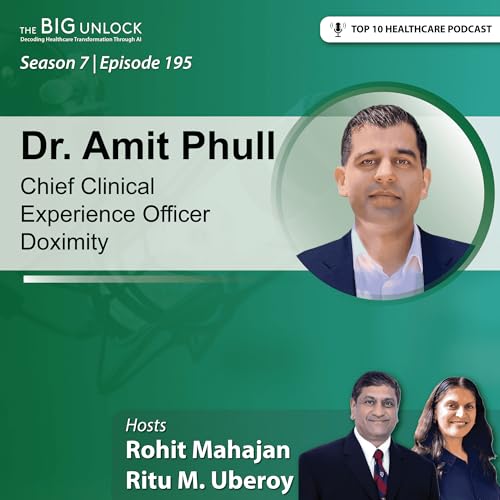
    The Big Unlock · Dr. Amit Phull, Chief Clinical Experience Officer, Doximity

    In this episode, Dr. Amit Phull discusses what responsible AI adoption in healthcare really looks like, starting with trust, usability, and preserving clinician judgment. He emphasizes that ease of use and confidence in outputs are non-negotiable for clinician adoption, especially in already time-constrained workflows.

    The discussion also explores why AI must be built with clinicians, not simply deployed for them, and how poorly integrated tools risk adding friction instead of value. Dr. Phull also talks about preserving a clinician’s “spidey sense”—the intuition developed through experience—while using AI to augment, not override, clinical judgment. The conversation also touches on how success should be measured beyond dashboards, including recurrent use, time savings, and reductions in burnout.

    Dr. Phull states that AI, when designed thoughtfully, can help clinicians reclaim time, sharpen expertise, and focus more fully on patient care, without losing the human edge that defines great medicine. Take a listen.

    Mostra di più Mostra meno
    27 min
  • AI Succeeds Through Seamless Workflow Integration and Clinician Empowerment
    Jan 22 2026
    The Big Unlock · Chethan Sathya, MD., Vice President of Strategic Initiatives, Northwell Health

    In this episode, Dr. Chethan Sathya, Vice President of Strategic Initiatives at Northwell Health, unpacks why healthcare innovation only scales when clinicians, public health, and AI are designed to work together.

    Dr. Sathya shares his journey from surgery to journalism to public health advocacy, including leading gun violence prevention efforts. He explains why most AI pilots fail, because of poor workflow integration and clinician burden, and why ambient intelligence, tele-specialty care, and agentic AI are poised to scale. His message is clear: build technology alongside clinicians, not around them. Take a listen.

    Mostra di più Mostra meno
    19 min
  • Fixing Healthcare’s “Blind Men and the Elephant” Data Problem
    Jan 12 2026
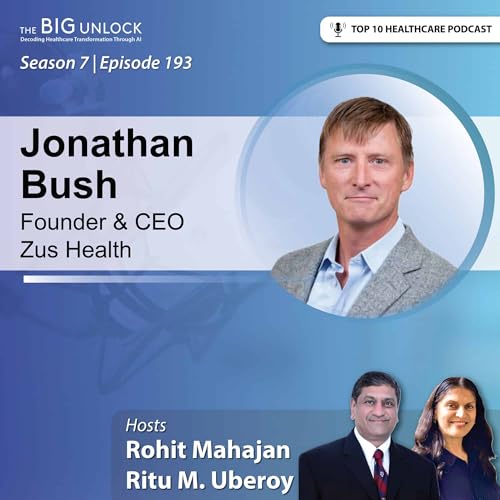
    The Big Unlock · Jonathan Bush, Founder & CEO, Zus Health

    In this episode, Jonathan Bush, Founder & CEO of Zus Health, shares a bold vision for the next phase of healthcare transformation. Drawing on decades of experience, Jonathan argues that while EHR adoption is largely complete, today’s systems remain fee-for-service–oriented, creating fragmented views of patients – what he describes as the “blind men and the elephant” problem. The result: clinicians still lack a complete, longitudinal picture of the patient and rely on repeated tests and “bags full of records.”

    Jonathan explains how Zus Health is re-architecting healthcare data by creating a longitudinal, always-on common patient record. Zus is an API-first platform built on an AI-enabled backbone that aggregates, structures, and continuously updates data across multiple EMRs. He emphasizes the power of network effects, where shared intelligence can eliminate redundant tests and unnecessary care.

    The conversation also explores why interoperability must move beyond regulatory compliance to become core infrastructure for value-based care, and how AI-driven summarization and agentic workflows can reduce clinician burden while enabling proactive, patient-centered care. Take a listen.

    Mostra di più Mostra meno
    31 min
  • AI Improves Endpoints and Evidence in Clinical Trials
    Dec 17 2025
    The Big Unlock · Gregory Goldmacher, M.D., Associate Vice President in Clinical Research, and Head of Clinical Imaging & Pathology, Merck Research Laboratories

    In this episode, Dr. Greg Goldmacher, Associate VP of Clinical Research at Merck, known as MSD outside of the United States and Canada, explains how AI is transforming imaging, clinical trials, and early-stage drug development. Greg describes endpoints as the core of every clinical trial, since they determine whether a therapy is safe or effective. He notes that AI is not new to imaging and aligns well with pattern recognition, yet its real value lies in identifying details that humans often miss.

    Greg stresses that drug development still depends on huge volumes of data spread across legacy systems. Without strong data standardization, AI cannot deliver reliable results. He also points to the FDA’s evolving guidance on AI and emphasizes the need for rigorous validation before using AI-derived measurements for regulatory decisions.

    Greg highlights the opportunity to improve efficiency, reduce human burden, and generate more consistent insights. With thoughtful adoption, AI can support better decisions in clinical development and improve outcomes for patients. Take a listen.

    Mostra di più Mostra meno
    32 min
  • Rural Health Transformation and the Future of Patient-First Care
    Dec 12 2025
    The Big Unlock · Lisa Hunter, Senior Director of Federal Policy & Advocacy, United States of Care

    In this episode, Lisa Hunter, Senior Director of Federal Policy and Advocacy at United States of Care, discusses how her organization is working to ensure every American has access to affordable, high-quality care, with a particular focus on rural communities. She explains the new Rural Health Transformation Program—a 50-billion-dollar, five-year federal investment that gives states a rare opportunity to redesign rural health delivery, address workforce gaps, and move toward “patient first care” models that emphasize coordination, whole-person care, and sustainable payment structures.​​

    Lisa highlights a growing trust gap around AI in healthcare, noting that patients are more comfortable with AI in back-office and ambient use cases compared to roles that feel like they replace clinicians. She stresses the need for rigorous listening, research, and language that resonates with people, so policy and technology decisions reflect real experiences rather than abstract concepts. Take a listen.

    Mostra di più Mostra meno
    28 min
  • Solving Healthcare’s Trilemma with Focus, Co-Innovation, and AI
    Dec 9 2025
    The Big Unlock · Matthew Blosl, Chief Executive Officer, DexCare

    In this episode, Matthew Blosl, CEO of DexCare, discusses how he helps high-growth healthcare technology companies navigate critical inflection points by pairing disciplined focus with a culture that embraces failure as a path to innovation. He describes DexCare’s journey from a Providence Health incubated initiative to a scaled care orchestration platform that helps health systems address a “trilemma” of rising patient demand, clinician shortages, and margin pressure.

    Matt explains DexCare’s co-innovation model, where every health system becomes an innovation partner rather than a one-size-fits-all implementation, enabled by modern data and AI capabilities. He outlines a pragmatic AI roadmap: first improving internal operations, then enhancing existing products, and finally accelerating true product innovation, while warning that AI can easily drive teams off-mission without strong focus. Matt also points out how fast things are shifting in healthcare and encourages leaders to rethink how they run their organizations and come together more often to tackle the challenges ahead. Take a listen.

    Mostra di più Mostra meno
    31 min
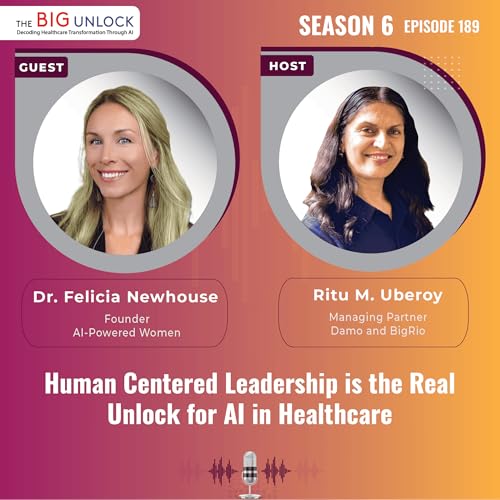
  • Human Centered Leadership is the Real Unlock for AI in Healthcare
    Dec 3 2025
    The Big Unlock · Dr. Felicia Newhouse, Founder, AI-Powered Women

    In this episode, Dr. Felicia Newhouse, Founder of AI-Powered Women, highlights the need for human centered leadership as the foundation for AI’s future in healthcare. Reflecting on her near-death experience and two decades in tech, she warns that rapid automation may boost efficiency but often leaves people feeling overwhelmed, disconnected, and burned out.

    Dr. Newhouse emphasizes that true progress requires qualities only humans can bring, empathy, intuition, emotional intelligence, and what she describes as “systems awareness” and “systems feeling.” These capabilities help leaders understand the broader human impact of digital tools and design AI that supports well-being rather than replacing human judgment.

    She urges organizations to slow down, prioritize dignity and belonging, and adopt AI in ways that strengthen human connection. According to Dr. Newhouse, the real unlock for healthcare will come when AI is guided by compassion, humanity, and mindful leadership. Take a listen.

    Mostra di più Mostra meno
    28 min