Episodi

  • Cults | Is Mormonism Christian? Defining Denomination, Doctrine, and the Divide
    Feb 19 2026

    Episode 2.84


    In this episode, Michael and Zach examine a foundational question: Is Mormonism a denomination of Christianity, or a distinct religion? The discussion moves beyond sincerity or moral character and focuses on theological definitions and historical continuity.


    They begin by clarifying key terms—what constitutes historic, creedal Christianity, and what defines a denomination. From there, the conversation analyzes LDS primary sources, particularly on the doctrine of God, the nature of the Godhead, and the concept of monotheism. While Mormonism uses Christian vocabulary, it explicitly rejects Nicene Trinitarianism and affirms three distinct divine beings united in purpose rather than essence.


    The episode also explores Joseph Smith’s restoration narrative, the claim of a Great Apostasy, and the logical implications of declaring historic Christian creeds “an abomination.” Further distinctions are examined in LDS teachings on pre-mortal existence, eternal marriage, exaltation, and the nature of salvation.


    Key questions addressed include:

    • What makes a group a “denomination” rather than a separate religion?

    • Is shared terminology the same as shared theology?

    • Can monotheism be redefined without altering Christianity’s foundation?

    • How does the LDS restoration claim reshape the entire Christian narrative?


    The conclusion is not rooted in polemics, but in doctrinal clarity: by its own authoritative teachings, Mormonism departs from historic Christianity at foundational points concerning God, Christ, and salvation. The disagreement is not secondary—it concerns the core of the faith itself.


    Find our videocast here: https://youtu.be/nLPVsd6obkA


    Merch here: https://take-2-podcast.printify.me/


    Music from #Uppbeat (free for Creators!):

    ⁠https://uppbeat.io/t/reakt-music/deep-stone⁠

    License code: 2QZOZ2YHZ5UTE7C8


    Find more Take 2 Theology content at http://www.take2theology.com

    Mostra di più Mostra meno
    40 min
  • Joshua 7 | Dividing the Land: From Lot Casting to Lasting Promises
    Feb 17 2026

    Episode 2.83

    In this episode, Michael and Zach walk through Joshua 18–21, a section often dismissed as tedious land surveys but loaded with theological weight. As the conquest narrative slows, the focus shifts from battle scenes to boundary lines—yet the central theme remains unchanged: Yahweh keeps His promises.


    Joshua 18 opens at Shiloh, where the tabernacle is established and the remaining tribes are confronted for their hesitation. Though the land has been subdued, Israel has grown slack in fully possessing what God has given. Through the casting of lots, the inheritance is formally distributed—Benjamin, Simeon, Zebulun, Issachar, Asher, Naphtali, and Dan—each territory marking tangible fulfillment of ancient covenant promises.


    The episode highlights the structural bookends of this section: Caleb’s bold faith (Joshua 14), the hesitation of the Joseph tribes (Joshua 17), the sluggishness of the remaining seven tribes (Joshua 18), and finally Joshua’s quiet reward (Joshua 19). The contrast echoes the twelve spies: faith versus fear, obedience versus delay.


    Joshua 20–21 then move to the “finishing touches” of the land. The Cities of Refuge reveal a profound theology of justice, mercy, and substitution—where freedom comes through the death of the high priest, pointing forward typologically to Christ. The Levites receive no territorial inheritance, yet are scattered throughout Israel as a reminder that worship and instruction remain central in a decentralized, kingless nation.


    The episode culminates in Joshua 21:43–45—one of the theological high points of the book—declaring that not one word of the Lord’s promises failed. What appears mundane proves monumental. The dividing of the land is not administrative filler; it is covenant fulfillment in geographic form.


    Find our videocast here: https://youtu.be/t9RNimPBL28


    Merch here: https://take-2-podcast.printify.me/


    Music from #Uppbeat (free for Creators!):

    ⁠https://uppbeat.io/t/reakt-music/deep-stone⁠

    License code: 2QZOZ2YHZ5UTE7C8


    Find more Take 2 Theology content at http://www.take2theology.com

    Mostra di più Mostra meno
    40 min
  • Does Baptism Save? A Clear Framework for a Divisive Question
    Feb 12 2026

    Episode 2.82


    In this episode, Michael and Zach examine the doctrine of baptism using William Lane Craig’s carefully defined taxonomy, focusing not on mode or tradition, but on the central theological question: what, if anything, does water baptism actually do?


    The discussion begins by framing baptism as commanded, important, and normative for Christians—while also recognizing that disagreements over baptism, though real, are non-cardinal. From there, the episode walks through Craig’s two broad categories: the figuralist view, which sees baptism as symbolic only, and the realist view, which holds that saving realities are somehow present in the act itself.


    Under the realist umbrella, three increasingly strong models are evaluated: occasionalism, instrumental causation, and proximate causation. Each is assessed for biblical coherence, theological consistency, and historical pressure—particularly the early church’s reliance on exceptions such as the thief on the cross, baptism of blood, and baptism of desire.


    The episode then turns to Craig’s strongest exegetical argument from Acts, noting that water baptism and Spirit baptism never coincide in the narrative. This observation proves decisive in undermining all sacramental realist models, not merely the strongest versions. Infant baptism is also addressed, with attention to faith as a necessary prerequisite for baptism in the New Testament.


    The episode concludes by articulating Craig’s positive position: salvation is by faith alone, while baptism stands as the ordained culmination of conversion—an act of obedience, public identification with Christ, and entry into the visible church. Baptism does not save, but those who are saved are called to be baptized.


    Find our videocast here: https://youtu.be/EacK2AZXT6c


    Merch here: https://take-2-podcast.printify.me/


    Music from #Uppbeat (free for Creators!):

    ⁠https://uppbeat.io/t/reakt-music/deep-stone⁠

    License code: 2QZOZ2YHZ5UTE7C8


    Find more Take 2 Theology content at http://www.take2theology.com

    Mostra di più Mostra meno
    33 min
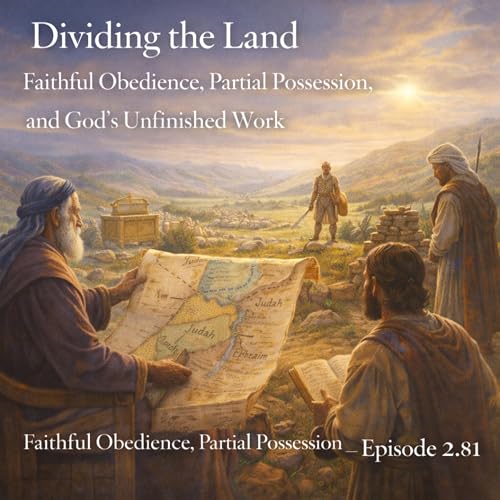
  • Joshua 6 | Dividing the Land: Faithful Obedience, Partial Possession, and God’s Unfinished Work
    Feb 10 2026

    Episode 2.81


    In this episode, Michael and Zach walk through Joshua 13–21, a section of the book that often feels tedious on first read but proves theologically rich on closer inspection. As Israel moves from taking the land to possessing it, the narrative slows down to show how God’s promises are fulfilled in real places, through real obedience—and real compromise.


    We examine Joshua’s advanced age and Yahweh’s command to divide land that has not yet been fully conquered, setting the stage for long-term faithfulness rather than immediate triumph. Caleb emerges as a living example of wholehearted trust in God’s word, while the allotments of Judah and the Joseph tribes reveal both courage and hesitation that will shape Israel’s future. Along the way, the text subtly shifts the storyline from Joseph to Judah, preparing the reader for kingship and pointing forward to Christ.


    Throughout the episode, we address key theological and biblical themes:

    • Why land is divided before it is fully possessed

    • Caleb as a model of persevering, word-centered faith

    • The significance of Judah’s prominence in the allotments

    • Partial obedience and its quiet but lasting consequences

    • How Joshua prepares the reader for the failures of Judges

    • God’s faithfulness despite Israel’s unfinished obedience


    The episode closes by showing that Joshua 13–21 is not about geography for its own sake, but about covenant faithfulness lived out over time. God keeps His promises—but His people must trust Him enough to walk in them fully.


    Find our videocast here: https://youtu.be/E-a1GXL9yuw


    Merch here: https://take-2-podcast.printify.me/


    Music from #Uppbeat (free for Creators!):

    ⁠https://uppbeat.io/t/reakt-music/deep-stone⁠

    License code: 2QZOZ2YHZ5UTE7C8


    Find more Take 2 Theology content at http://www.take2theology.com

    Mostra di più Mostra meno
    35 min
  • From Psalms to Hymns: How the Church Learned to Sing Christ
    Feb 5 2026

    Episode 2.80


    Why did the church move from singing only Psalms to writing and singing hymns—and was that shift faithful or dangerous?


    In this episode, Michael and Zach trace the history and theology of Christian hymnody, from the psalm-saturated worship of the early church to the rise of Christ-centered hymns, the Reformation divide, the golden age of hymn writing, and the modern praise movement. Along the way, we examine why hymns emerged in the first place, how they were used to teach doctrine and defend orthodoxy, and what was gained—and lost—as worship music changed over time.


    This is not a nostalgia tour or a critique for its own sake. It’s an attempt to answer a deeper question: what do our songs do to us? If worship forms belief, affections, and theology, then the church must think carefully about what it sings. Psalms anchor us in God’s Word. Hymns teach us to confess Christ clearly. Songs, for better or worse, shape the kind of Christians we become.


    Find our videocast here: https://youtu.be/-qx2wDD8CsE


    Merch here: https://take-2-podcast.printify.me/


    Music from #Uppbeat (free for Creators!):

    ⁠https://uppbeat.io/t/reakt-music/deep-stone⁠

    License code: 2QZOZ2YHZ5UTE7C8


    Find more Take 2 Theology content at http://www.take2theology.com

    Mostra di più Mostra meno
    50 min
  • Joshua 5 | Victory, Failure, and the God Who Fights for Israel
    Feb 3 2026

    Episode 2.79


    In this episode, Michael and Zach walk through Joshua 9–12, a pivotal section of the book that contrasts Israel acting without Yahweh with Yahweh fighting for Israel.


    We examine Israel’s deception by the Gibeonites in Joshua 9, where careful reasoning replaces prayer—and obedience becomes costly but necessary. From there, the narrative turns to the southern and northern campaigns (Joshua 10–11), highlighting Yahweh as the true warrior who grants victory, commands obedience, and fulfills His promises over time rather than through a quick conquest.


    Along the way, we address key theological and historical questions:

    • Why Israel honored a deceptive oath

    • The meaning of Joshua’s long-day prayer

    • Divine sovereignty and human obedience in battle

    • Why “taking the land” differs from fully “possessing” it

    • How Joshua’s obedience models covenant faithfulness


    The episode concludes with Joshua 12’s king list, showing the scope of Yahweh’s victory and the unity of God’s people—east and west of the Jordan. The takeaway is clear: victory comes not from strategy or strength, but from dependence on the Lord who fights for His people.


    Find our videocast here: https://youtu.be/pxIEkAN7v00


    Merch here: https://take-2-podcast.printify.me/


    Music from #Uppbeat (free for Creators!):

    ⁠https://uppbeat.io/t/reakt-music/deep-stone⁠

    License code: 2QZOZ2YHZ5UTE7C8


    Find more Take 2 Theology content at http://www.take2theology.com

    Mostra di più Mostra meno
    40 min
  • Exclusive Psalmody 101: Should Christians Sing Only Psalms?
    Jan 29 2026

    Episode 2.78


    Should Christian worship be limited to the inspired words of Scripture alone—or is it faithful to sing biblically rich hymns that proclaim Christ explicitly?


    In this episode, Michael and Zach examine Exclusive Psalmody, the view that only the Psalms should be sung in corporate worship. We explore what Exclusive Psalmody is, why it once dominated Reformed worship, and why it declined in the 18th century. Along the way, we trace the historical and theological arguments behind the practice, including its grounding in the regulative principle of worship and the sufficiency of the Psalter.


    The discussion then turns to Isaac Watts, whose question—“Where is Christ?”—reshaped Protestant worship by introducing explicitly Christ-centered hymnody. We weigh the strengths and challenges of both approaches, addressing concerns about inspiration, doctrinal purity, New Covenant worship, and pastoral clarity.


    The episode closes with a pastoral reflection on what our songs reveal about our theology—and whether faithfulness in worship is best defined by inspired words alone or inspired truth faithfully expressed.


    Find our videocast here: https://youtu.be/ud-ToP15bd4


    Merch here: https://take-2-podcast.printify.me/


    Music from #Uppbeat (free for Creators!):

    ⁠https://uppbeat.io/t/reakt-music/deep-stone⁠

    License code: 2QZOZ2YHZ5UTE7C8


    Find more Take 2 Theology content at http://www.take2theology.com

    Mostra di più Mostra meno
    47 min
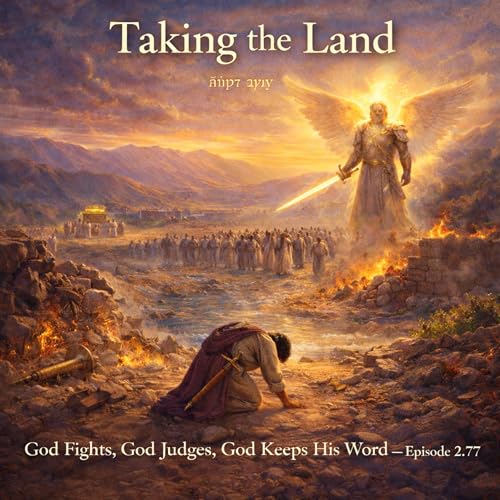
  • Joshua 4 | Taking the Land: God Fights, God Judges, God Keeps His Word
    Jan 27 2026

    Episode 2.77


    How does God give victory—and what happens when His people forget who the battle belongs to?


    In this episode, Michael and Zach walk through Joshua 5:13–12:24, the heart of Israel’s conquest of the Promised Land. Beginning with Joshua’s encounter with the Commander of the LORD’s army, the episode makes a crucial point: Joshua never wins by strategy or strength—God fights for His people.


    From the fall of Jericho to the defeat at Ai, the text shows that victory depends on obedience and dependence, not confidence or cleverness. The sin of Achan reveals the seriousness of God’s holiness and the corporate weight of covenant faithfulness. The covenant renewal at Mount Ebal reminds listeners that conquest is never separated from worship and God’s Word.


    The episode also addresses difficult questions—divine judgment, total warfare, archaeology, and the justice of God—while keeping the focus where Joshua does: Yahweh as Divine Warrior, Judge, and Promise-Keeper. Even as Israel “takes the land,” the book makes clear that the victory is partial, pointing forward to a greater rest still to come.


    Joshua isn’t about how great Israel was—it’s about how faithful God is, even when His people stumble.


    Find our videocast here: https://youtu.be/RSksvCyu3zM


    Merch here: https://take-2-podcast.printify.me/


    Music from #Uppbeat (free for Creators!):

    ⁠https://uppbeat.io/t/reakt-music/deep-stone⁠

    License code: 2QZOZ2YHZ5UTE7C8


    Find more Take 2 Theology content at http://www.take2theology.com

    Mostra di più Mostra meno
    45 min