• Love, Trust, and Money
    Jul 28 2026
    Money is rarely just about numbers inside a relationship. In this episode, Erik Garcia, CFP®, ChFC®, BFA™ and Dr. Matt Morris, LMFT unpack why financial conflict in marriages and partnerships is often rooted in deeper emotional needs like trust, security, control, communication, and vulnerability. Drawing from years of counseling couples and advising families, they discuss financial infidelity, power imbalances, differing money philosophies, and the emotional meaning attached to spending and saving. Rather than focusing solely on budgets and spreadsheets, the conversation centers on how couples can create healthier conversations around money — with more compassion, curiosity, and honesty. This episode helps listeners understand that strong financial partnerships are built less on perfect math and more on trust, communication, and shared purpose. Episode Highlights: Erik recounts the phone call years ago that sparked his ongoing collaboration with Dr. Dr. Matt Morris. (02:14) Financial infidelity surfaces in couples counseling as a serious, though less frequent, presenting issue. (03:23) Money problems in couples counseling are rarely about the money itself, but a disguise for deeper relationship issues. (07:34) Dr. Matt explains how people protect themselves financially in relationships with earning discrepancies, from squirreling away money to becoming controlling or people-pleasing. (08:59) Erik shares that even as a financial planner married almost 25 years, money has still been a point of pain in his own marriage. (10:44) Dr. Matt explains that financial planners should first determine whether a couple's conflict is a technical money issue or an emotional relational one. (12:14) Money conversations go further when approached with care, curiosity, and compassion instead of criticism. (14:56) Key Quotes: “We're going to have to learn to talk about money in new and different ways.” - Dr. Matt Morris, LMFT “Money is like this persistent stream that kind of runs in the background that impacts everything.” - Erik Garcia, CFP®, ChFC®, BFA™ “As a financial planner, I think when a couple comes to you, you need to be thinking about is this a problem that relates to the technicalities of money management.” - Dr. Matt Morris, LMFT Resources Mentioned: Dr. Matt Morris, LMFT Dr. Matt Morris & Associates Erik Garcia, CFP®, ChFC®, BFA™ Xavier Angel, CFP®, ChFC, CLTC Plan Wisely Wealth Advisors
    Mostra di più Mostra meno
    18 min
  • Your Past Financial Mistakes Are Not Your Identity
    Jul 14 2026
    Everyone has financial regrets. In this episode, Erik and Dr. Matt tackle the emotional weight people carry from past financial decisions — debt, overspending, failed investments, divorce, financial scams, and seasons of instability. The real danger, they explain, isn’t the mistake itself; it’s allowing the mistake to become an identity. Dr. Matt introduces the difference between guilt and shame: “I made a bad decision” versus “I am bad with money.” Together, they explore how language, self-perception, and emotional patterns influence future behavior. Erik shares examples of clients who rebuilt their financial lives after major setbacks, proving that financial mistakes can become chapters of growth rather than permanent labels. The episode is ultimately about hope, ownership, and reclaiming the belief that your financial story is still being written. Episode Highlights: Dr. Matt discusses the range of financial mistakes he sees in his practice, including overspending and secret debt kept from a spouse. (03:11) Dr. Matt shares the costly timeshare he and his wife bought while on their honeymoon in Mexico. (04:38) A language strategy for separating personal identity from a past financial mistake. (07:52) Dr. Matt mentions that reframing a mistake as "a chapter, not the whole story" is a simple but powerful shift. (10:54) Erik shares an analogy about his CrossFit coach calling him an athlete and how that language shaped his choices. (12:01) Erik concludes that a past financial mistake doesn't determine your future and that it's never too late to build wealth. (14:19) Key Quotes: “There is a difference between a bad decision and feeling some regret about that decision versus shame over that decision.” - Dr. Matt Morris, LMFT “You want to start separating yourself from the problem. And the first way to do that is linguistically, using your language.” - Dr. Matt Morris, LMFT “If you make a small plan and you strategize on small wins and you celebrate those small wins as you go, that reinforces this idea that, hey, I can do this. I can overcome this, that that is a chapter. The story is still being written.” - Erik Garcia, CFP®, ChFC®, BFA™ Resources Mentioned: Dr. Matt Morris, LMFT Dr. Matt Morris & Associates Erik Garcia, CFP®, ChFC®, BFA™ Xavier Angel, CFP®, ChFC, CLTC Plan Wisely Wealth Advisors
    Mostra di più Mostra meno
    16 min
  • Motivation Won’t Build Wealth. Habits Will
    Jun 30 2026
    Most people believe financial transformation starts with motivation. Erik Garcia, CFP®, ChFC®, BFA™ and Dr. Matt Morris, LMFT argue the opposite: motivation fades, but habits compound. In this episode, they explain why relying on bursts of inspiration or willpower almost always leads to inconsistency — especially when it comes to money. Using stories from fitness, personal finance, and everyday life, they break down how systems and routines quietly shape long-term outcomes. From automating savings and debt payments to separating spending accounts and reducing decision fatigue, listeners learn practical ways to create financial habits that work even when emotions and motivation disappear. This episode reinforces one of the core themes of the series: long-term financial success is behavioral more than intellectual. Episode Highlights: Erik explains why motivation is a poor long-term financial strategy. (04:41) Dr. Matt shares that habits and systems are the real answer to lasting financial change. (05:49) Erik connects accountability and environment-building to showing up consistently, using his gym experience as an example. (08:27) Automating savings removes the need to make the same decision repeatedly. (09:14) Dollar cost averaging is explained and how automated investing helps combat emotional reactions to market swings. (10:42) Automating debt payments eliminates willpower battles when tempting expenses arise. (12:48) A one-week waiting rule is shared as a practical way to curb stress-driven impulse shopping. (13:52) Erik walks through his budgeting system of separating fixed expenses from variable spending into different accounts. (15:31) Dr. Matt reflects on how good financial systems become boring in the best way, eliminating repeated emotional decision-making. (17:26) Erik recommends keeping savings at a different bank to create friction and reduce the urge to raid savings impulsively. (19:00) Building systems tailored to your own tendencies works better than following generic budgeting advice. (20:01) Dr. Matt closes by reinforcing that willpower has limits and lasting financial progress comes from habits and systems. (21:09) Key Quotes: “Motivation deals with willpower, and generally speaking, we have willpower to do things in bursts, but anything that takes energy is really, really, really hard to sustain.” - Erik Garcia, CFP®, ChFC®, BFA™ “You need habits. You need patterns. You will not rise to the level of your financial intentions. You will fall to the level of your financial systems.” - Dr. Dr. Matt Morris, LMFT “It really helps to have a disinterested third party to help you think. We have blind spots, and oftentimes we don't know what we need to do.” - Erik Garcia, CFP®, ChFC®, BFA™ Resources Mentioned: Dr. Matt Morris, LMFT Dr. Matt Morris & Associates Erik Garcia, CFP®, ChFC®, BFA™ Xavier Angel, CFP®, ChFC, CLTC Plan Wisely Wealth Advisors
    Mostra di più Mostra meno
    24 min
  • Emotions Are Signals, Not Instructions
    Jun 16 2026
    Money is emotional — and in this episode, Erik Garcia, CFP®, ChFC®, BFA™ and Dr. Matt Morris, LMFT explore why emotions have such a powerful influence on financial behavior. From market volatility and economic uncertainty to comparison, insecurity, and fear of failure, people rarely make purely rational financial decisions. Instead, emotions often drive reactions that conflict with long-term goals. Dr. Matt introduces a powerful framework: emotions are signals, not commands. Fear, anxiety, and stress may reveal that something matters deeply, but they should not automatically dictate behavior. Erik shares real examples from his work as a financial planner, explaining how emotional reactions during market downturns or financial stress can sabotage otherwise solid plans. The episode offers practical tools for slowing down emotional reactions, identifying what feelings are trying to communicate, and responding with intention rather than panic. Episode Highlights: Dr. Matt explains that emotions drive thoughts and behaviors, making it essential to pay attention to the feelings behind financial actions. (03:03) Dr. Matt clarifies that people tend to treat emotions as facts rather than signals worth examining. (04:44) Dr. Matt shares that emotions are good data points but not directives. (06:05) Erik recalls choosing to validate clients' fear during a market crisis rather than dismissing it with "don't panic." (07:52) Dr. Matt recounts calling Erik during a market drop and how Erik's grounding in market history helped calm his fear. (09:00) Erik discusses how social media and financial content creators trigger emotional responses that push people toward decisions inconsistent with their values. (10:48) Dr. Matt explains that financial fear often points to a deeper concern such as "Will I have enough?" rather than surface-level market activity. (14:24) Erik emphasizes that emotions have legitimacy and decisions should align with what matters most rather than being hijacked by emotion. (15:31) Dr. Matt recommends using an emotions wheel to name feelings precisely, which slows reactive thinking. (17:07) Erik believes that talking through high-stakes emotional moments with a professional, whether a therapist or financial planner, is especially valuable. (19:01) Key Quotes: “Emotions are good data but they're not directives. They're not marching orders.” - Dr. Matt Morris, LMFT “Let's make sure that we make a good decision that's consistent with the things that are most important to you.” - Erik Garcia, CFP®, ChFC®, BFA™ “We think about feelings as being signals that something is really important to you. And then we want to be able to connect that to the thing that's really important.” - Dr. Matt Morris, LMFT Resources Mentioned: Dr. Matt Morris, LMFT Matt Morris & Associates Erik Garcia, CFP®, ChFC®, BFA™ Xavier Angel, CFP®, ChFC, CLTC Plan Wisely Wealth Advisors
    Mostra di più Mostra meno
    21 min
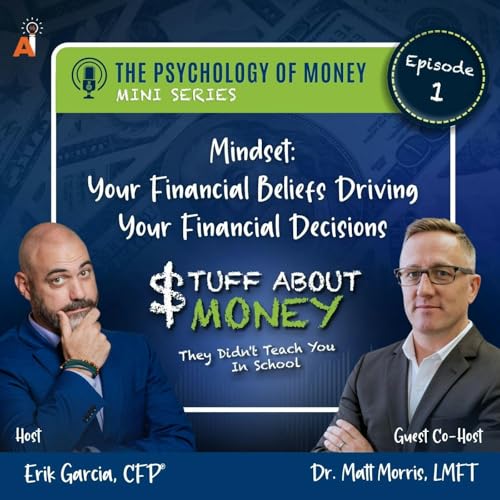
  • Mindset: Your Financial Beliefs Driving Your Financial Decisions
    Jun 2 2026
    In the opening episode of The Psychology of Money series, Erik Garcia, CFP®, ChFC®, BFA™ and Dr. Matt Morris, LMFT explore one of the most overlooked drivers of financial success: mindset. Long before people learn how to invest, budget, or build wealth, they develop internal “money scripts” — subconscious beliefs shaped by childhood experiences, family dynamics, culture, and personal history. Together, Erik and Matt unpack how these invisible beliefs influence everything from spending habits and lifestyle expectations to fear, scarcity, ambition, and financial anxiety. Through relatable stories, humor, and real-world examples, they explain why wealth-building is often less about intelligence and more about the mental filters through which we interpret money. The episode challenges listeners to begin identifying the stories they carry about money — and whether those stories are helping or hurting their future. Episode Highlights: Erik explains how mindset functions as a constant background filter for the way people think about and approach money. (03:00) Dr. Matt discusses how scarcity mindset surfaces in couples when partners feel they will never have enough or get ahead. (08:50) Building awareness and changing behavior are the keys to rewiring a money mindset. (14:40) Erik shares how the most valuable client conversations focus on mindset and behavior rather than technical financial advice. (16:50) Dr. Matt shares a starting point for exploring money scripts by reflecting on what a family communicated about money. (18:20) Key Quotes: "Building wealth, having financial success has as much to do with behavior, with managing emotions, all that psychology stuff than it does with the technical stuff about money" - Erik Garcia, CFP®, ChFC®, BFA™ "There's a script running in the background. We don't just act rationally with money. We are acting out a story about our beliefs about money." - Dr. Matt Morris, LMFT "We're using mindset and script synonymously, so take time to understand your money scripts. They probably came from your family of origin, so take some time. If you have a spouse, take some time to understand theirs also." - Dr. Matt Morris, LMFT Resources Mentioned: Dr. Matt Morris, LMFT Matt Morris & Associates Erik Garcia, CFP®, ChFC®, BFA™ Xavier Angel, CFP®, ChFC, CLTC Plan Wisely Wealth Advisors
    Mostra di più Mostra meno
    22 min
  • Episode 109: Time, Compounding, and the Truth About Building Wealth
    May 21 2026
    In this episode, Erik P. Garcia, CFP®, ChFC®, BFA™, and Xavier J. Angel, CFP®, ChFC®, unpack a misunderstood truth about building wealth: real wealth takes time. Picking up from their earlier conversations on discipline, behavior, and consistency, they dive into the power of compounding—not just financially, but professionally and personally as well. Through stories, analogies, and practical examples, they challenge the myth that wealth is built overnight and instead show how patience, endurance, and staying invested are what truly create long-term success. From the famous “penny doubled every day” example to lessons about career growth, relationships, and reputation, this conversation highlights how the biggest rewards often come after years of unseen work. Erik and Xavier explain why consistency matters more than quick wins, why emotional discipline is critical during slow seasons, and how time rewards those willing to stay in the game. Whether you’re building financial wealth, developing skills, or growing a business, this episode is a reminder that compounding doesn’t reward urgency—it rewards endurance. Episode Highlights: Xavier frames time as the series' "final ingredient," the force that turns discipline into stability and consistency into growth. (01:45) Erik discusses compound interest as one of the most powerful forces in finance, noting that every Stuff About Money guest asked what they wish they'd known sooner points to the same answer. (05:20) Erik explains the penny-doubling example, showing how a single cent doubled every day for 30 days compounds into more than five million dollars. (08:24) Xavier discusses career compounding, a form of growth driven not by money but by skills and experiences that stack into advantages over time. (12:26) Xavier shares the principle he stresses to his mentees: always be mindful of the person next to you, because you never know when they'll be in a position to help. (18:54) Erik wraps the series by revisiting the three wealth-building myths and landing on the real formula: avoid bad behaviors, cultivate good ones, and do both consistently enough for long enough. (22:23) Key Quotes: “Time is what turns discipline into stability and consistency into growth.” - Xavier J. Angel, CFP®, ChFC® “You never know who you're going to meet and when they may be able to help you or when they give you an opportunity. So always be mindful of that person next to you.” - Xavier J. Angel, CFP®, ChFC® “Compounding doesn't reward urgency. It rewards endurance. By definition, compounding rewards those who stay in the game long enough.” - Erik P. Garcia, CFP®, ChFC®, BFA™ Resources Mentioned: Erik Garcia, CFP®, BFA Xavier Angel, CFP®, ChFC, CLTC Plan Wisely Wealth Advisors
    Mostra di più Mostra meno
    26 min
  • Episode 108: Consistency: The Hidden Engine of Wealth
    May 5 2026
    In this third episode of the series, Erik Garcia, CFP®, and Xavier Angel, CFP®, uncover what they call the hidden engine behind wealth: consistency. After breaking down the behaviors that destroy wealth and the ones that protect it, this episode answers the real question—what actually builds it. The answer isn’t intensity, timing, or even talent. It’s doing the right things over and over again, long after the excitement fades. As Erik puts it, most people don’t fail financially because they’re wrong—they fail because they stop. Drawing on Angela Duckworth’s research on grit, Erik and Xavier connect the dots between perseverance and financial success. They break down the three key areas where consistency shows up: saving, investing, and developing your skills. Along the way, they challenge common behaviors like present bias and emotional investing, while reinforcing a simple truth—wealth is built little by little. This episode is a reminder that showing up when it’s boring isn’t a weakness…it’s a competitive advantage. Episode Highlights: Erik introduces consistency as the hidden engine behind wealth building and why it matters more than talent or intensity. (03:36) Erik shares Angela Duckworth's grit research, revealing that it's the grittiest individuals, not the most talented or intelligent, who tend to succeed long-term. (05:24) Xavier connects the grit conversation to his daughter's four-year journey in competitive dance, crediting her growth to determination and grind over raw talent. (07:49) Erik uses the "plateau of latent potential" from Atomic Habits to show how consistent, unseen effort eventually compounds into visible results. (09:52) Xavier explains how consistent savers reverse the urge to spend now and save later by choosing to save first. (12:25) Erik discusses how dollar cost averaging and emotional discipline set 401k millionaires apart. (14:15) Erik explains how building expertise over time enables higher-level work and greater income potential. (17:03) Xavier reflects on the power of grinding it out, noting that those who stay in the game longer do so by learning from failures and redefining their approach along the way. (20:25) Erik cites Proverbs to reinforce that money made quickly disappears, while wealth gathered little by little grows and endures. (21:32) Xavier connects consistency to momentum, saying the magic happens when you hold the fire to it and keep showing up. (23:38) Erik encourages listeners to make consistent financial decisions that stack over time, because wealth gained little by little is what lasts. (24:38) Key Quotes: “In the context of money, most people are not failing because they don't know what to do. They're failing because they don't do it long enough.” - Erik Garcia, CFP® “You are failing along the way and you're learning from those failures and redefining what you're doing.” - Xavier Angel, CFP® “What's important is that wealth builders consistently build their base. They're consistently building their foundation.” - Erik Garcia, CFP® Resources Mentioned: Erik Garcia, CFP®, BFA Xavier Angel, CFP®, ChFC, CLTC Plan Wisely Wealth Advisors
    Mostra di più Mostra meno
    26 min
  • Episode 107: 3 Behaviors That Protect Your Wealth: The Disciplines That Keep You From Losing What You’ve Built
    Apr 21 2026
    In the last episode, we broke down the behaviors that quietly destroy wealth—emotional decisions, lifestyle creep, and overconfidence. But avoiding mistakes is only half the equation. In this episode, Erik Garcia, CFP®, and Xavier Angel, CFP®, flip the conversation and focus on what actually protects wealth once you start building it. Because wealth isn’t just created—it has to be preserved with intention. We walk through three foundational disciplines: living below your means to create margin, reinvesting instead of extracting to keep your money working, and avoiding catastrophic mistakes that can undo years of progress. Grounded in behavioral finance and real-world experience, this episode shows why wealth is often less about big wins—and more about consistently doing the right things over time. Episode Highlights: Erik explains the behavioral economics foundation of today's episode, referencing Richard Thaler's book "Misbehaving" to highlight how humans often act irrationally in financial decision-making. (04:14) Xavier explains how building financial margin is what creates the space to save, invest, and pursue what matters most. (07:14) Erik shares the single most consistent pattern across people who successfully build wealth: they spend less than they earn and make building margin their priority. (10:10) Xavier discusses the second behavior, reinvesting instead of extracting, explaining that wealth grows when money is kept in the system and put back to work rather than pulled out early. (13:44) Erik explains the third behavior, avoiding catastrophic mistakes, using a golf analogy to share why minimizing financial damage matters more than chasing perfect results. (19:08) Erik discusses specific strategies for avoiding catastrophic financial mistakes: managing risk at the right level, maintaining sufficient liquidity, and diversifying rather than concentrating in speculative assets. (22:04) Xavier shares a sharp contrast between wealth lost and wealth built, explaining that losses often trace back to one risky decision while lasting wealth comes from thousands of small, consistent good ones. (25:25) Key Quotes: “When building wealth, the goal isn't to look wealthy, right? The goal is to be wealthy. I can be wealthy and not own the most expensive clothes or the biggest house or the most expensive car.” - Xavier Angel, CFP® “This is the common thread in financially successful people. It's what allows everything else to work. Without financial margin, there's nothing to invest. Nothing to save, no money to compound.” - Erik Garcia, CFP® “Reinvesting, not spending your investments involves an intentional, purposeful, conscious decision to choose the future over today. I'm saying no to myself today because I'm saying yes to something tomorrow” - Erik Garcia, CFP® Resources Mentioned: Erik Garcia, CFP®, BFA Xavier Angel, CFP®, ChFC, CLTC Plan Wisely Wealth Advisors
    Mostra di più Mostra meno
    28 min