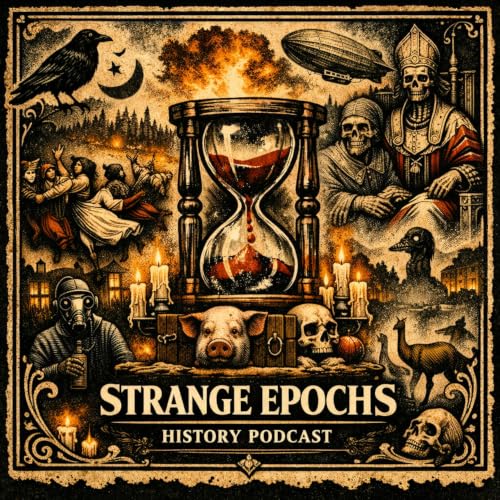
Strange Epochs • Weird History copertina

Strange Epochs • Weird History

Strange Epochs • Weird History

Di: Strange History • Sleep Podcast
Ascolta gratuitamente

Offerte di stagione | 0,99 €/mese per i primi 3 mesi

A seguire 9,99 €/mese – si applicano condizioni. Puoi disdire mensilmente.

Strange Epochs: History's Most Extraordinary True Stories

History is full of events so remarkable, so inexplicable, that they seem like they couldn't possibly be real. And yet they are.

Every week, host Shawn Spainhour takes you deep inside one of history's most extraordinary true stories. Not the events you studied in school — the ones that got left out. The ones historians still argue about. The ones that make you question everything you thought you knew about the past.

From medieval mass hysteria to unsolved disappearances, from forgotten wars to events that defied every reasonable explanation — Strange Epochs brings history to life the way it actually felt to the people who lived it. Immersive. Atmospheric. Completely true.

This isn't a history lecture. It's an experience.

Episodes explore stories like:

  • The Dancing Plague of 1518 — when hundreds of people danced uncontrollably for days and couldn't stop

  • The Cadaver Synod — when a Pope put a dead man on trial

  • The Great Emu War — when the Australian military lost a war against birds

  • The Tunguska Event — the largest unexplained explosion in recorded history

  • The Lost Colony of Roanoke — America's oldest unsolved mystery

  • Hinterkaifeck — the farmstead murder that was never solved

  • The Voynich Manuscript — a book no one has ever been able to read

  • The Ghost Army of WWII — the secret unit that won battles with illusions

New episodes every Tuesday.

If you love history podcasts like Fall of Civilizations, Hardcore History, or Cautionary Tales — Strange Epochs is your next listen.

Subscribe now and never miss an episode.

Strange Epochs 2026
Mondiale Scienze sociali
  • The Dyatlov Pass Incident: Nine Hikers, One Tent Cut From Inside — Ural Mountains, 1959
    Oct 20 2026

    In February of 1959, nine experienced hikers set out on a skiing expedition through the northern Ural Mountains of the Soviet Union. They never came home. When a search party finally found their camp three and a half weeks later, the tent had been cut open from the inside, and the hikers had fled into subzero temperatures without proper clothing — some in socks, some barefoot — running down the mountainside away from their shelter and, as far as anyone can tell, away from nothing at all.

    Some of the bodies had died of hypothermia, tragic but comprehensible. Others were not comprehensible at all: two had crushed chests with no external bruising, injuries typically associated with a serious car accident. One was missing his tongue and his eyes. Some of the clothing tested positive for radiation.

    The Soviet investigation closed the case within months, attributing the deaths to what the official report called "a compelling natural force," without specifying what that force was. The files were sealed.

    Host Shawn Spainhour takes you into the full story: the group and their expedition, the specific and deeply strange condition of the camp and the bodies, the six decades of theories ranging from avalanches to secret weapons to the Yeti, and the modern scientific explanation that may finally account for most — though not all — of what happened on that mountain.

    If you love history, true crime, or storytelling — or if you're just looking for something to listen to on a long drive or drift off to sleep — this one is for you.

    Strange Epochs is a weekly narrative history podcast hosted by Shawn Spainhour. Each episode takes one strange, true, documented moment from somewhere in the long span of human history and sits with it — slow, atmospheric, and built for deep listening. New episodes every Tuesday. If this is your first episode, there are twenty-eight more waiting for you.

    Sources:

    • Wikipedia contributors. Dyatlov Pass incident. Wikipedia, Wikimedia Foundation, 2024.
    • History.com editors. The Dyatlov Pass Incident: Why the Hiker Deaths Remain a Mystery. A and E Television Networks, 2025.
    • Science History Institute. The Russian Roswell. sciencehistory.org, 2024.
    • All That's Interesting. We May Finally Know Why Nine Soviet Hikers Lost Their Lives in the Dyatlov Pass Incident. 2024.
    • History Chronicles. The Dyatlov Pass Incident: What Really Happened in 1959? 2026.
    • École Polytechnique Fédérale de Lausanne. Using Science to Explore a Sixty-Year-Old Russian Mystery. epfl.ch, 2021.
    • Gaume, Johan and McElwaine, Alexander. Reconstructing the Dyatlov Pass Incident through a re-evaluation of a slab avalanche. Communications Earth and Environment, 2021.
    • Lost in History. The Mystery of the Dyatlov Pass Incident. 2024.
    Mostra di più Mostra meno
    44 min
  • The Great Molasses Flood: A Twenty-Five-Foot Wave in Boston — Boston, 1919
    Oct 13 2026

    On January 15th, 1919, on an unseasonably warm day in Boston's North End, a steel storage tank containing more than two million gallons of molasses failed catastrophically. The tank had been leaking for years — the company that owned it painted it brown so the drips wouldn't show, rather than fix it. When it finally gave way, the rivets shot out with enough force that men who had just returned from the trenches of the First World War mistook the sound for machine-gun fire.

    What followed was a wave of molasses twenty-five feet high, moving at thirty-five miles an hour, through one of the most densely packed immigrant neighborhoods in America. It swept away buildings. It knocked a firehouse off its foundation. It tore a support beam out from under the elevated railway. And because molasses cools and thickens, it trapped the people and animals caught in it the way flypaper traps a fly — rescuers spent days afterward pulling victims from a substance that would not let them go.

    Twenty-one people died. A hundred and fifty were injured. The six-year legal battle that followed would help invent, in the modern American sense, the idea that engineers could be held legally responsible for their calculations.

    Host Shawn Spainhour takes you into the full story: the neighborhood the tank stood over, the company that ignored years of warning signs, the wave itself, and the courtroom fight that changed how an entire country thought about engineering accountability.

    If you love history, true crime, or storytelling — or if you're just looking for something to listen to on a long drive or drift off to sleep — this one is for you.

    Strange Epochs is a weekly narrative history podcast hosted by Shawn Spainhour. Each episode takes one strange, true, documented moment from somewhere in the long span of human history and sits with it — slow, atmospheric, and built for deep listening. New episodes every Tuesday. If this is your first episode, there are twenty-seven more waiting for you.

    Sources:

    • Wikipedia contributors. Great Molasses Flood. Wikipedia, Wikimedia Foundation, 2024.
    • Britannica editors. Great Molasses Flood. Encyclopaedia Britannica, updated 2026.
    • History.com editors. Boston shocked by deadly molasses flood. A and E Television Networks, 2025.
    • History.com editors. Why the Great Molasses Flood Was So Deadly. A and E Television Networks, 2025.
    • Boston.com. There Was No Escape from the Wave: These Are the Twenty-One Victims of the Great Boston Molasses Flood. January, 2019.
    • Boston.gov. One Hundred Years Ago Today: Molasses Crashes Through Boston's North End. 2025.
    • Puleo, Stephen. Dark Tide: The Great Boston Molasses Flood of 1919. Beacon Press, 2003.
    • Chambers Associate. Boston Legal History: The Great Molasses Disaster. chambers-associate.com.
    • Historians for History. The Great Molasses Flood of 1919. March, 2024.
    Mostra di più Mostra meno
    43 min
  • The Tanganyika Laughter Epidemic: When an Entire Region Could Not Stop — Tanzania, 1962
    Oct 6 2026

    On January 30th, 1962, three girls at a boarding school in Kashasha, on the western shore of Lake Victoria in what was then Tanganyika, began laughing uncontrollably. By the end of the week, nearly sixty percent of the school's one hundred and fifty-nine pupils were affected — fits of laughter lasting hours, sometimes days, accompanied by crying, fainting, rashes, and difficulty breathing. No joke had been told. No toxin was found. No physiological cause was identified.

    The school was closed. The students went home. The laughter went with them.

    Over the following eighteen months the epidemic spread to at least fourteen schools and villages across the region, affecting nearly a thousand people. Schools closed for months. The local government and the medical community were baffled. The colonial administration found the situation both scientifically inexplicable and politically inconvenient.

    The Tanganyika Laughter Epidemic of 1962 is documented, investigated, and written up in medical journals. It was not funny. It was terrifying. And it remains, more than sixty years later, stubbornly not fully explained.

    Host Shawn Spainhour takes you into the full story: the mission school where it started, the specific pressures of colonial Tanganyika that may have made a population vulnerable, the medical response that failed to contain it, and what the best current science says about how fear and stress can move through a community like a contagion with no pathogen at all.

    If you love history, true crime, or storytelling — or if you're just looking for something to listen to on a long drive or drift off to sleep — this one is for you.

    Strange Epochs is a weekly narrative history podcast hosted by Shawn Spainhour. Each episode takes one strange, true, documented moment from somewhere in the long span of human history and sits with it — slow, atmospheric, and built for deep listening. New episodes every Tuesday. If this is your first episode, there are twenty-six more waiting for you.

    Sources:

    • Wikipedia contributors. Tanganyika laughter epidemic. Wikipedia, Wikimedia Foundation, 2024.
    • Rankin, A.M. and Philip, P.J. An epidemic of laughing in the Bukoba District of Tanganyika. Transcultural Psychiatric Research, 1963.
    • Atlas Obscura. The 1962 Laughter Epidemic of Tanganyika Was No Joke. atlasobscura.com, 2025.
    • HowStuffWorks. Not So Funny: The Mysterious 1962 Tanganyika Laughter Epidemic. health.howstuffworks.com, 2023.
    • Commonplace Fun Facts. The Tanganyika Laughter Epidemic of 1962: When Giggles Shut Down a Nation. January, 2026.
    • Mental Floss. The Strange Months-Long Laughing Epidemic of 1962 No One Could Stop. May, 2026.
    • Owaahh. The Tanganyika Laughing Epidemic of 1962. owaahh.com, 2024.
    • Provine, Robert R. Laughter: A Scientific Investigation. Viking, 2000.
    • Bartholomew, Robert E. and Wessely, Simon. Protean nature of mass sociogenic illness. British Journal of Psychiatry, 2002.
    Mostra di più Mostra meno
    47 min
adbl_web_anon_alc_button_suppression_t1
Ancora nessuna recensione