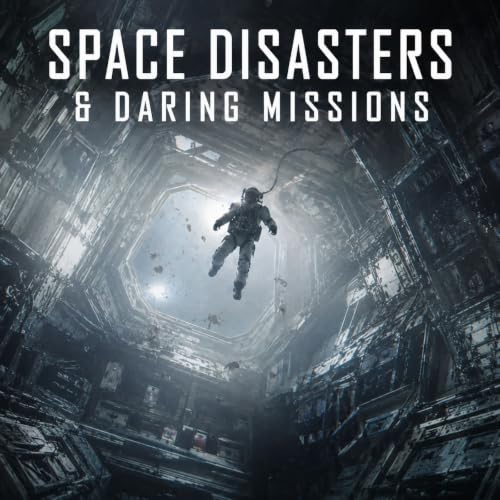
Space Disasters & Daring Missions copertina

Space Disasters & Daring Missions

Space Disasters & Daring Missions

Di: OBOMEDIA ENTERTAINMENT
Ascolta gratuitamente

Offerte di stagione | 0,99 €/mese per i primi 3 mesi

A seguire 9,99 €/mese – si applicano condizioni. Puoi disdire mensilmente.
Space has swallowed careers, missions, and men whole, leaving behind bolts, checklists, and a few surviving voices who know exactly how close the silence came. This show digs through NASA archives, mission transcripts, and the quiet testimony of astronauts to rebuild what actually happened when the plan fell apart forty miles above Earth or a quarter million miles toward the Moon.

Each episode is one complete, reconstructed story, told without a host standing between you and the record. A skull rides shotgun on Hubble's highest orbit. A 121-pound cap gets bolted onto a spacecraft that still won't reveal where it's leaking. A navigator with no instruments steers by starlight to bring Apollo 13 home. A surgeon performs emergency repairs on a live solar array with no operating room and no second attempt. These are not summaries — they are minute-by-minute accounts built from flight logs, radio chatter, and the private memories of the people who lived through space disasters that never made the headlines they deserved.

The show moves through the full arc of American spaceflight: the astronauts denied their missions for reasons buried in politics, the men who crossed space three times and still never got their wings, the geologists who proved the Moon itself had lied about a mountain's identity. It is NASA history told through the human cost of ambition — the near-misses, the improvised fixes, the decisions made in seconds that took decades to fully explain.

If you want space history that reads like a thriller because it actually was one, subscribe now. New episodes arrive weekly, each one a self-contained descent into a mission that almost didn't make it back.Copyright OBOMEDIA ENTERTAINMENT
Astronomia Astronomia e scienze spaziali Scienza
  • The thruster command that found the tank empty and cost them the window
    Oct 14 2026
    A volunteer sent a thruster command to a decades-old spacecraft and heard only the silence of an empty tank - did they lose their final window?

    The thruster command that found the tank empty and cost them the window

    In this episode, we follow the sequence of decisions, maneuvers, and improvisations that kept an aging spacecraft alive and aiming for a comet decades after its launch. What happened when a crowdfunded effort met an empty propellant tank, and could the team still make the window?

    Person: Robert Farquhar
    Date: July 8, 2014
    Location: L1 halo orbit / lunar flybys
    Event: Retasking ISEE-3 / ICE for comet science
    Topic: thruster command, empty nitrogen tank

    - Engineers and volunteers sent a thruster command into deep space on July 8, 2014 and received a response from the spacecraft.
    - The spacecraft was spinning at 19.76 rotations per minute while its instruments still broadcast data despite a battery failure decades earlier.
    - ISEE-3 launched August 12, 1978, settled into a halo orbit at L1 on November 20, 1978, and survived a 1981 battery failure that limited it to sunlight operations.
    - Robert Farquhar and others planned a sequence of burns and five lunar gravity assists between June 10, 1982 and December 22, 1983 to redirect the probe toward the Moon and beyond.
    - On September 11, 1985, redesignated ICE, the spacecraft crossed a comet’s plasma tail 7,800 km from the nucleus, returning the first in-situ measurements of a cometary plasma environment.

    To listen to this podcast ad-free and access premium episodes, try our subscription with a 14-day free trial at obomedia.com.

    © 2026 OBOMEDIA. All rights reserved.
    This episode and its content (audio, text, and related materials) are the exclusive property of OBOMEDIA and are protected by applicable copyright laws. Reproduction, distribution, editing, or commercial use, in whole or in part, without prior written permission from OBOMEDIA is prohibited. For permissions, licensing, and business inquiries: business@obomedia.com.
    Mostra di più Mostra meno
    23 min
  • A paint flake fooled the star sensor - could Mariner 4 make Mars on time?
    Oct 13 2026
    A paint flake fooled Mariner 4's star sensor into locking the wrong star - can the spacecraft still point its camera at Mars?

    A paint flake fooled the star sensor - could Mariner 4 make Mars on time?

    In this episode, we follow the final weeks of the Mariner 4 mission as engineers race against a closing launch window and a ticking clock. The crew at JPL confronts hardware compromises, failed tests, and a navigation system being tricked by debris - but will the spacecraft arrive with its cameras correctly pointed?

    Mission: Mariner 4
    Date: November-December 1964
    Location: Jet Propulsion Laboratory / en route to Mars
    Event: Star sensor failures and navigation challenges
    Status: Eight-month voyage in progress

    - Engineers hand-colored the first low-resolution image of Mars by filling numbered squares while the computer finished processing.
    - Mariner 3 failed on launch when its payload shroud failed to jettison, prompting a three-week crash redesign of the shroud material and tests.
    - Mariner 4 launched Nov 28, 1964 with a spare tape recorder pressed into service because of time constraints.
    - The navigation system used Canopus as a single-star reference and began repeatedly acquiring and losing other bright stars during flight.
    - Paint flakes and dust near the star sensor created false bright points that intermittently fooled the lock algorithm, affecting camera orientation.

    To listen to this podcast ad-free and access premium episodes, try our subscription with a 14-day free trial at obomedia.com.

    © 2026 OBOMEDIA. All rights reserved.
    This episode and its content (audio, text, and related materials) are the exclusive property of OBOMEDIA and are protected by applicable copyright laws. Reproduction, distribution, editing, or commercial use, in whole or in part, without prior written permission from OBOMEDIA is prohibited. For permissions, licensing, and business inquiries: business@obomedia.com.
    Mostra di più Mostra meno
    21 min
  • The frozen hydrazine line stalled the thrusters and doomed the burn
    Oct 12 2026
    A frozen hydrazine line on a Fregat upper stage stopped the thrusters-did the Galileo satellite make the second burn on time?

    The frozen hydrazine line stalled the thrusters and doomed the burn

    In this episode, we follow the sequence of events on 22 August 2014 when a Soyuz launch left two Galileo satellites in the wrong orbit. The episode covers the Fregat MT’s design, the multi-burn profile, and the unnoticed thermal bridge that chilled hydrazine lines-what decisions and design assumptions led to that coast-phase failure?

    Date: August 22, 2014
    Event: Soyuz VS09 launch carrying two Galileo satellites
    Stage: Fregat MT upper stage (S5.92 engine)
    Propellant: Hydrazine (attitude thrusters) and hypergolic main propellants (UDMH and dinitrogen tetroxide)
    Target orbit: 17,500 kilometers circular

    - Liftoff occurred at 12:27:11 from Kourou, French Guiana on a Soyuz ST-B carrying Europe’s Galileo satellites
    - Fregat MT used a multi-burn profile: an initial burn, a ballistic coast, then a second engine ignition to insert satellites into their precise orbit
    - Hydrazine attitude-control lines ran alongside cold helium pressurant lines on a shared support bracket during the coast
    - Thermal conduction via the bracket allowed cold helium temperatures to freeze hydrazine in the lines, halting two thrusters mid-coast
    - With attitude control lost before the second burn, Fregat’s engine fired while pointed at the wrong piece of sky

    To listen to this podcast ad-free and access premium episodes, try our subscription with a 14-day free trial at obomedia.com.

    © 2026 OBOMEDIA. All rights reserved.
    This episode and its content (audio, text, and related materials) are the exclusive property of OBOMEDIA and are protected by applicable copyright laws. Reproduction, distribution, editing, or commercial use, in whole or in part, without prior written permission from OBOMEDIA is prohibited. For permissions, licensing, and business inquiries: business@obomedia.com.
    Mostra di più Mostra meno
    21 min
adbl_web_anon_alc_button_suppression_t1
Ancora nessuna recensione