Episodi

  • NA027 - Great Depression - When the American Dream Collapsed Into Dust
    May 4 2026

    ### Opening Hook

    Black Tuesday. 29 October 1929. 16 million shares traded in a single day—a record that would stand for four decades. In twelve hours, investors lost more money than the United States had spent fighting World War I. The roar of the 1920s fell silent, and the decade-long nightmare of the Great Depression began.

    ### The Story

    Welcome to Sovereign of Cyprus. I'm your narrator, and today we travel to the United States to explore the most severe economic catastrophe in modern industrial history: the Great Depression, spanning from 1929 to 1939.

    Between 1929 and 1933, American industrial production plummeted 47 percent. Real GDP fell 30 percent. Unemployment reached 25 percent—with African American unemployment at approximately 50 percent. The money supply contracted by a third. A quarter of the nation's banks failed.

    But statistics alone cannot convey the human devastation. Mass homelessness manifested in shantytowns derisively named "Hoovervilles." Hundreds of thousands fled the American heartland during the Dust Bowl—an environmental catastrophe that coincided with economic collapse. Families broke apart under psychological strain. Racial discrimination intensified as white Americans claimed jobs previously held by minorities.

    The Depression resulted from a perfect storm of causes: a speculative bubble fuelled by margin buying, the Federal Reserve's catastrophic monetary contraction, the Smoot-Hawley Tariff's destruction of global trade, widespread banking panics, structural weaknesses in income distribution, and the rigidity of the international gold standard.

    The crisis fundamentally transformed the relationship between American government and its people. President Herbert Hoover's faith in laissez-faire capitalism proved inadequate. President Franklin D. Roosevelt's New Deal represented an unprecedented expansion of federal power—establishing Social Security, federal deposit insurance, and the principle that government bears responsibility for citizens' welfare.

    ### What You'll Discover

    - How the Roaring Twenties created the conditions for collapse

    - Black Thursday, Black Monday, Black Tuesday: the three days that changed everything

    - Why the Federal Reserve's policy errors transformed recession into depression

    - The Bonus Army march and the violent dispersal that shocked America

    - FDR's First Hundred Days and the birth of the modern American state

    - The Dust Bowl exodus: environmental catastrophe meets economic collapse

    - How the Depression contributed to the rise of Adolf Hitler

    ### Why It Matters

    The Great Depression remains the crucial reference point for policymakers confronting financial crises. It taught stark lessons about the dangers of monetary contraction, banking system collapse, and policy passivity.

    But it also taught something more fundamental: that unregulated capitalism can fail catastrophically, and that government bears responsibility for protecting citizens from the worst consequences of economic breakdown.

    The regulatory framework, social safety net, and governmental responsibilities established during the Depression continue to shape American life today. Understanding this decade means understanding the origins of modern America.

    ### Timestamps

    00:00 - Introduction: Black Tuesday

    04:18 - The Roaring Twenties: Prosperity Built on Sand

    12:44 - The Crash: October 1929

    21:30 - Why the Depression Happened: Six Fatal Mistakes

    32:15 - Banking Panics: When the System Collapsed

    41:08 - Hoover's Response: Rugged Individualism Fails

    50:33 - The Bonus Army: Veterans March on Washington

    59:20 - The 1932 Election: A Political Realignment

    1:08:45 - FDR's First Hundred Days: Emergency Action

    1:17:30 - The New Deal: Relief, Recovery, Reform

    1:26:14 - The Dust Bowl: Environmental Catastrophe

    1:35:00 - Human Cost: Hoovervilles, Hunger, and Homelessness

    1:44:22 - African Americans and the Depression: Double Crisis

    1:53:08 - Global Impact: From Trade Collapse to Hitler's Rise

    2:02:15 - Legacy: What the Depression Taught America

    2:11:30 - Conclusion: Why We Must Remember

    ---

    Mostra di più Mostra meno
    33 min
  • AS014 - Gupta Golden Age - When India Invented Zero and Reshaped the World
    Apr 27 2026

    ### Opening Hook

    What if I told you that one of humanity's most important inventions came not from ancient Greece, not from Renaissance Europe, but from India? The number zero. The decimal system. The calculation that the Earth rotates on its axis—all discovered during a single golden age that most people in the West have never heard of.

    ### The Story

    Welcome to Sovereign of Cyprus. I'm your narrator, and today we travel to the Indian subcontinent to explore one of history's most transformative civilisations: the Gupta Empire, spanning from approximately 320 to 550 CE.

    For over two centuries, the Gupta dynasty unified much of the Indian subcontinent, creating a period of peace, prosperity, and intellectual flowering that scholars call the "Golden Age of India." This was not mere political consolidation—it was an unprecedented concentration of human creative capacity that would profoundly influence global knowledge systems for centuries to come.

    The Gupta era witnessed revolutionary advances in mathematics—including the discovery of zero as a number. Astronomers calculated the Earth's circumference with remarkable accuracy, proposed that the Earth rotates on its axis, and determined the value of pi to four decimal places. Literary masterpieces were composed in Sanskrit that remain canonical texts today. Architects and sculptors created works that defined classical Indian aesthetics for millennia.

    The reign of Chandragupta II, known as Vikramaditya or "sun-like," represented the apex of Gupta achievement. His court assembled the legendary "Navratna"—the Nine Jewels—comprising preeminent scholars and artists whose contributions spanned literature, mathematics, astronomy, medicine, and statecraft. The poet Kalidasa, the astronomer Varahamihira, the mathematician Aryabhata—all flourished under Gupta patronage.

    Yet this golden radiance proved ephemeral. By the late fifth century, internal fragmentation, invasions by the White Huns from Central Asia, and economic strain precipitated the empire's gradual dissolution. The political structure collapsed—but the legacy endured. The mathematical and astronomical foundations laid during this period travelled westward through Islamic scholars, fundamentally reshaping European intellectual traditions.

    ### What You'll Discover

    - How the Gupta Empire unified India after five centuries of fragmentation

    - The discovery of zero and the birth of the decimal system

    - Aryabhata's calculation that the Earth rotates on its axis—1,000 years before Copernicus

    - The legendary court of the Nine Jewels: scholars, poets, and scientists

    - Kalidasa's literary masterpieces that define Sanskrit literature

    - How White Hun invasions ended the golden age

    - Why Gupta achievements travelled westward to transform European mathematics

    ### Why It Matters

    The Gupta Golden Age produced innovations that literally changed how humanity thinks. The decimal system with zero is not merely a mathematical curiosity—it is the foundation of modern computation, science, and engineering. Every time you use a computer, you rely on a system invented in Gupta India.

    Yet this story remains largely unknown in the West. History textbooks celebrate ancient Greece and Rome whilst largely ignoring the parallel achievements of Indian civilisation. Understanding the Gupta Golden Age means understanding the global nature of human intellectual progress—and recognising that genius flourishes in many places, not just the ones we're taught to celebrate.

    ### Timestamps

    00:00 - Introduction: The Number That Changed Everything

    04:22 - Before the Guptas: Five Centuries of Fragmentation

    12:45 - Chandragupta I: Founding an Empire

    21:18 - Samudragupta: The Napoleon of India

    30:33 - Chandragupta II Vikramaditya: The Golden Age Begins

    39:50 - The Navratna: Nine Jewels of the Imperial Court

    48:14 - Aryabhata: Mathematician Who Calculated the Cosmos

    57:30 - The Discovery of Zero: How India Invented Modern Mathematics

    1:06:45 - Varahamihira: Astronomer Who Knew the Earth Rotates

    1:15:20 - Kalidasa: The Shakespeare of India

    1:24:08 - Art, Architecture, and Aesthetic Innovation

    1:33:00 - Daily Life in Gupta India: Prosperity and Its Limits

    1:41:45 - The White Hun Invasions: Storm from the Northwest

    1:50:30 - The Empire Falls: How the Golden Age Ended

    1:59:15 - Legacy: How Gupta Knowledge Transformed the World

    2:08:00 - Conclusion: Why This Story Matters

    ---

    Mostra di più Mostra meno
    43 min
  • EU016 - Magna Carta Signed - The Day a King Was Forced to Bow Before the Law
    Apr 20 2026

    ### Opening Hook

    Picture a meadow beside the River Thames on a cool June morning in 1215. Tensions run high as armed barons face their king across the negotiating table. In a few hours, the monarch will seal a document that fundamentally changes the relationship between ruler and ruled—and its ripples will be felt for eight centuries.

    ### The Story

    Welcome to Sovereign of Cyprus. I'm your narrator, and today we travel to Runnymede, England, where one of history's most consequential documents was born not from wisdom or benevolence, but from desperation, rebellion, and the iron will of men who had simply had enough.

    King John of England was, by nearly all accounts, a disaster. He had lost the vast French territories inherited from his brother Richard the Lionheart. He had taxed his barons into poverty to fund failed military campaigns. He had ruled through arbitrary imprisonment, extortionate fines, and the systematic exploitation of feudal law. By 1215, England's most powerful nobles had reached their breaking point.

    What followed was a high-stakes drama involving a treacherous king, an archbishop who became the charter's architect, and a coalition of barons who did the unthinkable—they forced their anointed sovereign to accept written limitations on his power.

    But here's what makes this story truly remarkable: the Magna Carta failed. Within weeks, King John had convinced the Pope to declare it null and void. Civil war erupted. John died the following year. And yet, this "failed" document became the foundation of constitutional law, inspiring everyone from the American Founding Fathers to modern human rights advocates.

    ### What You'll Discover

    - How King John lost an empire and alienated his entire baronage

    - The brilliant archbishop who drafted the charter's most revolutionary clauses

    - Why the charter's famous "security clause" was both its greatest innovation and its death warrant

    - How a document that was immediately annulled became the most celebrated legal text in English history

    - The three key principles that survived from 1215 to influence modern constitutions

    - The unsung royal clerk who ensured Magna Carta wasn't just another forgotten promise

    ### Why It Matters

    The Magna Carta established something revolutionary: the principle that no one, not even a king, is above the law. Its famous clauses 39 and 40 guaranteeing due process and swift justice became the bedrock of Anglo-American jurisprudence. The US Constitution's Fifth Amendment, the Universal Declaration of Human Rights, and countless modern legal protections trace their lineage to that meadow beside the Thames.

    But Magna Carta also teaches us that principles alone aren't enough. The charter survived not because it was brilliantly written, but because it was reissued, revised, and fought over across generations. Its legacy reminds us that liberty is never secured once and for all—it must be constantly defended, reinterpreted, and renewed.

    ### Timestamps

    00:00 - Introduction: The Revolutionary Meadow

    03:24 - King John: The Monarch Who Lost Everything

    12:18 - Archbishop Stephen Langton: The Scholar Who Changed History

    21:45 - The Articles of the Barons: Demands That Shaped a Nation

    34:02 - Runnymede, 15 June 1215: The Day the King Bowed

    42:33 - The Security Clause: The Innovation That Doomed the Charter

    51:20 - The Charter Annulled: Pope Innocent III's Intervention

    58:14 - The First Barons' War: When Peace Failed

    1:05:30 - John's Death and the Charter's Revival

    1:12:45 - The Three Principles That Changed the World

    1:21:08 - Legacy: From Runnymede to Modern Constitutions

    1:28:33 - The Unsung Hero: The Royal Clerk Who Preserved History

    1:35:20 - Conclusion: Why Magna Carta Still Matters

    ---

    Mostra di più Mostra meno
    31 min
  • AF016 - The Boer War - The Rifle That Frightened an Empire
    Apr 13 2026

    In October 1899, a small republic of Dutch-descended farmers issued an ultimatum to the British Empire. Britain laughed. Within weeks, it wasn't laughing anymore.

    Welcome to Seven Continents, One Story — the podcast that uncovers the extraordinary stories that never quite made it into the history books.

    🔍 The Artefact Detective Nils holds up a single rifle. A Mauser K98 — bolt-action, German-engineered, beautifully balanced. When British soldiers first encountered it in the hands of Boer marksmen, they discovered something that shocked Victorian confidence: this weapon could pick off soldiers from distances no one thought possible. Smokeless powder, precise calibration, and the hands of men who'd grown up hunting on the open veld. The Mauser K98 became more than a weapon. It became a symbol of what a smaller nation could do when it refused to be conquered.

    🦸 The Unsung Hero: Emily Hobhouse She was a British woman, a minister's niece, who sailed to South Africa to see for herself what was happening inside Britain's concentration camps. What she found — emaciated women, dying children, catastrophic disease — she documented with relentless precision. She returned to Britain and forced Parliament to look at what it was doing. She was insulted, dismissed, and ultimately banned from returning to South Africa. She helped anyway. Emily Hobhouse proved that one individual's conscience can stand against the machinery of empire.

    🤔 Choose Your Own History It is 1899. You are Paul Kruger, president of the Transvaal. Britain has stationed troops on your borders. The witlanders — British migrants who flooded in after gold was discovered — are demanding voting rights. You know that giving them the vote means handing your republic to Britain. You offered to reduce the residency requirement from 14 years to 9. Britain said no. Now the deadline is approaching. Do you issue the ultimatum — knowing that war means your republic against the entire British Empire? Or do you negotiate further, knowing that negotiation may simply delay conquest? Kruger chose the ultimatum. The war that followed changed South Africa forever.

    Timestamps: - 00:00 — Introduction - 01:38 — The Artefact Detective: the Mauser K98 - 03:00 — Who are the Boers? - 04:53 — The witlanders and the gold - 05:44 — Emily Hobhouse — remember this name - 07:07 — The Bloemfontein Conference: negotiations fail - 07:58 — October 1899: the war begins - 10:00 — The Boers outfight an empire - 18:51 — The concentration camps - 20:35 — Treaty of Vereeniging, 1902 - 27:00 — Emily Hobhouse: courage against empire - 28:30 — Why the Boer War still matters today - 31:33 — Conclusion

    Key Facts: - The Transvaal produced approximately one-quarter of the world's gold supply by the 1890s - The Boer War saw the first large-scale use of concentration camps in modern warfare - Emily Hobhouse's 1901 report exposed conditions in the camps to the British public - The Treaty of Vereeniging (1902) explicitly delayed voting rights for the Black majority until after Boer self-governance — a delay that helped lay the groundwork for apartheid - The Mauser K98 rifle used smokeless powder, giving Boer fighters a significant accuracy and range advantage

    Subscribe to Seven Continents, One Story for a new episode every week. Follow us @7ContinentsOneStory.

    #BoerWar #SouthAfrica #AfricanHistory #BritishEmpire #EmilyHobhouse #MauserRifle #SevenContinentsOneStory #HistoryPodcast #ColonialHistory #AfrikanerHistory #ConcentrationCamps #ImperialHistory #AfricaHistory #TrueHistory #ExplorationHistory

    Mostra di più Mostra meno
    32 min
  • AN001 - First Sighting Disputed - Three Nations, One Continent, Zero Agreement
    Apr 6 2026

    In January 1820, three ships converged on the same frozen ocean. Three nations. Three captains. Three claims. And 200 years later, historians still cannot agree who actually discovered Antarctica.

    Welcome to Seven Continents, One Story — the podcast that uncovers the extraordinary stories that never quite made it into the history books.

    🔍 The Artefact Detective Nils holds up two objects: a bronze medal struck in St. Petersburg in 1819, bearing the profile of Tsar Alexander I, and a leather-bound logbook filled with precise navigation notes. The medal was made before the expedition even departed — the Tsar was so confident his men would make history that he had the medals ready in advance. What they found would shape our understanding of the world's last great continent.

    🦸 The Unsung Heroes History remembers Bellingshausen. It forgets the 190 men who sailed with him. Ivan Simonov, the astronomer who recorded every observation with painstaking precision. Semen Zeleny, who sketched the Antarctic wildlife no European had ever seen. Mikhail Novosilsky, the gifted navigator who plotted their course through impossible waters. Their names deserve to be remembered.

    🤔 Choose Your Own History You are the captain of the Vostok. January 1820. You've been sailing for months through the most dangerous waters on Earth. As the mist clears, you see an impossibly tall wall of white — an ice shelf stretching to the horizon. You can't see rock. You can't see mountain peaks. But your instincts and training tell you something vast and solid lies beneath. Do you claim you've discovered a continent? Or do you sail on and risk losing the moment to someone else? The choice Bellingshausen made in that moment is still being debated today.

    Timestamps: - 00:00 — Introduction - 01:02 — The Artefact Detective: medals and logbooks - 05:11 — The three expeditions - 07:14 — The Tsar commissions confidence - 08:05 — 27 January 1820: Bellingshausen sights the ice shelf - 09:30 — 30 January 1820: Brancefield sees the mountains - 10:57 — November 1820: Palmer arrives - 14:00 — The dispute: why two sightings, two definitions - 16:47 — The Unsung Heroes: the crew of the Vostok - 21:36 — Choose Your Own History: you are the captain - 26:16 — What modern historians agree on - 27:49 — The Antarctic Treaty: shared by all of humanity - 32:00 — Conclusion

    Key Facts: - Bellingshausen sighted the Antarctic ice shelf on 27 January 1820 at 69°21'S, 2°15'W - Brancefield sighted rocky continental peaks on 30 January 1820 - Palmer arrived in November 1820, later confirming both expeditions - 190 medals were struck before the voyage departed — one per crew member - The Antarctic Treaty (1961) declared Antarctica a shared scientific commons for all humanity

    Subscribe to Seven Continents, One Story for a new episode every week.

    #Antarctica #AntarcticHistory #Bellingshausen #PodcastHistory #ExplorationHistory #SevenContinentsOneStory #HistoryPodcast #FirstSighting #AntarcticDiscovery #TrueHistory

    Mostra di più Mostra meno
    34 min
  • NA003 - Aztec Empire Founded - Three Cities, One Destiny
    Mar 30 2026
    🎙️ Before Moctezuma. Before the Spanish conquest. Before the Aztec Empire became legendary… three subject cities paid tribute to brutal overlords. Then three leaders made a choice that changed 90 years of history.The year is 1428 CE. You're standing on the shores of Lake Texcoco in the Valley of Mexico. White pyramids gleam on island cities. Floating gardens stretch across shallow waters. But this isn't an empire — not yet. Tenochtitlan, the Mexica city, is subordinate. Humiliated. Paying tribute. Until an ageing warrior, a dispossessed prince, and a forgotten diplomat forge an alliance that will shatter the existing order.What happens next creates the Aztec Empire. Not gradually. Not peacefully. But through 114 days of siege, strategic brilliance, and a gamble where nobles risked enslavement if they lost.🔍 THE ARTEFACT DETECTIVEIt's massive — 25 tonnes of solid stone. Circular, 3.7 metres across. For over 300 years, it lay buried face down beneath Mexico City. When workers discovered it in 1790, they unearthed something extraordinary: a 12-foot disc carved from basalt, originally painted in brilliant blue, red, green, and yellow. At the centre, a face with clawed hands holding human hearts. Around it, 20 symbols representing days of the Aztec month. Two fire serpents encircle everything.What is this mysterious object? It's the Aztec Sun Stone — the most famous Aztec monument in existence. A cosmological map showing the Aztec understanding of time, the universe, and their place in it. The four squares around the central face show the four previous eras when the world was destroyed and recreated. This stone embodies their entire worldview: sacrifice, cosmic duty, and the need to feed the sun with blood to prevent the world's end.🦸 THE UNSUNG HEROMeet Totocuihuatzin. The ruler of Tlacopan. The diplomat history forgot. Whilst Itzcoatl and Nezahualcóyotl became legends — the warrior-statesman and the philosopher-prince who founded an empire — Totocuihuatzin quietly changed everything. He was Tepanec himself, yet when Itzcoatl proposed rebellion, he joined the alliance. Then he did something brilliant: he convinced other Tepanec cities to switch sides peacefully, blocking Maxtla's escape route. Without Totocuihuatzin's diplomatic skill, the Tepanec War could have dragged on for years. Remember Totocuihuatzin. Remember the diplomat who prevented civil war.🤔 CHOOSE YOUR OWN HISTORYIt's 1427 CE. You're a noble of Tenochtitlan. Itzcoatl proposes revolt against the Tepanec Empire. But there's a catch — if the rebellion fails, the nobles agree the commoners can enslave them. Your entire class structure hangs on one battle.Option A: Support the rebellion. Risk total destruction for independence.Option B: Stay subordinate. Continue paying tribute.Option C: Try negotiation. Offer more tribute for safety.The nobles of Tenochtitlan chose Option A. They gathered 100,000 warriors, laid siege to Azcapotzalco for 114 days — and won. That decision created the Aztec Empire. What would YOU have chosen?📚 IN THIS EPISODE:How the death of Tezozomoc triggered a succession crisis that destabilised the Valley of MexicoWhy Itzcoatl wasn't the obvious choice for leadership — and why that made him perfectThe engineering genius of Nezahualcóyotl, who organised supply lines for 100,000 warriorsTotocuihuatzin's brilliant diplomatic manoeuvre that prevented prolonged civil warHow Tlacaelel transformed Mexica religion and created ideological justification for empireThe tribute system that fuelled 90 years of Aztec expansion⏱️ TIMESTAMPS:00:00 - Introduction & Artefact Mystery02:13 - The Valley of Mexico: City-States & Tepanec Dominance04:45 - Maxtla's Usurpation & the Murder of Chimalpopoca06:51 - Enter Itzcoatl: The Unlikely Leader09:12 - The Impossible Gamble: Nobles Risk Everything11:06 - The 114-Day Siege of Azcapotzalco14:20 - Victory & the Birth of the Triple Alliance16:45 - The Artefact Revealed: Aztec Sun Stone18:30 - Tlacaelel's Religious Revolution21:15 - Legacy: 90 Years of Empire23:45 - Unsung Hero: Totocuihuatzin25:30 - Why It Matters Today📖 SOURCES:Smith, M. E. (2012). The Aztecs. Wiley-Blackwell.Townsend, R. F. (2009). The Aztecs. Thames & Hudson.Clendinnen, I. (1991). Aztecs: An Interpretation. Cambridge University Press.León-Portilla, M. (1963). Aztec Thought and Culture. University of Oklahoma Press.🎧 SUBSCRIBE:Spotify | Apple Podcasts | YouTube | Website: sevencontinentsonestory.comJoin Nils, Celine, and Ethan as we explore 2,000 years of history across seven continents. Where Expert Knowledge Meets Curious Minds.#HistoryPodcast #AztecEmpire #NorthAmericanHistory #MesoamericanHistory #Tenochtitlan #AncientCivilisations #EducationalPodcast #LearnHistory #SevenContinents
    Mostra di più Mostra meno
    28 min
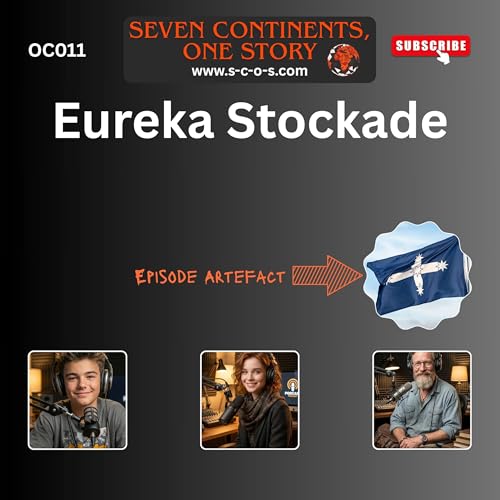
  • OC011 - Eureka Stockade - Democracy's First Uprising
    Mar 23 2026

    🔍 ARTEFACT DETECTIVE MYSTERY

    A silk flag. Roughly one and a half metres square. Five white stars arranged in a pattern you can see in the night sky. A white cross superimposed across them. It was handmade—meticulously stitched by hand—and it was raised in the air by desperate people on the night of 29 November 1854. Three women made it—Anastasia Hayes, Anastasia Withers, and Anne Duke, who was heavily pregnant at the time—in a Catholic church tent.

    This flag became so powerful that it's still used today to represent resistance to injustice. When workers march for their rights in Australia, when citizens challenge government authority—they carry this flag. On the morning of 3 December 1854, it was captured by government forces during a dawn assault that lasted just fifteen minutes.

    EPISODE SUMMARY

    The year is 1854. Gold has been discovered in Victoria, Australia. The colonial government has imposed a £1 monthly licensing fee on every gold digger, payable regardless of whether they've found any gold. The miners cannot vote. They have no voice in the laws that govern them.

    When a Scottish digger named James Scobie is beaten to death and the killer acquitted twice, 10,000 miners erupt. They burn their mining licences. They raise the Southern Cross flag. They swear an oath to stand together. And then they build a stockade at the Eureka diggings.

    The battle lasts fifteen minutes. The miners lose militarily—but win politically. Within months: voting rights. Within years: universal male suffrage. Australia—a colonial outpost—becomes a global leader in democratic governance.

    KEY FACTS & FIGURES

    1. 3 December 1854, 3:30 AM: Government forces (276) attack stockade
    2. Battle duration: approximately 15 minutes
    3. Casualties: at least 22 miners, 5 soldiers killed
    4. 113 miners arrested; 13 tried for high treason — all acquitted
    5. May 1855: General amnesty declared
    6. 1856: Victoria introduces secret ballot voting
    7. 1857: Universal male suffrage implemented

    TRINITY FORMAT

    🔍 Artefact Detective: The Southern Cross Flag — handmade silk banner, stitched by three women (one heavily pregnant), captured during the assault, now preserved at the National Museum of Australia.

    🦸 Unsung Hero: The unnamed woman killed defending her wounded husband during the assault — erased from official records for 170 years.

    🤔 Choose Your Own History: Governor Hotham's dilemma — execute the rebels as traitors or grant amnesty and implement democratic reforms. What would you choose?

    EPISODE TIMESTAMPS

    00:00 – Introduction | 00:35 – Artefact Detective: The Southern Cross Flag | 02:33 – Setting the Scene: Ballarat 1854 | 03:19 – The Victorian Gold Rush | 04:14 – The Licensing System | 05:28 – James Scobie's Death | 07:32 – The Reform League Charter | 09:07 – The Flag: Women's Hidden Contribution | 10:27 – The Unnamed Woman | 13:01 – Peter Lalor: Engineer-Commander | 17:04 – The 15-Minute Battle | 19:31 – Trials & Acquittals | 22:03 – Hotham's Dilemma | 29:22 – Democratic Reforms | 35:04 – Women's Erasure & Recovery | 37:34 – The Eureka Flag Today | 45:40 – Why History Matters

    KEY SOURCES

    1. Carboni, Raffaello. The Eureka Stockade: A Personal Narrative. 1855.
    2. Wright, Clare. The Forgotten Rebels of Eureka. Text Publishing, 2013.
    3. National Museum of Australia: nma.gov.au/defining-moments/resources/eureka-stockade

    About Seven Continents, One Story

    Hosted by Nils (Swedish history professor), Celine (Edinburgh-based history enthusiast), and Ethan (Gen Z history-lover from Malta). Each episode features the Trinity Format: an Artefact Detective mystery, an Unsung Hero, and a Choose Your Own History dilemma.

    #EurekaStockade #AustralianHistory #HistoryPodcast #DemocraticResistance #WorkersRights #SevenContinents

    Mostra di più Mostra meno
    48 min
  • AF017 - The Suez Canal Opens - How One Map Made the Impossible Possible
    Mar 16 2026

    For three thousand years, they said it was impossible. The Mediterranean sat higher than the Red Sea — connect them without locks and you'd create an uncontrollable flood. The dream of a canal through the Suez Isthmus was just that: a dream. Then a survey team spent two years in the desert measuring. Their discovery? Just 0.16 metres of difference. A sea-level canal was mathematically possible. On 17 November 1869, it became real.

    Welcome to Seven Continents, One Story. Nils, Céline, and Ethan uncover the full story behind the Suez Canal's opening — from forced labour to steam dredgers, from an Egyptian viceroy's visionary decisions to an ecological catastrophe no one foresaw.

    🔍 ARTEFACT DETECTIVE — The Original Suez Canal Survey Map (1854–1856)

    Nils brings a linen-backed parchment into the studio: cream-coloured, aged to pale yellow, two metres long and ninety centimetres wide. Drawn in fountain pen. Annotated in French. Blue watercolour washes mark water bodies on either side of a narrow desert strip — and through that strip, a single precise mathematical line. This is the Original Suez Canal Survey Map, created by de Lesseps' survey teams. It documents the most consequential measurement in nineteenth-century engineering: proof that the Mediterranean and Red Sea sit at virtually the same level. This artefact is the moment the impossible became possible.

    🦸 UNSUNG HERO — Ismail Pasha, Khedive of Egypt

    History remembers Ferdinand de Lesseps. But fewer people remember the Egyptian viceroy whose decisions made it all possible. In 1863, Ismail Pasha inherited a half-finished canal and a forced-labour crisis. He abolished corvée labour — ending forced conscription entirely — and compelled mechanisation with steam dredgers. He overrode the Ottoman Sultan's suspension order, allowing construction to continue. He funded the most lavish inauguration ceremony the world had seen. History remembers the spending that bankrupted Egypt. Remember the name. Ismail Pasha.

    🤔 CHOOSE YOUR OWN HISTORY — De Lesseps, 1863

    The Ottoman Sultan has ordered the project suspended. De Lesseps faces a choice: negotiate a legitimate compromise with broad international support — or appeal to Napoleon III and force construction through French diplomatic pressure. He chose to force it. The canal opened on schedule. But the resentment led to Britain purchasing Egypt's canal shares in 1875 and invading Egypt in 1882. Was he right?

    📖 WHAT YOU'LL DISCOVER:

    - 74 million cubic metres of earth removed in ten years of construction

    - The inauguration: 6,000 guests, Empress Eugénie, 77 ships, 1.5 million Egyptian pounds

    - The Lessepsian migration: 1,000+ Red Sea species now colonising the Mediterranean

    - The Ever Given blockage (2021): $9–10 billion per day — why this still matters

    ⏱️ TIMESTAMPS:

    00:00 - Introduction & Artefact Detective

    02:30 - 1854: The Desert Survey & The Impossible Question

    07:00 - Ferdinand de Lesseps & The Concession

    11:00 - Britain's Opposition & Lord Palmerston

    14:30 - Ismail Pasha: The Unsung Hero

    18:00 - Artefact Revealed: Original Suez Canal Survey Map

    21:00 - Ten Years of Construction (1859–1869)

    26:00 - The Waters Mingle: 15 August 1869

    29:00 - The Lavish Inauguration: 17 November 1869

    33:00 - Choose Your Own History: The 1863 Crisis

    38:00 - The Lessepsian Migration

    41:00 - Britain Buys In (1875) & Invades Egypt (1882)

    44:00 - Why It Still Matters Today

    47:00 - Recap & Remember the Name: Ismail Pasha

    📚 SOURCES:

    - Karabell, Z. (2003). Parting the Desert. Knopf.

    - Farnie, D.A. (1969). East and West of Suez. Clarendon Press.

    - Cuno, K. (1992). The Pasha's Peasants. Cambridge University Press.

    Mostra di più Mostra meno
    37 min