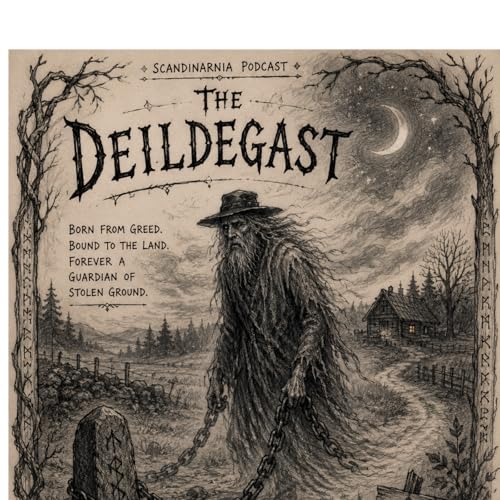
Scandinarnia copertina

Scandinarnia

Scandinarnia

Di: Lena Heide-Brennand
Ascolta gratuitamente

A proposito di questo titolo

Scandinarnia: Unlocking the Dark & Mystical North

What if the stories we were told as children were never meant for children at all?

Scandinarnia opens the door to the older, darker layers of Scandinavian mythology, folklore, and cultural history—before they were softened, simplified, and made safe. This is a podcast for those who want to understand not only the stories themselves, but the world that created them.

Each episode explores a creature, a place, or a tradition from the North: the Nøkken who inhabits rivers as both musician and predator; the Huldra, whose beauty conceals something deeply inhuman; the Myling, a voice of guilt and unresolved justice; and countless other figures drawn from oral tradition, archival sources, and historical accounts.

But these are not simply stories retold.

Through a blend of narrative, anthropology, and cultural analysis, Scandinarnia examines:

  • how folklore functioned as social control and moral instruction
  • how fear, landscape, and survival shaped belief
  • how Christianity reshaped older mythologies
  • and how these figures continue to live on in modern imagination

You will hear not only the tales themselves, but the meanings beneath them—the anxieties they reveal, the behaviours they enforced, and the realities they reflect. Rivers become thresholds. Forests become spaces of transformation. The supernatural becomes a language for very human fears.

Drawing on historical texts, folklore collections, and lived tradition, Scandinarnia invites you to step into a world where myth and reality were never clearly separated.

Lena Heide-Brennand 2026
Mondiale Scienze sociali
  • The disturbing story of the changeling myths
    Apr 30 2026

    In Scandinavian folklore, a changeling—known in Norwegian as bytting, in Swedish as bortbyting, and in Danish as skifting—was believed to be a supernatural substitute left in place of a human child that had been secretly taken. The original child was thought to have been abducted by hidden beings, most commonly trolls, the hulderfolk (the “hidden people”), or other underground or nature-dwelling spirits. In some traditions, elves or similar entities were also blamed. These beings were believed to take healthy human infants for their own purposes—whether to strengthen their own kind, replace a weak offspring, or simply out of desire for human vitality—and leave one of their own in the cradle.

    The period of greatest danger was considered to be before a child was baptised, reflecting the strong influence of Christian belief layered over older folk traditions. Infants were thought to be particularly vulnerable when left unattended, especially at night, near doorways or windows, or in close proximity to forests, mountains, or burial mounds—places associated with supernatural presence. As a result, mothers were strongly warned never to leave their babies alone, even briefly.

    Descriptions of changelings are strikingly consistent across Norway, Sweden, and Denmark. They were often said to appear physically unusual: sometimes unnaturally ugly, with large heads, thin limbs, or an oddly aged expression. Behaviourally, they might exhibit an insatiable appetite while failing to grow or thrive. Some cried incessantly, while others were eerily quiet and withdrawn. Developmental delays were commonly noted—they might not speak, walk, or respond as expected. In certain accounts, the changeling was believed to possess an old consciousness within its infant body, observing the world with unsettling awareness.

    Mostra di più Mostra meno
    22 min
  • The Evil and Vengeful Myling -Utburdr-The Once Killed And Abandoned Babies That Come Back For Human Flesh
    Apr 29 2026

    The forest does not forget.

    Not the footprints pressed into wet earth by a woman who walked alone at dusk. Not the shallow grave beneath the roots, where the soil was too hastily turned. Not the small, silenced breath that never learned to cry out loud.

    In this episode, we follow something that should never have been left behind.

    The Myling is not merely a ghost. It is a hunger. A weight. A voice that was denied its first scream and now seeks it endlessly in the dark. In the old stories whispered across the North, the Myling is the spirit of an unwanted child—killed at birth, hidden away, buried without name, without rite, without mercy.

    But the earth does not keep secrets kindly.It waits.And when the night grows damp and the forest begins to breathe, something small begins to move beneath the moss. You may hear it first as a sound mistaken for an animal—soft, dragging, uneven. Then closer. Then far too close.

    “Carry me.”

    The voice is thin, childlike—but wrong. Too hollow. Too old with sorrow.

    “Carry me… to the graveyard.”

    And if you are foolish enough to turn—if you dare to look—you will see it.

    A child, yes. But not as it should be. Limbs twisted from the cold earth, skin dark with soil and time, eyes wide with a grief that has rotted into something far worse. It reaches for you—not in plea, but in claim.

    You must carry it.

    That is the rule. The curse. The cruel bargain of the Myling.

    It will climb onto your back, light at first—like nothing at all. You may even think you imagined it. But with each step, it grows heavier. And heavier. And heavier still. Its small hands tighten around your throat as its weight presses down, crushing breath, bending spine, dragging you toward the place it was denied in death.

    You will try to walk.

    You will try to run.

    But the forest stretches. The path vanishes. And the child becomes unbearable. “Faster,” it whispers. Your legs tremble. Your lungs burn. Your heart pounds against a weight that no living body should endure. And still—it grows.

    Some never reach the graveyard.

    Some collapse in the dark, their bodies found at dawn—twisted, broken, as though something vast had pressed them into the earth. And the child?

    Gone.

    Waiting again.For the next passerby.

    For the next set of footsteps foolish enough to wander alone.

    In this episode, we do not simply tell a story. We listen.

    To the voices beneath the ground.

    To the children who were never given names.

    And to the terrible truth that in the North, the dead do not always rest—especially not the ones who were never meant to live.

    Mostra di più Mostra meno
    19 min
  • The Dark Witches of Nordic Folklore- The Demon Volva
    Apr 29 2026

    Did you know that the wise old ladies, the Volve of pre-Christian times and the herbalists that saved lives in the Nordic communities had some dark and evil counterparts that are not so widely known and spoken about? The twisted and cannibalistic female demons that rarely left the woods? Well, here’s a story and some facts thst will send chills down your spine.

    Mostra di più Mostra meno
    25 min
Ancora nessuna recensione