Episodi

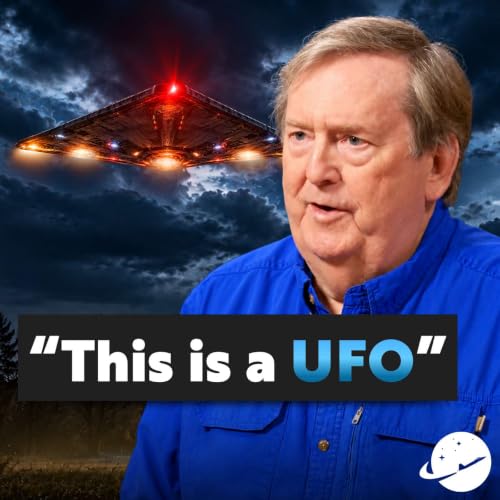
  • Test Pilot Watched a 300-Foot Black Triangle Blot Out the Stars Over Edwards | Dan Isbell Part 2
    Oct 15 2026

    Stars winking out in the shape of a giant triangle. A beam of light that found him alone at his hot tub, with no source in sight. A sphere of plasma that stopped behind his house. And a veteran journalist’s warning: they’re tracking you.

    In this part two of a two-part series, and the conclusion of Dan Isbell’s story.

    Dan Isbell flew the F-111 on Cold War nuclear alert, graduated first in his Air Force Test Pilot School class, flew more than 70 types of aircraft, and later taught test pilots at Edwards before a career in directed-energy weapons. In part one, he described the silent triangular craft he saw near a NATO base in England in 1980 and kept to himself for 43 years. In part two, he walks through the three encounters that followed, spread across 35 years and three states, none of them from an aircraft.

    I sit down with Dan to hear all of it: a roughly 300-foot black triangle that blotted out the stars over a classified range at Edwards in 1990, moving so slowly it unnerved him; a defocused beam of blue-green light that surrounded him at his Florida hot tub in 2014, its source expanding in discrete steps into a white sphere before accelerating out of sight in under half a second; and a silent plasma sphere that moved down a retention pond and stopped behind his Tampa-area home in 2016. He also describes sitting across a table from journalist George Knapp and filmmaker Jeremy Corbell, and the four words Knapp said to him that he could not shake.

    Dan does not claim to know what any of it was. He says he ruled out the prosaic explanations he could, and as an engineer he has spent decades theorizing about propulsion, optical stealth, and the physics that might make such objects possible, wherever those theories lead. Whether these were unacknowledged programs, a natural phenomenon, or something genuinely outside our science, his account returns to the question this show keeps asking: how many credentialed observers have stayed silent for fear of their careers, and what would we understand about our own skies if they felt safe to speak?

    Missed part one? Watch it here: https://youtu.be/MJHO8iB6tDw

    Learn more, become a member, and support our work at: https://www.safeaerospace.org

    Please like, subscribe, and share this episode to help us continue producing independent aviation-safety research and conversations.

    Mostra di più Mostra meno
    47 min
  • Air Force Test Pilot Saw a Silent Triangular Craft Over an English Golf Course | Dan Isbell Part 1 of 2
    Oct 8 2026

    A red Corvette alone on a dark English road. Strange lights closing fast in the rearview mirror, then stopping dead. A silent, color-shifting craft hovering just above a golf course.

    Dan Isbell spent his career at the leading edge of American airpower. He went straight into the left seat of the F-111, the first variable-sweep-wing fighter, flew nuclear alert for NATO at the height of the Cold War, graduated first in his Air Force Test Pilot School class, and eventually flew more than 70 different types of aircraft. He later helped shape the F-22 program and pioneered the fiber-laser work behind today's directed-energy weapons. On the night of December 26, 1980, driving home from alert duty at RAF Upper Heyford, he saw something he could not explain, and told no one for more than 40 years.

    In part one of a two-part conversation, I sit down with Dan to trace that career from a poor kid who had never set foot on an airport to a test pilot who talked his way into Georgia Tech and never looked back. We discuss the F-111 and the jets that followed, the near-fatal moments he survived, the lung injury he still carries from an F-16 ground fire, and then the encounter itself: a roughly 50-to-60-foot triangular craft ringed with shifting, plasma-like color, completely silent, that descended toward him as he walked closer before he thought better of it and drove away.

    Dan does not claim to know what he saw. He says he worked through every prosaic explanation he could, from a helicopter to a Soviet or NATO aircraft to a reverse-engineered platform of our own, and none of them fit. His sighting also falls within hours of the late-December nights now known as the Rendlesham Forest incident. He kept all of it to himself for decades, convinced that reporting it could end his flying career. Whether the object was an unacknowledged craft, an atmospheric phenomenon, or something genuinely outside our physics, his account raises the question this show keeps returning to: how many credible aviators have stayed silent, and what do we lose as a nation when the people best equipped to observe our skies are the ones with the most to lose by speaking?

    Learn more, become a member, and support our work at: https://www.safeaerospace.org

    Please like, subscribe, and share this episode to help us continue producing independent aviation-safety research and conversations.

    Mostra di più Mostra meno
    1 ora e 42 min
  • Black Triangles, Pilot Reports & the Search for UAP Evidence | JMill & Ryan Graves
    Oct 1 2026

    What are pilots reporting, and how do we turn those accounts into evidence we can study?

    I sit down with Jonathan Miller, known as JMill, to discuss his work on sensemaking and MIT's Confronting Unknowns program. We explore how researchers can study ambiguous data, separate signal from noise, and stay open to new information without jumping to conclusions.

    Then we turn the tables. JMill asks me about the encounters that led me to speak publicly, my 2023 congressional testimony, and the work underway at Americans for Safe Aerospace. We discuss pilot reporting, witness privacy, the development of a structured research database, and a longer-term vision for connecting witness accounts with sensor data.

    We close with accounts reported to ASA, including luminous spheres, objects described near aircraft, and black triangles. I discuss what witnesses have described, how satellite effects can complicate observations, and why credible testimony still needs careful investigation. These are reported experiences and open questions, not established explanations of what the objects are.


    Learn more, report an encounter, become a member, and support our work at https://www.safeaerospace.org/

    Learn more about JMill's sense making work at: https://www.sensemaking.wtf

    Subscribe and share this episode to support independent aviation-safety research and conversations.

    Chapters
    00:00 Opening: pilot reports and unanswered questions
    01:05 Introducing Jonathan Miller (JMill)
    04:27 MIT's Confronting Unknowns and sensemaking
    08:21 Finding signal in ambiguous data
    11:57 Discussing government UAP releases
    18:39 Turning the tables: JMill interviews Ryan
    20:06 Navy encounters and the road to Congress
    24:46 Pilot reporting protections and state policy
    29:47 What ASA's reports can tell us
    32:15 Building a structured research database
    34:37 Oshkosh plans and membership support
    39:40 Sharing witness accounts through the podcast
    42:36 Protecting witness privacy
    43:57 How ASA's mission has evolved
    46:41 A vision for connected sensor networks
    51:30 Confirmation bias and independent analysis
    58:56 Patterns in the reports: spheres and lights
    01:00:44 Satellite effects and ambiguous observations
    01:04:08 A close-range account from Marines
    01:05:57 Black triangles and reported near-misses
    01:09:24 Why reporting matters and how to help

    Mostra di più Mostra meno
    1 ora e 13 min
  • SpaceShipOne Astronaut Saw a Dozen Glowing Spheres in His Backyard | Kevin Curran & Matt Stinemetze
    Sep 24 2026

    A crashed spaceship. A career left in doubt. And six days later, a backyard full of light he couldn't explain.

    Brian Binnie was the second person to fly a private spacecraft to the edge of space — a Navy veteran with 33 combat missions, advanced degrees from Brown and Princeton, and the test pilot who flew the final flight of SpaceShipOne. Six days after a hard landing damaged its landing gear and left him wondering whether he would ever fly it again, Binnie described watching roughly a dozen glowing, translucent spheres move through his backyard in Rosamond, California, at four in the morning. He kept the account within a small circle for years. He passed away in 2022.

    I sit down with filmmaker Kevin Curran, who documented Binnie's story in Beyond Blue Sky: The Untold Story of the First Private Astronauts, and aerospace engineer Matt Stinemetze, who led the SpaceShipOne program and shared an office with Binnie for years. We trace Binnie's path from Gulf War Hornet cockpits to the high-stakes, low-budget test-flight culture at Scaled Composites, the crash that nearly ended his career, and the encounter he described six days later — a dozen fixed-shape spheres, some patrolling his fence line like sentries, two of which he said drifted through his bedroom window and passed into him before the whole scene dissolved back into darkness.

    Binnie looked for every prosaic explanation and never claimed to know what he saw; those closest to him describe it not as a fright but as something that gave him peace and, in his telling, the resolve to climb back into the cockpit. Whether it was a genuine anomaly, an artifact of a sleep-deprived mind under enormous stress, or something we don't yet have the science to describe, the conversation returns to a question this show keeps running into: what do we lose when we dismiss a credible, sober observer simply because their account doesn't fit the paradigm — and who pays for that silence?

    Watch Kevin Curran's documentary, Beyond Blue Sky: The Untold Story of the First Private Astronauts, on Apple TV: https://tv.apple.com/us/movie/beyond-blue-sky/umc.cmc.3scqjpza3p8lkaz5tr55ksmu9

    Learn more, become a member, and support our work at: https://www.safeaerospace.org

    Please like, subscribe, and share this episode to help us continue producing independent aviation-safety research and conversations.

    Mostra di più Mostra meno
    58 min
  • “That's No Balloon!”: F-18 Pilot Reconsiders His UAP Encounter | Austin Hulbert
    Sep 11 2026

    Three passes. A persistent radar contact. A brief glimpse of something silvery off the wing.

    Former Navy F-18 pilot Austin Hulbert and his weapons systems officer called it a balloon and moved on. Years later, Austin started building stratospheric balloons for the military. That explanation no longer made sense to him.

    I sit down with Austin, one of my instructors during Navy flight training, to revisit his encounter off the coast of Virginia Beach and what changed his mind. We discuss what he remembers seeing, what the radar was tracking, and why neither crew member thought much of it at the time.

    Austin also takes us inside his career in naval aviation and special operations, the return of balloons to modern warfare, and the challenge of detecting objects our air defenses weren’t built to find. Throughout the conversation, we return to a question familiar to many military aviators: What gets missed when pilots dismiss something they can’t explain?

    Learn more, become a member, and support our work at: safeaerospace.org

    Please like, subscribe, and share this episode to help us continue producing independent aviation-safety research and conversations.

    Mostra di più Mostra meno
    1 ora
  • Former DISA Contractor Saw a UAP Live on an MQ-9 Feed Over East Asia | Kevin Campbell
    Sep 3 2026

    What did a defense network engineer see while monitoring U.S. military drone feeds over the waters of East Asia?

    I sit down with former Defense Information Systems Agency (DISA) contractor Kevin Campbell, who supported satellite communications and monitored MQ-9 feeds from Hill Air Force Base. Kevin says he encountered several clips of unidentified objects in the East China Sea and Yellow Sea region—including one event he watched live. He describes a roughly spherical object moving just above the water, an elongated rust-colored form briefly visible in electro-optical imagery, and another luminous object that changed direction before it was lost from view.

    Our conversation examines how unusual footage was discovered and saved, the increased MQ-9 coverage Kevin says he observed after the first incident, and the lack of a clear reporting process inside his workplace. Kevin also discusses contacting Americans for Safe Aerospace, speaking with the FBI, his concerns about AARO’s early reporting pathway, and congressional interest in footage he believes may include one of the events he reported.

    Kevin does not claim to know what the objects were. He argues that the underlying footage should be preserved, analyzed, and, when possible, released so the public and policymakers can better assess what military sensors are recording.

    His account raises a broader aviation-safety and national-security question: How should agencies collect, retain, and share UAP data when important observations are scattered across systems and organizations?

    Learn more, become a member, and support our work at: safeaerospace.org

    Please like, subscribe, and share this episode to help us continue producing independent aviation-safety research and conversations.

    Mostra di più Mostra meno
    50 min
  • Intel Officers Saw a Massive Craft Over Cheyenne Mountain Complex | Caison Best
    Aug 20 2026

    What really happened over Cheyenne Mountain in February 2022?

    Ryan Graves sits down with former Army intelligence officer Caison Best, whose own unexplained broad-daylight sighting of a massive craft led him on a journey through the military and federal intelligence apparatus. After attempting to report the incident through official channels, Caison navigated an investigation by the Pentagon’s All-domain Anomaly Resolution Office (AARO) before engaging in an in-depth inquiry conducted by the FBI, culminating in his files and drawings recently being released to the public through the PURSUE program.

    Our conversation examines the physical characteristics of the asymmetric, white-porcelain geometric craft, the high-stakes Ukraine war briefing that occurred moments after the sighting, the stark contrast in investigative standards between AARO and the FBI, the psychological toll and peer-to-peer dynamics among military witnesses, and the broader patterns Caison observed while managing the witness intake process for Americans for Safe Aerospace (ASA).

    Whether this object was a highly advanced foreign asset, a classified domestic platform, or a true UAP, Caison’s experience reveals a troubling gap in how our national security apparatus processes, coordinates, and acts on critical intelligence from its own most highly vetted operators.

    Learn more, become a member, and support our work at: safeaerospace.org

    Please like, subscribe, and share this episode to help us continue producing independent aviation-safety research and conversations.

    Mostra di più Mostra meno
    1 ora e 17 min
  • Phantom NJ Swarms: Uncovering 13,000 UAP Police Records with AI | John Malaska x Ryan Graves
    Jul 28 2026

    What really happened during the 2024 New Jersey drone wave?

    Ryan Graves sits down with AI researcher John Malaska, whose own unexplained thermal-camera sighting led him to investigate the incidents through public records. After contacting municipalities across New Jersey, John assembled approximately 13,000 records—including police reports, dispatch logs, emails, body-camera transcripts, drone telemetry, and government intelligence reports—and used AI to identify patterns within the data.

    Our conversation examines reports of possible electromagnetic interference, unidentified radar returns near airports, activity around reservoirs and other critical infrastructure, the difficulties faced by local police, and the gap between official assurances and what responding agencies documented.

    Whether these objects were drones, misidentified aircraft, UAP, or a combination of all three, the records reveal a serious weakness in America’s ability to understand and protect its increasingly congested low-altitude airspace.

    Learn more, become a member, and support our work at: safeaerospace.org.

    Mostra di più Mostra meno
    1 ora e 32 min