

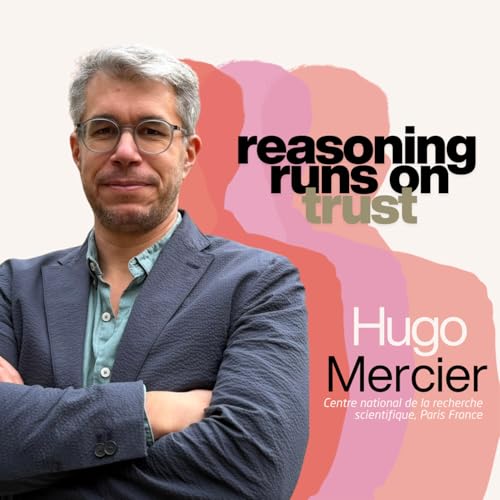
Reasoning Runs on Trust
Impossibile aggiungere al carrello
Rimozione dalla Lista desideri non riuscita.
Non è stato possibile aggiungere il titolo alla Libreria
Non è stato possibile seguire il Podcast
Esecuzione del comando Non seguire più non riuscita

Reasoning Runs on Trust
-
Letto da:
-
Di:
When we disagree with someone, it's tempting to assume the problem is simple: they're irrational, biased, or misinformed. But what if human reasoning doesn't work the way we think it does? What if reasoning isn't primarily about finding the truth on our own, but about exchanging arguments with others?
In this episode of TrustTalk, we speak with cognitive scientist Hugo Mercier of the CNRS in Paris and co-author of The Enigma of Reason. He explains why humans may be better at reasoning than we assume, why disagreement often turns on trust rather than logic, and what this means for science communication, polarization, and our ability to reason together.
Hugo Mercier also reflects on how confirmation bias can serve a useful function in group deliberation, why personal and local relationships often succeed where institutional messaging fails, and why, despite everything, he remains cautiously optimistic about our collective capacity to reason well.