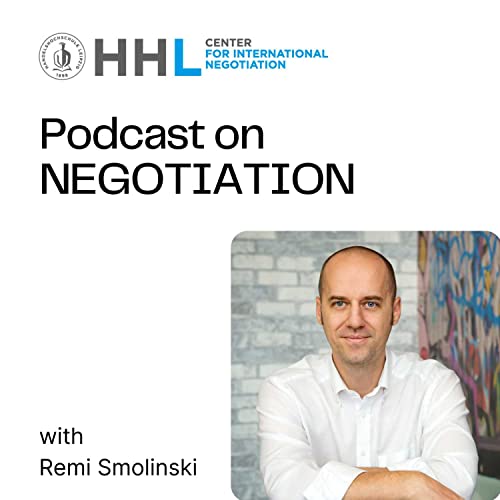
Podcast on Negotiation copertina

Podcast on Negotiation

Podcast on Negotiation

Di: Remi Smolinski
Ascolta gratuitamente

Offerte di stagione | 0,99 €/mese per i primi 3 mesi

A seguire 9,99 €/mese – si applicano condizioni. Puoi disdire mensilmente.
As a negotiation professor, I've spent my academic career trying to answer a question what it means to negotiate well and helping my students and executives achieve better negotiation results. In the Podcast on Negotiation, I invite negotiation scholars and professionals to discuss the most recent research findings, analyze ongoing negotiations, and review negotiation strategies and tactics that really work!Remi Smolinski 2025 Economia
  • On Impact Negotiation Toolkit with Nuno Delicado
    Jun 3 2026

    In this episode, we welcome Nuno Delicado, negotiation expert, founding partner of Pluris, and author of Impact Negotiations Toolkit. With experience advising, training, and supporting negotiators across countries, sectors, and complex situations, Nuno brings a practical and deeply human perspective on what it means to negotiate well.

    Together, we explore why he wrote Impact Negotiations Toolkit and why the word “impact” is at the heart of his approach. Rather than seeing negotiation only as a way to win, close a deal, or secure an immediate outcome, Nuno invites us to think about negotiation through its lasting effects: on relationships, organizations, communities, and the wider world.

    The conversation looks at how impactful negotiation differs from traditional frameworks, what negotiators can do before, during, and after a conversation, and why reflection is essential for learning and long-term success. Nuno shares insights into the main components of his toolkit, including preparation, connection, creativity, decision-making, and continuous improvement.

    We also discuss what separates negotiators who consistently create meaningful results from those who do not, how to navigate strong power imbalances, and whether there are universal principles of negotiation across cultures and sectors. Nuno challenges common myths about negotiation and reflects on how hybrid work, artificial intelligence, and cross-cultural collaboration are reshaping the way we negotiate today.

    This episode is for anyone who wants to move beyond short-term wins and learn how negotiation can become a tool for better decisions, stronger relationships, and positive change. We close with Nuno’s view on what makes someone a truly great negotiator and the one idea he hopes every listener takes away from Impact Negotiations Toolkit.

    More free tools from Nuno's great book can be found at: https://www.impactnegotiations.org/.

    Mostra di più Mostra meno
    57 min
  • On why we avoid negotiating with David Hunsaker, Hong Zhang, and Alice Lee
    May 13 2026

    In this episode, we talk with David A. Hunsaker, Hong Zhang, and Alice J. Lee, authors of the paper “Beyond Propensity: Thresholds, Costs, and Interventions in Negotiation Avoidance,” about why people often choose not to negotiate, even when negotiation could benefit them.

    The conversation begins with the origins of their research project on negotiation avoidance, a phenomenon that is both common and surprisingly underexamined. Starting from a relatable observation that even negotiation scholars sometimes avoid negotiating, we ask why people decide not to negotiate at all, before they ever reach the bargaining table.

    We discuss the paper’s finding that negotiation avoidance is widespread: more than 95% of participants reported avoiding negotiation in at least some situations, and people avoided negotiation up to 51% of the time. The episode explores why studying the decision to initiate negotiation is just as important as studying what happens once people are already engaged in the negotiation itself.

    The authors introduce two key concepts from the paper. The first is Threshold for Negotiation Initiation, which refers to the point at which a person decides that negotiation is “worth it.” We examine how people make that decision, including the role of percentage-based thinking: the same dollar savings may feel more or less worthwhile depending on the total price of the item.

    The second concept is Willingness to Pay to Avoid Negotiation. We explore the striking finding that nearly half of participants were willing to pay extra to avoid negotiating, and consider what people may really be trying to avoid: time, discomfort, conflict, embarrassment, or the fear of seeming inappropriate.

    The episode also looks at the tension revealed in the car-buying scenario: many people preferred having the possibility of negotiation, yet later said they would pay to avoid actually doing it. This opens a broader discussion of the cognitive, emotional, and social barriers that keep people from initiating negotiations.

    Finally, we discuss the interventions tested in the paper. A financial comparison showing that negotiation could be worth more per hour than a person’s usual wage did not significantly increase negotiation initiation, while a social norm intervention, showing that negotiation is common, did. The conversation considers why financial logic may not be enough, why social permission matters, and what practical advice the authors would give to consumers, employees, managers, and negotiation educators.

    We close by asking what future research should explore next in understanding when, why, and how people decide to negotiate.

    Mostra di più Mostra meno
    56 min
  • On body language secrets with Greg Williams
    May 5 2026

    In this episode, we sit down with Dr. Greg Williams, a leading expert in negotiation, body language, emotional intelligence, and microexpressions, to explore what is really happening beneath the surface of every negotiation.

    Most people focus on the words being spoken in a negotiation. But tone, posture, facial expressions, eye movement, gestures, silence, and subtle behavioral shifts often reveal just as much as the conversation itself. Dr. Williams has spent decades studying how these nonverbal signals influence trust, tension, confidence, power, and decision-making.

    Drawing from his book, Body Language Secrets To Win More Negotiations, Greg explains why body language is not about guessing what someone is thinking, but about becoming a more careful observer of patterns, context, and emotional change. We discuss what nonverbal cues can reveal, what they cannot reliably tell us, and why misreading body language can damage trust if negotiators jump to conclusions too quickly.

    Throughout the conversation, Greg shares practical insights on how to recognize important signals at the negotiation table, including microexpressions, subtle shifts in behavior, emotional triggers.

    We also explore how negotiators can manage their own body language to project confidence, openness, and control without appearing artificial, aggressive, or manipulative. Greg offers guidance for anyone who wants to become a better listener, a sharper observer, and a more emotionally intelligent communicator.

    The conversation begins with Greg reflecting on what first drew him to the nonverbal side of negotiation and how his decades of work shaped the central message of Body Language Secrets To Win More Negotiations. From there, we examine what body language can and cannot reveal, the first signals negotiators should watch for when entering a conversation, and the microexpressions or behavioral cues that are often missed when people focus too heavily on words alone.

    Greg also discusses why context is essential when interpreting body language, including the influence of culture, personality, stress, power dynamics, and high-stakes pressure. We look at the most common mistakes people make when trying to read others, how to respond when someone’s words and body language do not seem to align, and how to avoid making assumptions that could weaken trust.

    Later in the episode, Greg explains why some people seem naturally better at reading body language, whether this skill can be learned, and how negotiators can become more aware of the signals they are sending themselves. He also shares a practical exercise listeners can begin using immediately to become sharper observers in everyday conversations.

    Whether you negotiate in business, leadership, sales, law, conflict resolution, relationships, or everyday life, this episode will help you better understand the signals people send before they ever say a word.

    Mostra di più Mostra meno
    1 ora
adbl_web_anon_alc_button_suppression_t1
Ancora nessuna recensione