Palestine Bookshelf copertina

Palestine Bookshelf

Palestine Bookshelf

Di: Stephen Heiner
Ascolta gratuitamente

3 mesi a soli 0,99 €/mese

Dopo 3 mesi, 9,99 €/mese. Si applicano termini e condizioni.

A proposito di questo titolo

Reading and learning about what has really happened in Palestine since 1917. #endtheoccupation2025 Politica e governo Scienze politiche Scienze sociali
  • The Hundred Years' War on Palestine by Rashid Khalidi
    Jan 21 2026
    also viewable on Substack: https://open.substack.com/pub/palestinebookshelf/p/the-hundred-years-war-on-palestine Copy of the summary below: https://docs.google.com/document/d/1KiBSLYqj5qd2TXU4cE9pLfRGg3Pdis7rd5fwQxwx-Tw/edit?tab=t.qlcudpdxuuf Summary of The Hundred Years' War on Palestine by Rashid Khalidi OVERVIEW The video is a book review of The Hundred Years' War on Palestine: A History of Settler Colonialism and Resistance from 1917 to 2017 by Professor Rashid Khalidi. The presenter describes it as an "express version" of a longer two-part review previously done on his main channel, totaling about an hour. He praises the book as one of the best single-volume works providing the Palestinian perspective, ideal for someone new to the topic wanting a shorter overview. The video breaks the book's content into six historical eras (or "declarations of war") from 1917 to 2017, reading one or two excerpts per era. The purpose of the video is to educate viewers on the Palestinian side of the conflict, highlight the book's unflinching analysis of mistakes made, and encourage grassroots support for Palestinian narratives. MAIN THESIS The book's main thesis frames the history from 1917 to 2017 as a "hundred years' war" of settler colonialism against the Palestinian people and their resistance. It argues that Zionism, backed by British and later international powers, aimed to establish a Jewish state through displacement and control, but failed to fully supplant the indigenous Arab population. Settler colonial confrontations end in one of three ways: elimination or subjugation of natives (as in North America), defeat and expulsion of the colonizer (rare, as in Algeria), or abandonment of colonial supremacy through compromise (as in South Africa, Zimbabwe, and Ireland). Today, with the Arab population in Palestine/Israel roughly equal to or larger than the Jewish population from the Jordan River to the sea, this demographic reality poses a central moral question to Zionism's legitimacy. The thesis critiques Zionist ideology as rooted in "blood and soil" nationalism, emphasizing the need for grassroots political work by Palestinians in the US, recognizing the US's bias against Palestinian aspirations, and rejecting flawed PLO strategies since the 1980s. HISTORICAL CONTEXT The book covers 1917 to 2017, divided into six eras of conflict. The first (1917-1939) begins with the Balfour Declaration and ends with the Arab Revolt (1936-1939). Britain sought geopolitical control over Palestine, sponsoring Zionism for strategic reasons while making contradictory promises to Arabs (e.g., Hussein-McMahon correspondence, Sykes-Picot agreement). The Zionist movement was officially recognized via the Mandate for Palestine, granting privileges to the Jewish Agency while denying them to the Arab majority unless they accepted the Balfour Declaration. The second era (1947-1948) involves the UN Partition Plan (Resolution 181) and the ethnic cleansing of Palestine leading to Israel's establishment. The third (1967) covers the Six-Day War, debunking myths of Israeli vulnerability. The fourth (1982) focuses on the Lebanon invasion and Sabra-Shatila massacres. The fifth (1987-1995) addresses the First Intifada. The sixth (2000-2014) extends to events like the 2014 Gaza assault, with the presenter noting it could apply to 2025. The video ties these to ongoing Israel-Palestine issues, referencing related works like Ghassan Kanafani's on the 1936-1939 revolt and Benny Morris's on 1948. KEY IDEAS The book conceptualizes the conflict as successive "declarations of war" by colonial powers and Israel against Palestine. Key ideas include British imperialism's role in enabling Zionism for control, not altruism; the UN partition as a violation of self-determination, necessitating Palestinian expulsion for a Jewish majority; the 1967 war as unprovoked aggression, not defensive, perpetuating a myth of existential threat to justify policies; the 1979 Egypt-Israel peace treaty restricting Palestinian negotiations to "self-rule" without sovereignty; the 1982 Lebanon invasion as an attempt to destroy Palestinian nationalism, culminating in massacres; the First Intifada as spontaneous grassroots resistance impossible to suppress; and post-2000 escalations as continued colonization. Excerpts highlight: Britain's "central" strategic interest in Palestine (2:08; expulsion of 300,000 Palestinians before May 15, 1948 (4:24); UN 181 as a "declaration of war" ignoring Palestinian rights (5:28); 1967 as non-existential threat (7:43); Begin's policies ceiling Palestinian demands (8:41; author's personal account of 1982 Beirut siege and building demolition killing refugees (11:15); Intifada's 1,422 Palestinian deaths vs. 175 Israeli (14:25); 2014 Shuja'iyya bombardment as disproportionate (17:45); Zionism's failure to eliminate natives, with demographic inequality as moral core (19:37). EVIDENCE AND RESEARCH ...
    Mostra di più Mostra meno
    25 min
  • The Jewish State by Theodore Herzl
    Jan 13 2026

    also viewable on Substack:

    https://open.substack.com/pub/palestinebookshelf/p/the-jewish-state-by-theodore-herzl

    Copy of the summary:

    https://docs.google.com/document/d/1KiBSLYqj5qd2TXU4cE9pLfRGg3Pdis7rd5fwQxwx-Tw/edit?tab=t.9j8cl4u1u8zu

    OVERVIEW

    The episode discusses Theodor Herzl's book The Jewish State, a pamphlet proposing a solution to the "Jewish question" in Europe through establishing a Jewish homeland (potentially in Palestine or elsewhere). Presenter Stephen Heiner reads excerpts, highlights proposed policies, and offers commentary on their secular, tolerant, and socialist elements—while pointing out divergences in contemporary Israel. It challenges viewers to read Zionist texts critically and notes brief references to Ilan Pappé's views on Israel's internal divisions.

    MAIN THESIS

    Herzl envisioned a modern, secular Jewish state as a neutral, tolerant federation solving anti-Semitism and diaspora issues through European-style governance, socialism, and equality. The presenter argues these ideals (e.g., separation of religion and state, multilingual tolerance, limited military) have not materialized—instead, modern Israel features strong religious influence, conflict, and policies contradicting Herzl's predictions.

    HISTORICAL CONTEXT

    Written amid rising European anti-Semitism in the late 19th century, Herzl's book responds to persecution by proposing Jewish self-determination and sovereignty. It debates location (Palestine favored for biblical ties but not exclusively), draws on Enlightenment ideas, and uses examples like Switzerland for multilingual governance. The video ties this to early Zionism's secular roots while noting biblical justifications despite Herzl's non-religious stance.

    KEY IDEAS

    The video examines Herzl's core proposals and their implications:

    • Multilingualism and Language: Herzl suggests retaining native languages while adopting a practical national tongue (Hebrew predicted to emerge); critiques "ghetto languages" like Yiddish. Excerpt: "Everyone can continue using their native language... we'll stop using those inadequate jargons."

    • Jewish Identity and Faith: Bound by "forefathers' faith" uniquely, even secularly. Excerpt: "Our community of race is peculiar... bound together only by our forefathers' faith."

    • Secular Governance and Tolerance: No theocracy; equal rights for all faiths. Excerpt: "Will we establish a theocracy? Absolutely not... every man will enjoy the same freedom to believe or not believe."

    • Military and Neutrality: Professional army for a neutral state.

    • Socialist Economy: 7-hour workday, shifts for efficiency. Excerpt on flag: white with seven golden stars (for workday).

    • Other Policies: Extradition of criminals (initially stricter for Jews), predictions that the state would end anti-Semitism permanently.

    The reviewer reads short passages to illustrate these, then contrasts with modern realities (e.g., religious influence, conscription, ongoing conflict).

    EVIDENCE AND RESEARCH

    Herzl draws on personal observations of anti-Semitism, European models (e.g., Switzerland), and pragmatic planning. The presenter uses direct quotes, notes historical predictions' failures (e.g., most Jews remain in diaspora, anti-Semitism persists), and references Ilan Pappé's framing of Israel's current "battle between the state of Judea [religious Zionists] and the state of Israel [secular]."

    CONTROVERSY AND RECEPTION

    Herzl's work is foundational to Zionism but critiqued here for naive optimism and inconsistencies (e.g., secular vision vs. biblical claims). The video's tone is analytical and pro-Palestinian, highlighting how Zionist ideals have evolved into something more exclusionary toward Palestinians.

    IMPACT AND LEGACY

    Encourages critical reading of Zionist origins to understand the Israeli-Palestinian conflict's roots. Highlights gaps between Herzl's tolerant vision and today's realities, contributing to discussions on Zionism's evolution and Palestinian rights.

    PURPOSE OF THE VIDEO

    To provide a quick overview of Herzl's key arguments and policies in an accessible format. To critique how they contrast with modern Israel and encourage viewers to engage with primary Zionist sources critically.

    Find other summaries like this at Palestine Bookshelf: www.palestinebookshelf.org

    #EndTheOccupation

    Mostra di più Mostra meno
    16 min
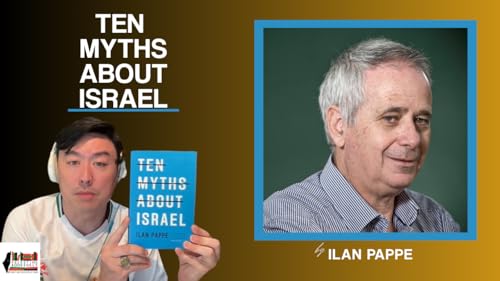
  • Ten Myths About Israel by Ilan Pappe
    Jan 7 2026

    also viewable on Substack:

    https://open.substack.com/pub/palestinebookshelf/p/ten-myths-about-israel-by-ilan-pappe

    Copy of the summary below:

    https://docs.google.com/document/d/1KiBSLYqj5qd2TXU4cE9pLfRGg3Pdis7rd5fwQxwx-Tw/edit?usp=sharing

    Summary of Ten Myths About Israel by Ilan Pappé

    OVERVIEW

    • The video is a concise "express review" from the Palestine Bookshelf channel, discussing Ilan Pappé's book Ten Myths About Israel.
    • Presenter Stephen Heiner highlights key myths debunked by Pappé, reading excerpts from each chapter.
    • It focuses on challenging common narratives surrounding Israel's history, Zionism, and the Palestinian issue.

    MAIN THESIS

    • Pappé argues that widely accepted "myths" about Israel's founding and policies are misleading or false.
    • These myths serve to justify historical actions and ongoing policies, including displacement and exclusion of Palestinians.
    • The book uses historical data, demographics, and scholarly analysis to counter them.

    HISTORICAL CONTEXT

    • Set against the backdrop of late Ottoman Palestine, rising Zionism, and the post-World War I British Mandate.
    • Involves Jewish immigration, demographic realities, and the lead-up to 1948.
    • References debates on Jewish historical ties, national identity, and international influences.

    DETAILS OF THE MYTHS

    • Examples include: "Palestine was an empty land" (debunked with Ottoman records showing a majority Muslim and Christian population).
    • "The Jews were a people without a land" (discusses debates on descent and the political implications of Zionist claims).
    • "Zionism is Judaism" (quotes Gandhi's rejection of the idea of a Jewish state in Palestine).
    • The reviewer reads short passages to illustrate strategies used to perpetuate these narratives.

    EVIDENCE AND RESEARCH

    • Pappé draws on Ottoman records, demographic statistics, and scholarly works (e.g., by Shlomo Sand).
    • References historical figures, genetic debates, and political uses of identity claims.
    • Cross-references with other sources to reveal intentions and realities behind Zionist projects.

    CONTROVERSY AND RECEPTION

    • Pappé's work is highly controversial, particularly in Israeli circles, for challenging foundational national narratives.
    • Critics may argue it overemphasizes certain interpretations or downplays complexities.
    • Supporters view it as an essential deconstruction of biased historical accounts.

    IMPACT AND LEGACY

    • Encourages reevaluation of mainstream stories about Israel's establishment and policies.
    • Highlights ongoing effects on Palestinian rights, identity, and the conflict.
    • Contributes to broader debates on historical responsibility and potential reconciliation.

    PURPOSE OF THE VIDEO

    • To inform viewers about the book's key myths and arguments in a quick format.
    • To present a critical alternative to dominant accounts of Israel's history.
    • To encourage critical thinking about the roots of the Israeli-Palestinian conflict.

    Find other summaries like this at Palestine Bookshelf: www.palestinebookshelf.org

    #EndTheOccupation

    Mostra di più Mostra meno
    14 min
Ancora nessuna recensione