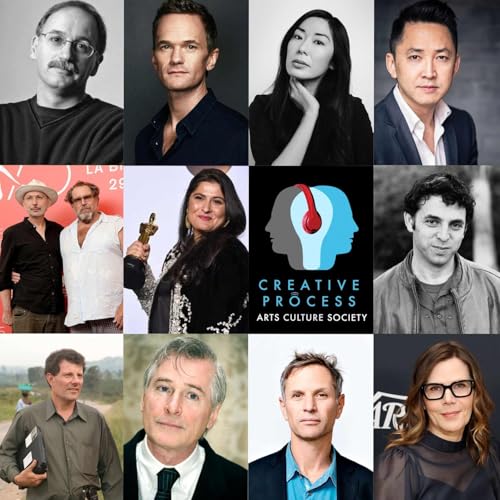
• Who Are We? What Makes Us Care? Jim Shepard, Neil Patrick Harris, John Patrick Shanley & Artists Share Their Stories
    Feb 11 2026

    Can curiosity and empathy be taught? How can we expand our sense of solidarity through stories? In this episode, we explore the internal dialogues of artists, actors and writers to ask what it means to step into someone else's shoes.

    (0:00) Novelist Jim Shepard discusses Literature as a Tool for Emotional Education and Exploring History

    (2:05) Tony Award-winning Actor Neil Patrick Harris on Being Moved by Theater and its Ability to Bridge Worlds

    (3:55) Novelist Katie Kitamura on How a Book is Made in Collaboration with the Reader

    (5:00) Screenwriter, Playwright Laura Eason on Inhabiting the Hearts of Characters Different from Ourselves

    (6:03) Academy Award-winning Director Sharmeen Obaid-Chinoy on the Art of Visual Storytelling

    (6:37) Cinematographer, Director Benoit Delhomme on the Freedom of Handheld Cinematography

    (7:19) Author Etgar Keret on Looking for Humanity through Shared Intention

    (8:18) Viet Thanh Nguyen – Opposing Power through Expansive Solidarity

    (9:27) Adam Moss – Author, Fmr. Editor New York magazine on “The Work of Art”

    (10:29) John Patrick Shanley – Tony & Academy Award-winning Writer, Director on Finding Value in Ordinary Experiences and the Creative Power of Daydreaming

    (11:56) Pulitzer Prize-winning Journalist Nicholas Kristof on Why Individual Stories are Necessary to Generate Connection

    To hear more from each guest, listen to their full interviews.

    Episode Website

    www.creativeprocess.info/pod

    Instagram:@creativeprocesspodcast

    Mostra di più Mostra meno
    14 min
  • The Wisdom of Nature: Artists & Scientists on The Beauty & Fragility of Our Planet
    Jan 9 2026

    In this special edition, we hear from our guests from across the arts and sciences. From composers and poets to forest ecologists and climate envoys, they tell the story of our planet. Moving beyond the data of destruction, we explore the intelligence of nature, the ethics of what we eat, and the empathy required to save our future.

    MAX RICHTER, Composer, Sleep, The Blue Notebooks

    CARL SAFINA, Author, Becoming Wild

    ADA LIMÓN, 24th US Poet Laureate

    CYNTHIA DANIELS, Grammy Award-winning Sound Eng.

    SUZANNE SIMARD, Finding the Mother Tree

    JOELLE GERGIS, Lead Author, IPCC 6th Assessment Rpt

    NOAH WILSON-RICH, CEO, Best Bees Company

    INGRID NEWKIRK, PETA Founder

    BERTRAND PICCARD, Solar Impulse Foundation

    DAVID FARRIER, Author, Footprints

    KATHLEEN ROGERS, Pres, Earth Day Network

    ODED GALOR, Unified Growth Theory

    PETER SINGER, Philosopher

    GEOFF MULGAN, Another World Is Possible

    CLAIRE POTTER, Welcome to the Circular Economy

    CHRIS FUNK, Dir. Climate Hazards Car.

    JENNIFER MORGAN, Special Envoy, International Climate Action

    To hear more from each guest, listen to their full interviews.

    Episode Website

    Mostra di più Mostra meno
    18 min
  • The Musician Who Sings to Animals - PLUMES on Trust & Cross-Species Communication - Highlights
    Dec 31 2025

    On Music, Trust and Connection with the Animal World

    “Mostly I’ll play in a minor key, something sad, which I think can work for an animal because they can sense the sadness, and they try to reassure me and comfort me. I chose love songs because I'm convinced they are very intuitive and they can sense what I am trying to say to them, and profess my love in a way. I think there's always a way to connect, and if you're being cautious and don't threaten the animals, something beautiful can happen.”

    Musician Plumes takes his guitar to the world's most unlikely concert halls—farms, sanctuaries, and wild habitats. A passionate advocate for veganism and animal welfare, we discuss what animals hear, how trust forms, and what music can reveal when it enters a world not made for humans alone.

    Episode Website

    www.creativeprocess.info/pod

    Instagram:@creativeprocesspodcast

    Mostra di più Mostra meno
    Meno di 1 minuto
  • Animals & The Healing Power of Music
    Dec 31 2025

    How is music a pathway to understanding animals?

    Musician Plumestakes his guitar to the world's most unlikely concert halls—farms, sanctuaries, and wild habitats. A passionate advocate for veganism and animal welfare, we discuss what animals hear, how trust forms, and what music can reveal when it enters a world not made for humans alone.

    “Mostly I’ll play in a minor key, something sad, which I think can work for an animal because they can sense the sadness, and they try to reassure me and comfort me. I chose love songs because I'm convinced they are very intuitive and they can sense what I am trying to say to them, and profess my love in a way. I think there's always a way to connect, and if you're being cautious and don't threaten the animals, something beautiful can happen.”

    Episode Website

    www.creativeprocess.info/pod

    Instagram:@creativeprocesspodcast

    Mostra di più Mostra meno
    41 min
  • Speaking Out of Place - DAVID PALUMBO-LIU on Reclaiming Our Political Voices - Highlights
    Dec 27 2025

    On the urgent need to reclaim our political voices, the forces that silence dissent, and how art and poetry are crucial tools for survival

    Our guest today is an activist scholar who believes the classroom is inseparable from the public square. David Palumbo-Liu is the Louise Hewlett Nixon Professor of Comparative Literature at Stanford University and a founding faculty member of Stanford’s Program in Comparative Studies in Race and Ethnicity. But his work has long reached beyond the academy. Through his book, Speaking Out of Place: Getting Our Political Voices Back, and his podcast of the same name, he insists that the great global crises of our time—from escalating wars and democratic failures to environmental collapse—are fundamentally crises of value and voice. His recent work has put him on the front lines of campus activism, challenging institutions, resigning his membership from the MLA, a move that highlights the ethical cost of speaking truth to power. We’ll talk about what he calls the "carceral logic" of the modern university, why art and poetry are crucial tools for survival in times of war, and what he tells his students about preparing for a future defined by uncertainty. His perspective is rooted in literature, but his urgency is all about the world we live in now. We will discuss the forces that silence dissent, the "imperial logic" of AI, and what it means to be a moral, active citizen when the systems we rely on are failing.

    “There is a dispute about what the American Dream is or how it would play out in different circumstances. The American dream has essentially been narrowed into a white Christian nationalist notion of things so that everything that falls outside what they imagine that to be is not only undesirable, but should be the subject of extermination, deportation, and detention. I am heartened by the fact that more of our 'better angels' are emerging with a more capacious and expansive notion of what the American dream could be.”

    Episode Website

    www.creativeprocess.info/pod

    Instagram:@creativeprocesspodcast

    Mostra di più Mostra meno
    12 min
  • Reclaiming the American Dream with DAVID PALUMBO-LIU – Stanford Professor, Author & Host, Speaking Out of Place
    Dec 27 2025

    On the urgent need to reclaim our political voices, the forces that silence dissent, and how art and poetry are crucial tools for survival

    “There is a dispute about what the American Dream is or how it would play out in different circumstances. The American dream has essentially been narrowed into a white Christian nationalist notion of things so that everything that falls outside what they imagine that to be is not only undesirable, but should be the subject of extermination, deportation, and detention. I am heartened by the fact that more of our 'better angels' are emerging with a more capacious and expansive notion of what the American dream could be.”

    Our guest today is an activist scholar who believes the classroom is inseparable from the public square. David Palumbo-Liu is the Louise Hewlett Nixon Professor of Comparative Literature at Stanford University and a founding faculty member of Stanford’s Program in Comparative Studies in Race and Ethnicity. But his work has long reached beyond the academy. Through his book, Speaking Out of Place: Getting Our Political Voices Back, and his podcast of the same name, he insists that the great global crises of our time—from escalating wars and democratic failures to environmental collapse—are fundamentally crises of value and voice.

    His recent work has put him on the front lines of campus activism, challenging institutions, resigning his membership from the MLA, a move that highlights the ethical cost of speaking truth to power. We’ll talk about what he calls the "carceral logic" of the modern university, why art and poetry are crucial tools for survival in times of war, and what he tells his students about preparing for a future defined by uncertainty. His perspective is rooted in literature, but his urgency is all about the world we live in now. We will discuss the forces that silence dissent, the "imperial logic" of AI, and what it means to be a moral, active citizen when the systems we rely on are failing.

    Episode Website

    www.creativeprocess.info/pod

    Instagram:@creativeprocesspodcast

    Mostra di più Mostra meno
    1 ora e 7 min
  • In the Presence of the DALAI LAMA - Doc. Director of WISDOM OF HAPPINESS - Highlights
    Nov 6 2025

    I can change my mind. I can reduce anger, hatred. Nothing to do with religion. All religions carry the message of love, loving kindness, and tolerance. With different views, there is a possibility to synthesize new ideas. If majority of the world leaders become female, world become safer. I feel that. Compassion is the key factor. Non-violence, compassion and self-confidence, these are key factors for happy individual, happy community, peaceful world. This century should be century of compassion, century of peace. No more bloodshed. We should develop a big “we,” rather than “we” or “they.” With these wings, you can fly.” -DALAI LAMA

    For decades, the Dalai Lama has been a global symbol of peace, compassion, and resilience, a spiritual leader living in exile from his home in Tibet. But how do you capture the essence of his wisdom—the kind that can truly change a life—in a way that feels intimate and personal? My guest today, documentary filmmaker Barbara Miller, has managed to do just that in her new film, Wisdom of Happiness. It’s a beautiful film that feels less like a documentary and more like a private, heart-to-heart conversation, where he invites us into his thoughts and shares practical steps for finding inner peace in a chaotic world.  She's dealt with anti-globalization, domestic violence, and the fight for female pleasure in her previous works. We’ll talk about how she shifted from exposing systemic pain to focusing on radical hope and her collaboration with Executive Producer Richard Gere and Manuel Bauer, the Dalai Lama’s personal photographer for the last thirty-five years, who made his cinematography debut with this film. She shares what the Dalai Lama taught her about living in harmony with our body, nature, and the world.

    Episode Website

    www.creativeprocess.info/pod

    Instagram:@creativeprocesspodcast

    Mostra di più Mostra meno
    14 min
  • WISDOM OF HAPPINESS - Heart-to-Heart w/ DALAI LAMA - Conversation w/ Director Barbara Miller
    Nov 6 2025

     Everybody wants happiness, joyfulness, peaceful world. Our 21st century will not be easy century. Fear, anger, hatred. In our mind we created distinctions. Different nationality, different color, different religion. Strong concept of “we” and “they”. Brothers and sisters of this small planet, we are same human beings. Meanwhile, global warming is a serious problem. Destruction of this planet is actually destruction of yourself. Our common responsibility should be work together, to save our world. We all have this marvelous human brain. The problem is, when negative emotions develop, our whole mind is taken over. So, we must deal with emotions.

    I can change my mind. I can reduce anger, hatred. Nothing to do with religion. All religions carry the message of love, loving kindness, and tolerance. With different views, there is a possibility to synthesize new ideas. If majority of the world leaders become female, world become safer. I feel that. Compassion is the key factor. Non-violence, compassion and self-confidence, these are key factors for happy individual, happy community, peaceful world. This century should be century of compassion, century of peace. No more bloodshed. We should develop a big “we,” rather than “we” or “they.” With these wings, you can fly.” -DALAI LAMA

    For decades, the Dalai Lama has been a global symbol of peace, compassion, and resilience, a spiritual leader living in exile from his home in Tibet. But how do you capture the essence of his wisdom—the kind that can truly change a life—in a way that feels intimate and personal? My guest today, documentary filmmaker Barbara Miller, has managed to do just that in her new film, Wisdom of Happiness. It’s a beautiful film that feels less like a documentary and more like a private, heart-to-heart conversation, where he invites us into his thoughts and shares practical steps for finding inner peace in a chaotic world.  She's dealt with anti-globalization, domestic violence, and the fight for female pleasure in her previous works. We’ll talk about how she shifted from exposing systemic pain to focusing on radical hope and her collaboration with Executive Producer Richard Gere and Manuel Bauer, the Dalai Lama’s personal photographer for the last thirty-five years, who made his cinematography debut with this film. She shares what the Dalai Lama taught her about living in harmony with our body, nature, and the world.

    Episode Website

    www.creativeprocess.info/pod

    Instagram:@creativeprocesspodcast

    Mostra di più Mostra meno
    44 min