Episodi

  • Episode 105: The Board Already Knows Something About You
    Aug 24 2026

    FREE Decision Chain™ Analysis:
    Get instant feedback on your superintendent interview response


    The board has your résumé and application materials. But how much does it actually know about the way you lead?

    Our latest superintendent selection case study examined five finalists competing for the same position. While they answered many of the same questions, the board did not necessarily begin with the same amount of evidence about each candidate.

    One finalist had spent nearly three decades working inside the district. Other candidates had to make leadership developed elsewhere visible during the interview.

    That distinction gives us another way to understand Step 6 of the Six-Step Operating Model™: Reduce Hiring Uncertainty.

    In Episode 105, we examine why an external candidate's interview may have to carry more of the burden of making executive leadership visible, how the Decision Chain™ and Upgrade Formula™ help communicate leadership the board has never personally observed, and why being known by a board is not automatically an advantage.

    The case study also produced an unexpected result: the candidate who created the strongest interview signal in our assessment was not the candidate ultimately selected.

    We aren't changing the scores after learning the outcome. Instead, this new series of research observations will examine what the five candidates communicated and what their responses can teach you about preparing for your own superintendent interview.

    Executive Interview Intelligence™ | Research Observation #134


    Candidates can enter the same superintendent search with different amounts of leadership evidence already available to the board. When the board knows less about how you lead, your interview has more work to do.

    Most superintendent candidates prepare for interview questions. School boards are evaluating something else.

    Mostra di più Mostra meno
    17 min
  • Episode 106: The Board Asked How You Make Decisions. Did You Actually Answer?
    Aug 24 2026

    FREE Decision Chain™ Analysis:
    analysis.next-leveledleadershipinterviewprep.com

    A school board asked five superintendent finalists essentially the same question:

    “Describe your decision-making style and give us a few examples of strategies you have used in different situations.”

    The candidates talked about collaboration, data, students, stakeholder input, and communication. But their responses did not give the board the same amount of evidence about how they actually make decisions.

    In Episode 106, we use Surface Question → Hidden Evaluation™ to examine what may sit underneath one of the most common superintendent interview questions.

    Using responses from five candidates in the same superintendent search, we compare what changed when candidates moved beyond describing their leadership philosophy and began making their judgment visible. The episode examines why collaboration can improve a decision without completing the decision-making process—and why the board may still need to see what happened when the final judgment became the candidate's responsibility.

    The research connects directly to the Decision Chain™: Constraint → Decision → Tradeoff → Action → Leadership Signal, giving superintendent candidates a practical way to examine their own interview examples.

    Executive Interview Intelligence™ | Research Observation #135

    When a board asks about your decision-making style, describing how you collaborate is not enough. The board needs evidence of how you move from input to judgment when the decision ultimately becomes yours.

    Most superintendent candidates prepare for interview questions. School boards are evaluating something else.

    Mostra di più Mostra meno
    17 min
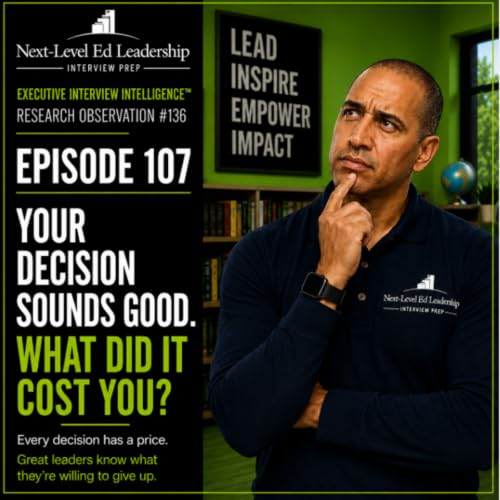
  • Episode 107: Your Decision Sounds Good. What Did It Cost You?
    Aug 25 2026

    FREE Decision Chain™ Analysis:
    analysis.next-leveledleadershipinterviewprep.com


    A superintendent candidate can clearly explain a difficult decision and still leave out the part that may reveal the most about executive judgment: the tradeoff.

    In Episode 107, we move deeper into the Decision Chain™ and examine what happens when a superintendent has to choose between legitimate priorities that cannot all be fully protected.

    Using an executive decision involving a structural budget deficit and administrative restructuring, we examine how the same accomplishment sounds different once the board understands the organizational consequence the leader accepted in order to protect another priority.

    The episode also explores why tradeoffs aren't limited to financial decisions, how organizational capacity can create competing priorities, and why candidates shouldn't manufacture conflict simply to make an interview example sound more consequential.

    Executive Interview Intelligence™ | Research Observation #136

    A decision tells the board what you chose. The tradeoff reveals what you prioritized when you couldn't have everything.

    The goal isn't to make your answers longer. It's to preserve the evidence that often disappears when a complicated leadership decision gets simplified for an interview.


    Most superintendent candidates prepare for interview questions. School boards are evaluating something else.

    Mostra di più Mostra meno
    17 min
  • Episode 108: You Made the Decision. What Happened Next?
    Aug 25 2026

    FREE Decision Chain™ Analysis:
    analysis.next-leveledleadershipinterviewprep.com

    A superintendent candidate can clearly explain a leadership decision and tell the board how the story eventually turned out. But what happened between those two points?

    In Episode 108, we examine the leadership evidence that can disappear when an interview response jumps from a decision directly to a successful result.

    The episode looks at how superintendent candidates can make implementation visible without turning their answer into a project-management checklist. It also explores the difference between describing activity and showing how a leader created movement across an organization, why superintendent-level execution has to work through other leaders, and what boards may learn when a candidate explains how an implementation changed after encountering real conditions.

    Executive Interview Intelligence™ | Research Observation #137

    A decision shows the board what you chose. What happens next shows whether you know how to move an organization after the choice has been made.

    The goal isn't to add more implementation details. It's to identify the evidence that helps the board understand how your leadership moved the organization from a decision toward an outcome.


    Most superintendent candidates prepare for interview questions. School boards are evaluating something else.


    Mostra di più Mostra meno
    16 min
  • Episode 109: You Answered the Question. What Did the Board Learn About You?
    Aug 26 2026

    You Answered the Question. What Did the Board Learn About You?

    FREE Decision Chain™ Analysis:
    analysis.next-leveledleadershipinterviewprep.com


    A strong superintendent interview example does more than explain what happened. It leaves the board with evidence about how you lead.


    But the leadership signal isn't simply whatever you intended the story to communicate.

    In Episode 109, we examine what happens after the board hears the complete leadership example. What can board members reasonably conclude about the candidate from the evidence they were actually given?

    The episode explores why telling a board you're collaborative, decisive, transparent, or data-driven isn't the same as letting those characteristics show through real leadership experience. It also examines how the leadership signal you intend to send can differ from the one the board actually receives.


    Executive Interview Intelligence™ | Research Observation #138


    Your story is the evidence. The leadership signal is the conclusion the board draws from it.

    The goal isn't to add another statement explaining what your example proves. It's to make sure the leadership evidence already present in your experience survives the interview.

    Because you already know what you're saying.


    The real question is: What is the board hearing?

    Most superintendent candidates prepare for interview questions. School boards are evaluating something else.


    Mostra di più Mostra meno
    19 min
  • Episode 110: Your Answers Are Strong. But Do They Fit Together?
    Aug 26 2026

    FREE Decision Chain™ Analysis:
    analysis.next-leveledleadershipinterviewprep.com


    A superintendent candidate can give several strong interview answers and still leave the board with an unclear picture of how they actually lead.

    Episode 110 looks beyond the individual response and examines what happens when the board begins connecting leadership evidence across the entire interview.

    Consistency doesn't mean responding to every situation the same way. Different circumstances should produce different leadership responses. What matters is whether the board has enough evidence to understand why those responses make sense together.

    Executive Interview Intelligence™ | Research Observation #139

    A strong answer can create a leadership signal. The rest of the interview determines whether the board believes it.


    Instead of reviewing only whether each answer works on its own, listen to the entire interview and consider the leader those answers reveal.

    Most superintendent candidates prepare for interview questions. School boards are evaluating something else.


    Mostra di più Mostra meno
    13 min
  • Episode 111: Your Answer Is Strong. What Would Make It Executive?
    Aug 27 2026

    FREE Decision Chain™ Analysis:
    analysis.next-leveledleadershipinterviewprep.com


    A superintendent candidate can describe substantial leadership experience and still leave some of its executive value difficult for the board to see.


    Episode 111 begins the next phase of Executive Interview Intelligence™ by moving from the Decision Chain™ into the Upgrade Formula™.


    Using a real response from Case Study #17, we examine a candidate describing district-level curriculum and instructional leadership: analyzing data with instructional leaders, identifying gaps, developing curriculum maps and pacing guides, reviewing implementation every nine weeks, and using classroom evidence to determine whether adjustments are necessary.

    The experience is already credible. The question is whether the board can identify the leadership priority organizing that work.


    That leads to the first element of the Upgrade Formula™: Leadership Focus.

    Executive Interview Intelligence™ | Research Observation #140

    A strong leadership example doesn't automatically become an executive interview response. The upgrade begins by making the leadership priority behind the work visible.


    The goal isn't to add leadership language or manufacture executive reasoning that wasn't part of the experience. It's to determine whether the board can recognize what was actually guiding your judgment.

    Most superintendent candidates prepare for interview questions. School boards are evaluating something else.

    Mostra di più Mostra meno
    15 min
  • Episode 112: Your Answer Makes Your Leadership Look Smaller Than It Is
    Aug 27 2026

    FREE Decision Chain™ Analysis:
    analysis.next-leveledleadershipinterviewprep.com

    You may have significant organizational leadership experience while describing it in a way that makes your leadership look much smaller.

    Episode 112 continues the Upgrade Formula™ with its second element: Organizational Level.


    Using a different response from Case Study #17, we examine a candidate who describes being someone administrators trust when difficult situations arise. Elsewhere in the same exchange, he talks about empowering principals, establishing expectations, providing support, and holding leaders accountable.


    The question is what changes when someone moves from helping individual leaders solve difficult problems to leading the organization in which those leaders operate.

    Executive Interview Intelligence™ | Research Observation #141

    Your title doesn't make an answer executive. The level of leadership your response makes visible does.

    Organizational Level isn't about making an experience sound bigger than it was. It's about making sure the answer accurately represents the scope of the leadership that was already there.

    Most superintendent candidates prepare for interview questions. School boards are evaluating something else.


    Mostra di più Mostra meno
    12 min