Episodi

  • Big Tech and Its Populist Critics
    Jan 12 2026

    Besides working in Washington, DC, what do American politicians like Elizabeth Warren, Donald Trump, Alexandria Ocasio-Cortez, Josh Hawley, and Bernie Sanders all have in common? As political scientist Gary Winslett observes, at least one thing is their strong, populist critiques of “Big Tech”. Whether it’s Apple, Amazon, Meta, Microsoft, or Google, American populist politicians from the Left and Right find much to criticize: Leftwing populists typically stress economic concerns and monopolistic practices, while their Rightwing counterparts focus on free speech issues. But how valid are these critiques? How useful (and accurate) are the historical analogies used to support them? And how might the populists’ view of Big Tech affect America’s capacity for technological advancement and innovation down the line? Based on the research conducted for his new book—“Big Tech and its Populist Critics”—Winslett explores these issues, questions the validity of populist critiques from both political sides, and advocates for a 'dynamist' approach to public policy that promotes risk-taking, innovation, and a positive outlook towards technological progress.


    Gary Winslett is a Johnson Fellow in Modern Political Thought and associate professor of Political Science at Middlebury College.

    New Frontiers (from the Rohatyn Center for Global Affairs at Middlebury College) is a higher education podcast series bringing scholarly research and expertise to bear on national, international, and global affairs.

    Produced and edited by Margaret DeFoor and Mark Williams, director of the Rohatyn Center for Global Affairs. Intro by Charlotte Tate, associate director of the Rohatyn Center for Global Affairs.

    Music Credits
    Forte by Kestra - Summer with Sound Album
    Soul Zone by Kestra - Light Rising Album

    Mostra di più Mostra meno
    33 min
  • Are Madagascar’s Marine Biodiversity Programs Working?
    Nov 12 2025

    Are Madagascar’s marine biodiversity programs protecting the ocean—or leaving coastal communities behind? Mez Baker-Médard explores the promise and pitfalls of “feminist conservation.”

    With 90% of its plants and 85% of its non-flying animals found nowhere else in the world, Madagascar—with its extensive coral reefs—is home to incredible biodiversity. It’s also the site of multiple international projects whose aim is to preserve its biodiversity treasure.

    How might we assess the efficacy of these international conservation efforts? In this episode of New Frontiers, environmental scientist Mez Baker-Médard discusses her new book Feminist Conservation: Politics and Power in Madagascar’s Marine Commons. Drawing on two decades of research, she explores how Madagascar’s internationally-funded marine conservation programs often marginalize local fishers—especially women—by excluding them from traditional fishing areas. Employing the concept of feminist conservation, which emphasizes local knowledge, traditions, and equity in environmental conservation decision-making, she critiques “top-down” conservation models and calls for a model that “trusts local knowledge, resists enclosure, and addresses the root causes of ecological and social harm.

    New Frontiers (from the Rohatyn Center for Global Affairs at Middlebury College) is a higher education podcast series bringing scholarly research and expertise to bear on national, international, and global affairs.

    Produced and edited by Margaret DeFoor and Mark Williams, director of the Rohatyn Center for Global Affairs. Intro by Charlotte Tate, associate director of the Rohatyn Center for Global Affairs.

    Music Credits
    Forte by Kestra - Summer with Sound Album
    Soul Zone by Kestra - Light Rising Album

    Mostra di più Mostra meno
    29 min
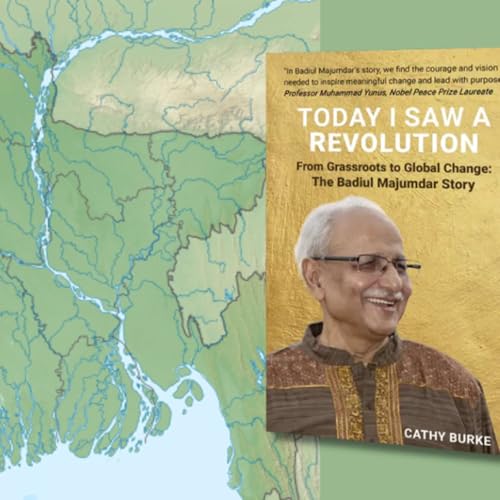
  • Unlikely Leaders: Lessons from “Today I Saw a Revolution”
    Sep 29 2025

    For twenty years, Cathy Burke—author, leadership expert, changemaker—served as CEO of The Hunger Project Australia and later, Global Vice President. In this capacity, she worked to help end hunger by developing leadership at scale in communities across Africa, Latin America, and South Asia. Through her work with The Hunger Project, she met Dr. Badiul Majumdar, who—born into poverty—rose to become leader of a national movement that not only helped end hunger in his home country of Bangladesh, but transformed its political landscape too. Inspired by his commitment, energy, vision—and incredible results—Cathy wrote his biography, “Today I Saw a Revolution”. In this episode of “New Frontiers” Cathy sits down with host Mark Williams to discuss her book, the remarkable man it celebrates, and the lessons his life’s work can teach us about leadership, collective action, and political change.

    For more information on the Rohatyn Center for Global Affairs at Middlebury College and the New Frontiers podcast series, visit our website.
    New Frontiers is a higher education podcast series bringing scholarly research and expertise to bear on national, international, and global affairs.

    Produced and edited by Margaret DeFoor and Mark Williams, director of the Rohatyn Center for Global Affairs. Intro by Charlotte Tate, associate director of the Rohatyn Center for Global Affairs.


    Music Credits
    Forte by Kestra - Summer with Sound Album
    Soul Zone by Kestra - Light Rising Album

    Mostra di più Mostra meno
    35 min
  • PART II - Nukes, Landmines, and Disarmament: A Conversation with Matthew Breay Bolton
    Jun 2 2025

    This is the second part in our two-part series on global demining and disarmament efforts, and the Trump administration’s decision to suspend all US assistance and funding for these international campaigns. In this episode, Mark Williams speaks with political scientist and Nobel Laureate Matthew Breay Bolton regarding the US role in helping to address the problems posed by landmines and unexploded ordinance—problems that past US policy had sometimes helped create. Their conversation examines some of the ethical, political, and strategic implications of the US decision to cease supporting global demining efforts—such as the potential rise in civilian casualties, abdication of moral responsibility, and the broader strategic disadvantages this policy change (and a US withdrawal from global leadership more generally) seems likely to impose on the United States.

    Mostra di più Mostra meno
    25 min
  • PART I Nukes, Landmines and Disarmament: A Conversation with Matthew Breay Bolton
    May 14 2025

    How could activists, academics, NGOs and others lead the world to a Nuclear Weapons Ban treaty in 2017, despite resistance from the world’s major nuclear powers? Why do states, militaries, and militias still use landmines in war zones, despite their proven inability to deter an opposing military—or even delay its assault for an extended time? How effective have global efforts to clear landmines from post-conflict societies been? What role has the United States played in helping to create—and address—the problems posed by landmines and unexploded ordinance? And could the Trump administration’s decision to suspect aid for global demining campaigns affect those operations as well as America’s global influence and strategic interests? This is the first of a two-part series in which 2017 Nobel Laureate Matthew Breay Bolton joins host Mark Williams to discuss these and other topics.

    Dr. Matthew Breay Bolton is professor of political science and co-director of the International Disarmament Institute at Pace University, New York City. He is also affiliated with the Environmental Science and Studies department. Along with his wife, Emily Welty, Bolton was part of the International Campaign to Abolish Nuclear Weapons (ICAN) team awarded the 2017 Nobel Peace Prize. He has worked for more than 20 years with UN and NGO efforts addressing the humanitarian impact of landmines, cluster munitions, military robotics and the arms trade.

    For more information on the Rohatyn Center for Global Affairs at Middlebury College and the New Frontiers podcast series, visit our website.
    New Frontiers is a higher education podcast series bringing scholarly research and expertise to bear on national, international, and global affairs.

    Produced and edited by Margaret DeFoor and Mark Williams, director of the Rohatyn Center for Global Affairs. Intro by Charlotte Tate, associate director of the Rohatyn Center for Global Affairs.

    Music Credits
    Forte by Kestra - Summer with Sound Album
    Soul Zone by Kestra - Light Rising Album

    Mostra di più Mostra meno
    36 min
  • The Path to Autocracy: Venezuela and Beyond
    Dec 13 2024

    In this episode of New Frontiers, Mark Williams sits down with political scientist Javier Corrales, to discuss his latest book—‘Autocracy Rising: How Venezuela Transitioned to Authoritarianism’. Known for decades as one of the developing world’s most stable democracies, Venezuela’s slide toward autocracy began with Hugo Chávez’s rise to the presidency. In 1998 public displeasure with various economic, political, and social issues swept Chávez to power. Thereafter, power itself increasingly accrued to the presidency—at the expense of civil society elements, pluralism, and institutional checks and balances—to the point that Freedom House now ranks the Venezuelan political system led by current president Nicolás Maduro as “not free.” How did Venezuela transition from democracy to autocracy? What factors played the largest causal roles? And what lessons might Venezuela’s experience teach about democracy’s fragility elsewhere? This episode offers a deep dive into these topics.

    Javier Corrales is Dwight W. Morrow 1895 professor of Political Science at Amherst College in Amherst, Massachusetts. He obtained his Ph.D. in political science from Harvard University in 1996.


    Corrales's research focuses on democratization, presidential powers, ruling parties, democratic backsliding, populism, political economy of development, oil and energy, the incumbent's advantage, foreign policies, and sexuality. He has published extensively on Latin America and the Caribbean.


    For more information on the Rohatyn Center for Global Affairs at Middlebury College and the New Frontiers podcast series, visit our website.
    New Frontiers is a higher education podcast series bringing scholarly research and expertise to bear on national, international, and global affairs.

    Produced and edited by Margaret DeFoor and Mark Williams, director of the Rohatyn Center for Global Affairs. Intro by Charlotte Tate, associate director of the Rohatyn Center for Global Affairs. Editing also by Rohatyn Center for Global Affairs intern, Mehr Sohal.


    Music Credits
    Forte by Kestra - Summer with Sound Album
    Soul Zone by Kestra - Light Rising Album

    Mostra di più Mostra meno
    36 min
  • The East India Company: Commerce, Conquest, and Colonialism
    Nov 1 2024

    Established in 1600 to secure trade relations between India, East and Southeast Asia, and Britain, the East India Company did this and much, much more. For nearly 300 years it ran a global trading network that operated for profit, politics, and eventually empire. In the process it not only became the world’s first multinational corporation, but — thanks to its own army, navy, currency, and legal system—came to rule territories far more extensive than its home base of the British Isles. On this episode, Mark Williams speaks with historian Ian Barrow about this remarkable company, how it came to support British imperialism, what its history might tell us about the rise of capitalism and the nature of colonialism, and some of the legacies its operations left behind.

    Ian Barrow is director of the Axxin Center for the Humanities and the A. Barton Hepburn Professor of History at Middlebury College. An historian of South Asia, he has written three books, most recently a history of the East India Company titled The East India Company, 1600–1858.


    For more information on the Rohatyn Center for Global Affairs at Middlebury College and the New Frontiers podcast series, visit our website.
    New Frontiers is a higher education podcast series bringing scholarly research and expertise to bear on national, international, and global affairs.

    Produced and edited by Margaret DeFoor and Mark Williams, director of the Rohatyn Center for Global Affairs. Intro by Charlotte Tate, associate director of the Rohatyn Center for Global Affairs. Outro by Rohatyn Center for Global Affairs intern, Mehr Sohal.


    Music Credits
    Forte by Kestra - Summer with Sound Album
    Soul Zone by Kestra - Light Rising Album

    Mostra di più Mostra meno
    39 min
  • Election 2024 and US Foreign Policy
    Sep 17 2024

    How has US foreign policy changed since the end of the Cold War? When—and over what issues—did America’s largely bipartisan foreign policy collapse? What major foreign policy challenges await the next US president? Where will the next US administration take America, and how might it seek to advance and protect its notion of the national interest? In this episode of New Frontiers, Ambassador Michael McKinley joins Mark Williams to discuss the foreign policy implications of the 2024 US presidential election. Their conversation ranges from such historic milestones as the end of the Cold War and the Global War on Terror, to more contemporary policy issues like the Middle East, Ukraine, trade, and immigration.

    Over the course of a 37-year career, Michael McKinley served as the US Ambassador to Peru, Colombia, Afghanistan, and Brazil, and as Senior Advisor to the Secretary of State. Earlier assignments included serving as Deputy Chief of Mission and Chargé d’affaires at US embassies in Mozambique, Uganda, and the US Mission to the European Union. His articles on foreign policy and US politics have appeared in Foreign Affairs, the Atlantic, the Financial Times, and other publications. He has a Ph.D. from Oxford University in Latin American history.


    For more information on the Rohatyn Center for Global Affairs at Middlebury College and the New Frontiers podcast series, visit our website.
    New Frontiers is a higher education podcast series bringing scholarly research and expertise to bear on national, international, and global affairs.

    Produced and edited by Margaret DeFoor and Mark Williams, director of the Rohatyn Center for Global Affairs. Intro by Charlotte Tate, associate director of the Rohatyn Center for Global Affairs.


    Music Credits
    Forte by Kestra - Summer with Sound Album
    Soul Zone by Kestra - Light Rising Album

    Mostra di più Mostra meno
    35 min