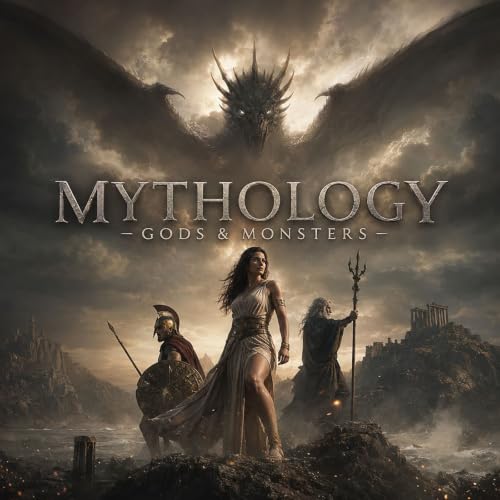
Mythology - Gods & Monsters copertina

Mythology - Gods & Monsters

Mythology - Gods & Monsters

Di: OBOMEDIA ENTERTAINMENT
Ascolta gratuitamente

Offerte di stagione | 0,99 €/mese per i primi 3 mesi

A seguire 9,99 €/mese – si applicano condizioni. Puoi disdire mensilmente.
Mythology hides its heroes in plain sight, dressing a warrior in silk before it lets him pick up a sword. A mother disguises her son as a girl in a palace full of women, and a trumpet blast is all it takes to reveal the boy who will die at Troy. That single moment says everything about this show: gods testing mortals, prophecies nobody escapes, and choices that cost exactly what they promise to cost.

Mythology: Gods & Monsters is a narrated documentary podcast, no host, no chatter, just one complete mythology story per episode, reconstructed in careful detail from ancient sources and the scholarship built around them. Each episode stands alone. You get the full arc of a myth or legend, from the strange rule that sets it in motion to the ending that made it endure for thousands of years, whether that ending is triumphant, tragic, or simply unresolved.

The show moves freely across greek mythology and beyond it, drawing on mythology from cultures far outside the Mediterranean world. You will hear how Zeus watches his own son Sarpedon die at Troy because even gods answer to fate, how a king sits frozen on a chair in the underworld and cannot rise, how a divine smith turns grief into a slaughter of skulls and stolen gold. There is room here for ancient mythology that predates the Olympians, for the dragon-slayer Siegfried and the betrayal waiting for him, for guides with three eyes and cheats who win kingdoms through nerve rather than glory. Gods and monsters share the stage equally, because in these mythology tales neither side plays fair.

If you want legends told with texture, tension, and enough historical grounding to feel real rather than recited, this mythology podcast is built for you. New episodes release regularly, each one a self-contained world you can enter cold. Subscribe now, so the next piece of mythology finds you the moment it drops.Copyright OBOMEDIA ENTERTAINMENT
Fantascienza
  • You hear the oracle name the sun seeing Orpheus' bones - what do you do?
    Oct 20 2026
    A city watches sunlight strike a buried tomb and an oracle names the sun and Orpheus’ bones - do you treat the warning as poetry or prophecy?

    You hear the oracle name the sun seeing Orpheus' bones - what do you do?

    In this episode, we visit the ancient city of Leibethra and follow the layered evidence - archaeology, landscape, and myth - that surround its sudden disappearance. The narrative asks how a community responds when a warning sounds impossible, and whether dismissal can become the cause of ruin.

    Location: Leibethra (eastern foot of Mount Olympus, Pieria)
    Period: occupied from Bronze Age through c. 100 BCE
    Event: oracle warning that “when the sun sees the bones of Orpheus” Leibethra will be destroyed by a boar
    Archaeology: acropolis excavated (1.5 ha); full site ~150 ha with 99% unexcavated
    Hypothesis: possible earthquake and flooding; the oracle’s exposure motif central to legend

    - The city stood 130 meters above the plain, ~4 km from the sea, bordered by the Griva and Kavourolaka rivers.
    - Built to last: multi-story houses with tiled roofs, pithoi set into floors, walls using two distinct masonry styles.
    - Finds from the acropolis include a lead weight stamped “Leibethra,” Macedonian coins, and a 2,000-liter storage vessel fragment.
    - Material timeline: Bronze Age tombs nearby, acropolis occupied by 8th century BCE, last deposits around 100 BCE, vineyard burned in early 3rd century BCE.
    - The oracle’s phrase links exposure (“sun sees the bones”) to a boar as the mechanism, a riddle the inhabitants dismissed as poetic rather than literal.

    To listen to this podcast ad-free and access premium episodes, try our subscription with a 14-day free trial at obomedia.com.

    © 2026 OBOMEDIA. All rights reserved.
    This episode and its content (audio, text, and related materials) are the exclusive property of OBOMEDIA and are protected by applicable copyright laws. Reproduction, distribution, editing, or commercial use, in whole or in part, without prior written permission from OBOMEDIA is prohibited. For permissions, licensing, and business inquiries: business@obomedia.com.
    Mostra di più Mostra meno
    14 min
  • If you heard Hylas cry from the spring, would you jump in?
    Oct 19 2026
    Each year a city climbs Mount Arganthonius to call a vanished boy's name into a spring - what would you do with that grief?

    If you heard Hylas cry from the spring, would you jump in?

    In this episode, we follow how a single disappearance shaped a city's rituals, landscape, and identity across centuries. It traces the myth of Hylas, the founding grief of Cius, and asks how collective practices hold a community together when the person they seek cannot return.

    Person: Hylas
    Location: Mount Arganthonius, Cius (head of the gulf)
    Event: Annual festival calling Hylas's name into the trees and spring
    Source: Strabo and Apollonius of Rhodes (Argonautica)
    Artifact: Two rivers named Hylas and Cius running through the territory

    - The Argo lands on the Mysian coast; Hylas goes alone into the trees to fetch water and kneels by a spring.
    - Naiads (spring nymphs) draw Hylas into the water; he cries once and disappears with no body or confirmed death.
    - Heracles tears through the forest calling Hylas's name; the Argonauts sail on while some accounts record an Argonaut staying behind.
    - Strabo records a living ritual: every year citizens climb Mount Arganthonius to call Hylas's name and return in silence.
    - The myth reappears in the landscape and governance: rivers named Hylas and Cius, debates among ancient geographers, and a city organized around perpetual searching.

    To listen to this podcast ad-free and access premium episodes, try our subscription with a 14-day free trial at obomedia.com.

    © 2026 OBOMEDIA. All rights reserved.
    This episode and its content (audio, text, and related materials) are the exclusive property of OBOMEDIA and are protected by applicable copyright laws. Reproduction, distribution, editing, or commercial use, in whole or in part, without prior written permission from OBOMEDIA is prohibited. For permissions, licensing, and business inquiries: business@obomedia.com.
    Mostra di più Mostra meno
    21 min
  • The Red Dragon of Latmus: An 8,000‑Year Secret Beneath the Lake
    Oct 18 2026
    A lone researcher finds an 8,000‑year‑old red dragon painted in a cave above Lake Bafa - what kept people coming here?

    The Red Dragon of Latmus: An 8,000‑Year Secret Beneath the Lake

    In this episode, we follow the discovery and deep history of a painted red dragon high on Mount Latmus and trace the mountain’s long relationship with the water below. The episode asks how a place can draw people back for millennia and what the landscape’s changes tell us about those visits.

    Person: Anneliese Peschlow
    Location: Mount Latmus / Lake Bafa, Muğla province, southwestern Turkey
    Date: 1994 (discovery); paint dated to ~8,000 years old
    Event: Discovery of red dragon cave painting; sediment cores revealing environmental history
    Topic: Sacred landscape, geological change, and human continuity

    - A researcher crawled into a shallow cave above a glittering lake and found a red dragon painted on stone.
    - The pigment on the dragon was radiocarbon‑dated to roughly eight thousand years before present.
    - Lake Bafa was once the Gulf of Latmus, a seaport gradually filled by the meandering Büyük Menderes (Maeander) river.
    - Sediment cores show a shift from oak‑and‑pine forest to agricultural species and charcoal spikes indicating human clearance centuries later.
    - The mountain hosted successive peoples - unknown prehistoric visitors, Carians, Greeks, Persians, Byzantines - each leaving traces but not the dragon’s maker.

    To listen to this podcast ad-free and access premium episodes, try our subscription with a 14-day free trial at obomedia.com.

    © 2026 OBOMEDIA. All rights reserved.
    This episode and its content (audio, text, and related materials) are the exclusive property of OBOMEDIA and are protected by applicable copyright laws. Reproduction, distribution, editing, or commercial use, in whole or in part, without prior written permission from OBOMEDIA is prohibited. For permissions, licensing, and business inquiries: business@obomedia.com.
    Mostra di più Mostra meno
    25 min
adbl_web_anon_alc_button_suppression_t1
Ancora nessuna recensione