

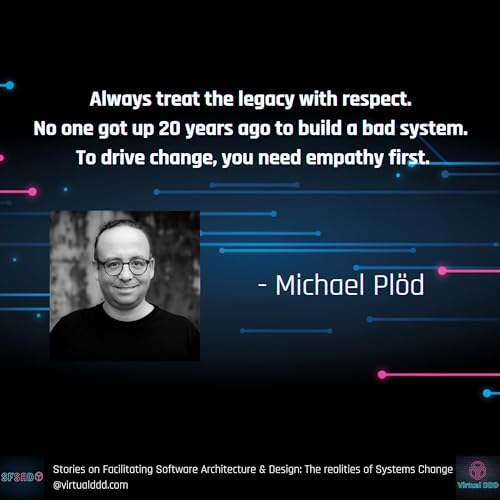
Modernizing with Respect: Acknowledging the Best Intentions Behind Legacy Code
Impossibile aggiungere al carrello
Rimozione dalla Lista desideri non riuscita.
Non è stato possibile aggiungere il titolo alla Libreria
Non è stato possibile seguire il Podcast
Esecuzione del comando Non seguire più non riuscita

Modernizing with Respect: Acknowledging the Best Intentions Behind Legacy Code
-
Letto da:
-
Di:
A proposito di questo titolo
We have all been there: you walk into a new client engagement ready to implement modern patterns, only to find a tangle of a 20-year-old legacy system and a wall of resistance from the existing staff. It’s easy to label the old system as "crap" and the gatekeepers as "blockers," but what if that legacy system is the only reason the company survived long enough to hire you?
In this episode of Stories of Facilitating Software Design and Architecture, Michael Plöd shares a powerful story about a modernisation project that was nearly derailed by a "difficult" stakeholder. By taking a massive emotional risk and stepping away from the technical arguments to ask, "Why are you resisting?", Michael uncovered that he was criticising the life's work of the company's original "rockstar developer."
Michael, together with Beija and hosts Andrea, Kenny, and Andrew, explores the critical role of empathy in architecture. They discuss how to reframe legacy conversations using Gregor Hohpe’s concept of shifting from "Economies of Scale" to "Economies of Speed," and why the most important tool in an architect's belt isn't Kubernetes—it’s the ability to ride the "elevator" between the engine room and the penthouse without losing the message.
Key Discussion Points- [00:02:50] Conference Driven Development: The danger of throwing buzzwords like Microservices, DDD, and Kubernetes at a problem without understanding the context.
- [00:06:00] The Hidden History of Legacy: Discovering that the "blocker" in the room is often the creator of the system that earned the company millions.
- [00:09:20] Contextual Reframing: How to explain the need for change by contrasting the historical need for "Economies of Scale" (centralization/control) with today's need for "Economies of Speed."
- [00:10:00] The Architect as Path-Maker: Transforming a legacy developer from a defender of the old guard into the architect of the new context.
- [00:14:00] Professional Resilience: How to draw boundaries and not take professional resistance as a personal attack, allowing you to stay objective in heated modernization efforts.
- [00:25:00] Riding the Elevator: Why stakeholder communication—translating technical complexity for different audiences—is the number one skill for aspiring architects.