

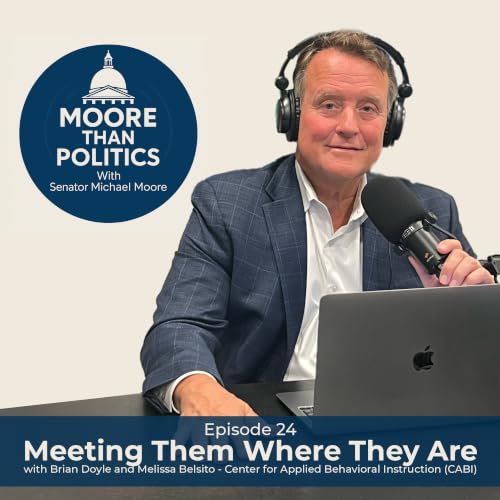
Meeting Them Where They Are
Impossibile aggiungere al carrello
Rimozione dalla Lista desideri non riuscita.
Non è stato possibile aggiungere il titolo alla Libreria
Non è stato possibile seguire il Podcast
Esecuzione del comando Non seguire più non riuscita

Meeting Them Where They Are
-
Letto da:
-
Di:
In Episode 24 of Moore Than Politics, State Senator Michael Moore sits down with Brian Doyle, Executive Director of the Center for Applied Behavioral Instruction (CABI), and Melissa Belsito, Director of Student Services, to discuss the highly specialized educational services CABI provides for students on the autism spectrum with significant behavioral and learning needs.
Founded in 2014, CABI was created in response to a growing need for intensive educational programs for children whose needs could not always be met in a traditional public-school environment. The school uses the principles of Applied Behavior Analysis (ABA) and provides highly individualized instruction, including one-to-one and two-to-one student-to-staff ratios, along with special education teachers, behavior analysts, speech therapy, occupational therapy, and physical therapy.
The conversation explores how behavior can often be a form of communication, and how CABI uses data, reinforcement, and individualized plans to help students develop safer behaviors, stronger communication skills, greater independence, and improved academic performance.
Senator Moore and his guests also discuss the importance of preparing students for life beyond the classroom. CABI's transition programs help students develop vocational, social, and independent-living skills while building partnerships with local employers and community organizations.
The episode also takes an honest look at the cost and staffing challenges involved in providing this level of specialized care, including the shortage of special education teachers and the difficulty of recruiting and retaining staff for demanding but deeply meaningful work.
At the heart of the conversation is one goal: helping every student reach the greatest level of independence and opportunity possible—whether that means returning to a traditional school environment, entering the workforce, continuing their education, or successfully transitioning into adult services.
This is more than politics. It’s about giving every child the support, skills, and opportunities they need to build their own future.