Episodi

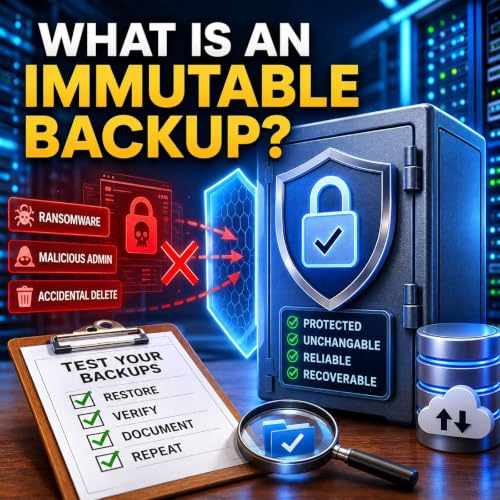
  • What Is an Immutable Backup?
    Jul 28 2026

    An immutable backup is a protected copy of data that cannot be modified or deleted during a defined retention period, even by accounts that normally possess administrative privileges. Certification exams may connect immutability with ransomware recovery, insider threats, retention controls, and protection against compromised backup administrators. Attackers frequently attempt to erase or encrypt recovery data before disrupting production systems, so an immutable copy can preserve a trusted restoration point. Organizations should separate backup credentials, restrict management access, maintain offline or logically isolated copies, monitor deletion attempts, and define retention periods that meet operational and regulatory needs. Immutability does not guarantee successful recovery, so backups must still be verified, scanned when appropriate, and tested through regular restoration exercises that confirm systems and data can be recovered. Produced by BareMetalCyber.com, where you’ll find more cyber audio courses, books, and information to strengthen your educational path. Also, if you want to stay up to date with the latest news, visit DailyCyber.News for a newsletter you can use, and a daily podcast you can commute with. And dont forget Cyberauthor.me for the companion study guide and flash cards!

    Mostra di più Mostra meno
    15 min
  • What Is Chain of Custody?
    Jul 28 2026

    Chain of custody is the documented record of how evidence was collected, identified, transferred, stored, examined, and protected from the moment it was acquired. Certification exams may ask why investigators record who handled an item, when possession changed, where it was stored, and what actions were performed. This documentation helps demonstrate that evidence presented during legal, disciplinary, or administrative proceedings is the same evidence originally collected and was not improperly altered. Investigators should assign unique identifiers, record dates and times, use tamper-evident packaging when appropriate, restrict access, calculate hashes for digital evidence, and document every transfer. Missing signatures, unexplained gaps, or improper storage can weaken confidence in the evidence even when the technical findings appear accurate. Produced by BareMetalCyber.com, where you’ll find more cyber audio courses, books, and information to strengthen your educational path. Also, if you want to stay up to date with the latest news, visit DailyCyber.News for a newsletter you can use, and a daily podcast you can commute with. And dont forget Cyberauthor.me for the companion study guide and flash cards!

    Mostra di più Mostra meno
    14 min
  • What Is Alert Fatigue?
    Jul 28 2026

    Alert fatigue develops when analysts or users receive so many repetitive, low-quality, or poorly prioritized notifications that important warnings become difficult to recognize and investigate. Certification exams may describe a security operations team ignoring alerts after repeated false positives and ask candidates to identify the operational problem. Common causes include overly broad detection rules, duplicate notifications, missing context, weak severity assignments, and alerts that provide no clear action. Organizations should tune rules, suppress known duplicates, enrich alerts with asset and identity information, automate routine analysis, and define escalation procedures based on risk. Metrics should examine alert volume, response time, closure reasons, and confirmed incidents. Reducing noise must be balanced carefully so that tuning does not create false negatives or hide meaningful changes in attacker behavior. Produced by BareMetalCyber.com, where you’ll find more cyber audio courses, books, and information to strengthen your educational path. Also, if you want to stay up to date with the latest news, visit DailyCyber.News for a newsletter you can use, and a daily podcast you can commute with. And dont forget Cyberauthor.me for the companion study guide and flash cards!

    Mostra di più Mostra meno
    17 min
  • False Positives and False Negatives
    Jul 28 2026

    A false positive occurs when a security control reports malicious activity that is not actually present, while a false negative occurs when genuine malicious activity is missed. Certification exams may ask candidates to identify these outcomes or explain the tradeoff created when detection thresholds are adjusted. A rule that alerts on every administrative script may create excessive false positives, while a rule that requires several severe conditions may overlook a real attack. Defenders should tune controls using validated data, asset criticality, threat context, and acceptable risk rather than attempting to eliminate one error type completely. Testing, analyst feedback, rule reviews, and comparison with confirmed incidents help improve accuracy. False negatives may leave threats undetected, while excessive false positives can consume resources and contribute to alert fatigue. Produced by BareMetalCyber.com, where you’ll find more cyber audio courses, books, and information to strengthen your educational path. Also, if you want to stay up to date with the latest news, visit DailyCyber.News for a newsletter you can use, and a daily podcast you can commute with. And dont forget Cyberauthor.me for the companion study guide and flash cards!

    Mostra di più Mostra meno
    16 min
  • What Is an Indicator of Compromise?
    Jul 28 2026

    An indicator of compromise is an observable clue suggesting that malicious activity may have occurred within a system or environment. Certification exams may present a suspicious file hash, unfamiliar domain, unexpected account, altered configuration, unusual process, or unauthorized network connection and ask candidates to classify it as an indicator requiring investigation. An indicator is not automatic proof of an incident because legitimate activity may produce similar evidence, and attackers may change their tools or infrastructure. Analysts should combine multiple indicators with context, timelines, asset information, user behavior, and threat intelligence before reaching a conclusion. Effective handling includes validating the evidence, searching for related activity, preserving relevant logs, containing confirmed threats, and updating detection rules without creating unnecessary false positives. Produced by BareMetalCyber.com, where you’ll find more cyber audio courses, books, and information to strengthen your educational path. Also, if you want to stay up to date with the latest news, visit DailyCyber.News for a newsletter you can use, and a daily podcast you can commute with. And dont forget Cyberauthor.me for the companion study guide and flash cards!

    Mostra di più Mostra meno
    15 min
  • What Is Code Signing?
    Jul 28 2026

    Code signing uses a digital signature to help recipients verify the identity associated with a software publisher and determine whether the signed code changed afterward. Certification exams may ask candidates to connect code signing with authenticity, integrity, certificates, hashing, and public-key cryptography. The publisher calculates a hash of the software and signs that value with a private key, while the recipient uses the corresponding public key to verify the signature. A valid signature does not prove that software is safe, because a trusted developer may sign vulnerable code or an attacker may steal a signing key. Organizations should protect private keys, restrict signing access, use trusted build systems, timestamp signatures, monitor certificate use, and revoke compromised certificates promptly. Produced by BareMetalCyber.com, where you’ll find more cyber audio courses, books, and information to strengthen your educational path. Also, if you want to stay up to date with the latest news, visit DailyCyber.News for a newsletter you can use, and a daily podcast you can commute with. And dont forget Cyberauthor.me for the companion study guide and flash cards!

    Mostra di più Mostra meno
    16 min
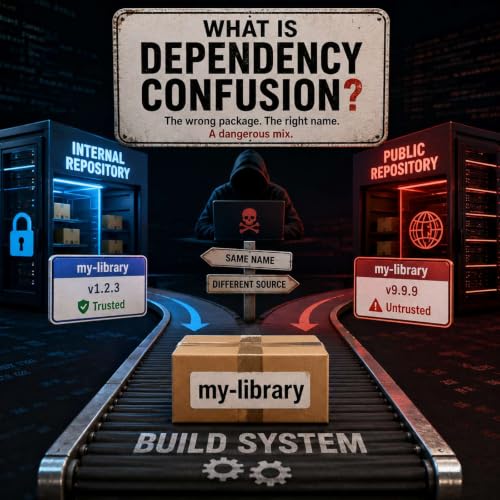
  • What Is Dependency Confusion?
    Jul 28 2026

    Dependency confusion occurs when a software build or package-management system retrieves an attacker-controlled public package instead of the organization’s intended internal dependency. Certification exams may describe identical package names in private and public repositories and ask candidates to identify the software supply-chain risk. An attacker may publish a package with the expected internal name and a version number that causes automated tools to select it during installation or compilation. Defenses include private package namespaces, repository-priority controls, package allowlists, dependency locking, integrity verification, and continuous monitoring of build activity. Development teams should also document approved sources and prevent build systems from contacting untrusted repositories. If suspicious code appears, investigators should preserve build logs, identify affected versions, remove the package, rotate exposed secrets, and rebuild trusted artifacts. Produced by BareMetalCyber.com, where you’ll find more cyber audio courses, books, and information to strengthen your educational path. Also, if you want to stay up to date with the latest news, visit DailyCyber.News for a newsletter you can use, and a daily podcast you can commute with. And dont forget Cyberauthor.me for the companion study guide and flash cards!

    Mostra di più Mostra meno
    15 min
  • What Is a Hardcoded Secret?
    Jul 28 2026

    A hardcoded secret is a password, token, application programming interface key, encryption key, or other sensitive value placed directly inside source code, scripts, configuration files, or application packages. Certification exams may present exposed credentials in a repository and ask which development practice created the risk. Secrets embedded in code may be copied into backups, logs, container images, compiled applications, documentation, and public repositories, making complete removal difficult. Developers should use approved secret-management systems, environment-based injection, access controls, short-lived credentials, and automated repository scanning. When exposure occurs, removing the visible value is not enough; the organization should revoke or rotate the secret, review its use, examine access logs, and determine whether unauthorized activity occurred. Produced by BareMetalCyber.com, where you’ll find more cyber audio courses, books, and information to strengthen your educational path. Also, if you want to stay up to date with the latest news, visit DailyCyber.News for a newsletter you can use, and a daily podcast you can commute with. And dont forget Cyberauthor.me for the companion study guide and flash cards!

    Mostra di più Mostra meno
    14 min