• Humanoid Robots in Manufacturing: Hype vs Reality
    Sep 14 2026

    Humanoid robots are coming fast, but where can they deliver real ROI for Australian manufacturers today?


    In this episode, David Pearce, Founder at Our Robot Future, and Adrian Tyson, Founder at Neuranext.ai, separate the hype from the reality of humanoid robotics and explain what manufacturers should be doing now to prepare for the next wave of automation. Shane and Paul cover:

    Why more than 90% of humanoid robot sales in Australia are currently going into education rather than industry

    Where humanoid robots are already being trialled in manufacturing, warehousing, laboratories and logistics environments

    The biggest barriers to adoption, including training data, workforce capability and deployment complexity

    How wheeled humanoids may reach manufacturing environments before fully legged systems

    What workforce shortages, dirty and dangerous jobs, and productivity challenges mean for the future of robotics in Australia

    Real-world examples from Figure, BMW, China Post, Hyundai, Boston Dynamics, AgiBot and Australian robotics companies

    Whether you're a plant manager, operations leader, automation engineer, or technology buyer, this episode provides a practical view of where humanoid robotics stands today and what to watch over the next few years.

    Follow Manufacturing Tech Australia on Spotify and leave a review if this episode helped you.

    Show notes and links for this episode: https://www.manufacturingtech.au/episodes/

    Mostra di più Mostra meno
    38 min
  • Digital Manufacturing for SMEs: Start Small, Scale Fast
    Aug 31 2026

    How manufacturers can start digital transformation with low-cost tools, real shop-floor data, and minimal risk.


    In this episode, Harry Baxter from Defence Materials Technology Centre (DMTC) and Matthew Doolan from UNSW Canberra explain how manufacturers can begin their digital manufacturing journey without investing in large-scale MES projects or expensive infrastructure. Shane and Paul explore practical examples from Digital Manufacturing on a Shoestring and Smart Enough Factory initiatives, covering:

    • How low-cost sensors, Raspberry Pi devices and simple dashboards can provide immediate visibility of factory operations
    • Using energy monitoring to identify hidden power consumption and reduce operating costs
    • How job-tracking systems help identify bottlenecks and improve production flow
    • Why air-quality monitoring can improve workplace transparency and operational awareness
    • The cultural challenges of digital adoption and how to build operator engagement from the shop floor up
    • Why manufacturers should focus on solving business problems first and then select the appropriate technology

    Whether you're a plant manager, operations leader, continuous improvement specialist, or SME owner, this episode provides practical examples of how to start capturing meaningful production data and build momentum for broader digital transformation.

    Follow Manufacturing Tech Australia on Spotify and leave a review if this episode helped you.

    Show notes and links for this episode: https://www.manufacturingtech.au/episodes/

    Mostra di più Mostra meno
    31 min
  • Women in Manufacturing: Building the Next Talent Pipeline
    Aug 17 2026

    How mentoring, work experience and maker spaces help attract more women into Australian manufacturing.


    In this episode, Rachelle Turner and Steph Piper share their experiences entering manufacturing, engineering and maker spaces, along with practical ideas for increasing female participation across the sector.


    We cover:

    Why visibility and representation matter when encouraging young women to consider manufacturing careers

    How work experience, apprenticeships and pre-apprenticeship pathways create entry points into industry

    The role mentoring plays in building confidence, capability and long-term career growth

    Why workplace culture, bystander intervention and respectful feedback help retain diverse teams

    How maker spaces, libraries, 3D printing and hands-on projects introduce people to manufacturing and engineering skills


    Whether you're a manufacturer, plant manager, educator or parent, this episode provides practical ideas for attracting, supporting and developing the next generation of manufacturing talent.


    Follow Manufacturing Tech Australia on Spotify and leave a review if this episode helped you.


    Show notes and links for this episode: https://www.manufacturingtech.au/episodes/

    Mostra di più Mostra meno
    24 min
  • FoodPro 2026: AI, Robotics & Food Automation
    Aug 3 2026

    How food manufacturers are using AI vision, robotics, sorting and automation to boost quality, efficiency and competitiveness.


    In this episode, we share the latest automation and technology innovations showcased at FoodPro 2026.


    How upcycled textile robot covers can extend robot life and reduce maintenance in harsh manufacturing environments

    Affordable palletising automation designed to help smaller manufacturers adopt robotics safely and cost-effectively

    AI-powered machine vision systems for real-time food quality inspection, labelling compliance and defect detection

    Food sorting and grading technologies using AI, machine vision and spectral analysis to improve yield and decision-making

    End-of-line coding, marking, labelling and palletising solutions that help streamline packaging operations

    Whether you're a plant manager, operations leader, automation engineer or technology buyer, this episode provides practical insights into the latest technologies shaping Australian food manufacturing.


    Featured guests: Ben Wood, Co-Founder at WipTex (Waste in Progress Textiles), Jim Karatasos, Founder of Process Evolution, Aditya Agrawal, Co-founder of Frinks AI, Andrew Saliba, Area Sales Manager at TOMRA, and Steven B Cail, State General Manager at Visy.


    Follow Manufacturing Tech Australia on Spotify and leave a review if this episode helped you.

    Show notes and links for this episode: https://www.manufacturingtech.au/episodes/

    Mostra di più Mostra meno
    28 min
  • Circular Dairy Packaging: Closing the Virgin Cost Gap
    Jul 20 2026

    How dairy processors can close the recycled plastic cost gap with backhauled bottle returns and food-grade HDPE reuse.

    Recorded live at CeMAT 2027, Shane hosts a panel discussion with Ben McCulloch from Martog & Company, Edward Vaudrey from Popit Recycling, and Taylor Quinn from Procal Dairies who share how a closed-loop model could reduce the cost barrier that keeps food-grade recycled HDPE above virgin polymer. The cover:

    * Why food-grade recycled HDPE usually costs more than virgin plastic, including smaller plant scale and the added collection, sorting, washing, decontamination, and extrusion steps.

    * How Procal’s existing crate return network can backhaul empty milk bottles from cafés, restaurants, and other food-service sites without adding new logistics cost.

    * How Popit’s modular recovery system scans bottles, removes contaminants, flakes material on site, and sends it to Martog for hot washing and food-grade processing.

    * Why 30 to 50 per cent recycled content is currently the commercial sweet spot for milk bottles, even though the long-term goal is to push costs to parity with virgin resin.

    * What rollout could look like next, from proving the economics at Prokal to expanding across more dairy processors in Australia.

    Whether you’re a plant manager, packaging lead, or sustainability manager, this episode gives you a practical model for testing circular packaging without building an entirely new recovery network.

    Follow Manufacturing Tech Australia on Spotify and leave a review if this episode helped you.

    Show notes and links for this episode: https://www.manufacturingtech.au/episodes/

    Mostra di più Mostra meno
    30 min
  • CeMAT 2026: Robotics, Humanoids, and AI That Actually Work in Warehouses
    Jul 7 2026

    From cold chain robotics to humanoid AI, what will actually deliver value on the warehouse floor in 2026 might surprise you.

    At CeMAT 2026, Shane and Paul sat down with John Sauer from OPEX, Daniele Farioli from Modula, Maryam Ziaee from Slimstock, and Adam Frank from SugarAI, along with a Daemon robotics showcase, to break down what’s real versus hype.

    In this episode, we cover:


    How next-gen AS/RS systems are enabling multi-temperature storage without traditional cold rooms

    What humanoid robots can actually do today and how VR-trained AI models are shaping warehouse automation

    The evolution of vertical storage systems and how businesses are scaling high-speed fulfilment

    How inventory optimisation platforms are improving stock accuracy, cutting waste, and lifting revenue

    Why most manufacturers are sitting on untapped data and how AI-driven CRM is unlocking better forecasting


    If you're running warehouse operations, supply chain, or manufacturing, this episode gives you a grounded view of where automation and AI are really delivering results right now.

    Follow Manufacturing Tech Australia on Spotify and leave a review if this episode helped you.

    Show notes and links for this episode: https://www.manufacturingtech.au/episodes/

    Mostra di più Mostra meno
    25 min
  • CeMAT '26: Industry 4.0 from Training to Robotics
    Jun 25 2026

    How Australian manufacturers can adopt Industry 4.0 using training, collaboration, and emerging robotics technologies.


    In this episode, recorded live at CeMAT 2026, Vikram Sachdeva from Swinburne University, Andrew Brown from the Association for Manufacturing Excellence, and Jun from Agibot share how Australian manufacturers can practically adopt Industry 4.0 and AI. Paul covers:


    How Swinburne’s Factory of the Future and Digital Jobs programmes help manufacturers build AI and digital capability


    Using readiness frameworks like CERI and EMRI to prioritise digital transformation initiatives


    How AME supports continuous improvement through systems thinking, networking, and global knowledge sharing


    The role of humanoid and quadruped robotics for education, inspection, and manufacturing use cases


    Why collaboration across education, industry bodies, and robotics providers accelerates adoption


    Whether you're a plant manager, operations leader, or technology buyer, this episode gives you a practical view of how to get started with Industry 4.0 in Australia.


    Follow Manufacturing Tech Australia on Spotify and leave a review if this episode helped you.


    Show notes and links for this episode: https://www.manufacturingtech.au/episodes/

    Mostra di più Mostra meno
    15 min
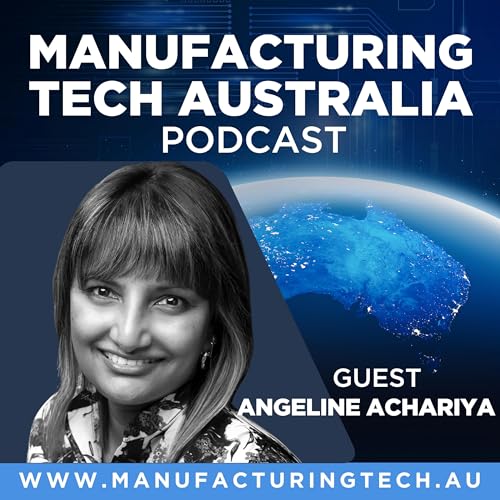
  • Australia’s Biggest Manufacturing Sector Is Being Squeezed, Here’s How to Fix It | Angeline Achariya
    Jun 8 2026

    Food manufacturing is Australia’s largest manufacturing sector, yet it’s under pressure from every direction, squeezed margins, rising costs, global competition, and ongoing underinvestment.

    In this episode, Paul sits down with Angeline Achariya from Innovation Gamechangers to unpack what’s really happening inside the industry and why it matters far beyond food.

    They explore why manufacturers keep falling into the cycle of cutting costs instead of investing, how this is eroding long-term competitiveness, and why the real challenge isn’t a lack of capital, it’s a lack of understanding around ROI and strategic investment.

    Angeline shares a clear pathway forward, from mapping supply chain vulnerabilities and rethinking partnership strategies, to shifting Australia’s focus from volume production to high-value manufacturing that captures more margin.

    They also dive into the global landscape, including how China is reshaping food production through technology and biomanufacturing, and what Australian manufacturers can learn from it.

    If you’re in manufacturing, this episode is a wake-up call and a practical guide to building resilience, unlocking growth, and staying competitive in a rapidly changing world.

    Key takeaways:

    • Why food manufacturing is the backbone of Australia’s economy, and why it’s being squeezed

    • The real reason companies underinvest in technology and innovation

    • Why capital isn’t the constraint, but mindset and ROI understanding are

    • How to shift from volume-driven growth to margin-driven strategies

    • The importance of mapping your supply chain and identifying vulnerabilities

    • Why partnerships will define the next generation of manufacturers

    • What China’s long-term strategy means for Australian industry

    Follow Manufacturing Tech Australia on Spotify and leave a review if this episode helped you.

    Show notes and links for this episode: https://www.manufacturingtech.au/episodes/

    Mostra di più Mostra meno
    36 min