Episodi

  • Danish Colonialism in Greenland? U.S. National Security, Sovereignty, and Self-Determination | Logic Dictate Hot Topics (Steve Gibson)
    Jan 21 2026

    Denmark’s claim to Greenland is treated as “normal,” but a U.S. claim is called outrageous—why? In Episode 73, Steve Gibson challenges the assumptions behind sovereignty, colonial attachment, and the strategic importance of Greenland in a changing Arctic.

    In Logic Dictate Hot Topics — Episode 73, host Steve Gibson revisits the Greenland debate through a lens most media coverage avoids: colonial legitimacy, sovereignty, and the double standards applied to territorial claims.

    Steve examines why Denmark’s historic control over Greenland is often accepted at face value—while U.S. interest (framed in the episode as national-security strategy) is treated as inherently illegitimate. He argues the core question isn’t only what the U.S. wants, but what claim Denmark has beyond colonial attachment, and how the approximately 57,000 people of Greenland should weigh into any future outcome.

    The episode also raises uncomfortable but important parallels: if colonial history undermines legitimacy, how should modern nations think about their own territorial origins—and where does self-determination begin and end?

    In this episode:

    • Greenland’s strategic importance and U.S. national security arguments
    • Denmark’s colonial relationship with Greenland and questions of legitimacy
    • Why the debate often applies different standards to different countries
    • The role of Greenland’s people in independence vs. alignment decisions
    • Big-picture questions about sovereignty, history, and moral consistency
    • Why a peaceful, strategic outcome may benefit Greenland, the U.S., and global stability (as argued in the episode)

    Learn more about the philosophy behind Logic Dictate:

    https://www.logicsdictate.com


    📘 Read Logic’s Dictate for only $0.99:
    https://amzn.to/4oAo6AJ


    Mostra di più Mostra meno
    5 min
  • Is the United States the Only Superpower? China’s Trade Surplus, Tariffs, and “Pax Americana” | Logic Dictate Hot Topics (Steve Gibson)
    Jan 21 2026

    A Wall Street Journal opinion argues the United States is the only superpower again—but the real question isn’t whether it’s true. It’s why it matters. In Episode 72, Steve Gibson connects superpower status to trade deficits, China’s exports, tariffs, and what “Pax Americana” means for peace, allies, and American voters.

    In Logic Dictate Hot Topics — Episode 72, host Steve Gibson responds to a Wall Street Journal opinion arguing the United States is the only remaining superpower—and reframes the debate around the question that actually counts: why does superpower status matter in the real world?

    Steve breaks down trade deficit vs. trade surplus in plain English, then ties it to today’s economic and geopolitical realities—especially claims discussed in the episode about China’s massive trade surplus and how U.S. tariffs can reshape trade balance without stopping China from exporting to other countries.

    From there, Episode 72 moves into the strategic argument for American strength: the ability to deter “bad actors,” influence global stability, and support a broadly free-market world order—while still insisting allies carry more of the burden. Steve argues that Europe, Japan, and South Korea must play bigger roles in self-defense and regional stability, with the U.S. supporting—not carrying—the entire load.

    Finally, Steve brings it home: American voters should evaluate candidates based on whether their policies help the U.S. thrive economically and lead strategically, while still supporting domestic self-sufficiency through incentives—not dependency.

    Learn more about the philosophy behind Logic Dictate:

    https://www.logicsdictate.com
    https://amzn.to/4oAo6AJ

    Mostra di più Mostra meno
    5 min
  • Credit Card Interest Rate Caps & Institutional Home Buyers — Why Price Controls Backfire Logic Dictate Hot Topics (Steve Gibson)
    Jan 19 2026

    Interest rate caps on credit cards and banning institutional buyers from single-family homes might sound like help—but what if those policies shrink access, reduce construction, and create new problems? In Episode 71, Steve Gibson explains why price controls usually backfire—and why consistency matters.

    In Logic Dictate Hot Topics — Episode 71, host Steve Gibson takes on two headline-grabbing policy ideas: capping credit card interest rates (APR) and restricting institutional/industrial buyers from purchasing single-family homes.

    Steve argues we should be consistent: if we recognize why rent control often fails in places like New York City or Minnesota, we should also be skeptical of price controls applied to credit markets and housing demand.

    Key points discussed in this episode:

    • Why credit card APR caps can reduce access to credit (especially for higher-risk borrowers)
    • How credit card pricing reflects risk, defaults, and market competition
    • Why banning institutional buyers may reduce demand signals that support new construction
    • The difference between solving housing with more supply versus restricting buyers (demand-side fixes)
    • Why “creative” policy is fine—but price controls almost never work the way politicians promise

    This episode is commentary and analysis—not financial advice—and it’s built around a simple theme: good intentions don’t override economic reality.

    📘 Learn more about this philosophy in “Logic’s Dictate” (sci-fi political thriller):
    https://www.logicsdictate.com

    📕 Read Logic’s Dictate for only $0.99:
    https://amzn.to/4oAo6AJ

    Mostra di più Mostra meno
    3 min
  • Attack on Iran? Strategic Patience, Protests, and U.S. Military Intervention | Logic Dictate Hot Topics (Steve Gibson)
    Jan 18 2026

    Iran is erupting with massive protests—and the pressure for the U.S. to act is rising by the hour. But when the situation is fluid, is immediate military action strength… or a strategic mistake? In Episode 70, Steve Gibson breaks down why patience can be power.

    Episode 70 tackles one of the most volatile questions in geopolitics right now: “Attack on Iran”—should the United States intervene militarily as Iran faces massive protests and reports of deadly crackdowns?

    On this episode of Logic Dictate Hot Topics, host Steve Gibson argues that while public pressure and nonstop commentary demand instant action, real foreign policy decisions can’t be made “willy-nilly.” Strategy is calculated. Timing is tactical. And when negotiation signals appear, the smartest move may be restraint—not reaction.

    Steve also addresses a common trap in political commentary: judging military decisions without access to the intelligence and operational context the administration has. This is a fluid situation, and Episode 70 makes the case for stepping back, analyzing the chessboard, and evaluating outcomes—rather than demanding headlines.

    In this episode:
    • Iran protests and global pressure to respond
    • When military intervention is discussed—and when it’s strategically unsound
    • Why negotiation signals change the decision tree
    • The danger of instant judgment from outside the situation room
    • How to evaluate a foreign-policy strategy in real time

    More about the philosophy behind Logic Dictate Hot Topics:
    https://www.logicsdictate.com

    Read Logic’s Dictate for only $0.99:
    https://amzn.to/4oAo6AJ

    Mostra di più Mostra meno
    2 min
  • Why the Chicago Bears Start Slow—and Finish Strong: Coaching, Strategy, and What Must Change
    Jan 14 2026

    Why do the Chicago Bears consistently struggle through the first half—only to come alive late in the fourth quarter? In Episode #69 of Logic Dictate: Hot Topics, host Steve Gibson breaks down the psychological, strategic, and tactical reasons behind the Bears’ slow starts. From game-planning and quarterback mindset to run-game deployment and upcoming matchups against the Los Angeles Rams, Gibson explores what must change if Chicago wants to control games from the opening drive—and make a serious playoff push.

    Welcome back to Logic Dictate: Hot Topics, the podcast where law, logic, psychology, and strategy collide—on and off the field. I’m Steve Gibson, and today we’re tackling a question every Bears fan knows all too well: why does Chicago wait half a game—or more—before playing its best offense?

    We’ve seen flashes of dominance, like the run-heavy success against the Philadelphia Eagles, but too often the Bears don’t hit their stride until desperation sets in. That raises serious questions about coaching orientation, quarterback preparation, and early-game strategy—especially with tough opponents and playoff implications ahead.

    If the Bears can execute in the final minutes, why can’t they do it in the first five drives?

    With bad weather looming, a mid-tier Rams defense, and the playoff picture hinging on outcomes involving the San Francisco 49ers and the Seattle Seahawks, this episode asks the hard questions:

    • Is this a coaching issue—or a mindset problem?
    • Can early-game urgency be trained and enforced?
    • And will Chicago finally start fast when it matters most?

    This is a must-listen for Bears fans who want more than hope—they want answers.

    📘 Go deeper into strategy, psychology, and power
    You can read more about this philosophy in Logic’s Dictate, a sci-fi political thriller published by Mindstir Media.

    👉 Read Logic’s Dictate for only $0.99: https://amzn.to/4oAo6AJ

    🌐 Learn more: https://www.logicsdictate.com

    Mostra di più Mostra meno
    2 min
  • Minnesota ICE Fatal Encounter — Immigration Enforcement, Obstruction, and Use-of-Force Questions
    Jan 13 2026

    A fatal encounter involving U.S. Immigration and Customs Enforcement (ICE) in Minnesota has ignited intense political reactions—and plenty of assumptions. In Logic Dictate Hot Topics, Episode 68, host Steve Gibson breaks down what a balanced response should look like when enforcement, public obstruction, and use-of-force allegations collide.

    Steve argues two things can be true at once: ICE has a lawful mandate to enforce immigration law, and obstructionist behavior—such as blocking traffic or interfering with enforcement—creates serious risks and shouldn’t be normalized. At the same time, if video evidence suggests force may have crossed a line, the standard should be consistent: investigate, verify facts, and hold individuals accountable case-by-case—without rushing to politically convenient conclusions.

    This episode challenges the “instant verdict” culture on both sides and calls for clarity: enforce the law, condemn obstruction, and demand transparent oversight whenever lethal outcomes occur.

    A man is dead after an ICE enforcement encounter in Minnesota—and the narrative is already splitting into political camps. Was this lawful enforcement met with reckless obstruction… or a situation where force went too far? Let’s separate what we know, what we don’t, and what a responsible government response must be.

    Episode Introduction

    Welcome back to Logic Dictate Hot Topics—I’m Steve Gibson, and this is Episode 68.

    Today we’re talking about the fatal ICE-related incident in Minnesota that’s sparked a firestorm—online, in the media, and among elected officials. And here’s the problem: too many people are trying to force an immediate, definitive conclusion before the facts are fully established.

    Let me start with what shouldn’t be controversial: ICE is entitled to enforce immigration law. That’s not “chaos.” That’s the function of government. And secondly, if someone is blocking traffic or physically obstructing enforcement, that behavior is dangerous, reckless, and has no place in a lawful society.

    Now—here’s where seriousness matters: do we know, definitively, whether there was excessive force? Not yet. But if video raises legitimate questions, the correct response isn’t political grandstanding—it’s this: investigate, assess, and determine accountability based on evidence. Case-by-case. Fact-by-fact.

    So in this episode, we’re going to talk about what a balanced, rational approach looks like—one that defends lawful enforcement, rejects obstruction, and still demands transparency and consequences if force was excessive.

    Learn more about the philosophy behind this show in "Logic’s Dictate" (sci-fi political thriller):
    https://www.logicsdictate.com

    Read Logic’s Dictate for $0.99:
    https://amzn.to/4oAo6AJ

    Mostra di più Mostra meno
    2 min
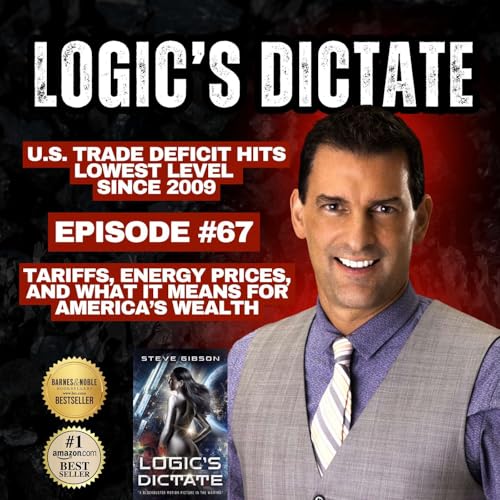
  • U.S. Trade Deficit Hits Lowest Level in Years — Tariffs, Energy Prices, and America’s Wealth
    Jan 11 2026

    In this episode of Logic Dictate Hot Topics, host Steve Gibson breaks down a major economic milestone: the U.S. trade deficit has fallen to its lowest level since 2009, according to The Wall Street Journal.

    Steve explains why reduced capital outflow strengthens national wealth, how tariff policy and a robust domestic economy are driving this shift, and why falling oil and gas prices are quietly easing inflation across the entire economy. He also explores how global pressures involving Venezuela, China, Russia, and Iran could shape U.S. economic advantages in 2026.

    This episode connects real-world economics with the deeper geopolitical themes explored in Logic’s Dictate, published by Mindstir Media.

    Welcome back to Logic Dictate Hot Topics. I’m Steve Gibson.

    Today we’re talking about something that doesn’t make headlines nearly as loudly as it should—but it matters enormously. The United States has just recorded its lowest monthly trade deficit since 2009. That’s not a talking point. That’s a structural shift in how wealth moves in and out of this country.

    When less money leaves the United States, the nation becomes wealthier—stronger—more resilient. And this change isn’t happening by accident. It’s being driven by tariff policy, economic engagement with global markets, and energy prices that are finally moving in the right direction.

    Lower oil and gas prices ripple through everything—transportation, manufacturing, consumer goods—and they reduce real inflation in ways most people never stop to consider.

    Today, we’ll break down why this matters, why it should be recognized across party lines, and how emerging global dynamics may continue to work in America’s favor in 2026.

    What if the most important economic story in America right now isn’t inflation—but where our money isn’t going anymore?

    The U.S. trade deficit just hit its lowest level since 2009, and that single fact may explain more about America’s economic future than any headline you’ve seen this week.

    You can explore the deeper philosophy behind today’s discussion in Logic’s Dictate, a sci-fi political thriller that examines power, economics, and global control through a provocative fictional lens.

    🔗 Learn more: https://www.logicsdictate.com
    📘 Read Logic’s Dictate for only $0.99: https://amzn.to/4oAo6AJ

    Mostra di più Mostra meno
    2 min
  • Why the “Donroe Doctrine” Weakens U.S. Foreign Policy
    Jan 10 2026

    In Episode 66 of Logic Dictate Hot Topics*, host *Steve Gibson breaks down why reviving a modernized version of the Monroe Doctrine—dubbed the “Donroe Doctrine”—is not only unnecessary, but strategically dangerous.

    From Cold War history and the Cuban Missile Crisis to modern flashpoints like China and Taiwan and Russia and Ukraine, Gibson explains how claiming spheres of influence invites adversaries to justify their own expansionist policies. Using Venezuela as a case study, he highlights why surgical, transactional foreign policy works better than sweeping ideological doctrines.

    This episode challenges conventional thinking on U.S. power, deterrence, and global security—and makes the case for precision over overreach.

    👉 Learn more through the sci-fi political thriller *Logic’s Dictate*, published by Mindstir Media
    🌐 https://www.logicsdictate.com
    📘 Read_Logic’s Dictate_for only $0.99: https://amzn.to/4oAo6AJ

    Welcome back to *Logic Dictate Hot Topics*, where we cut through political noise and examine global power through logic, strategy, and common sense.

    I’m *Steve Gibson*, and today we’re tackling a dangerous idea that’s quietly resurfacing in foreign policy circles—the so-called _Donroe Doctrine_. It’s being framed as a modern extension of the Monroe Doctrine, but in reality, it may be handing our geopolitical rivals a justification to do exactly what we’re trying to prevent.

    This episode isn’t about ideology. It’s about security, leverage, and knowing when not to overreach.

    If the United States claims the right to control its hemisphere…
    what stops China from claiming Taiwan?
    Or Russia from claiming Ukraine?

    Today, I’ll explain why reviving doctrines built on “spheres of influence” doesn’t strengthen American power—it weakens it. And why smart, surgical foreign policy beats sweeping declarations every time.

    Mostra di più Mostra meno
    3 min