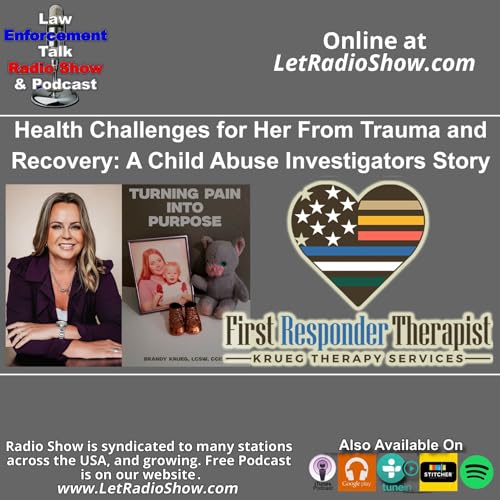
• Health Challenges for Her From Trauma and Recovery
    Jan 25 2026
    Health Challenges for Her From Trauma and Recovery: How One Child Abuse Investigator Turned Pain Into Purpose. For more than two decades, she stood on the front lines of child protection in California, investigating some of the most disturbing cases of abuse and neglect imaginable. As a seasoned Child Abuse Investigator, she bore witness to the darkest corners of humanity, stories most people never hear, and few could carry without consequence. The Law Enforcement Talk Radio Show and Podcast social media like their Facebook , Instagram , LinkedIn , Medium and other social media platforms. Those consequences eventually arrived. Check out Her Podcast appearance, and content shared for free on the Law Enforcement Talk Radio Show and Podcast website, also on Apple Podcasts, Spotify, YouTube and most major podcast platforms. In the final year of her investigative career, Brandy Krueg was diagnosed with PTSD. The diagnosis forced her to confront a truth she had long postponed: the emotional weight of trauma does not disappear simply because the job is done. Supporting articles about this and much more from Law Enforcement Talk Radio Show and Podcast in platforms like Medium , Blogspot and Linkedin . “I was trained to protect children, not myself,” Brandy has said. “For years, I believed strength meant pushing through. I didn’t realize how much I was carrying until my body and mind finally said, ‘Enough.’” Two Cases That Changed Everything Among the many investigations Brandy handled, two child abuse cases left an indelible mark on her mental health and recovery. One of those cases escalated into a devastating homicide, a tragedy that still echoes through her work today. Health Challenges for Her From Trauma and Recovery: How One Child Abuse Investigator Turned Pain Into Purpose. Available for free on the Law Enforcement Talk Radio Show and Podcast website, also on Apple Podcasts, Spotify, Youtube and most major Podcast networks. “When a case ends in murder, it doesn’t just close,” she explains. “It lives with you. You replay every decision, every report, every moment you wonder if something, anything, could have changed the outcome.” The emotional toll of repeated exposure to violence, abuse, and loss is well-documented among frontline professionals, yet often minimized. Brandy’s experience highlights the health challenges for her from trauma and recovery, a reality shared by many investigators, first responders, and healthcare workers who silently shoulder cumulative trauma. From Investigator to Therapist Following her PTSD diagnosis, Brandy made a life-altering transition. Today, she is a Licensed Clinical Social Worker (LCSW) and practicing therapist, specializing in trauma recovery for frontline professionals and their families. Look for The Law Enforcement Talk Radio Show and Podcast on social media like their Facebook , Instagram , LinkedIn , Medium and other social media platforms. Based in California, Brandy now helps others navigate the very terrain she once crossed alone. “Healing didn’t mean leaving my past behind,” she says. “It meant understanding it, and using it to help others survive theirs.” Health Challenges for Her From Trauma and Recovery. Her work as an in-house therapist with the Stockton Police Department places her alongside officers coping with stress, addiction, critical incidents, and cumulative trauma. Certified in First Responder Counseling, Critical Incident Stress Management (CCISM), and EMDR, Brandy delivers evidence-based care tailored to high-risk professions. A Childhood Marked by Abuse, and Survival Brandy’s professional journey cannot be separated from her personal story. Raised by a teenage mother battling bipolar disorder and addiction, her childhood was marked by instability, emotional neglect, violent outbursts, and repeated abuse by trusted family friends. Available for free on their website and streaming on Apple Podcasts, Spotify, Youtube and other podcast platforms. Her experiences reflect a painful reality often hidden behind closed doors, one that shapes both victims and the professionals who later serve them. “I didn’t just investigate abuse,” Brandy writes. “I understood it.” That understanding would later become the foundation of her memoir, Turning Pain Into Purpose. Turning Pain Into Purpose: A Memoir of Trauma and Redemption In Turning Pain Into Purpose, Brandy chronicles her journey from a childhood defined by abuse, to a career immersed in trauma, and finally to a life rooted in healing and advocacy. The book is unflinching, deeply human, and profoundly hopeful. Health Challenges for Her From Trauma and Recovery. The Law Enforcement Talk Radio Show and Podcast episode is available for free on their website , Apple Podcasts , Spotify and most major podcast platforms. As she navigates unimaginable loss, the death of loved ones, and her sister’s battle with addiction, Brandy becomes the protector she ...
    Mostra di più Mostra meno
    40 min
  • What Is Verbal Judo and Drug Interdiction for Police?
    Jan 21 2026
    What Is Verbal Judo and Drug Interdiction for Police? A Maryland State Perspective. In modern policing, success is not measured solely by arrests or seizures, but by how safely and professionally officers navigate high-stress encounters. Two critical tools continue to shape effective law enforcement across the United States: verbal judo and drug interdiction for police. Both rely heavily on observation, communication, and disciplined decision-making rather than force. Check out Jerimy Tindall's Podcast appearance, and content shared for free on the Law Enforcement Talk Radio Show and Podcast website, also on Apple Podcasts, Spotify, YouTube and most major podcast platforms. The Power of Verbal Judo in Policing Verbal judo for police is a tactical communication system developed by Dr. George Thompson, widely recognized as the father of the discipline. First introduced in his groundbreaking 1983 book, verbal judo teaches officers how to use words strategically to de-escalate conflict and gain voluntary compliance. The Law Enforcement Talk Radio Show and Podcast social media like their Facebook , Instagram , LinkedIn , Medium and other social media platforms. Rather than relying on aggressive commands, verbal judo emphasizes professionalism, empathy, and redirection. Officers are trained to ask purposeful questions, actively listen, and use respectful language to manage tense encounters. Supporting articles about this and much more from Law Enforcement Talk Radio Show and Podcast in platforms like Medium , Blogspot and Linkedin . “Verbal judo isn’t about winning an argument,” Dr. Thompson often explained. “It’s about achieving a peaceful resolution while maintaining officer safety and dignity for everyone involved.” What Is Verbal Judo and Drug Interdiction for Police? A Maryland State Perspective. Although Dr. Thompson passed away in 2001 at the age of 69, his teachings remain deeply influential. In recent years, police instructors have renewed their focus on tactical communication, blending scientific analysis with realistic training scenarios to prepare officers for the psychological stress of the job. A Maryland State Police Example Jerimy Tindall, a retired Maryland State Police Sergeant, offers a powerful real-world example of verbal judo in action. Early in his career, Tindall encountered a suicidal individual, an incident that could have easily turned violent. Available for free on the Law Enforcement Talk Radio Show and Podcast website, also on Apple Podcasts, Spotify, Youtube and most major Podcast networks. “I realized very quickly that force would only make things worse,” Tindall recalled. “What worked was slowing the situation down, listening, and choosing my words carefully.” Through calm dialogue and empathy, Tindall was able to de-escalate the situation without using force, a moment he credits directly to verbal judo training. He later retired early to focus on the growing demands placed on his family, but his lessons continue to resonate with officers today. Drug Interdiction for Police: More Than Traffic Stops In addition to his experience with tactical communication, Tindall also worked drug interdiction in Frederick, Maryland, a specialized area of policing focused on preventing illicit drugs from reaching their destination. What Is Verbal Judo and Drug Interdiction for Police? A Maryland State Perspective. Look for The Law Enforcement Talk Radio Show and Podcast on social media like their Facebook , Instagram , LinkedIn , Medium and other social media platforms. Drug interdiction often takes place during traffic stops, including pretextual stops. These are lawful stops initiated for a traffic violation but used to investigate unrelated criminal activity. The U.S. Supreme Court affirmed this practice in Whren v. United States, ruling that an officer’s motivation is irrelevant as long as probable cause exists for the traffic violation. “When you stop a vehicle, you’re observing everything,” Tindall said. “Body language, tone of voice, how someone reacts when they see police lights, it all tells a story.” Officers trained in drug interdiction learn to recognize behavioral indicators of stress that may suggest criminal activity. Sudden braking, furtive movements, inconsistent answers, or visible nervousness can all contribute to developing probable cause during a lawful stop. Observation, Communication, and Strategy Drug interdiction is rooted in constant observation and communication. Every driver responds differently to stress, and officers are trained to watch and listen closely. Communication extends beyond spoken words to include posture, gestures, and tone. Available for free on their website and streaming on Apple Podcasts, Spotify, Youtube and other podcast platforms. Beyond individual stops, agencies also rely on spatial optimization to deploy interdiction resources effectively. This strategic planning determines where officers, ...
    Mostra di più Mostra meno
    40 min
  • When Undercover Police Plans Go Bad
    Jan 18 2026
    When Undercover Police Plans Go Bad: From Virginia State Police to the ATF. The consequences can be immediate, violent, and life-altering. Few understand this reality better than Jennifer Clark Eskew, a retired ATF agent whose career began on the front lines as an undercover Virginia State Police trooper and later evolved into some of the most dangerous covert work in federal law enforcement. The Law Enforcement Talk Radio Show and Podcast on social media like their Facebook , Instagram , LinkedIn , Medium and other social media platforms. Eskew’s story is one of grit, calculated risk, and survival, one that continues to resonate across law enforcement circles and on platforms like the Law Enforcement Talk Radio Show and Podcast's Facebook, Instagram, LinkedIn, and beyond, where her experiences are discussed through interviews, her Podcast appearance, and content shared on their website, also on Apple Podcasts, Spotify, YouTube and most major podcast platforms. A Bad Day Undercover Jennifer Eskew’s undercover career started early, and it started hard. As a Virginia State Police trooper, she was selected for undercover work at a time when female officers were still rare, especially in deep-cover assignments. Supporting articles about this and much more from Law Enforcement Talk Radio Show and Podcast in platforms like Medium , Blogspot and Linkedin . One operation in particular would change everything. When Undercover Police Plans Go Bad: From Virginia State Police to the ATF. “It was just a really bad day,” Eskew has said of the moment when an undercover operation unraveled. “The gang I was dealing with started getting weird. The energy shifted.” Available for free on the Law Enforcement Talk Radio Show and Podcast website, also on Apple Podcasts, Spotify, Youtube and most major Podcast networks. Her backup was slow to respond. What Eskew didn’t yet know was that the very gang members she had been investigating had mistaken someone else for a rival. They shot and killed the wrong man, shooting him five times. “That’s when you realize how fast things can go sideways,” she later reflected. “You can plan everything perfectly, and it still falls apart.” The incident underscored a harsh truth of undercover policing: even when an officer survives, the psychological toll can be profound. Eventually, Eskew made the decision to leave the agency, not to step away from undercover work, but to continue it at a higher level. Look for The Law Enforcement Talk Radio Show and Podcast on social media like their Facebook , Instagram , LinkedIn , Medium and other social media platforms. From State Trooper to ATF Eskew transitioned to the Bureau of Alcohol, Tobacco, Firearms and Explosives (ATF), where her undercover experience made her a natural fit for high-risk federal investigations. At ATF, she went deeper than ever before, posing not just as a criminal associate, but at times as a contract killer. When Undercover Police Plans Go Bad: From Virginia State Police to the ATF. “She was essentially an undercover hitman,” one colleague noted. “Or hitwoman. She had to convince the worst people you can imagine that she was one of them.” Much like famed ATF undercover agent Jay Dobyns, Eskew infiltrated violent criminal organizations. Her role required adopting a persona capable of inspiring fear and trust at the same time, an impossible balance where a single misstep could mean death. Available for free on their website and streaming on Apple Podcasts, Spotify, Youtube and other podcast platforms. “In those moments,” Eskew has said, “you’re constantly asking yourself where the act ends and where Jennifer begins.” The Power and Risk of Female Undercover Officers Eskew’s career highlights why female undercover officers are uniquely valuable in law enforcement. Often perceived as non-threatening, women can exploit dangerous misconceptions held by criminals. “I could go into any bar, and I wouldn’t pose a threat,” Eskew explained. “I could get an enormous amount of information. They may look at me as a victim, but not as a threat, and that makes you incredibly valuable for UC work.” When Undercover Police Plans Go Bad: From Virginia State Police to the ATF. The Law Enforcement Talk Radio Show and Podcast episode is available for free on their website , Apple Podcasts , Spotify and most major podcast platforms. Female officers have proven especially effective in infiltrating drug rings, organized crime syndicates, and prostitution-related operations. As more women enter law enforcement, agencies are increasingly recognizing these tactical advantages. But the work comes with risks that male officers rarely face. “Overcoming sexual advances is a constant concern,” Eskew noted. Across the United States, there have been documented cases where female undercover officers were sexually assaulted during operations. These realities demand specialized training, ...
    Mostra di più Mostra meno
    40 min
  • Police, They Said It Could Not Be Done, Undercover With the Crips
    Jan 14 2026
    Police, They Said It Could Not Be Done, Undercover With the Crips in Texas. For years, many in law enforcement believed it was impossible. Crossing racial, cultural, and gang boundaries at the deepest level of a violent criminal organization was something most said simply could not be done. But one Texas police officer proved them all wrong. Available for free on the Law Enforcement Talk Radio Show and Podcast website, also on Apple Podcasts, Spotify, Youtube and most major Podcast networks. Tegan Broadwater, a veteran of the Fort Worth Police Department, spent nearly two years embedded in one of the most dangerous Crips gangs operating in Fort Worth, Texas. What began as skepticism, and even laughter from colleagues, turned into one of the most successful undercover investigations the department had ever seen. The Law Enforcement Talk Radio Show and Podcast on social media like their Facebook , Instagram , LinkedIn , Medium and other social media platforms. “They told me flat out that it wouldn’t work,” Broadwater later said. “That I wouldn’t blend in, wouldn’t be accepted, and wouldn’t survive long enough to make a case. I took that personally.” Supporting articles about this and much more from Law Enforcement Talk Radio Show and Podcast in platforms like Medium , Blogspot and Linkedin . A Mission Few Would Attempt Undercover work, also known as a covert or clandestine operation, requires an officer to assume a false identity, gain trust, and quietly gather intelligence without ever revealing who they truly are. Unlike plainclothes policing, undercover operations demand total immersion, deception, and constant vigilance. Broadwater’s assignment went even further. “There’s undercover, and then there’s deep cover,” he explained. “Deep cover means you live a separate life. You don’t visit it, you become it.” Police, They Said It Could Not Be Done, Undercover With the Crips in Texas. Look for The Law Enforcement Talk Radio Show and Podcast on social media like their Facebook , Instagram , LinkedIn , Medium and other social media platforms. His experience existed somewhere between traditional undercover work and deep cover. Pretending to be a high-end cocaine dealer, Broadwater infiltrated a violent Crips set responsible for drug trafficking, prostitution, and brutal violence that terrorized innocent residents. The risk was absolute. “If you’re discovered, there’s no arrest,” he said. “There’s no backup. There’s just consequences.” Two Years Inside the Fishbowl What followed was a high-stakes, real-life cat-and-mouse game between Broadwater and M.D., a calculated drug lord with a street-level MBA and sharp instincts. Broadwater earned trust, navigated betrayal, and lived daily with the psychological strain of maintaining his cover. “The stress doesn’t turn off,” he said. “You’re always acting, always watching, always measuring your words. Eventually, that pressure catches up to you.” Police, They Said It Could Not Be Done, Undercover With the Crips in Texas. Available for free on their website and streaming on Apple Podcasts, Spotify, Youtube and other podcast platforms. Over the course of the operation, Broadwater helped dismantle a major Crips network, leading to the arrest of 51 gang members. But the cost was high. The emotional toll of living among violent criminals, forming complex relationships, and witnessing generational cycles of crime ultimately led him to retire early from the Fort Worth Police Department. “I didn’t leave because I was weak,” Broadwater said. “I left because the work changes you. And I knew it was time to choose my family, my health, and my future.” From the Streets to the Page Broadwater documented his experience in his book, Life in the Fishbowl – The Harrowing True Story of One Cop Who Took Down 51 of the Nation’s Most Notorious Crips. The book is both an action-packed account of undercover policing and a deeply reflective examination of America’s War on Drugs, gang culture, and more. Police, They Said It Could Not Be Done, Undercover With the Crips in Texas. The Law Enforcement Talk Radio Show and Podcast episode is available for free on their website , Apple Podcasts , Spotify and most major podcast platforms. “All book profits are donated to charities that mentor children of incarcerated parents,” Broadwater noted. “If we want real change, we have to break the cycle before it starts.” The book has drawn praise from some of the most respected voices in law enforcement and beyond. “For me there’s no more compelling reading than books written by cops who can write,” said Mike Levine, NY Times bestselling author of Deep Cover. “This is must-reading for every cop in or out of uniform.” Former Apollo XVII Commander Gene Cernan called it “a gripping story of determination and courage,” while retired FBI Hostage Rescue Team Commander Danny O. Coulson described Broadwater as...
    Mostra di più Mostra meno
    41 min
  • FDNY Firefighter Experienced Severe Trauma
    Jan 11 2026
    FDNY Firefighter Experienced Severe Trauma: How Cooking Is His Salvation. For many first responders, the uniform becomes both a source of pride and a shield, one that often hides pain, grief, and trauma the public never sees. For this veteran FDNY firefighter and U.S. Air Force veteran, a lifetime of service came with losses so profound that few could endure them without lasting scars. The Law Enforcement Talk Radio Show and Podcast on social media like their Facebook , Instagram , LinkedIn , Medium and other social media platforms. He comes from a family of firefighters, a tradition rooted in courage and sacrifice. But his career began with tragedy. Early on, he lost his mother in a devastating house fire, an event that would forever shape his understanding of loss, duty, and survival. Available for free on the Law Enforcement Talk Radio Show and Podcast website, also on Apple Podcasts, Spotify, Youtube and most major Podcast networks. “That kind of loss never leaves you,” he has said. “You don’t just mourn your mother. You replay every ‘what if’ for the rest of your life.” Years later, tragedy struck again. His brother, Michael Bonanno, a retired FDNY firefighter, died by suicide in 2012. The loss exposed the unspoken mental health crisis that continues to affect firefighters and other first responders across the country. Supporting articles about this and much more from Law Enforcement Talk Radio Show and Podcast in platforms like Medium , Blogspot and Linkedin . “We’re trained to run toward danger,” he explained, “but we’re not trained to talk about what that danger does to us afterward.” FDNY Firefighter Experienced Severe Trauma: How Cooking Is His Salvation. As if those personal losses were not enough, his career culminated at one of the darkest chapters in American history, working at Ground Zero during the 9/11 attacks in New York City. The physical danger was immediate, but the emotional toll would last decades. “You don’t leave the pile unchanged,” he said. “You carry those images, those smells, those sounds. They stay with you.” How Cooking Became His Salvation Like many firefighters, he struggled in silence. Trauma accumulated quietly, from the firehouse to family life, from loss to loss. But unexpectedly, healing began not in therapy rooms or training halls, but in the kitchen. Look for The Law Enforcement Talk Radio Show and Podcast on social media like their Facebook , Instagram , LinkedIn , Medium and other social media platforms. Cooking became his refuge. “In the kitchen, I could focus,” he said. “It grounded me. Cooking gave me something positive to build when everything else felt broken.” FDNY Firefighter Experienced Severe Trauma: How Cooking Is His Salvation. What started as a personal coping mechanism evolved into a mission. He began writing and speaking openly about the connection between food, firehouse culture, and mental health. Today, he is not only a firefighter and USAF veteran but also a podcaster, author, and advocate for recovery through creativity and connection. Available for free on their website and streaming on Apple Podcasts, Spotify, Youtube and other podcast platforms. From Firehouse to Media Platforms His work now reaches audiences through the Law Enforcement Talk Radio Show and Podcast,their facebook, Instagram, YouTube and other News and Social media outlets. His voice has resonated with firefighters, veterans, and civilians alike, especially those searching for ways to recover from trauma they’ve never been encouraged to discuss. “Food brings people together,” he explained. “Around the table, walls come down. Conversations happen that wouldn’t happen anywhere else.” FDNY Firefighter Experienced Severe Trauma: How Cooking Is His Salvation. The Law Enforcement Talk Radio Show and Podcast episode is available for free on their website , Apple Podcasts , Spotify and most major podcast platforms. He is the founder of American Firehouse Cuisine, a platform dedicated to firehouse cooking and culture. His recently published cookbook, American Firehouse Cuisine, celebrates the meals that fuel firefighters while honoring the traditions that bind them together. Previously, he authored The Healthy Firehouse Cookbook and The Firehouse Grilling Cookbook, blending nutrition with the realities of firehouse life. He also wrote a children’s storybook, Monutza the Firefighting Elephant, aimed at helping young readers understand bravery, service, and compassion. More information about his work can be found at his website, see below, and his content is available on the Law Enforcement Talk Radio Show and Podcast website also on Apple Podcasts, Spotify, Youtube and other major platforms. A Message of Recovery and Hope Today, his story stands as a powerful example of resilience. An FDNY firefighter experienced severe trauma, losing family, enduring historic catastrophe, and facing the silent burden ...
    Mostra di più Mostra meno
    41 min
  • Police Officer Arrested and Convicted, Sent to Prison, Was It Fair?
    Jan 7 2026
    Police Officer Arrested and Convicted, Sent to Prison, Was It Fair?. The Case of Stephanie Mohr. Was a police officer unfairly prosecuted and sent to prison by the Department of Justice? That question sits at the center of a Special Episode available for free on the Law Enforcement Talk Radio Show and Podcast website, also on Apple Podcasts, Spotify, Youtube and most major Podcast networks. Former Prince George’s County, Maryland police officer and K9 handler Stephanie Mohr is telling her story, one that spans nearly three decades, from a routine call for backup outside Washington, D.C., to a federal conviction, a 10-year prison sentence, and ultimately a Presidential Pardon. The Law Enforcement Talk Radio Show and Podcast on social media like their Facebook , Instagram , LinkedIn , Medium and other social media platforms. “This was never just about one incident,” Mohr says. “It became about making an example of me.” A Routine Call That Changed Everything In 1995, Mohr was a relatively new K9 handler when she responded to a suspected burglary in Takoma Park, Maryland. At the time, the area was experiencing a series of break-ins. Two suspects were discovered on the roof of a building, and during the arrest, Mohr’s police dog bit one of the men as he attempted to flee. Police Officer Arrested and Convicted, Sent to Prison, Was It Fair? Supporting articles about this and much more from Law Enforcement Talk Radio Show and Podcast in platforms like Medium , Blogspot and Linkedin . What followed was anything but routine. Years later, Mohr was charged and ultimately convicted in 2001 of a federal civil rights violation, becoming a police officer arrested and convicted, sent to prison for actions she maintains were lawful and consistent with her training. “I did what I was trained to do,” Mohr explains. “I never imagined it would cost me my career and a decade of my life.” An Extraordinary Prosecution According to Mohr and her supporters, the D.O.J. pursued her case with unusual intensity. After an initial trial, prosecutors sought a retrial and even brought a witness, an illegal immigrant, back into the United States from another country to testify against her. Police Officer Arrested and Convicted, Sent to Prison, Was It Fair? Look for The Law Enforcement Talk Radio Show and Podcast on social media like their Facebook , Instagram , LinkedIn , Medium and other social media platforms. “Who does that?” Mohr asks. “It felt like they were determined to secure a conviction at any cost.” During the second trial, federal prosecutors introduced testimony portraying Mohr as a problematic officer with a pattern of targeting minorities, claims she has consistently denied. “That narrative was devastating,” she says. “It wasn’t true, but it stuck.” The result was a 10-year federal prison sentence, which Mohr served before being released in 2011. A 19-Year Fight for Justice Mohr’s case eventually caught the attention of the Law Enforcement Legal Defense Fund (LELDF). After reviewing the facts, the organization committed to what would become a 19-year battle to clear her name. Police Officer Arrested and Convicted, Sent to Prison, Was It Fair? Special Episode. Available for free on their website and streaming on Apple Podcasts, Spotify, Youtube and other podcast platforms. “Stephanie wasn’t guilty of anything,” the LELDF later stated. “Her case represented a dangerous precedent for law enforcement officers nationwide.” Mohr became the first police officer supported by the LELDF to ultimately receive a presidential pardon. In December 2020, President Donald J. Trump granted Mohr a full and unconditional pardon, bringing long-awaited closure to a case that had followed her for 25 years. “For me, the pardon wasn’t about politics,” Mohr says. “It was about finally being able to say: I was telling the truth.” The Law Enforcement Talk Radio Show and Podcast episode is available for free on their website , Apple Podcasts , Spotify and most major podcast platforms. Life After Prison and After the Pardon Following her release, Mohr rebuilt her life quietly. She worked as a Property Standards Inspector and later a Construction Standards Inspector for Prince George’s County before moving on to a similar role with St. Mary’s County government. Police Officer Arrested and Convicted, Sent to Prison, Was It Fair? “My dogs saved me as much as I saved them,” she says with a smile. You Be the Judge The story of Stephanie Mohr raises difficult questions about accountability, prosecutorial power, and whether justice was truly served. The special episode can be found on The Law Enforcement Talk Radio Show and Podcast website, on Apple podcasts, Spotify, Youtube and on LinkedIn, Facebook, Instagram, and across most podcast platforms where listeners will find authentic law enforcement stories. Was this a fair conviction, or did the D.O.J. go out of its way to ...
    Mostra di più Mostra meno
    38 min
  • Did Fentanyl Almost Kill a Cop?
    Jan 4 2026
    Did Fentanyl Almost Kill a Cop? One Deputy’s Story of Trauma, Survival, and a Mission to Help Others. Special Episode. For years, fentanyl has dominated headlines as a driving force behind America’s overdose crisis. What’s discussed far less often is how this drug impacts the first responders who encounter it in the line of duty. For Deputy Jeff Brown, a long-serving law enforcement officer, accidental fentanyl exposure didn’t just spark a frightening moment, it caused permanent injuries, ongoing trauma, and a new mission focused on helping others. The Law Enforcement Talk Radio Show and Podcast on social media like their Facebook , Instagram , LinkedIn , Medium and other social media platforms. By any measure, Jeff Brown is a law enforcement hero. But one accidental fentanyl exposure nearly ended his life, and forever changed it. This special episode is streaming for free on the Law Enforcement Talk Radio Show and Podcast website, on Apple Podcasts, Spotify, YouTube, and most every major Podcast platform This is not just a story for the news-cycle. It’s a story meant to be shared on Facebook, Instagram, YouTube, and across platforms like the Law Enforcement Talk Radio Show and Podcast website, Apple Podcasts and Spotify, because it speaks to the hidden cost of service, the reality of trauma, stress, PTSD, and the lasting injuries many heroes carry long after the call ends. Supporting articles about this and much more from Law Enforcement Talk Radio Show and Podcast in platforms like Medium , Blogspot and Linkedin . Accidental Fentanyl Exposure Almost Claimed His Life Jeff Brown had built a distinguished law enforcement career when one routine encounter with drug abusers turned into a life-threatening emergency. During the incident, Jeff and his backup deputies were accidentally exposed to fentanyl. The effects were immediate and terrifying. Had it not been for department-issued Narcan and the training the deputies received, Jeff believes he and others would not have survived. In a matter of minutes, deputies were forced to save each other’s lives. Did Fentanyl Almost Kill a Cop? One Deputy’s Story of Trauma, Survival, and a Mission to Help Others. Special Episode. Look for The Law Enforcement Talk Radio Show and Podcast on social media like their Facebook , Instagram , LinkedIn , Medium and other social media platforms. They lived, but not without consequence. For Jeff, the exposure caused permanent damage to his heart, altering his health and his future. What should have been just another shift became the defining moment of his life. The Aftermath: Injuries, Recovery, and a Broken System Surviving the incident was only the beginning. Jeff openly talks about: The physical recovery and lingering medical issues The emotional toll and ongoing stress Battles with Worker’s Compensation The lack of understanding surrounding first responder injuries The rarely discussed crime problem in a tourist-driven resort area Like many first responders, Jeff learned that surviving the job does not guarantee support afterward. The system often struggles to recognize invisible injuries, especially when fear, misinformation, and stigma surround incidents involving fentanyl. Did Fentanyl Almost Kill a Cop? One Deputy’s Story of Trauma, Survival, and a Mission to Help Others. Special Episode. Available for free on their website and streaming on Apple Podcasts, Spotify, Youtube and other podcast platforms. Fentanyl Misinformation and First Responder Trauma In 2016, the U.S. Drug Enforcement Administration (DEA) released advisories warning that simply touching or inhaling fentanyl could be fatal within minutes. Images of tiny, allegedly lethal doses circulated widely, reinforcing fear among first responders. At the time, the narrative felt plausible. Illicit fentanyl was flooding the streets, and officers had limited information. Later, medical experts, including the American College of Medical Toxicology and the American Academy of Clinical Toxicology clarified that incidental exposure leading to overdose is extremely unlikely. Other countries adjusted their guidance accordingly. Special Episode. The Law Enforcement Talk Radio Show and Podcast episode is available for free on their website , Apple Podcasts , Spotify and most major podcast platforms. But misinformation lingers, and it carries consequences. Officers who believe they’ve been exposed can experience panic attacks, hyperventilation, vertigo, and racing heart rates. These symptoms are real and distressing, yet often misinterpreted as fentanyl toxicity. In a culture where fear is seen as weakness, these events can go under-reported or misdiagnosed, potentially leading to delayed or inappropriate medical care. We stand by this critical point: Accidental fentanyl exposure can have drastic effects when combined with preexisting health conditions, particularly involving the heart. These incidents deserve serious, compassionate, and ...
    Mostra di più Mostra meno
    37 min
  • Police in a Riot: An Officer Speaks. Special Episode.
    Dec 31 2025
    Police in a Riot: An Officer Speaks. Special Episode. Riots are something most people only see through the lens of a television screen or a viral clip on social media. Flames in the background. Police lines in riot gear. Shouting crowds. What rarely makes it into the headlines is what it feels like to stand in the middle of that chaos, especially when you’re a young police officer with only weeks of experience on the street. This special episode is streaming for free on the Law Enforcement Talk Radio Show and Podcast website, on Apple Podcasts, Spotify, YouTube, and most every major Podcast platform In this special episode, former Charlotte, North Carolina police officer Bill Broadway takes listeners inside the harsh realities of policing during violent riots. His account is raw, detailed, and deeply unsettling, not because it’s political, but because it’s personal. Look for The Law Enforcement Talk Radio Show and Podcast on social media like their Facebook , Instagram , LinkedIn , Medium and other social media platforms. Thrown Into the Fire Bill Broadway was just weeks out of field training when he was suddenly called into action to help control violent riots in Charlotte. Like many young officers, he expected to learn policing step by step, traffic stops, calls for service, building rapport with the community. Instead, he found himself facing crowds that were no longer protesting, but actively engaging in violence. Police in a Riot: An Officer Speaks. Special Episode. Supporting articles about this and much more from Law Enforcement Talk Radio Show and Podcast in platforms like Medium , Blogspot and Linkedin . “These weren’t peaceful demonstrations,” Bill explains. “This was chaos.” From the moment he arrived, it was clear this was something different. Police vehicles were targeted and removed. Officers were surrounded. Projectiles were thrown. Every decision carried the risk of serious injury, or worse. Police in a Riot: An Officer Speaks. Special Episode. Protest vs. Riot: A Critical Distinction Much of the public conversation blurs the line between protest and riot, but legally and practically, the difference matters. Generally speaking, a protest is an organized public demonstration of disapproval, often protected under the First Amendment. A riot, by contrast, is defined as a violent disturbance of the peace involving multiple people acting together in a way that threatens public safety. Police in a Riot: An Officer Speaks. Special Episode. Available for free on their website and streaming on Apple Podcasts, Spotify, Youtube and other podcast platforms. Federal law, under the Anti-Riot Act of 1968, defines a riot as a public disturbance involving acts of violence by an assemblage of three or more people that create a clear and present danger to people or property. Many states, including North Carolina, enforce similar statutes through laws addressing arson, looting, assault, unlawful assembly, and destruction of property. As Bill describes it, the moment objects started flying and officers became targets, the situation crossed that line. “When violence starts, it’s no longer a protest,” he says. “It’s something else entirely.” Injuries, Fear, and Constant Threats Bill walks listeners through every phase of the riot, from his initial arrival, to the loss of police vehicles, to the injuries sustained by officers on the line. What stands out most is the constant psychological pressure. Police in a Riot: An Officer Speaks. Special Episode. The Law Enforcement Talk Radio Show and Podcast episode is available for free on their website , Apple Podcasts , Spotify and most major podcast platforms. “You don’t just worry about what’s in front of you,” Bill explains. “You’re watching rooftops, alleys, shadows. You’re wondering if the next hit is coming from behind.” The stress didn’t end when the shift was over. Officers went home bruised, exhausted, and emotionally drained, knowing they could be called back at any moment. For many, sleep was elusive. The adrenaline lingered. The fear stayed close. Optics vs. Officer Safety One of the most controversial topics addressed is the allegation that department leadership and city officials were more concerned with optics and public opinion than with the truth, or the safety of their officers. This is not a new accusation in American policing, and it remains a deeply divisive issue. Critics argue that police departments often prioritize public relations to manage perception, reduce backlash, and limit legal exposure. The use of Public Information Officers and carefully worded statements can sometimes feel, to officers on the ground, like a disconnect from reality. Police in a Riot: An Officer Speaks. Special Episode. The special episode can be found on The Law Enforcement Talk Radio Show and Podcast website, on Apple podcasts, Spotify, Youtube and on LinkedIn, Facebook, Instagram, and across most podcast ...
    Mostra di più Mostra meno
    37 min