• US Imperialism and Cuban Development w/ Andrew Smolski
    Jul 3 2026

    Alexander Scott speaks with rural sociologist Andrew Smolski about U.S. imperialism and the long history of empire in Cuban development. Drawing on Smolski's archival research and his work on Cuban agriculture, the conversation traces how imperialism has shaped Cuba's capacity to develop across five centuries — from Spanish colonialism, the Haitian Revolution, and the rise of the sugar-slavery complex, through U.S. occupation and the Platt Amendment era, to a blockade now in its seventh decade — and asks what it would mean for development research to treat imperialism as a condition of development rather than mere background.

    Andrew Smolski is an assistant professor of rural sociology in the Department of Agricultural Economics, Sociology, and Education at The Pennsylvania State University, and a member of the Latin American Perspectives editorial collective.

    Further reading from our guest:

    "Interrogating Structural Conditions for Agricultural Production: A Comparative-Historical Study of Cuban Incorporation, Delinking, and Exile," Journal of World-Systems Research 28(2), 2022 (open access):
    https://jwsr.pitt.edu/ojs/jwsr/article/view/1117

    The Agrarian Question as an Ecological Question in Latin America, special issue of Latin American Perspectives (January 2024), co-edited with Daniela García Grandón and Joana Salém Vasconcelos:
    https://journals.sagepub.com/doi/10.1177/0094582X241252111

    Violence, Capital Accumulation, and Resistance in Contemporary Latin America, special issue of Latin American Perspectives (January 2021), co-edited with Matthew Lorenzen:
    https://doi.org/10.1177/0094582X20975005

    "Class Struggle and Violence in Latin American Cities," Latin American Perspectives 48(1):
    https://journals.sagepub.com/doi/10.1177/0094582X19860470

    For more information about Latin American Perspectives, our podcasts, and guests, please contact lap.outreach@gmail.com.

    Listen now on Spotify, Apple Podcasts, YouTube, or your preferred listening platform.

    Mostra di più Mostra meno
    1 ora e 21 min
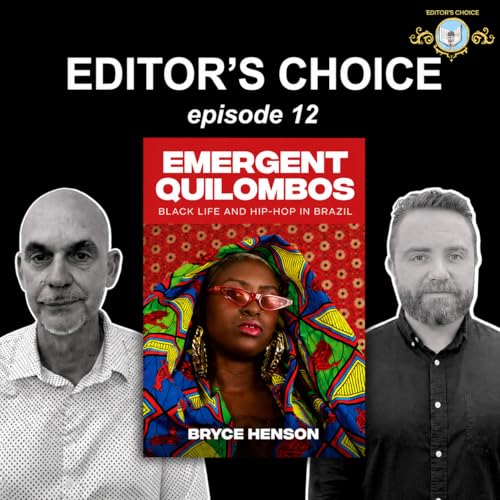
  • Editor's Choice Ep. 12: Emergent Quilombos: Black Life and Hip-Hop in Brazil w/ Bryce Henson
    May 13 2026

    Bryce Henson joins the pod to discuss his book Emergent Quilombos: Black Life and Hip Hop in Brazil (University of Texas Press, 2023). Drawing on ethnographic research in Salvador da Bahia, Henson explores Brazilian hip hop as a diasporic cultural and political movement rooted in Black radical traditions, anti-racist struggle, and collective community formation. Throughout the conversation, the group discusses the historical significance of quilombos in Brazil, the relationship between Blackness and political struggle, the role of hip hop as a form of "quilombismo," and the intersections of race, class, gender, and diaspora in contemporary Brazil.

    Bryce Henson is Associate Professor in the Department of Communication and Journalism at Texas A&M University, with affiliations in Africana Studies and the Race and Ethnic Studies Institute. He is also an affiliated researcher with the Pós-Afro Program at the Universidade Federal da Bahia and serves as Associate Editor for Transforming Anthropology.

    Emergent Quilombos: Black Life and Hip Hop in Brazil can be purchased here: https://utpress.utexas.edu/9781477327986/

    Spotify Playlist Curated by Bryce Henson:

    https://open.spotify.com/playlist/3KnR3IBULZ9aAesr8pY3Ov?si=wp_fX5SwSnigAXai5nWT6Q

    Subscribe to Latin American Perspectives

    A journal for discussion and debate on the political economy of capitalism, imperialism, and socialism in the Americas.

    https://latinamericanperspectives.com/

    Mostra di più Mostra meno
    57 min
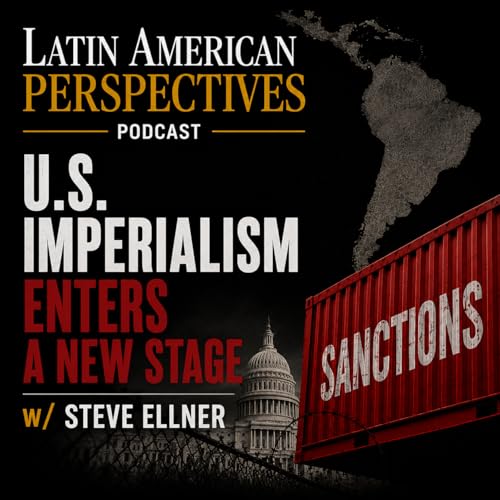
  • U.S. Imperialism Enters a New Stage w/ Steve Ellner
    May 8 2026

    In this episode of the Latin American Perspectives Podcast, Alexander Scott speaks with historian and political scientist Steve Ellner about the changing nature of U.S. imperialism and the escalating political crisis in Venezuela.

    Drawing on Ellner's recent work, the conversation examines sanctions, economic warfare, "hyper-imperialism," the Venezuelan opposition, and the broader geopolitical tensions shaping Latin America today.

    Topics discussed include:

    • Sanctions as a form of warfare
    • Economic coercion and financial blockades
    • U.S. policy toward Venezuela
    • María Corina Machado and the Venezuelan far right
    • Debates on the left surrounding anti-imperialism and democracy
    • The global implications of a new phase of U.S. power

    Steve Ellner is a historian and political scientist who taught for over two decades at the Universidad de Oriente in Venezuela. He is Associate Managing Editor of Latin American Perspectives and the author of numerous books and articles on Venezuelan politics, the Latin American left, and the Chávez era.

    Further Reading from Steve Ellner
    • CounterPunch — "U.S. Imperialism Enters a New Stage"
      https://www.counterpunch.org/2026/04/21/u-s-imperialism-enters-a-new-stage/
    • Jacobin — "Trump, Latin America, and the Left Opposition"
      https://jacobin.com/2025/11/trump-latin-america-left-opposition
    • Venezuelanalysis Author Page
      https://venezuelanalysis.com/guest-author/steve-ellner/
    • Venezuela Solidarity Network — María Corina Machado & Venezuela
      https://www.venezuelasolidaritynetwork.org/mcm_venezuela

    Mostra di più Mostra meno
    1 ora e 13 min
  • Political Ecology, Gender, and the Environment in Latin America con Mayarí Castillo
    Apr 30 2026

    En este episodio del podcast de Latin American Perspectives, conversamos con Mayarí Castillo, socióloga de la Universidad Mayor y coeditora del número de enero de 2026, sobre los principales ejes que estructuran este nuevo dossier.

    A lo largo de la conversación, abordamos la ecología política como un marco para comprender la relación entre sociedad, naturaleza y poder en América Latina, y exploramos las raíces históricas de los conflictos socioambientales contemporáneos—desde el colonialismo y la formación de los Estados hasta el extractivismo y las crisis climáticas actuales. También discutimos el papel central del género y de la ecología política feminista para repensar cómo estas luchas se viven, se disputan y se transforman.

    Este episodio ofrece una puerta de entrada accesible al número, al tiempo que destaca su relevancia para entender las dinámicas actuales de desigualdad, territorio y conflicto ambiental en la región.

    🎧 Escucha el episodio
    📖 Explora el número de enero de 2026 aquí: https://journals.sagepub.com/toc/lapa/53/1

    Mostra di più Mostra meno
    37 min
  • Amazon Rainforest and Socio-Ecological Alternatives in Latin America w/ Claudia Horn
    Apr 23 2026

    LAP coordinating editor Claudia Horn (King's College London) joins the pod to discuss the September 2025 issue: Amazon Rainforest and Socio-Ecological Alternatives in Latin America.

    What is the Amazon—and how should we understand it beyond dominant environmental, state-centered, or extractivist narratives? Our conversation explores the concept of multiplicity as a way of rethinking the Amazon as a space of diverse social worlds, political struggles, and ways of life. We also examine the forces threatening these worlds, while highlighting the forms of resistance, collective action, and alternative socio-ecological futures emerging across the region.

    Drawing on contributions from across the issue, this episode situates the Amazon within broader debates on global capitalism, environmental crisis, and the possibilities for more just and sustainable futures.

    Access the issue here: https://journals.sagepub.com/toc/lapa/52/5?_gl=1*2tnc8d*_up*MQ..*_ga*MTU2OTAyODIzMi4xNzc3MDQwMjQ4*_ga_60R758KFDG*czE3NzcwNDAyNDckbzEkZzEkdDE3NzcwNDAyNTckajUwJGwwJGg2Mjg3NzUxMjA.

    For additional information about contacting the journal, podcast host, or guests, please contact latampodcasts@gmail.com

    Mostra di più Mostra meno
    47 min
  • Editor's Choice Ep. 11 (Part 2): Dependency and Crisis in Brazil and Argentina w/ Felipe Antunes de Oliveira
    Feb 22 2026

    Part 2 of our interview with Felipe Antunes de Oliveira on his recent book Dependency and Crisis in Brazil and Argentina: A Critique of Market and State Utopias (2024).

    In this timely and theoretically rigorous work, Antunes de Oliveira examines why the two largest countries in South America fail to materialize the development they continually promise to achieve. Instead of approaching the topic from a policy-failure perspective, he focuses on what public debates reveal about "development" itself. Building on this, Antunes de Oliveira offers a theoretical and empirical critique of neoliberal and neodevelopmentalist ideas surrounding cycles of structural reform in Brazil and Argentina, drawing on dependency theory to propose an alternative political economic framework for analyzing development challenges.

    Felipe Antunes de Oliveira is a senior lecturer in International Relations at Queen Mary University of London and a coordinating editor at Latin American Perspectives. Outside the academy, he has served as a diplomat for the Brazilian Ministry of Foreign Affairs, as General Coordinator of International Financial Affairs at the Brazilian Ministry of Finance in 2024, and, since December 2024, as an Alternate Executive Director at the International Monetary Fund.

    Dependency and Crisis in Brazil and Argentina is available for purchase through the University of Pittsburgh Press: https://upittpress.org/books/9780822948100/

    For more information about Latin American Perspectives, our podcasts, and guests, please contact latampodcasts@gmail.com

    Mostra di più Mostra meno
    57 min
  • Editor's Choice Ep. 11: Dependency and Crisis in Brazil and Argentina w/ Felipe Antunes de Oliveira (Part 1)
    Dec 19 2025

    In this special two-part edition of Editors' Choice, Felipe Antunes de Oliveira, joins us to discuss his recent book Dependency and Crisis in Brazil and Argentina: A Critique of Market and State Utopias (2024).

    In this timely and theoretically rigorous work, Antunes de Oliveira examines why the two largest countries in South America fail to materialize the development they continually promise to achieve. Instead of approaching the topic from a policy-failure perspective, he focuses on what public debates reveal about "development" itself. Building on this, Antunes de Oliveira offers a theoretical and empirical critique of neoliberal and neodevelopmentalist ideas surrounding cycles of structural reform in Brazil and Argentina, drawing on dependency theory to propose an alternative political economic framework for analyzing development challenges.

    Felipe Antunes de Oliveira is a senior lecturer in International Relations at Queen Mary University of London and a coordinating editor at Latin American Perspectives. Outside the academy, he has served as a diplomat for the Brazilian Ministry of Foreign Affairs, as General Coordinator of International Financial Affairs at the Brazilian Ministry of Finance in 2024, and, since December 2024, as an Alternate Executive Director at the International Monetary Fund.

    Dependency and Crisis in Brazil and Argentina is available for purchase through the University of Pittsburgh Press: https://upittpress.org/books/9780822948100/

    For more information about Latin American Perspectives, our podcasts, and guests, please contact latampodcasts@gmail.com

    Mostra di più Mostra meno
    54 min
  • Editor's Choice Ep. 10: Una historia del cine documental argentino con Javier Campo
    Nov 3 2025

    En este episodio, conversamos con Javier Campo, editor de Una historia del cine documental argentino: Tomo 1 (1896–1989) y Tomo 2 (1990-2024), publicados por Prometeo Editorial. La charla recorre la evolución del cine documental argentino desde la era del cine mudo hasta los años de la dictadura y la transición democrática, mostrando cómo distintos realizadores han utilizado el documental para abordar temas de memoria, resistencia y activismo.

    Javier Campo reflexiona sobre el proceso de investigación y edición detrás de este ambicioso proyecto histórico, y sobre el papel fundamental que el cine documental ha desempeñado en la vida política y cultural de la Argentina. También analizamos la relevancia de este género para comprender las luchas más amplias en América Latina en torno a la historia, la representación y la política de la imagen.

    Javier Campo es investigador del CONICET especializado en el cine documental argentino. Es autor de Revolución y Democracia: El cine documental argentino del exilio y Jorge Prelorán: Cineasta de las culturas populares argentinas, y editor de A Trail of Fire for Political Cinema: The Hour of the Furnaces Fifty Years Later. Actualmente es presidente de la Asociación Argentina de Estudios de Cine y Audiovisual (AsAECA).

    Encuentra Una historia del cine documental argentino: Tomo 1 (1896–1989) y Tomo 2 (1990-2024) en Prometeo Editorial.

    Mostra di più Mostra meno
    55 min