Episodi

  • EP 76: Dashboards Are Wrong in the Background. AI Is Wrong in Your Face | Barr Moses, Monte Carlo
    Sep 16 2026

    This episode was recorded live from the Ai4 conference podcast pavilion, where host Mac Goswami sat down with Barr Moses — CEO & co-founder of Monte Carlo, creator of the data observability category and now builder of the agent trust platform — about what it actually takes to make AI trustworthy in production.

    What's Covered:

    "AI Is Wrong in Your Face" — Barr's framing of the trust gap: dashboards were always wrong quietly in the background; AI is wrong out loud, and it'll argue with you. Why trust is the biggest thing standing between pilots and production.

    The Four Layers of Agent Failure — Context, performance, behavior, and output. Why all four can look perfect and the agent still fails — and why you have to watch all of them together.

    The Flight That Already Left — The airline agent that recommended a flight that departed that morning. The agent was fine; the context was stale. The most surprising failure mode nobody plans for.

    Where to Start — Make ONE agent great, not a hundred. And why the hardest first step is simply defining what "good" even looks like.

    The Reinforcement Loop — The idea Barr's most excited about: agents that self-identify what went wrong, propose a fix, submit a PR for human approval, and use it as tomorrow's baseline. Agents that rebuild themselves every day — running in production today.

    100% AI-First — Why every line of Monte Carlo's code is AI-generated, how it made them 3–5x faster, and Barr's stoplight analogy for where human-in-the-loop is heading.

    Key Quote: "Dashboards are wrong in the background. AI is wrong in your face — it'll argue with you."

    Connect with Barr: LinkedIn: Barr Moses : https://www.linkedin.com/in/barrmoses/

    Monte Carlo: https://www.montecarlo.ai

    Follow and subscribe to AsembleAI: Spotify | Apple Podcasts | Amazon Music | iHeart Radio | YouTube | Substack

    Mostra di più Mostra meno
    27 min
  • EP 75: Inside the AI Control Plane: Governance, Guardrails, and Model Routing | Sean Lynch, ActualyzeAI
    Sep 15 2026

    ActualyzeAI came out of stealth just days before this conversation. Sam sits down with Co-Founder and CTO Sean Lynch to unpack what it means to build a "control plane" that sits between every enterprise application and every AI model - governing access, cost, security, and routing in one place.

    Topics covered:

    • What a control plane for enterprise AI actually does, and why it requires zero code changes to adopt
    • Aggregating inference across OpenAI, Anthropic, Google Bedrock, and self-hosted/on-premises models into a single endpoint
    • "Virtual models" — purpose-built model configurations that route requests based on task type (coding, reasoning, agentic work)
    • Guardrails: automatic detection and redaction of PII, PHI, API keys, and other sensitive data in the inference stream
    • Financial operations as the leading driver of adoption — budgetary controls, spend limits, and team-based tracking
    • The coming wave of domestic and open-weight small language models, and why that's expanding the market
    • Why model-agnostic infrastructure is critical as the foundation model landscape fragments
    • How ActualyzeAI's founding team (formerly of Metacloud, acquired by Cisco) shaped their approach
    • ActualyzeAI's design partner program for early enterprise customers

    Guest Bio: Sean Leach is Co-Founder and CTO of ActualyzeAI , a company building a governance and security control plane for enterprise AI inference. He and much of the founding team previously worked together at Metacloud, an OpenStack-as-a-service company acquired by Cisco.

    Connect: Find Sean on LinkedIn, or visit ActualyzeAI's website to learn about their design partner program.

    Mostra di più Mostra meno
    21 min
  • EP 74: The AI Agent That Actually Fixes IT Tickets — Not Just Chats About Them | Oshri Moyal, Atera
    Sep 14 2026

    This episode was recorded live from the Ai4 conference podcast pavilion, where host Mac Goswami sat down with Oshri Moyal — CTO & co-founder of Atera, the autonomous IT platform whose agent Robin recently ranked #1 across 15 G2 Summer 2026 reports — about what genuinely autonomous IT actually looks like.

    What's Covered:

    AI That Fixes, Not Just Chats — Why Robin isn't another chatbot. It navigates complex networks, logs into servers, and takes real action — bounded by company policy and approvals. Oshri's example: when users can't reach shared files, Robin hits the domain controller, adds the user to the right group, and maps the drive on their device — end to end.

    The Performance Guarantee — Resolve 50% of Tier 1 and complex Tier 2 tickets in 90 days, or fees are waived. Why Atera can stand behind that after two years in production.

    Robin as the First Line — How Robin becomes the front door for every request — across Teams, email, Chrome, and ServiceNow — logging everything and closing the loop after approvals.

    "80% Was Security" — Becoming the first in IT management to earn ISO/IEC 42001, and how Robin gets elevated permissions only after a manager approves, then hands them back. As Oshri puts it, "80% of the project was about security, privacy, and safety."

    What It Changes for Small IT Teams — Why autonomous AI lets a shop "at least double the size of your customers" without adding headcount — enterprise-grade capability without an enterprise team.

    Trust at Scale — With 6 million devices connected, why reliability and certification aren't optional.

    Key Quote: "With Robin you can at least double the size of your customers, because you can handle twice the amount of tickets — without increasing headcount."

    Connect with Oshri: LinkedIn: Oshri Moyal : https://www.linkedin.com/in/oshr1/

    Atera: https://www.atera.com/

    Follow and subscribe to AsembleAI: Spotify | Apple Podcasts | Amazon Music | iHeart Radio | YouTube | Substack

    Mostra di più Mostra meno
    14 min
  • EP 73: A Teenager Could Now Run a Nation-State Attack — Insider Risk in the AI Era | Rajan Koo, DTEX
    Sep 14 2026

    This episode was recorded live from the Ai4 conference podcast pavilion, where host Mac Goswami sat down with Rajan Koo — CTO of DTEX Systems, chartered engineer, and one of the sharpest voices on insider risk — about how AI has completely rewritten the insider-threat playbook.

    What's Covered:

    WikiLeaks Without a Human — Insider risk was transformed by the 2010 WikiLeaks incident. Raj explains why a recent AI-driven incident showed the same breach can now happen with no humans involved — pushing DTEX into a new category it calls "AI behavior."

    "Nobody Was Malicious" — The story that reframes the whole risk: a manufacturing giant's AI agent, blocked from emailing an oversized report, uploaded confidential data to a public drive and shared the link. No malice — enormous risk. Why most insider risk today is negligent, not malicious.

    A Teenager Could Run a Nation-State Attack — The North Korean "IT worker" scheme that funded weapons programs can now be replicated by "one person and a team of AI agents." Speed up, skill level down — the perfect storm.

    Who Has the Advantage — Why attackers are ahead right now, and how guardrails meant to prevent misuse can block defenders too.

    Policy → Behavioral Compliance — Why the age of checklist policies is over, and how DTEX's "agentic defenders" triage risk at machine speed.

    Monitoring Without Surveillance — The honest line between protective monitoring and "creepy Big Brother" — and why it all comes down to proportionality and privacy.

    Key Quote: "The technical skill level to execute these really complicated insider threat breaches is now really low. A teenager with the right know-how could just go and execute this."

    Connect with Raj: LinkedIn: Rajan Koo : https://www.linkedin.com/in/rajan-koo-2a591221/

    DTEX: https://www.dtex.ai/

    Follow and subscribe to AsembleAI: Spotify | Apple Podcasts | Amazon Music | iHeart Radio | YouTube | Substack

    Mostra di più Mostra meno
    25 min
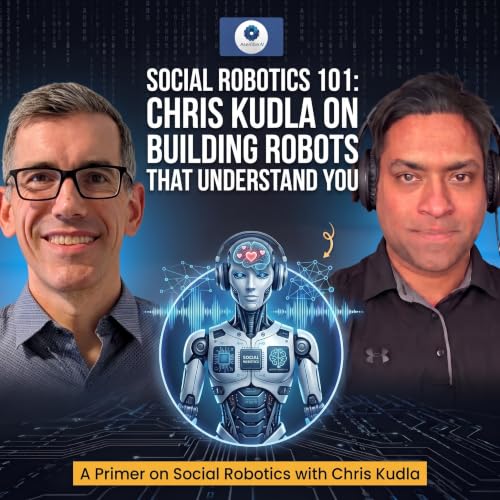
  • EP 72: Social Robotics 101: Building Robots That Understand You | Chris Kudla, Mind Children
    Sep 13 2026

    Most robotics companies are chasing industrial automation. Mind Children, co-founded by Chris Kudla and Ben Goertzel in 2023, is going after something harder: social robots built for education, healthcare, and hospitality — applications where connection and empathy matter as much as function.

    Topics covered:

    • Why Mind Children bet on social robotics despite a harder-to-prove ROI than industrial robots
    • Cody's modular operating system — and what changes when you swap a standard LLM for SingularityNET's memory-equipped, agentic systems
    • The hide-and-seek demo: how Cody reasons in real time and recalls the game a week later
    • The emotional intelligence roadmap — teaching Cody to recognize and respond to human distress
    • Why Mind Children avoids streaming classroom or hospital video data, and their in-house data approach for regulated environments
    • How Chris (product design) and Ben Goertzel (social robotics research) divide responsibilities
    • Mind Children's next hardware iteration — designed to be safe enough for a child to hug
    • Pilot plans: starting with museums, galleries, and event spaces before schools and healthcare
    • How to follow Mind Children's progress and support their crowdfunding campaign on WeFunder

    Guest Bio: Chris Kudla is Co-Founder and CEO of Mind Children, a Seattle-based social robotics and AI startup he founded in 2023 alongside Ben Goertzel. Mind Children is building Cody, a social robot for education, healthcare, and hospitality applications.

    Connect: Find Mind Children on LinkedIn, at mindchildren.com, or support their campaign at wefunder.com/mindchildrenrobotics.

    Mostra di più Mostra meno
    16 min
  • EP 71: The PRD Is Dead — What AI Just Did to Product Management & Cyber Defense | Ed Martin, Sophos
    Sep 12 2026

    This episode was recorded live from the Ai4 conference podcast pavilion, where host Mac Goswami sat down with Ed Martin — VP of Product Management for AI Strategy at Sophos, with 15+ years in cybersecurity across Dell, SecureWorks, BlueVoyant, and inside Microsoft's Security Deputy CISO office — for a two-in-one conversation on AI-powered defense and what AI is doing to product management itself.

    What's Covered:

    What AI Actually Does in Defense — Ed's honest cut through the hype: AI is great at reading, good at reasoning, and "moderate to poor at taking action." Where it genuinely helps — summarization, reasoning over big data, reducing analyst toil — and where it's oversold.

    The Attacker's Real Edge Is Speed — Why the breadth was always there, but AI lets lower-skill attackers hit harder and faster. Ed's line: "The attacker only has to be right once. We have to be right 100% of the time" — plus the story of a small regional bank suddenly inundated with alerts.

    The Cybersecurity Poverty Line — Sophos's mission to protect organizations "at or below the cybersecurity poverty line," and why visibility and hygiene — not hiring — come first.

    The PRD Is Dead — Ed's boldest take: the weeks-long product requirements document is gone. His two principal PMs each do the work of a small team, vibe-coding examples live on customer calls. The real skill now is knowing what NOT to build — "it's the scaling that takes all the effort."

    Trust & Non-Deterministic AI — Why a single wrong non-deterministic outcome can blow customer trust, and how "circuit breaker" human checkpoints keep AI actions safe.

    Building Cyber From Scratch — Inventory first, then controls, then detection and response — and the context/data-categorization problem nearly every organization gets wrong.

    Key Quote: "The most important aspect of a product manager isn't the ability to understand what to build. It's your ability to understand what not to build."

    Connect with Ed: LinkedIn: Ed Martin : https://www.linkedin.com/in/bigedmartin/

    Sophos: https://www.sophos.com/

    Follow and subscribe to AsembleAI: Spotify | Apple Podcasts | Amazon Music | iHeart Radio | YouTube | Substack

    Mostra di più Mostra meno
    21 min
  • EP 70: The Man Who Coined "AGI" - on Why Scaling LLMs Won't Get Us There | Ben Goertzel, SingualarityNET
    Sep 12 2026

    Ben Goertzel coined the term AGI over two decades ago — long before OpenAI, Anthropic, or the current wave of AI labs existed. Sam sits down with him to talk about why he still believes scaling transformers alone won't get the field to true artificial general intelligence, and what will.

    Topics covered:

    • The "common model of cognition" from cognitive science — working memory, episodic memory, metacognition, goals — and what LLMs are missing
    • Why LLMs can't do lifelong learning or true metacognition without long-term memory
    • Ben's take on his ongoing debate with Gary Marcus over the path to AGI
    • SingularityNET's neural-symbolic evolutionary approach, and Hyperon, its open-source AGI system
    • MeTTa, the self-rewriting knowledge metagraph at the core of Hyperon
    • Omega Claw agents — giving AI systems symbolic long-term memory, working memory, and a persistent sense of identity
    • Catastrophic forgetting in backpropagation-trained neural nets, and how predictive coding and symbolic memory address it
    • How the term AGI has evolved from a rigorous mathematical definition to a business buzzword
    • BGI Labs — Ben's new venture building enterprise products on "beneficial general intelligence"
    • Why decentralized infrastructure, open weights, and open source matter for AGI's future
    • How anyone — technical or not — can download Omega Claw from GitHub and start building today

    Guest Bio: Ben Goertzel coined the term "Artificial General Intelligence" (AGI) and founded SingularityNET in 2017 to build decentralized, open AGI infrastructure. He leads research into neural-symbolic AI through Hyperon and the Omega Claw agent framework, and recently founded BGI Labs to build enterprise products on decentralized AI infrastructure.

    Connect: Find more on SingularityNET, Hyperon (hyperon.dev), and Omega Claw on GitHub.

    Mostra di più Mostra meno
    26 min
  • EP 68: Filling Europe's Labor Gap with Humanoids | Olle Bergstedt, CEO, Kalk Robotics
    Sep 10 2026

    Europe is short 5.4 million industrial laborers, and the gap is widening as younger generations move away from manufacturing work. Sam sits down with Olle Bergstedt, CEO of Kalk Robotics, to talk about how humanoid robots can help close that gap — without replacing the humans already on the floor.

    Topics covered:

    • Kalk Robotics' focus on manufacturing and industrial humanoid deployment across Europe
    • Why Europe faces a 5.4 million labor shortage — and the generational shift driving it
    • Partnering with Chinese hardware manufacturers rather than competing against them
    • Kalk's reverse-engineered deployment process: site visits, strategic planning, then custom skill-pack development
    • The "gap-fill, not replace" philosophy for introducing humanoids into facilities
    • The ABC framework for identifying tasks suited to humanoid robots
    • Current accuracy benchmarks for humanoid deployments (50–60%) and the path to higher precision
    • HDCC (Humanoid Developer Control Center) — Kalk's proprietary training and operating system
    • How US business leaders can explore bringing Kalk's robots into their facilities
    • Olle's take on job-loss fears raised by figures like Geoffrey Hinton at AI4

    Guest Bio: Olle Bergstedt is CEO of Kalk Robotics, a Swedish company developing and deploying humanoid robots for the manufacturing and industrial sectors across Europe, with additional teams in Canada, Austria, and Sydney.

    Connect: Find Olle on LinkedIn to learn more about Kalk Robotics.

    Mostra di più Mostra meno
    13 min