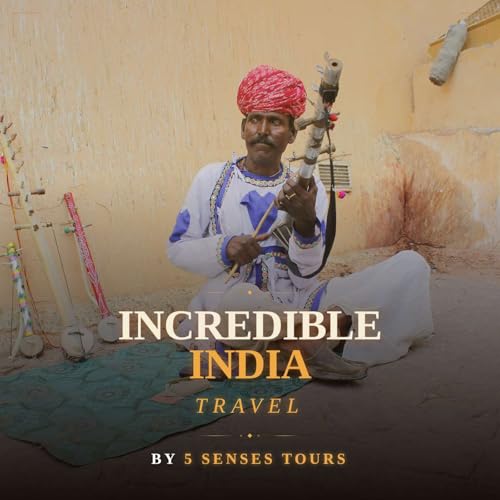
Incredible India Travel | Social Impact & Culture Tours copertina

Incredible India Travel | Social Impact & Culture Tours

Incredible India Travel | Social Impact & Culture Tours

Di: Madhusudan Narayanan | 5 Senses Tours
Ascolta gratuitamente

Offerte di stagione | 0,99 €/mese per i primi 3 mesi

A seguire 9,99 €/mese – si applicano condizioni. Puoi disdire mensilmente.
India travel podcast exploring responsible tourism, deep cultural experiences, and experiential travel across incredible India. Your India travel guide for authentic, meaningful journeys. Created by Madhusudan Narayanan, founder of 5 Senses Tours, an inbound tour operator specialising in cultural and sustainable travel in India, and hosted by Debbie and Tim, this podcast takes you beyond the monuments to the real heart of the country. Each episode covers places to visit in India, hidden heritage sites, ethical community tourism, and off the beaten path adventures that celebrate Indian culture and support local communities. From the ancient forts of Rajasthan and the backwaters of Kerala to tribal Odisha and the Himalayan ashrams, this is responsible tourism India done right, immersive, purposeful, and unforgettable. Whether you are a first time visitor or a seasoned India traveller, we help you explore with purpose and respect. 🎧 Subscribe now and start your journey. 🌏 Plan your India tour: 5sensestours.com2025 Five Senses Tours Privted Limited Scienze sociali Scrittura e commenti di viaggio
  • Damascus Steel Was Not From Damascus: The Indian Metal That Armed the Medieval World
    Oct 19 2026
    The Crusaders called it the most terrifying metal they had ever encountered. When the armies of the First Crusade arrived in the Holy Land in 1099 CE and met the forces of the Islamic world in battle, they discovered that their European swords were inferior in every measurable way to the blades their opponents carried. Harder. More flexible. Sharper. Capable of being sharpened to a finer point. The Islamic blades carried a flowing wavy pattern on their surface that European smiths had never seen and could not understand.European metallurgists spent the next seven centuries trying to replicate those blades. They failed. The formula died somewhere in the 18th century and was not reconstructed until 1998, when a materials scientist at Iowa State University named John Verhoeven finally worked out what had been lost.The metal those Crusader swords could not match was called Damascus steel in Europe, named for the Syrian city through which it was traded. Its actual origin was approximately 5,000 kilometres further east, in the crucible furnaces of Tamil Nadu and Karnataka, where a material called Wootz had been produced since at least 300 BCE.Damascus steel was not from Damascus. It was from India.In this episode we tell the complete story of Wootz steel. Where it was made and why South India’s specific geology and botanical resources made it possible there and nowhere else. How it travelled to Persia and was renamed. How it armed the armies of Saladin and defeated the best European blades of the medieval period. Why Napoleon commissioned its reconstruction as a military priority and failed. What Michael Faraday got wrong and what John Verhoeven finally got right. And why the story of Wootz steel’s loss and reconstruction is a template for understanding what happens to craft knowledge when the economic conditions that sustain it are disrupted.What You Will Hear in This EpisodeWhat the Crusaders found when they encountered Damascus blades for the first time and why they could not match them.The specific metallurgical properties that made Wootz steel extraordinary: hardness, flexibility, edge retention and the self-sharpening mechanism created by carbide particles in the steel matrix.Where Wootz was actually produced: the crucible furnaces of Konasamudram in Telangana and Salem in Tamil Nadu, and why the specific geology and botany of these locations made the production process possible there and nowhere else.How Wootz became Damascus: the Persian and Arab trading networks that carried Indian Wootz westward and the Syrian city whose name it took from the trading intermediary rather than the producer.Six centuries of brilliant failure: how Michael Faraday, Napoleon’s metallurgists, the Swedish chemist Berzelius, the German chemist Wöhler and the Russian metallurgist Anosov all failed to crack the formula and why.What John Verhoeven found in 1998: the critical role of vanadium and other trace elements in the South Indian ore that every previous researcher had missed.The connection between Wootz steel and the Tamil Nadu Iron Age discoveries at Adichanallur and Sivagalai: how a three-thousand-year metallurgical tradition produced the world’s finest blade metal.Why the formula was lost: how British colonial trade policy disrupted the economic basis of Wootz production before the knowledge inside it was fully understood.What the Wootz story tells us about craft knowledge, independent invention and the recurring pattern of South Asian knowledge being extracted from its context, renamed and credited to the wrong place.Where to encounter the Wootz tradition today: the Salar Jung Museum in Hyderabad, the Konasamudram region of Telangana and the Tamil Nadu heritage circuit.Key Moments00:00 — Introduction: the Crusaders and the metal they could not match05:20 — What Wootz steel actually is and why its properties were extraordinary11:45 — The crucible furnaces of Konasamudram and Salem: why South India and nowhere else18:30 — From Wootz to Damascus: how Indian steel was renamed after a Syrian trading city24:15 — The armies of Saladin and the metallurgical dimension of the Crusades29:40 — Six centuries of failure: Faraday, Napoleon, Berzelius and the quest to crack the formula36:10 — What John Verhoeven found in 1998: vanadium, trace elements and the reconstruction of a lost tradition42:30 — The connection to Adichanallur and Sivagalai: Wootz as the continuation of a five-thousand-year South Indian metallurgical tradition48:15 — Why the formula was lost: colonial trade policy and the disruption of craft knowledge53:40 — What the Wootz story tells us about South India’s place in the history of human civilisation58:00 — Where to encounter the tradition today and why now is the moment to goResources and LinksRead the full blog: 5sensestours.com/wootz-steel-india-damascus-steel-medieval-world-tamil-nadu/Read the Tamil Nadu Iron Age blog: 5sensestours.com/...
    Mostra di più Mostra meno
    23 min
  • The Iron Age Did Not Begin in Turkey: How Tamil Nadu Rewrote the History of Human Civilisation
    Oct 14 2026
    In 1876 a German archaeologist named Friedrich Jagor began digging in a field near Tirunelveli in southern Tamil Nadu and found something that should have rewritten the history of human civilisation. He found burial urns containing human skulls covered in thin sheets of beaten gold. He found iron artefacts. He filed his report and the world moved on.Over a century later the Tamil Nadu State Department of Archaeology resumed excavations at the same site, Adichanallur, and at a nearby site called Sivagalai. What the carbon dating returned stopped everyone in the room. The organic materials found alongside iron artefacts at Adichanallur averaged 2,613 BCE, over 4,600 years ago. At Sivagalai the date was 3,345 BCE, over 5,300 years ago.The conventionally accepted beginning of the global Iron Age in Anatolia is approximately 1,200 BCE.Tamil Nadu was smelting iron over two thousand years before that. And it may have done so entirely independently, because the geology south of the Vindhya range gave these communities iron ore but no copper, meaning they may have bypassed the Bronze Age entirely and moved directly from stone to iron while the Harappan civilisation was still discovering copper in the north.In this episode we follow the complete story of these discoveries: what was found, what it means, why South India may have invented the Iron Age independently, what the ongoing scholarly debate is about and why visiting the Tamirabarani valley now, before these sites become famous, is one of the most extraordinary things a person curious about human history can do.What You Will Hear in This EpisodeWhat Friedrich Jagor found at Adichanallur in 1876 and why it took over a century for the world to understand what it meant.The carbon dating results from Adichanallur and Sivagalai in full, what the dates are, how they were obtained, what they were obtained from and what they imply for the global history of iron technology.Why the Tamil Nadu Iron Age may have developed entirely independently of every other iron-working tradition in the ancient world, and the geological argument that explains how this was possible.What the Harappan or Indus Valley Civilisation was doing with copper at exactly the moment communities on the Tamirabarani River were already working with iron, and what this comparison tells us about the story of ancient India.The extraordinary burial tradition of Adichanallur: gold-covered skulls, black-and-red ware pottery and a civilisation that left no written records but left behind objects that outlasted everything the ancient world thought it knew about South India.The discovery at Thirumalapuram reported in 2025 and what it confirms about Adichanallur being not an isolated site but the most visible node of a broader Iron Age cultural network across the Tamirabarani valley.Why the Tamil word for iron, irumbu, has no known cognate in any language family that would indicate a borrowed word for a borrowed technology, and what that linguistic evidence adds to the case for independent invention.The ongoing scholarly debate: what is accepted, what is still being discussed and what the ongoing excavations are likely to reveal.What visitors can see at these sites today and why now is the moment to go, before the museum is built and the tourist infrastructure arrives and the quiet of a place that holds its significance invisibly is replaced by the noise of the world discovering it.Key Moments00:00 — Introduction: the discovery at Adichanallur and why it matters04:15 — What Friedrich Jagor found in 1876 and why the world was not ready to hear it09:30 — The carbon dating results: 2,613 BCE at Adichanallur and 3,345 BCE at Sivagalai15:45 — The Harappan comparison: copper in the north, iron in the south, at the same moment in history21:20 — Why South India may have invented the Iron Age independently: the geological argument27:40 — The burial tradition: gold-covered skulls, black-and-red ware pottery and a civilisation without written records33:15 — Thirumalapuram 2025: the new site that confirms a broader cultural network38:50 — The Tamil word irumbu and the linguistic evidence for independent invention44:10 — The scholarly debate: what is accepted, what is still being discussed49:30 — What visitors can see today and why now is the moment to go54:00 — The Tamirabarani valley as part of the broader Tamil Nadu civilisational arc: Keeladi, Mahabalipuram, Thanjavur, Chennai58:30 — Closing thoughts: the river that was producing iron for the ancient world 5,300 years ago, still moving, still hereResources and LinksRead the full blog: 5sensestours.com/adichanallur-sivagalai-tamil-nadu-iron-age-history/Tamil Nadu State Department of Archaeology: tnarch.gov.inThe Antiquity of Iron report: Published by the Tamil Nadu State Department of Archaeology, available through the department directlyAdichanallur site location: Approximately 24 kilometres from Tirunelveli, Thoothukudi district, Tamil ...
    Mostra di più Mostra meno
    22 min
  • The Art That Fire Makes Permanent: Varanasi Enamelling and Its Three Thousand Year Global Journey
    Oct 7 2026
    There is a colour that changed the history of art on three continents. It is called the Purple of Cassius and it connects a working studio in Varanasi to the painted enamel houses of Limoges in France, to the Persian court of the medieval period, to the Mycenaean Greece of 1450 BCE and to the fragile silver heritage of the Andaman coast. In this episode we follow that thread across three thousand years of human craft history and arrive, at the end of it, in a kiln-lit studio in one of the world's oldest cities where the same chemistry is still alive in the hands of a working artist.Enamelling is the art of fusing powdered glass onto metal at temperatures between 750 and 850 degrees Celsius. The result is a coloured surface that is chemically bonded to the metal and effectively permanent on any human timescale. The enamel jewellery found in Mycenaean graves dating to 1450 BCE is still the same colour it was three thousand years ago. No painted surface from the same period survives with its colour intact.This episode tells the complete global story of enamelling: how it was developed independently in ancient Greece, Egypt and China, how it reached the Persian court and then the meenakari tradition of Mughal India under Emperor Akbar, how it connected Varanasi to the enamel houses of Limoges through the shared chemistry of the Purple of Cassius, and how it arrived at its present moment in Varanasi, where the number of working enamellists has fallen sharply over three decades and where what happens in one working studio on weekend mornings is an act of craft preservation as much as it is an art practice.What You Will Hear in This EpisodeWhy enamelling is the only art form in which the colour is not applied to the surface but fused into it, and why that single fact explains everything about the craft's three thousand year survival.The story of the Purple of Cassius: what it is, how it is made, and why a colour produced by dissolving gold in acid connected craftspeople in Persia, India and France who had no direct contact with each other.How Emperor Akbar brought Persian enamellists to the Mughal court in the 16th century and what happened to that knowledge when it arrived in Varanasi.Why Varanasi specifically, a city whose ghats have been lit by cremation fires for over three thousand years, is the right place for an encounter with a craft whose entire logic depends on what fire does to fragile materials.The Andaman connection: how a remote island archipelago became the unexpected meeting point of craft traditions from Rajasthan, Tamil Nadu and Burma, and how that convergence produced the silver jewellery tradition that gives The Andaman Way its name.What responsible tourism looks like when the community is a single working artist in an urban studio rather than a rural farming or weaving community, and why the economic signal of a booking matters as much here as it does on the Coast to Canopy trail.What it feels like to make something that will almost certainly outlast you.Key Moments00:00 — Introduction: the Purple of Cassius and the colour that changed the history of art04:30 — What enamelling actually is and why colour fused into glass never fades09:15 — The oldest known enamel objects: Mycenaean Greece, 1450 BCE13:40 — The Persian court, the trade routes and the road to Limoges19:20 — How the meenakari tradition reached India through Emperor Akbar and the Mughal court24:45 — Varanasi enamelling: its specific character and its connection to the city's three thousand year relationship with fire31:10 — The Andaman connection: where craft histories converge unexpectedly36:30 — Why enamelled objects last three thousand years: the chemistry of permanence41:15 — What hands learn that eyes cannot: the embodied knowledge inside Varanasi's enamelling tradition47:00 — Responsible tourism and craft preservation: why your booking matters51:30 — The Andaman Way: meeting Soma Pradhan in her Varanasi studioResources and LinksBook The Andaman Way Enamelling Workshop in Varanasi: 5sensestours.com/tour/the-andaman-way-varanasi-enameling-workshop/Read the full blog on the history of Varanasi enamelling: 5sensestours.com/varanasi-enamelling-history-limoges-persia-ancient-craft/The Andaman Way by Soma Pradhan: Available on Amazon India and Amazon globallyByzantine enamelwork from Constantinople: Treasury of San Marco, Venice Kunsthistorisches Museum, ViennaLimoges painted enamel collections: The Louvre, Paris Victoria and Albert Museum, London Metropolitan Museum of Art, New York5 Senses Tours: 5sensestours.com Outlook Responsible Tourism Award recipient Tripadvisor Travellers Choice 2025 Ministry of Tourism Recognised 4.9 Stars across 1,350 reviewsAbout 5 Senses Tours5 Senses Tours is an award winning cultural tour operator recognised by India's Ministry of Tourism, founded by Madhusudan Narayanan with a single conviction: that the best way to travel is as a traveller and not as a tourist....
    Mostra di più Mostra meno
    22 min
adbl_web_anon_alc_button_suppression_t1
Ancora nessuna recensione