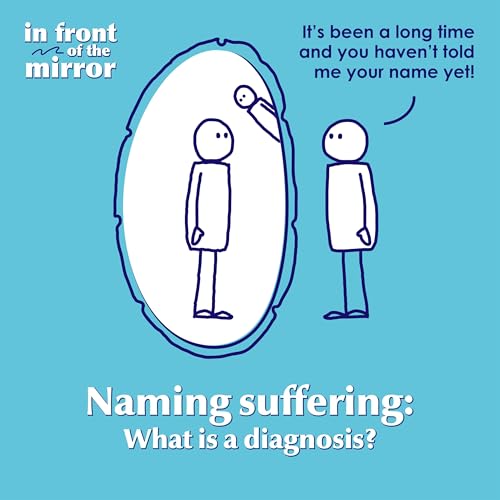
• Naming suffering: What is a diagnosis?
    Jan 12 2026

    Sooner or later, in life, we have all received a diagnosis.

    An expert comes to us, or we go to them, and they utter some words that can sometimes change the course of our lives, for better or for worse.

    Words like “cold,” “gastritis,” “sore throat,” “ADHD,” or “major depression.” Well then, what do these words have in common? Why do we call all of them “diagnoses”?


    Every other Monday, at 12pm.

    Follow us on:

    Instagram: ⁠mirror_podcast_⁠

    Substack: ⁠In front of the mirror⁠

    This project exists in Italian as well: ⁠In Front of the Mirror - Il Podcast in italiano⁠


    References:

    Hacking, I. (1995). The looping effects of human kinds. In D. Sperber, D. Premack, & A. J. Premack (Eds.), Causal cognition: A multidisciplinary debate (pp. 351–394). Clarendon Press/Oxford University Press.

    Lingiardi, V. (2018). Diagnosi e destino. Einaudi.

    Lingiardi, V. (2021). Arcipelago N. Variazioni sul narcisismo. Einaudi.

    Sadler, J. Z. (2004). Diagnosis/antidiagnosis. In J. Radden (Ed.), The philosophy of psychiatry: A companion (pp. 163–179). Oxford University Press

    Mostra di più Mostra meno
    24 min
  • Christmas Special: Our paths
    Dec 22 2025

    It's Christmas. We are all very tired.


    Today, we are bringing you a special episode: we talk about ourselves, our paths, and how we got here.


    Every other Monday, at 12pm.

    Follow us on:

    Instagram: mirror_podcast_

    Substack: In front of the mirror

    This project exists in Italian as well: In Front of the Mirror - Il Podcast in italiano


    Mostra di più Mostra meno
    38 min
  • Making complexity compelling: Psychiatry and its many lenses with Jazmine Russell
    Dec 8 2025

    The possibility of being offered and exposed to a multiplicity of frameworks reflects and respects the complex nature of mental health phenomena. Rather than finding themselves encapsulated within the neat confines of only one narrative, the person would benefit from choosing and adopting one or more stories and narratives that make sense to them. In light of this, we ask: are there frameworks that do more good than others? To what extent should the clinician guide, direct, or even impose particular narratives? Can the epistemic significance of a symptom be overlooked or misinterpreted?

    In the attempt to make complexity compelling, we are joined for the second time by Jazmine Russell, who is a mental health educator, writer, and interdisciplinary scholar focused on bridging mental health, mind-body healing, and societal change. She is the co-founder of the Institute for the Development of Human Arts, a transformative mental health training institute and the founder & host of the Depth Work Podcast. Drawing on her lived experiences and professional training working both within and outside the mental health system, Jazmine is a holistic counselor and trauma-informed holotropic breathwork practitioner. She co-edited the Mad Studies Reader: Interdisciplinary Innovations in Mental Health (Routledge, 2024). Find her work at ⁠www.depth-work.com⁠ and ⁠www.JazmineRussell.com⁠


    Every other Monday, at 12pm.

    Follow us on:

    Instagram: ⁠@mirror_podcast_⁠

    This project exists in Italian as well: ⁠In Front of the Mirror - Il Podcast in Italiano

    Mostra di più Mostra meno
    37 min
  • Making sense of psychiatric symptoms: from lived experience to philosophical exploration with Jazmine Russell
    Nov 24 2025

    Mental health crises might be investigated from a variety of perspectives. The lived experience of mental health conditions can be considered an irreplaceable source of knowledge. It is through lived experience that we become aware of aspects that are often neglected, such as the ways our bodies try to communicate with us and alert us, or how our personal histories are revealed to us through the very phenomena we tend to call "symptoms".


    Jazmine Russell is a mental health educator, writer, and interdisciplinary scholar focused on bridging mental health, mind-body healing, and societal change. She is the co-founder of the Institute for the Development of Human Arts, a transformative mental health training institute and the founder & host of the Depth Work Podcast. Drawing on her lived experiences and professional training working both within and outside the mental health system, Jazmine is a holistic counselor and trauma-informed holotropic breathwork practitioner. She co-edited the Mad Studies Reader: Interdisciplinary Innovations in Mental Health (Routledge, 2024). Find her work at www.depth-work.com and www.JazmineRussell.com


    Every other Monday, at 12pm.

    Follow us on:

    Instagram: @mirror_podcast_

    This project exists in Italian as well: In Front of the Mirror - Il Podcast in Italiano


    Mostra di più Mostra meno
    38 min
  • On the nature of psychiatric symptoms
    Nov 10 2025

    What are hallucinations, depressive episodes, or panic attacks?

    We know what they are, of course - psychiatric symptoms. The problem is that we don’t know what they are - ontologically.

    Which is to say: are they the manifestations of a compromised neurobiological mechanism? Or perhaps phenomena carrying a meaning to be deciphered? Adaptive strategies, defense mechanisms?

    The ninth episode is a philosophical inquiry into the nature of psychiatric symptoms and the power of the conceptual lenses we wear to understand them.


    References

    Eagle, M. N. (2011). From classical to contemporary psychoanalysis: A critique and integration. Routledge.

    Ritunnano, R., Humpston, C., & Broome, M. R. (2022). Finding order within the disorder: A case study exploring the meaningfulness of delusions. BJPsych Bulletin, 46(2), 109–115. https://doi.org/10.1192/bjb.2020.151

    Russell, J. (2024). How delusions can uncover sources of harm and pathology: The epistemic value of interoceptive & unconscious information. Philosophy and the Mind Sciences, 5. https://doi.org/10.33735/phimisci.2024.11490


    Every other Monday, at 12pm.

    Follow us on:

    Instagram: @mirror_podcast_

    This project exists in Italian as well: In Front of the Mirror - Il podcast in Italiano

    Mostra di più Mostra meno
    42 min
  • What does change mean? Self, identity, and the goal of psychotherapy
    Oct 27 2025

    The question of all questions: What do we mean when we say that therapy brings about change?

    Then, if there are different types of therapy, are there also different kinds of change?

    And furthermore, when it comes to the person - "who" is changing? And, where should we start if we want to build the sense a person has of being themselves?

    References:

    Kellog S., Torres A. (2021) Chairwork invites you to shift perspective on who you are. Aeon

    Kiverstein J, Rietveld E, Denys D. (2021) World Wide Open. Aeon

    Rossi Monti M. (2016) Manuale di psichiatria per psicologi. Carocci Editore.

    Rosfort, R., & Stanghellini, G. (2015). The Patient as an Autonomous Person: Hermeneutical Phenomenology as a Resource for an Ethics for Psychiatrists . In J. Z. Sadler, W. van Staden, & KWM. Fulford (Eds.), Oxford Handbook of Psychiatric Ethics (Vol. 1, pp. 319-335). Oxford https://doi.org/10.1093/oxfordhb/9780198732365.013.26


    Every other Monday, at 12pm.

    Follow us on:

    ⁠⁠⁠Instagram: @mirror_podcast_⁠⁠⁠

    This project exists in Italian as well: ⁠⁠In Front of the Mirror - Il Podcast in Italiano⁠


    Mostra di più Mostra meno
    39 min
  • A philosophical obsession and the search for character: when do we become what we are?
    Oct 13 2025

    When do we become who we are? What makes me the person I am, and not someone else?

    How far back should we go, to find that out?

    And what does it mean to embrace our destiny, to own our story?

    Today we are thrilled to discuss these topics with Susi Ferrarello, philosopher, Professor at California State University, East Bay, and philosophical counsellor.

    Susi's book: Ferrarello, S. (2024). The Phenomenology of Pregnancy and Early Motherhood: Ethical, Social, and Psychological Perspectives (1st ed.). Routledge.Other references:

    Ammaniti, M., & Gallese, V. (2014). The birth of intersubjectivity: Psychodynamics, neurobiology, and the self. W. W. Norton & Company.Beebe, B., & Steele, M. (2013). How does microanalysis of mother–infant communication inform maternal sensitivity and infant attachment? Attachment & Human Development, 15(5–6), 583–602. https://doi.org/10.1080/14616734.2013.841050

    Hillman, J. (1996)The Soul’s Code: In Search of Character and Calling.

    Mostra di più Mostra meno
    42 min
  • Having or being? Questions of ontology pt. 2
    Jul 28 2025

    It has even been said that depression, anorexia, and phobia are not something we ‘have’, rather they are modes of being of the person. But what does ‘being’ depressed, anorexic, or phobic mean?

    It has even been said these pathologies do not happen to the person, they are worlds instead, which persons inhabit. So: one does not have autism, one is autistic. Or, at least, this is what they say.

    It has even been said that one has become schizophrenic, as if it were the culmination of a personal, and unique trajectory. But, which formulations can make justice to the lived experience of the person?

    In this episode Cristiano will be the spokesperson of the “being” formulation. But Giacomo has got some objections.

    So: does one have a mental illness, or should we rather say that one is mentally ill? If the titles didn’t make it clear enough, this debate is our focus for this, and the last episode.

    References

    Bollas, C. (2015). When the sun bursts: the enigma of schizophrenia. Yale University Press.

    Carrère. E. (2011) Lives Other Than My Own: A Memoir

    Laing, R. D. (1960) The divided self: An existential study in sanity and madness. Penguin Books

    Lingiardi, V., & McWilliams, N. (Eds.). (2017). Psychodynamic diagnostic manual: PDM-2 (2nd ed.). The Guilford Press.

    Stanghellini, G., Broome, M. R., Fernandez, A. V., Fusar-Poli, P., Raballo, A., & Rosfort, R. (Eds.). (2019). Oxford handbook of phenomenological psychopathology. Oxford University Press. https://doi.org/10.1093/oxfordhb/9780198803157.001.0001

    A video adaptation produced by the World Health Organization (2012), based on Matthew Johnstone’s book (2005). I had a black dog, his name was depression

    Every other Monday, at 12pm.

    Follow us on:

    ⁠⁠Instagram: @mirror_podcast_⁠⁠

    This project exists in Italian as well: ⁠In Front of the Mirror - Il Podcast in Italiano⁠


    Mostra di più Mostra meno
    36 min