

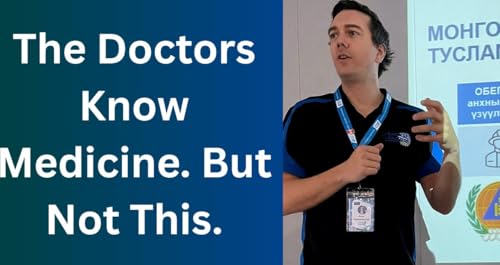
Mongolia's doctors know medicine. This is what they're missing.
Impossibile aggiungere al carrello
Rimozione dalla Lista desideri non riuscita.
Non è stato possibile aggiungere il titolo alla Libreria
Non è stato possibile seguire il Podcast
Esecuzione del comando Non seguire più non riuscita

Mongolia's doctors know medicine. This is what they're missing.
-
Letto da:
-
Di:
Mongolia’s ambulance doctors are qualified physicians. They know the medicine. What most of them have never been taught is what to do with that knowledge before the patient reaches hospital.
That is the problem international paramedic Leon Baranowski flew to Ulaanbaatar to help solve - for the third time.
This conversation was recorded mid-programme at the 103 Ambulance Service, while the training was still running. Leon is Operations Director for EMS Global and Senior Lecturer in Paramedicine at Monash University, and he has spent close to two decades working across paramedic systems in the UK, Canada, and Australia. But what he talks about in this episode is not his career. It is what happens when you try to build prehospital capability inside a system that was never designed around it.
The gap he describes - between clinical knowledge and prehospital application - is not unique to Mongolia. It recurs across health systems that rely on doctors and drivers rather than a paramedic workforce. Teamwork under pressure, communication on scene, decision-making before the hospital rather than inside it: these are not things medical school teaches, and they are not things that transfer automatically from hospital to ambulance.
What EMS Global is attempting in Ulaanbaatar is also not a short-term training visit. The harder question this episode sits with is whether you can build something that lasts after the instructors get on the plane home.
This is a public episode. If you would like to discuss this with other subscribers or get access to bonus episodes, visit emsglobalfoundation.substack.com