Episodi

  • S7, Ep 8- Protecting Patient Access to Vaccines: The Critical Role of Pharmacists
    Nov 19 2026

    In this episode of Healthcare Matters, Dr. Robert Popovian and co-host Angela Degrassi discuss the importance of pharmacists in providing vaccinations and why federal regulatory uncertainty and restrictive state laws could create unnecessary barriers for patients seeking immunizations.

    The conversation highlights how pharmacists have become essential to adult vaccination. Approximately 90% of Americans live within five miles of a pharmacy, and older adults visit their pharmacists more frequently than their primary care physicians. Pharmacies also provide critical access in rural and underserved communities, often delivering vaccinations more cost-effectively than physician offices.

    The episode examines the role of the Advisory Committee on Immunization Practices (ACIP), whose recommendations influence both pharmacists' authority to administer vaccines under many state laws and insurance coverage requirements. Dr. Popovian explains how disruptions or delays in federal recommendations can limit where patients receive vaccinations and whether insurance covers those services.

    Robert and Angela also discuss whether medical societies can provide alternative vaccine guidance when the federal recommendation process is disrupted. While these organizations offer valuable expertise, replacing ACIP's ongoing scientific evaluations would require substantial resources and coordination.

    The discussion outlines three approaches states can adopt to protect patient access. The preferred model allows appropriately trained pharmacists to administer FDA-approved vaccines under an accepted standard of care. Alternative approaches would authorize vaccination based on FDA approval or ACIP recommendations or eliminate additional state restrictions once ACIP recommends a vaccine. California's adoption of a standard-of-care framework in 2025 provides an example for other states.

    The key message: vaccines are among the most cost-effective healthcare interventions, but their benefits depend on patient access. States should modernize pharmacist practice laws and remove unnecessary barriers while maintaining appropriate safety standards, ensuring patients can receive timely vaccinations regardless of federal regulatory uncertainty.

    Contact Our Hosts

    Dr. Robert Popovian, Chief Science Policy Officer at GHLF: rpopovian@ghlf.org

    Angela Degrassi, Senior Manager, Patient-Centered Research Operations & Engagement: adegrassi@ghlf.org

    A podcast series produced by Amelia Violet Prouse.

    We want to hear what you think. Send your comments, or a video or audio clip of yourself, to podcasts@ghlf.org

    Listen to all episodes of Healthcare Matters on our website or on your favorite podcast channel.

    See omnystudio.com/listener for privacy information.

    Mostra di più Mostra meno
    19 min
  • S7, Ep 7- The Inflation Reduction Act: Are Lower Medicare Drug Prices Reaching Patients?
    Sep 10 2026

    In this episode of Healthcare Matters, Dr. Robert Popovian and co-host Angela Degrassi examine the Inflation Reduction Act’s Medicare Drug Price Negotiation Program and whether lower prices negotiated by the government are translating into meaningful savings for patients at the pharmacy counter.

    The conversation explains that the Inflation Reduction Act included several important changes for Medicare beneficiaries, including an annual cap on Medicare Part D out-of-pocket spending, the elimination of cost sharing for vaccines covered under Part D, and the introduction of government-negotiated maximum fair prices for selected medicines. Dr. Popovian emphasizes, however, that the maximum fair price determines what Medicare plans pay, not necessarily what patients pay.

    The episode also discusses research from Pioneer Institute using real-world prescription data from the four largest pharmacy benefit managers, which together account for approximately 85% of the Medicare Part D market. The research tracks what patients paid for 24 non-insulin medicines selected for the first two rounds of negotiation, as well as how frequently prescriptions were filled with no out-of-pocket cost.

    The findings show a complicated and uneven picture. From 2024 to 2025, patients paid more for 14 of the 24 medicines studied and less for ten, although the number of prescriptions filled at no cost increased because of the new out-of-pocket cap. During the first quarter of 2026, patients paid less for eight of the first nine negotiated medicines than in the same period in 2025, but several remained more expensive than in 2024.

    Robert and Angela also discuss why lower negotiated prices may not produce equivalent reductions in patient costs. Benefit design, manufacturer price reductions, generic and biosimilar competition, premiums, deductibles, formulary tiers, prior authorization, and step therapy can all affect what patients ultimately pay and whether they can access their medicines.

    The key message: lower government-negotiated prices should not be confused with lower patient out-of-pocket costs. Some provisions of the Inflation Reduction Act clearly help patients, but the ultimate test is whether Medicare beneficiaries pay less overall and can still obtain the medicines they need.

    Pioneer Institute Study: https://pioneerinstitute.org/the-inflation-reduction-act/

    Comments by Pioneer Institute to CMS: https://www.regulations.gov/comment/CMS-2026-2080-0019

    Contact Our Hosts

    Dr. Robert Popovian, Chief Science Policy Officer at GHLF: rpopovian@ghlf.org

    Angela Degrassi, Senior Manager, Patient-Centered Research Operations & Engagement: adegrassi@ghlf.org

    A podcast series produced by Amelia Violet Prouse.

    We want to hear what you think. Send your comments, or a video or audio clip of yourself, to podcasts@ghlf.org

    Listen to all episodes of Healthcare Matters on our website or on your favorite podcast channel.

    See omnystudio.com/listener for privacy information.

    Mostra di più Mostra meno
    19 min
  • S7, Ep 6- 340B Program & Hospital Charity Care: What Patients Need to Know
    Jul 13 2026

    In this episode of Healthcare Matters, Dr. Robert Popovian and co-host Angela Degrassi discuss the 340B Drug Discount Program and why a program created to help vulnerable patients has become an important issue for patient access, hospital transparency, and accountability.

    The conversation explains how 340B allows eligible hospitals and other covered entities to purchase certain outpatient medicines at steep discounts. The original purpose was to help safety-net providers stretch limited resources and support uninsured, underinsured, and underserved patients. Dr. Popovian emphasizes that the program is valuable and should not be eliminated but asks whether the savings are actually reaching patients directly.

    The episode also explores why many patients may not know they are receiving care at a 340B hospital, even though that hospital may be purchasing outpatient medicines at a significant discount. Patients are not automatically guaranteed to receive that discounted price, and hospitals are not clearly required to pass those savings directly to them.

    Robert and Angela also discuss findings from a study Dr. Popovian co-authored comparing 340B and non-340B hospitals. The study found that 340B hospitals, on average, provided less charity care, less charity care for uninsured patients, and less uncompensated or unreimbursed care as a percentage of operating expenses than non-340B hospitals.

    The key message: 340B was created to help vulnerable patients, but patients are often not told when hospitals receive these discounts and are not guaranteed to benefit directly. Patients should be informed, hospitals should be transparent, and there should be a clear pathway for patients to ask whether 340B discounts can help reduce their out-of-pocket drug costs.

    Read the study here: https://www.medrxiv.org/content/10.64898/2026.02.12.26346191v1

    Contact Our Hosts

    Dr. Robert Popovian, Chief Science Policy Officer at GHLF: rpopovian@ghlf.org

    Angela Degrassi, Senior Manager, Patient-Centered Research Operations & Engagement: adegrassi@ghlf.org

    A podcast series produced by Amelia Violet Prouse.

    We want to hear what you think. Send your comments, or a video or audio clip of yourself, to podcasts@ghlf.org

    Listen to all episodes of Healthcare Matters on our website or on your favorite podcast channel.

    See omnystudio.com/listener for privacy information.

    Mostra di più Mostra meno
    18 min
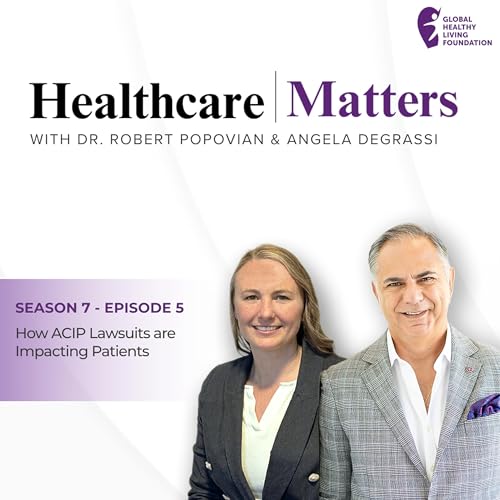
  • S7, Ep 5- How ACIP Lawsuits are Impacting Patients: When Vaccine Guidance Becomes an Access Problem
    May 20 2026

    In this episode of Healthcare Matters, Dr. Robert Popovian and co-host Angela Degrassi discuss why uncertainty surrounding the CDC’s Advisory Committee on Immunization Practices, known as ACIP, matters far beyond Washington, DC.

    The conversation explains how ACIP recommendations are connected to the real-world systems that help patients get vaccinated, including pharmacist authority, state scope-of-practice laws, and Medicaid reimbursement. Dr. Popovian explains that adult vaccination is especially vulnerable to disruption because most adults receive vaccines at pharmacies, and in many states, pharmacists’ ability to administer vaccines is tied to ACIP recommendations.

    The episode also explores why seasonal vaccines, such as flu and COVID vaccines, are particularly exposed to uncertainty because they require updated authorization and recommendations each year. Robert and Angela discuss what happened when COVID vaccine guidance was delayed, how some states responded with temporary workarounds, and why not every state may be prepared to act quickly if similar uncertainty continues.

    The discussion also highlights GHLF’s new integration of Walgreens’ Vaccine Scheduler into GHLF’s vaccine hub, a tool designed to help adult patients better understand and access vaccines at local pharmacies.

    The key message: ACIP may sound like an advisory body, but its recommendations can directly affect whether patients can get vaccines, whether pharmacists can provide them, and whether Medicaid will pay for them.

    Contact Our Hosts

    Dr. Robert Popovian, Chief Science Policy Officer at GHLF: rpopovian@ghlf.org

    Angela Degrassi, Senior Manager, Patient-Centered Research Operations & Engagement: adegrassi@ghlf.org

    A podcast series produced by Amelia Violet Prouse.

    We want to hear what you think. Send your comments, or a video or audio clip of yourself, to podcasts@ghlf.org

    Listen to all episodes of Healthcare Matters on our website or on your favorite podcast channel.

    See omnystudio.com/listener for privacy information.

    Mostra di più Mostra meno
    21 min
  • S7, Ep 4- COVID Antivirals: Are High-Risk Patients Missing the Window?
    Apr 8 2026

    In this episode of Healthcare Matters, Dr. Robert Popovian is joined by new co-host Angela Degrassi for a conversation about access to oral antiviral treatments for COVID-19, especially for older adults and people living with chronic disease.

    Prompted by a new CDC report and supported by findings from a recent Global Healthy Living Foundation survey, the discussion explores a troubling pattern: awareness of COVID antiviral treatments may be high, but many high-risk patients still do not receive them when they test positive.

    Dr. Popovian explains why prescribing appears to rise when COVID is dominating headlines and then fall when public attention fades, even though patient risk has not changed. He and Angela discuss the real-world barriers that can stand in the way of timely treatment, including missed prescribing opportunities, delays in testing, out-of-pocket costs, and uncertainty about eligibility.

    This episode highlights a simple but important message: for high-risk patients, timely treatment should be part of the care plan, not an afterthought. It also offers practical guidance for patients and caregivers on what to do immediately after testing positive and why acting quickly can make all the difference.

    COVID-19 Antiviral Prescription Receipt Among Outpatients Aged ≥65 Years

    COVID-19 Oral Antiviral Treatments Among U.S. Patients with Chronic Conditions

    Contact Our Hosts

    Dr. Robert Popovian, Chief Science Policy Officer at GHLF: rpopovian@ghlf.org

    Angela Degrassi|, Senior Manager, Patient-Centered Research Operations & Engagement: adegrassi@ghlf.org

    A podcast series produced by Amelia Violet Prouse.

    We want to hear what you think. Send your comments, or a video or audio clip of yourself, to podcasts@ghlf.org

    Listen to all episodes of Healthcare Matters on our website or on your favorite podcast channel.

    See omnystudio.com/listener for privacy information.

    Mostra di più Mostra meno
    12 min
  • S7, Ep 3- 340B: Are Patients Seeing the Savings?
    Apr 1 2026

    In this episode of Healthcare Matters, Dr. Robert Popovian breaks down the 340B drug pricing program through the lens that matters most: what it means for patients. Prompted by Minnesota’s latest transparency report, he explains how a program originally created to support care for uninsured and underinsured patients has grown into one of the largest and least understood drug programs in the country.

    Dr. Popovian unpacks how the program works, why contract pharmacies have become such a major part of it, and what the newest data suggest about who is benefiting most. He also raises a critical question: if hospitals and affiliated entities are receiving deep discounts on medicines, why are so many patients still facing high out-of-pocket costs?

    This episode explores whether the 340B program is truly delivering on its original mission and why greater transparency, accountability, and patient benefit should be at the center of the conversation.

    Minnesota 340B Covered Entity Report 2025

    Minnesota 340B Covered Entity Report 2024

    Contact Our Hosts

    Dr. Robert Popovian, Chief Science Policy Officer at GHLF: rpopovian@ghlf.org

    A podcast series produced by Amelia Violet Prouse.

    We want to hear what you think. Send your comments, or a video or audio clip of yourself, to podcasts@ghlf.org

    Listen to all episodes of Healthcare Matters on our website or on your favorite podcast channel.

    See omnystudio.com/listener for privacy information.

    Mostra di più Mostra meno
    15 min
  • S7, Ep 2- PBM Reform at an Inflection Point: What Comes Next?
    Feb 20 2026

    Pharmacy Benefit Manager (PBM) reform has reached a turning point. In this episode of Healthcare Matters, Dr. Robert Popovian and Ben Blanc are joined by Bob Schenk, RPh, to break down the latest wave of federal and state reforms, including the FTC settlement with Express Scripts.

    From pharmacy-level claims transparency to rebate reform and vertical integration, the conversation explores what’s changed, what’s still missing, and how these shifts could affect employers, patients, and healthcare costs nationwide.

    As regulatory pressure builds, the big question remains: will transparency lead to true accountability, or simply new revenue strategies?

    Contact Our Hosts

    Dr. Robert Popovian, Chief Science Policy Officer at GHLF: rpopovian@ghlf.org

    Ben Blanc, Director, Digital Production and Engagement at GHLF: bblanc@ghlf.org

    A podcast series produced by Ben Blanc.

    We want to hear what you think. Send your comments, or a video or audio clip of yourself, to podcasts@ghlf.org

    Listen to all episodes of Healthcare Matters on our website or on your favorite podcast channel.

    See omnystudio.com/listener for privacy information.

    Mostra di più Mostra meno
    40 min
  • S7, Ep 1- The $29 Billion Problem: Understanding Influenza's True Economic Toll
    Jan 29 2026

    In this season premiere of Healthcare Matters, Dr. Robert Popovian and Ben Blanc are joined by Dr. Wayne Winegarden, Senior Fellow and Director of the Center for Medical Economics and Innovation at the Pacific Research Institute, to discuss a new economic study revealing the true cost of influenza in America.

    The study finds that influenza imposed a $29 billion economic burden during the 2023-24 season; $16 billion in direct medical costs and $13 billion in lost productivity. Using 14 seasons of CDC data, the research demonstrates that higher adult vaccination rates are significantly associated with lower hospitalizations and mortality, particularly among adults aged 50 and older.

    The conversation explores why adult vaccination rates have declined, what drives the real economic impact of flu season, and why employers, especially small businesses, should view vaccination as a critical workplace investment. Dr. Popovian and Dr. Winegarden break down the data and discuss actionable solutions for healthcare systems, employers, and policymakers to close the gap between what we know works and what's actually happening.

    To access the full study and white paper, click here.

    Contact Our Hosts

    Dr. Robert Popovian, Chief Science Policy Officer at GHLF: rpopovian@ghlf.org

    Ben Blanc, Director, Digital Production and Engagement at GHLF: bblanc@ghlf.org

    A podcast series produced by Ben Blanc.

    We want to hear what you think. Send your comments, or a video or audio clip of yourself, to podcasts@ghlf.org

    Listen to all episodes of Healthcare Matters on our website or on your favorite podcast channel.

    See omnystudio.com/listener for privacy information.

    Mostra di più Mostra meno
    22 min