Episodi

  • Root2Res - Roots in Plant Breeding
    Aug 21 2026

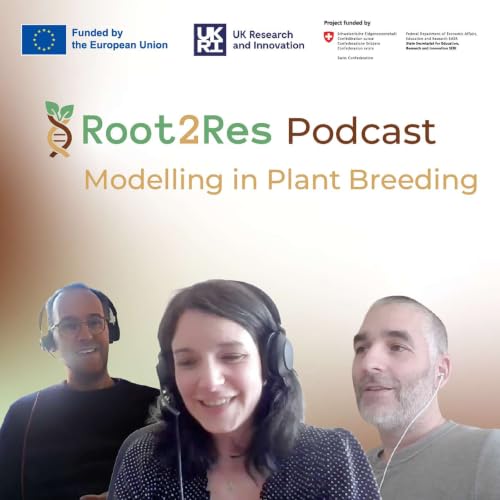
    In this Root2Resilience podcast episode, we explore the crucial role of roots in plant breeding. Often overlooked, roots play a fundamental part in plant health, nutrient uptake, and resilience to environmental stress. We discuss why it is important to focus on roots, what functions they perform, and how they can be better integrated into modern breeding processes. The episode also highlights ongoing work within the Root2Resilience project to better understand and utilise root traits for more sustainable and resilient agriculture.

    Key Topics Discussed

    • The functions of roots and their importance for plant performance.
    • The rhizosphere and the complex processes taking place belowground.
    • How roots are currently considered in plant breeding.
    • Methods for studying roots without destroying the plant.
    • The work of Root2Resilience in advancing root-focused breeding approaches.

    Guests

    • Christina Baxter: ADAS UK – christina.baxter@adas.co.uk
    • Charlotte White: ADAS UK – charlotte.white@adas.co.uk
    • Eva Oburger: BOKU University Vienna – eva.oburger@boku.ac.at

    Moderated by: Nina Gallmann (FiBL)

    Produced by: Nina Gallmann and Laura Kemper (both FiBL)

    Further information

    Learn more about Root2Resilience and stay up to date: www.root2res.eu

    Project on Cordis: https://cordis.europa.eu/project/id/101060124

    Project on YouTube: https://www.youtube.com/@root2res

    Funding

    Root2Resilience is supported by the European Union’s Horizon Europe research and innovation programme under Grant Agreement no 101060124, by Innovate UK through the Horizon Europe Guarantee Scheme and by the Swiss State Secretariat for Education, Research and Innovation (SERI) under contract number 23.00050.

    Get involved

    If you enjoyed this episode, please share it with your network and subscribe to hear more from the Root2Resilience project. Together, we can help build a more resilient future for agriculture!

    Mostra di più Mostra meno
    28 min
  • Diversité cultivée – de la graine à l’assiette
    Aug 18 2026

    D’où viennent les graines de nos légumes ? Et pourquoi leur origine est-elle importante ? À Genève, plusieurs acteurs travaillent ensemble pour conserver, sélectionner, multiplier et cultiver des variétés locales. Un voyage de la graine à l’assiette au cœur de la diversité cultivée.

    À Genève, le projet Légumes traditionnels genevois fait vivre la diversité cultivée de la graine à l’assiette. Mathias Gudinchet de ProSpecieRara, Joël Mützenberg de Semences de Pays et Julia Burgin, maraîchère bio à Dardagny, racontent comment conservation, sélection, production de semences et maraîchage s’articulent autour des variétés locales. Un échange sur le goût, la résilience et la souveraineté semencière. Ce projet constitue un des trois cas d’étude de benefits.biobreeding, porté par le FiBL.

    Modération: Claire Berbain, FiBL

    Téchnique: Adrian Krebs, FiBL, Anke Beermann, FiBL, Michaela Mayer

    Links:
    Site web du projet: biobreeding.org
    Légumes traditionnels genevois: prospecierara.ch

    Mostra di più Mostra meno
    31 min
  • From pilot to practice: Making agroforestry work at scale
    Jun 23 2026

    Agroforestry in the Sahel: Five years of science, partnership and impact of the SustainSahel project

    Research findings are one thing; farmers actually adopting new practices is another. Across development and agriculture, there is a well-known gap between promising pilot projects and real-world uptake — but what does the evidence actually tell us about what works, for whom, and under what conditions?

    In this episode, we dive deep into five years of rigorous impact data from the SustainSahel project, including randomised controlled trials designed to measure whether shrub-integrated farming genuinely improves yields, livelihoods, and food security. We explore adoption patterns across men and women farmers, unpack the economics that determine whether practices stick, and examine the policy levers and scaling pathways that could extend these benefits far beyond the original research sites.

    This is the moment where research meets reality — where scientists, policymakers, and farmers confront the hard question: does this work at scale? Through lessons learned, surprising findings, and candid reflections from five years in the field, we discover what it actually takes to transform agricultural practice, and why the Sahel's future may depend on getting this right. Listen in for the evidence, the challenges, and the possibilities ahead.

    Written and narrated by: Lauren Dietemann, FiBL

    Guests featured on the episode: Dr. Harun Cicek and Dr. Christian Grovermann, FiBL

    Many thanks to: All SustainSahel project partners

    Photo: FiBL, Harun Cicek

    Links:

    https://www.sustainsahel.net/

    https://www.sustainsahel.net/results-and-learning-materials.html

    https://www.organic-africa.net/organic-agriculture/african-organic-agriculture-training-manual/agroforestry-in-the-sahel.html

    Mostra di più Mostra meno
    39 min
  • Re-greening the Sahel: How shrubs and science can transform food security
    Jun 23 2026

    Agroforestry in the Sahel: Five years of science, partnership and impact of the SustainSahel project

    The Sahel is facing a perfect storm: erratic rainfall, degraded soils, rising temperatures, and growing populations with limited access to productive land. For generations, farmers have adapted to these conditions through innovation and resilience — but can traditional knowledge combined with rigorous science offer a genuine pathway to food security and thriving livelihoods?

    For five years, the SustainSahel project set out to answer this question by investigating whether deliberately integrating shrubs and trees into crop and livestock systems could transform farming across West Africa. In this episode, we travel to Senegal, Mali and Burkina Faso to understand what farming in the Sahel actually looks like, explore how agroforestry works in one of the world's most challenging climates, and meet the researchers and farmers who shaped a transdisciplinary research project in the face of COVID-19 and regional instability.

    This is not just about planting trees — it's about reimagining how we produce food in a warming world, with evidence grounded in the realities of smallholder farming and co-designed with the communities who live there. Listen in as we lay the foundation for understanding how science and practice can converge to build more resilient, productive, and equitable food systems.

    Written and narrated by: Lauren Dietemann, FiBL

    Guests featured on the episode: Dr. Harun Cicek and Dr. Christian Grovermann, FiBL

    Many thanks to: All SustainSahel project partners

    Photo: FiBL, Harun Cicek

    Links:

    https://www.sustainsahel.net/

    https://www.sustainsahel.net/results-and-learning-materials.html

    https://www.organic-africa.net/organic-agriculture/african-organic-agriculture-training-manual/agroforestry-in-the-sahel.html

    Mostra di più Mostra meno
    27 min
  • Leguminosennetzwerk: Welche Umweltleistungen erbringen Körnerleguminosen?
    Jun 9 2026

    Willkommen beim LeguNet-Podcast, dem Podcast über Soja, Erbse, Ackerbohne, Lupine & Co. Das Leguminosennetzwerk kümmert sich darum, dass wieder mehr Hülsenfrüchte (Körnerleguminosen) in Deutschland angebaut und auf dem Teller und im Trog landen. Denn die eiweißreichen Hülsenfrüchte sind für Tiere, Menschen und sogar für den Boden überaus gesund.

    Körnerleguminosen wie Erbsen, Ackerbohnen, Lupinen oder Soja sind weit mehr als reine Eiweißlieferanten. Sie lockern Fruchtfolgen auf, verbessern die Bodenfruchtbarkeit und fördern die Biodiversität. Gleichzeitig reduzieren sie den Bedarf an mineralischem Stickstoffdünger. Dadurch sinken sowohl der Verbrauch fossiler Energie bei der Düngemittelherstellung als auch Treibhausgasemissionen. Zudem kann ihr Vorfruchtwert Erträge und Qualitäten in Folgefrüchten verbessern. Viele dieser Vorteile zeigen sich jedoch erst im Gesamtsystem der Fruchtfolge und weniger in der Einzelkultur. Warum Körnerleguminosen trotz ihrer positiven Effekte bisher wenig angebaut werden und welche Rolle Wirtschaftlichkeit, Vermarktung und Förderungen spielen, diskutieren wir in dieser Folge mit Martin Kind vom Leibniz-Zentrum für Agrarlandschaftsforschung (ZALF).

    Folge 10/deutsch/14 Min. und 07 Sek.

    Gast: Martin Kind, Leibniz-Zentrum für Agrarlandschaftsforschung (ZALF)

    Moderation Gespräch: Kerstin Spory, FiBL Deutschland e.V.

    Anmoderation: Hella Hansen

    Weiterführende Informationen:

    Umweltleistungen / Fruchtfolgebeispiel:https://www.legunet.de/forschung/umweltleistungen-von-koernerleguminosen

    BMLEH Statistik Hülsenfrüchtehttps://www.bmel-statistik.de/landwirtschaft/bodennutzung-und-pflanzliche-erzeugung/huelsenfruechte

    Mehr heimische Hülsenfrüchte auf den Tellern:Marktrecherche bestätigt Potenzial:https://www.ble.de/SharedDocs/Pressemitteilungen/DE/2024/240424_Marktrecherche-Huelsenfruechte.html

    Eiweißpflanzenstrategie des BMLEH:https://www.bmleh.de/DE/themen/landwirtschaft/pflanzenbau/ackerbau/eiweisspflanzenstrategie.html

    LeguNet: www.legunet.de

    (Bild): Hella Hansen

    Mostra di più Mostra meno
    14 min
  • Leguminosennetzwerk: Weiße Lupine für die menschliche Ernährung
    May 21 2026

    Willkommen beim LeguNet-Podcast, dem Podcast über Soja, Erbse, Ackerbohne, Lupine & Co. Das Leguminosennetzwerk kümmert sich darum, dass wieder mehr Hülsenfrüchte (Körnerleguminosen) in Deutschland angebaut und auf dem Teller und im Trog landen. Denn die eiweißreichen Hülsenfrüchte sind für Tiere, Menschen und sogar für den Boden überaus gesund.

    In dieser Folge sprechen wir mit Markus Seeber aus der Nordpfalz über den Anbau weißer Lupinen auf seinem Betrieb. Markus und Melanie Seeber bewirtschaften rund 100 Hektar Ackerfläche und setzen neben Getreide auf Körnerleguminosen, Direktvermarktung und Tierhaltung. Im Mittelpunkt dieser Podcast-Folge steht die weiße Lupine: Warum kam sie in die Fruchtfolge? Welche Herausforderungen gibt es bei Trockenheit, im Hinblick auf Anthraknose und Alkaloide und wie funktioniert die Vermarktung für die menschliche Ernährung? Außerdem geht es um die Bedeutung stabiler Wertschöpfungsketten und verlässlicher Vermarktungspartner für den erfolgreichen Anbau heimischer Eiweißpflanzen.

    Folge 9/deutsch/23 Min. und 38 Sek.

    Gast: Markus Seeber, Biohof am Hollerberg

    Moderation Gespräch: Kerstin Spory, FiBL Deutschland e.V.

    Weiterführende Informationen:

    Biohof am Hollerberg: https://biohofamhollerberg.de

    Purvegan: https://www.purvegan.de

    Arbeitskreis Weiße Lupine: https://www.brotbuero.de

    LeguNet: www.legunet.de

    (Bild): Hella Hansen

    Mostra di più Mostra meno
    24 min
  • Traineeprogramm Ökolandbau: Wie weiter mit dem Erfolgsmodell für praxisnahe Biofortbildung?
    May 19 2026

    Das Traineeprogramm Ökologische Land- und Lebensmittelwirtschaft ist ein einjähriges, berufsbegleitendes Ausbildungsprogramm für zukünftige Fach- und Führungskräfte der deutschen Biobranche, und das bereits seit 21 Jahren.

    Die Mischung aus 11 Monaten Training on-the-job und 1 Monat Training off-the-job sorgt laut der Website des Programms für ein breites Verständnis der Wertschöpfungskette, branchenspezifische Zusatzqualifikationen und Management-Know-How. Nach dem Traineejahr entscheiden Unternehmen und Trainee über die Weiterbeschäftigung.

    Wir haben uns mit einer Absolventin, einer Arbeitgeberin und zwei der Organisator*innen beim FiBL Deutschland über die Erfolgsfaktoren und die besonderen Eigenheiten des Traineeprogramms unterhalten. Anne Böhm und Barbara Altmann (beide bei der Firma Rapunzel tätig) sowie Ann-Sophie Henryson und Johannes Augustin vom FiBL in Deutschland plaudern aus dem Nähkästchen, zeigen sich erfreut über das Erreichte und machen sich Sorgen um die Zukunft.

    Denn das Traineeprogramm wird künftig nicht mehr aus Mitteln des Bundesprogramm Ökologischer Landbau (BÖL) finanziert. Die Verantwortlichen bedauern diese Entscheidung sehr. Aus ihrer Sicht besteht weiterhin ein hoher Bedarf an qualifizierten Nachwuchskräften in der ökologischen Land- und Lebensmittelwirtschaft. Sie sind auch überzeugt vom grossen Potenzial in diesem bewährten Programm und suchen deshalb nach neuen Lösungen für die künftige Finanzierung. Das letzte Wort ist diesbezüglich noch längst nicht gesprochen.

    Weitere Informationen
    Die Website des Traineeprogramms https://www.traineeprogramm-oekolandbau.de

    Artikel über das Traineeprogramm aus «Ökologie & Landbau» (2025):
    https://traineeprogramm-oekolandbau.de/sites/default/files/2025-01/WasJungeTalenteBewegt_OEL_2025_01.pdf

    Gäst*innen:
    Anne Böhm, Rapunzel, ehemalige Trainee
    Barbara Altmann, Rapunzel
    Ann-Sophie Henryson, FiBL in Deutschland
    Johannes Augustin, FiBL in Deutschland

    Moderation und Schnitt:
    Adrian Krebs, FiBL

    Mostra di più Mostra meno
    45 min
  • Leguminosennetzwerk: Körnerleguminosenanbau in Südeuropa
    Dec 9 2025

    Willkommen beim LeguNet-Podcast, dem Podcast über Soja, Erbse, Ackerbohne, Lupine & Co. Das Leguminosennetzwerk kümmert sich darum, dass wieder mehr Hülsenfrüchte (Körnerleguminosen) in Deutschland angebaut und auf dem Teller und im Trog landen. Denn die eiweißreichen Hülsenfrüchte sind für Tiere, Menschen und sogar für den Boden überaus gesund.

    Wie wirkt sich der Klimawandel auf den Körnerleguminosenanbau aus und was können wir von Ländern lernen, die Hitze und Trockenheit schon lange gewohnt sind? In dieser Podcastfolge sprechen wir mit Werner-Vogt-Kaute von der Naturland-Beratung. Gemeinsam schauen wir nach Österreich, Ungarn, Serbien und Frankreich und diskutieren, welche Kulturen dort trotz extremer Bedingungen erfolgreich sind, welche Strategien sich bewährt haben und welche davon sich auf Mitteleuropa übertragen lassen. Welche Rolle spielen Winterformen oder neue Arten wie Kichererbsen und Trockenbohnen? Und wie können wir Schritt für Schritt unsere Anbausysteme an die neuen Herausforderungen anpassen?

    Folge 8/deutsch/15 Min. und 02 Sek.

    Gast: Werner Vogt-Kaute, Beratung für Naturland

    Moderation Gespräch: Kerstin Spory, FiBL Projekte GmbH

    Anmoderation: Hella Hansen

    Weiterführende Informationen:

    www.legunet.de

    (Bild): Hella Hansen

    Mostra di più Mostra meno
    15 min