• Vishnu's Philosophy: Cosmic Forms and Immanent Presence
    Oct 6 2025

    "The Hindu Philosophy of Vishnu" provides a structured overview of Viṣṇu across different Hindu traditions, beginning with the Vedic roots of the deity as a preserver and a cosmic entity. It meticulously maps out the three "stacked" forms of Viṣṇu (Mahā-Viṣṇu, Garbhodakaśāyī Viṣṇu, and Kṣīrodakaśāyī Viṣṇu) to explain the concepts of transcendence, universal architecture, and immanence within Vaiṣṇava cosmology. Furthermore, the script summarizes how major Vedāntic philosophies interpret these forms and draws analogies between Viṣṇu’s cosmic role and modern ideas regarding multiverses, scale-dependent theories in science, and panentheism. Ultimately, the podcast frames the different divine forms not as competing deities but as relational "windows" for devotion and ethical practice.

    Mostra di più Mostra meno
    8 min
  • The Grandfather Paradox and Causal Loops in Physics
    Oct 11 2025

    Grandfather Paradox—a classic logical contradiction arising from backward time travel—by framing it as a discussion between two hosts. The hosts establish that while General Relativity allows for theoretical spacetime loops called Closed Timelike Curves (CTCs), quantum physics introduces limitations that might prevent their formation. The majority of the discussion focuses on three major solutions to the paradox: the Novikov Self-Consistency Principle, which dictates that only paradox-free histories occur; the Many-Worlds/Branching Timelines model, where contradictions are avoided by jumping to a new timeline; and Deutsch’s CTC model, which uses quantum mixed states to enforce consistency probabilistically. The hosts also explain the implications of CTCs for quantum computation, arguing that the strict enforcement of consistency conditions is what prevents logical paradoxes from turning time loops into resources capable of solving complex problems. Finally, the text distinguishes the Grandfather Paradox from the Bootstrap Paradox, which involves originless information loops that are logically consistent rather than destructive.

    Mostra di più Mostra meno
    7 min
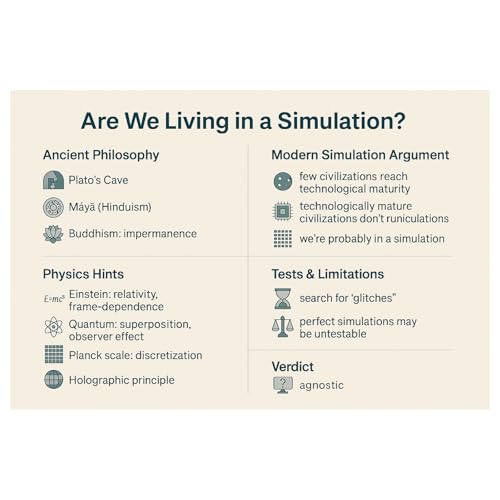
  • The Simulation Hypothesis: Ancient Intuition and Modern Physics
    Oct 6 2025

    Are We Living in a Simulation?" explores the simulation hypothesis across historical and scientific contexts. The discussion establishes that the idea of reality being an illusion is not new, referencing ancient concepts like Plato's Allegory of the Cave and the Hindu concept of Māyā. The episode then transitions to the modern argument by philosopher Nick Bostrom, who posits that statistically, we are likely living in an ancestor simulation created by a technologically mature civilization. Furthermore, the hosts connect the hypothesis to modern physics, pointing out how Einstein’s relativity makes reality frame-dependent and dynamic, while quantum mechanics suggests reality only "renders" upon observation, potentially hinting at a "pixelated" structure or information-based universe. Ultimately, while emphasizing that there is no concrete evidence we are simulated, the source concludes that this thought experiment serves as a modern lens for addressing fundamental metaphysical and ethical questions about the nature of existence.

    Mostra di più Mostra meno
    6 min
  • Newton Versus Einstein: Who Changed the World More?
    Oct 6 2025

    "Newton vs. Einstein: Who Changed the World More?” systematically compares the two scientific figures across three categories: Predictive Power & Scope, Technological & Everyday Impact, and Conceptual Depth & Philosophical Shockwaves. The segment dedicated to Newton emphasizes his invention of calculus, the laws of motion and universal gravitation, and his role as the "operating system" for modern engineering and the scientific method. Conversely, the segment supporting Einstein focuses on his revolutionary theories of Special and General Relativity, which redefined spacetime and gravity, and his foundational contributions to quantum theory, noting his importance for modern technologies like GPS and cosmology. The debaters ultimately conclude that Newton is the greater builder of scientific laws and methods, while Einstein is the greater conceptual reframer of reality.

    Mostra di più Mostra meno
    9 min
  • The Shifting Layers and Illusions of Reality
    Oct 3 2025

    The Layers and Illusions of Reality" provides an overview of how different fields have conceptualized the nature of reality. The discussion begins with ancient philosophical views, referencing Plato's Allegory of the Cave and the Hindu concept of Maya, which both suggest that perceived reality is merely an illusion or shadow of a deeper truth. The hosts then transition to modern scientific perspectives, covering the predictable "clockwork universe" of Newton before focusing on how Einstein’s theory of relativity made reality observer-dependent by uniting space and time. Furthermore, the script addresses quantum mechanics, which suggests reality is probabilistic until observed, and concludes by exploring neuroscience, positing that reality is a filtered, simplified construction built by the brain for survival, not a direct reflection of objective truth. Ultimately, the segment finds that while reality is sufficiently real for science and technology to function, its ultimate nature remains a profound mystery.

    Mostra di più Mostra meno
    9 min
  • The Enigma of Time: Physics, Philosophy, and Perception
    Oct 3 2025

    "What Is Time?" offers a comprehensive overview of the nature of time across multiple disciplines. The conversation, featuring hosts Maya, explores how time has been conceptualized, starting with ancient philosophy—discussing thinkers like Parmenides and Augustine who questioned whether time is real or merely a measure of change. The script then transitions to modern physics, contrasting Newton's absolute time with Einstein’s theories of relativity, which establish that time is elastic and interwoven with spacetime, affected by gravity and motion. Finally, the discussion incorporates thermodynamics (explaining the "arrow of time" through entropy) and quantum theories, concluding that while our subjective feeling of time’s "flow" might be a neurological construct, the objective structure of time (like causality and duration) is demonstrably real.

    Mostra di più Mostra meno
    8 min
  • The Kardashev Scale: Mapping Civilizations Among the Stars
    Oct 3 2025

    “The Kardashev Scale: Mapping Civilizations Among the Stars,” which introduces and explains the framework developed by Russian astrophysicist Nikolai Kardashev in 1964. The host of Cosmic Horizons explains that this scale classifies civilizations based on their capacity to harness energy, serving as a metric for cosmic progress. The explanation details the three original levels: Type I, which describes a civilization mastering all the energy of its home planet, a level humanity is currently approaching at an estimated 0.7; Type II, which requires controlling the total energy output of its star, often conceptualized using a Dyson Sphere; and finally, Type III, which is a galactic civilization capable of harnessing the power of billions of stars. The script also briefly mentions speculative extensions, such as Type IV and V, emphasizing that reaching Type I is humanity’s immediate challenge for survival and progress.

    Mostra di più Mostra meno
    7 min
  • The Butterfly Effect, Fate and Free Will
    Oct 3 2025

    “The Butterfly Effect, Fate, and Free Will” explores the complex relationship between chaos theory, predetermination, and individual agency. The host first explains the Butterfly Effect, which stems from meteorologist Edward Lorenz's work, showing how small changes in initial conditions can lead to vastly different outcomes in complex systems. It then integrates this scientific concept with philosophical ideas of fate and destiny, suggesting that destiny might not be a fixed path but rather the overall shape of a life influenced by numerous possibilities. Finally, the script addresses free will, proposing a theory of compatibilism where humans exercise meaningful choice within the boundaries of chaotic circumstances, ultimately concluding that even the smallest actions possess significant power to alter life's trajectory.

    Mostra di più Mostra meno
    7 min