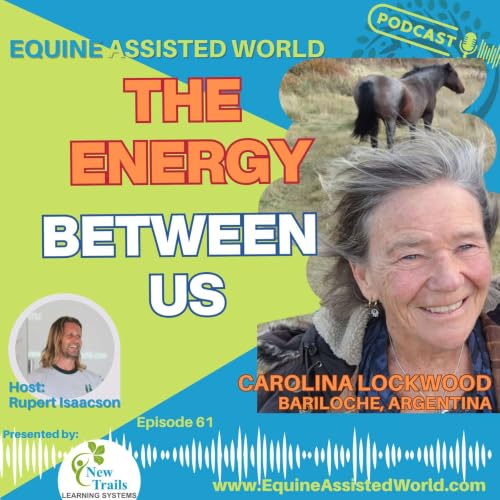
Equine Assisted World with Rupert Isaacson copertina

Equine Assisted World with Rupert Isaacson

Equine Assisted World with Rupert Isaacson

Di: Rupert Isaacson
Ascolta gratuitamente

Offerte di stagione | 0,99 €/mese per i primi 3 mesi

A seguire 9,99 €/mese – si applicano condizioni. Puoi disdire mensilmente.
Here on Equine Assisted World. We look at the cutting edge and the best practices currently being developed and, established in the equine assisted field. This can be psychological, this can be neuropsych, this can be physical, this can be all of the conditions that human beings have that these lovely equines, these beautiful horses that we work with, help us with. Your Host is New York Times bestselling author Rupert Isaacson. Long time human rights activist, Rupert helped a group of Bushmen in the Kalahari fight for their ancestral lands. He's probably best known for his autism advocacy work following the publication of his bestselling book "The Horse Boy" and "The Long Ride Home" where he tells the story of finding healing for his autistic son. Subsequently he founded New Trails Learning Systems an approach for addressing neuro-psychiatric conditions through horses, movement and nature. The methods are now used around the world in therapeutic riding program, therapy offices and schools for special needs and neuro-typical children.  You can find details of all our programs and shows on www.RupertIsaacson.com.Horse Boy LLC Igiene e vita sana Medicina alternativa e complementare Successo personale Sviluppo personale
  • The Fairy Forest: Nature, Story & Horses in Child Psychotherapy | Krisztina Molnar of ÉletrevaLÓ Gyermekekért Alapítvány, Debrecen, Hungary | EAW 63
    Oct 1 2026
    ✨ "I think the horse and the animal is kind of an anchor that keeps you in the present." – Krisztina MolnarDeep in the forest near Debrecen in eastern Hungary, a six-year-old foundation has become a home for animal-assisted therapy of every kind: clinical equine-assisted psychotherapy, work with neurodivergent children, family therapy, group therapy for children, adolescents and parents, and sessions for adults, alongside a small riding school, dressage and a vaulting team. Clinical psychologist Krisztina Molnar leads its clinical work with children and parents, supported by a team, 14 horses and three therapy dogs.The original plan was four to six horses and a quiet life in her "fairy forest." Instead, the foundation grew one family, one colleague and one need at a time, guided by a single principle: keep running something only as long as it serves everyone in the story, meaning the clients, the animals and the therapists. Along the way the forest itself became a therapeutic tool, complete with a wishing forest, a mound where problems can be blown away, and a transparent indoor arena that clients describe as a safety bubble inside nature.Rupert and Krisztina explore why nature can take clients deep very quickly, and why that is both a chance and a danger. They discuss how a classic "three wishes" diagnostic task becomes a fairy tale, what Winnicott's transitional space and the "wise mode" of schema therapy have to do with the forest, Hungary's relationship with mental health and transgenerational trauma, the difference between healthy fantasy and delusion, and why the horse is the anchor that keeps a person in the present moment.If you want to support the show, you can do so at Patreon: https://www.patreon.com/LongRideHome🔍 What You'll Learn in This EpisodeHow a foundation planned for four to six horses grew into a multi-program center with 14 horses, three dogs and a full teamWhy the guiding rule is to run something only as long as it serves clients, animals and therapists alikeWhy mentally healthy therapy horses need a natural environment, and how that shapes therapy before a session even startsWhy the forest can take clients deep very quickly, and why that brings both a chance to grow and a risk of falling apartWhy children who are overloaded by impressions may fear the forest, and what they are really afraid ofHow having a forest, an arena, a small indoor and an inside room lets the therapist tune the setting to each client's safety needsHow a transparent indoor arena, chosen because it was the cheapest option, works as a "safety bubble" and a transitional spaceHow magical places in the forest, like the wishing forest and the mound where problems are blown away, are built around clients' psychological needsHow the diagnostic "three wishes" task becomes a fairy tale, and how to translate a child's wish into an underlying needWhat schema therapy is, and how the forest may help clients connect to their inner "wise mode"How to tell healthy fantasy from delusion: does it connect you to yourself and others, or disconnect you?Why the horse acts as an anchor to the present momentHow Krisztina sees dressage as maintaining harmony through constant rebalancing, and why training of any kind helps therapy horses handle more situations🎤 Memorable Moments from the Episode00:03:40 Krisztina introduces herself as a clinical psychologist specializing in children and parents, certified to include her therapy dogs in sessions00:07:10 She reveals the original plan: four to six horses and a peaceful, quiet life in her fairy forest, which is not what happened00:08:50 Krisztina shares the one principle that guides every program: it runs only as long as it serves clients, animals and therapists00:22:50 She explains that frightened clients are not afraid of nature itself but of their own impulses projected onto the forest00:41:50 Krisztina describes nature as a model of resilience: a tree meeting an obstacle grows around it instead of trying the same way 100 times00:45:30 The transparent indoor arena, chosen as the cheapest option, turns out to be the best space for therapy, and clients call it a safety bubble in the forest00:51:00 The wishing forest story: Krisztina once wished for six horses and now has 14, so be careful what you wish for00:56:30 She shows how the "three wishes" diagnostic task becomes a fairy tale, and how a wish for one more toy car reveals a need to be heard01:16:40 Rupert asks whether there are real fairies in her forest, and Krisztina answers, "Of course there are"01:30:30 Krisztina draws the line between fantasy and delusion: imagination that connects you to yourself and your relationships, versus imagination that cuts you off01:49:30 Krisztina tells her own real-life fairy tale of asking the fairies for a life close to nature and horses, and finding more than she ever imagined📚 Contact, Projects, and Resources MentionedKrisztina Molnar – Clinical Psychologist, ÉletrevaLÓ ...
    Mostra di più Mostra meno
    1 ora e 57 min
  • An Autism Mom's Data on 70+ Horse Boy Sessions | Laila Rahmatian | EAW 62
    Sep 17 2026
    ✨ "Well, I'm an engineer. I collect data." – Laila Rahmatian Laila Rahmatian is an autism mom and former NASA engineer, originally from Houston and living in Indianapolis, Indiana when her son Donatello was diagnosed with autism spectrum disorder in October 2024 — now based near Frankfurt, Germany.Unlike most guests on this show, Laila isn't a practitioner — she's a service user. After her son's diagnosis, she brought her engineering background to bear on his care, systematically tracking data across a comparison of therapy approaches and, eventually, more than 70 Horse Boy Method sessions.This conversation covers Laila's diagnosis journey, why she walked away from a well-regarded autism center within minutes of touring it, the chance referral that led her family to Horse Boy Method after relocating to Germany, and the session-by-session developmental milestones her data captured — from a son who could barely stay on a horse for a minute to one making spontaneous eye contact, sleeping through the night, and initiating speech.If you want to support the show, you can do so at Patreon: https://www.patreon.com/LongRideHome🔍 What You'll Learn in This EpisodeWhy the first signs of Donatello's autism showed up not as a language delay but as a failure to respond to his own name — until a summer camp counselor discovered it wasn't the name he needed to hear, it was his mother's voiceHow Laila's background as a former NASA engineer, and later an ADHD coach and tutor, shaped her instinct to research every option rather than accept the first professional's recommended protocolWhy Laila and her husband initially tried to "rule out" the diagnosis entirely, and what changed their mindsWhat made Laila walk out of a well-regarded autism therapy center within ten minutes of touring it, and why environment turned out to matter as much as methodHow a chance referral from a school in Germany — not a marketing campaign — led Laila's family to Horse Boy Method for the first timeWhy Laila decided to start formally recording data on her son's sessions, and how skepticism from others became the reason she started tracking numbersWhat Laila's session-by-session data showed across roughly 70 sessions — from a child who could barely stay on the horse for a minute to one making spontaneous eye contact, sleeping through the night, and initiating speechHow working with multiple Horse Boy and Movement Method practitioners across Germany gave Laila a way to compare approaches and see which data patterns held upWhy Laila enrolled in Movement Method training herself rather than only bringing her son to sessions, and how that changed her ability to support him at homeWhat Laila is now planning for her family's next chapter — a "Horse Boy pilgrimage" across the practitioner network in Europe🎤 Memorable Moments from the Episode[00:01:15] Rupert introduces Laila as a mother tracking hard data on her autistic son's progress — and a former NASA scientist — flipping the show's usual practitioner-focused format[00:06:33] Laila recalls getting her son's diagnosis over the phone while driving, and telling the doctor she felt like they were "out to get my insurance money"[00:13:26] Laila breaks down in tears within ten minutes of touring a well-known autism therapy center, describing its sterile, neon-lit rooms as feeling like an asylum[00:29:30] Laila shares getting fired from a substitute teaching job at a Christian school for swearing in class — an unexpected twist in the chain of events that push her family toward the move to Germany[00:33:26] Laila recounts thinking "Horse Boy" was simply the German word for horse therapy, and mistakenly believing Rupert didn't speak English before their first meeting[00:39:50] Laila describes watching Donatello ride for the first time and hearing Rupert mention oxytocin and neuroplasticity — the moment she starts to move past her skepticism[00:54:52] Laila explains why she started formally logging data on every session: "Well, I'm an engineer. I collect data"[00:59:35] Laila walks through the data from session 19, when Donatello began saying "on" and "off" without prompting, answered yes/no questions at school, and slept through the night for the first time[01:20:38] Laila describes session 63, when Donatello pointed and said "That way" while on the horse[01:20:59] Laila recalls a session with practitioner Carla Brahms where Donatello sang and moved his hands on horseback, bringing Carla to tears📚 Contact, Projects, and Resources MentionedLaila Rahmatian https://www.instagram.com/lailaalieh/New Trails Learning Systems – Horse Boy Method, Movement Method & Takhin Equine Integration https://ntls.co Rupert Isaacson / Long Ride Home https://rupertisaacson.com Patreon Support https://www.patreon.com/LongRideHome🌍 Follow UsLong Ride Home https://longridehome.com https://facebook.com/longridehome.lrh https://instagram.com/longridehome_lrh https://youtube.com/@...
    Mostra di più Mostra meno
    2 ore
  • From Horse Theft to Horse-Facilitated Healing: Carolina Lockwood's 30-Year Evolution in Patagonia | Carolina Lockwood of Alquimia Equina, Bariloche, Argentina | EAW 53
    Sep 3 2026
    ✨ "It's not that I gave up. I switched." – Carolina Lockwood Carolina Lockwood joins Rupert Isaacson from Bariloche, in the Patagonia region of Argentina, where she has spent more than 30 years building equine-assisted work from the ground up — first blending art therapy with horses, then training directly with Rupert in Texas, then running an intensive Horse Boy–style program, then coaching, and now facilitating horse-based energy healing.What makes Carolina's story distinctive is the environment she's built it in. In the areas around Bariloche, horse theft for meat is a real and recurring danger — over the years Carolina has lost five horses to thieves, including cases where stolen horses were found slaughtered. She talks candidly about tracking horses down with the police, the informal social protections that eventually stabilized her herd's safety, and the anxiety that never fully goes away even after 30 years without an incident.The conversation traces her full arc: building a team of six staff and 30 kids a week at the height of her program, learning to read burnout in both horses and herself, closing that chapter deliberately rather than abandoning the work altogether, and evolving into equine coaching (trained through Kathy Pike and the Linda Kohanov lineage), liberty work (with Jean-François Pignon and Celeste Solzenne), and now a year-plus training in horse-facilitated energy healing with Saskia Marroquin of Caballo Cósmico. Along the way, Rupert and Carolina dig into what "energy work" actually means in practical terms, and why practitioners shouldn't feel locked into one rigid model for life.If you want to support the show, you can do so at Patreon: https://www.patreon.com/LongRideHome🔍 What You'll Learn in This EpisodeHow Carolina moved from art therapy and ceramics work with special-needs kids into equine-assisted work in Bariloche, PatagoniaWhy she traveled to Texas to train directly with Rupert after discovering the Horse Boy filmWhat it's actually like running horses in a region where theft and slaughter for meat is a recurring, organized threat — and how she and her family tracked down stolen horses with the policeWhy gauchos' and polo horses are rarely stolen while therapy and pleasure horses are the ones targetedHow Carolina rebuilt her herd's security by relocating and relying on informal community protection rather than fences or gunsWhat her own "non-structure structure" for horse welfare looks like, built around free roaming, herd life, and trust — and how it differs from the fitness-and-conditioning approach used in Horse Boy MethodHow she learned to read burnout in a horse, including a beloved therapy horse who started biting handlers when he was "done"Why she eventually closed her intensive riding-based program on purpose, and how she thinks about that decision nowHow she transitioned into equine coaching, training with Kathy Pike and the lineage of Linda Kohanov in ColoradoWhat liberty work with Jean-François Pignon and his student Celeste Solzenne taught her about horses reflecting a person's inner stateHow she began training in horse-facilitated energy healing with Saskia Marroquin of Caballo Cósmico, and what that work looks like in practiceThe story of a terminally ill client whose final wish involved Carolina's horses, and what it revealed to her about this kind of healingWhat Carolina's dream is for a future retreat and rescue sanctuary in Patagonia, and why she's decided to say it out loud🎤 Memorable Moments from the Episode[00:02:02] Carolina's path from art therapy and ceramics to horses, and the natural horsemanship training with Paul Walker that changed her perspective[00:06:27] Discovering the Horse Boy film, writing to Rupert, and going to Texas to train[00:11:56] The reality of horse theft and slaughter for meat in the mountains around Bariloche[00:15:22] Tracking down stolen horses with the police, and the ones she never got back[00:28:36] Carolina's "non-structure structure" for horse welfare, compared with Horse Boy's fitness-based system[00:38:00] A beloved therapy horse starts biting handlers — reading the signs of equine burnout[00:51:00] Carolina's own burnout, and the deliberate decision to close her intensive program[00:59:42] Liberty training with Jean-François Pignon and Celeste Solzenne[01:19:00] The story of a terminally ill client and what happened in her final horse session[01:32:55] Carolina's dream of a future healing retreat and rescue sanctuary in Patagonia📚 Contact, Projects, and Resources MentionedCarolina Lockwood – Equine-assisted practitioner, coach & energy healing facilitatorEmail: carowood9@gmail.comPatreon Supporthttps://www.patreon.com/LongRideHome🌍 Follow UsLong Ride Homehttps://longridehome.comhttps://facebook.com/longridehome.lrhhttps://instagram.com/longridehome_lrhhttps://youtube.com/@longridehomeNew Trails Learning Systemshttps://ntls.cohttps://facebook.com/horseboyworldhttps://instagram.com...
    Mostra di più Mostra meno
    1 ora e 49 min
adbl_web_anon_alc_button_suppression_t1
Ancora nessuna recensione