• What is Culture?
    Feb 1 2026

    What is culture, really? Is it food, clothing, music, beliefs — or something deeper? In this conversation, host Geoff Lawton and the panel explore culture through the lens of permaculture. From local food systems and ethics to migration, religion, consumerism and identity, the discussion keeps circling back to one core idea: culture emerges from place. When culture is disconnected from land, ecology, and local production, it becomes fragile, conflicted, and easy to manipulate. But when it’s rooted in care for the Earth and each other, culture becomes resilient and worth passing on.

    Watch the video episode here.

    Key Takeaways:

    00:00–02:00: Culture is not a trend or an identity label. It grows out of how people live with land, food, and each other over time.

    01:30–03:00: Agriculture and food systems sit at the foundation of every culture. Change the way food is grown, and culture changes with it.

    03:30–07:30: Belief systems and religion have historically provided shared ethics that guide behaviour, responsibility, and community life.

    07:30–10:30: Ethics are the invisible structure beneath culture. They shape how societies treat land, food, and one another.

    14:30–16:00: Culture is deeply shaped by place — climate, soil, resources, and what can be grown locally.

    17:00–19:30: Modern consumer culture disconnects people from land and food, replacing relationship with convenience and consumption.

    21:00–23:30: Local food systems create resilience and diversity, while centralized systems lead to sameness and cultural loss.

    22:30–24:00: When landscapes become homogenized, cultures begin to homogenize as well. Shopping malls and global supply chains are symptoms of this shift.

    26:30–28:30: Understanding other cultures requires context. Practices make sense when viewed through climate, history, and local conditions rather than judgment.

    27:30–30:30: Religion, culture, and ethics often overlap, functioning as systems that organise behaviour and shared responsibility.

    34:00–37:00: Culture is not static. It evolves — and can either degrade through extraction or regenerate through care and design.

    40:30–43:30: Permaculture provides a framework for consciously designing culture using ethics, ecology, and cooperation.

    43:30–46:00: The ethics of earth care, people care, and returning surplus offer a foundation for rebuilding resilient, place-based cultures.

    46:00–48:00 (end): A regenerative future depends on rebuilding culture from the ground up, starting with soil, food, and ethical responsibility.

    Mostra di più Mostra meno
    1 ora
  • Wildfires: How to Design a World that Doesn't Burn
    Jan 26 2026

    Wildfires aren’t just getting bigger — they’re behaving differently. In this episode, Host Geoff Lawton, Eric, Ben and Sam are joined by special guest Matthew Trumm to unpack why modern “mega-fires” burn hotter, faster, and across vast areas and what land design has to do with it. From degraded ecosystems and fuel loads to wind, water, and soil, this conversation explores how human decisions have reshaped fire behavior. The discussion also looks at Indigenous cultural burning, landscape buffers, and permaculture design strategies that reduce fire risk, offering a grounded and practical lens on how we can design landscapes and communities, that don’t burn.

    Watch the video episode here.

    Key Takeaways:

    00:11:50 – 00:16:30: Mega-fires aren’t normal wildfires. They’re driven by wind, heavy dry fuel loads, and degraded ecosystems, allowing fire to move into the canopy and accelerate rapidly.

    00:13:40 – 00:15:40: When forests lose grazing, ground cover management, and soil health, excess fuel builds up — allowing fire to climb into the treetops and spread uncontrollably.

    00:17:45 – 00:19:40: Open, simplified landscapes allow wind to accelerate. Well-designed buffer zones — trees, water, and earthworks — slow wind and reduce fire intensity.

    00:16:30 – 00:18:20: Low-intensity, intentional fire has long been used by Indigenous cultures to reduce fuel loads, protect ecosystems, and prevent catastrophic burns.

    00:35:55 – 00:36:45: Designs that work with natural systems require less energy and are more resilient. Forced systems rely on constant inputs — and tend to fail under stress.

    00:38:10 – 00:41:30: Degraded landscapes spiral toward desertification and disaster. Regenerative design rebuilds soil, holds water, and restores ecological balance.

    00:41:30 – 00:47:00: Start with water, restore soil, reduce fuel loads, and design buffers. Fire resilience is built long before fire season begins.

    Mostra di più Mostra meno
    1 ora e 39 min
  • Nationalism and the Permaculture Nation
    Jan 18 2026
    In this wide-ranging and deeply human conversation, host Geoff Lawton & Ben, Eric and Sam explore nationalism, immigration, borders and belonging through a permaculture lens. Drawing on Bill Mollison’s definition of a nation as a shared ethic — not a geographic boundary — the discussion reframes global challenges around scarcity, migration, labor and wealth. This is not a political debate. It’s a systems conversation about ethics, ecology and what it really means to belong. Watch the video episode here. Key Takeaways: 00:00 – 01:21 - The episode sets the stage by questioning modern nationalism and its confusion with patriotism. 01:38 – 02:15 - A nation is redefined through permaculture as a shared ethic and worldview, not borders or race. 02:15 – 03:07 - Ethnic nationalism is unpacked as a historical and dangerous distortion of identity. 03:09 – 06:29 - Economic stress, immigration, and labor exploitation are explored as systemic issues rather than moral failures. 06:30 – 08:21 - Modern borders and immigration are revealed as recent constructs that ignore historic movement and trade. 08:46 – 10:29 - Blame is shifted away from immigrants and toward concentrated wealth, power, and policy decisions. 10:29 – 12:41 - Survival instinct, territory, and human behavior are examined through both ecological and social lenses. 13:19 – 15:27 - Passport privilege highlights global inequality and the uneven experience of “freedom of movement.” 16:05 – 17:55 - Scarcity mindset vs. abundance mindset becomes a central theme, tying directly into permaculture ethics. 18:38 – 20:50 - Resource-rich nations suffering poverty reveal how systems, not nature, create deprivation. 21:26 – 22:41 - Geoff introduces the idea of a “permaculture nation” — a global identity rooted in care and action. 22:41 – 27:37 - Immigration reframed as an opportunity for land repair, skill-building, and eventual regeneration at home. 27:37 – 30:19 - Personal responsibility, consumer choices, and voting with time and labor are emphasized. 31:27 – 33:08 - Wealth is redefined as food, water, air, community, and resilience — not money. 33:08 – 35:13 - Local action and community engagement are positioned as real power outside financial systems. 35:13 – End - The episode closes by questioning unchecked systems while affirming permaculture as a practical, hopeful path forward.
    Mostra di più Mostra meno
    1 ora e 42 min
  • Bioremediation: Healing Sick Land
    Jan 10 2026

    What if pollution isn’t the end of the story but the beginning of regeneration? In this episode, host Geoff Lawton is joined by Sam Parker-Davis, Ben Missimer and Eric Seider for a grounded conversation on bioremediation – how living systems clean up humanity’s messes. This is a hopeful, practical conversation about resilience, confidence in nature, and why good biology wins in the end. If you’ve ever felt overwhelmed by pollution, toxicity, or environmental collapse—this episode offers a calm, grounded way forward.

    Key Takeaways:

    00:00 – 01:53 – Bioremediation uses living systems instead of high-energy machines to clean pollution.

    01:53 – 04:55 – Fear without solutions can paralyze us, but understanding biology empowers action.

    04:55 – 06:31 – Stories of snails surviving toxic conditions show nature’s resilience.

    06:31 – 10:16 – Growing up with nuclear anxiety and oil disasters taught Geoff that biology reduces fear.

    10:16 – 12:03 – John Todd’s wetlands can outperform mechanical systems for wastewater treatment.

    12:03 – 14:40 – The return of predators like wolves reveals ecosystem recovery beyond radiation readings.

    14:40 – 16:22 – Reed beds are legally required in rural Australia and effectively manage wastewater.

    16:22 – 21:17 – In Iraq, rubble, reeds, and gravity stopped disease and cleaned water in war-torn villages.

    21:17 – 24:35 – The John Bunker Sands wetland in Texas cleans wastewater efficiently but at high energy cost.

    24:35 – 28:02 – Wastewater wetlands from Melbourne to London support biodiversity and create abundance.

    28:02 – 30:22 – Pollution becomes damaging mainly when fear and ignorance prevent solutions.

    30:22 – 33:18 – pH, compost, and mulch make most gardens safe from heavy metals and contaminants.

    33:18 – 35:17 – Fungi can break down microplastics and other complex “forever chemicals.”

    35:17 – 39:27 – Permaculture mindset and soil life help humans stay hopeful and effective in a toxic world.

    38:56 – 40:22 – Life-rich soil locks up toxins, self-regulates, and reduces contaminant risks.

    40:22 – 42:45 – In Iran, crude oil was used on sand dunes to stop erosion and enable forest growth.

    42:45 – 44:52 – Light debris and windblown plastic can act as micro-mulch and aid plant growth if managed properly.

    45:17 – 46:38 – Permaculture interventions create structures that allow ecosystems to mature over generations.

    46:38 – 50:14 – Prioritize carbon storage in living soil for water retention, food, and ecosystem resilience.

    50:14 – 51:30 – Soil health is best measured by organic matter, and diverse plantings build resilience.

    51:30 – 53:58 – Hardy trees reclaim degraded land, recycle nutrients, and increase organic matter.

    54:37 – 01:00:12 – Let living systems self-replicate to reduce labor, toxicity, and create abundance.

    01:00:12 – 01:01:26 – High-quality compost introduces living soil ecosystems that naturally mobilize nutrients."

    Mostra di più Mostra meno
    1 ora e 7 min
  • Compost: The Engine of Fertility
    Jan 3 2026

    Compost isn’t just a pile — it’s the engine that drives soil fertility. In this conversation, Host Geoff Lawton and the regular crew, Sam, Eric, Ben are joined by guest Mohammed to unpack how compost really works, why biology matters more than recipes, and how the same principles apply from a backyard bin to large-scale farms. From hands-on composting stories to soil biology, bokashi, and scaling systems, this episode explores compost as a living process that feeds soil, plants, and people. If it once lived, it can live again.

    Watch the video episode here.

    Key takeaways:

    00:00:00–01:10: Compost isn’t a thing you make once — it’s a living process driven by biology.

    01:10–02:50: There’s more than one way to compost, and if life is breaking things down, it’s working.

    02:50–06:10: You don’t really learn compost from books — you learn it by doing it, mistakes and all.

    06:10–10:40: Compost works best when animals, gardens, and soil are designed to support each other.

    10:40–17:50: With compost and biology, even worn-out land can recover faster than most people expect.

    17:50–20:40: Compost builds fertility by feeding soil life first, not by feeding plants directly.

    20:40–23:40: Most compost problems come down to balance, and carbon is usually the missing piece.

    23:40–28:30: Good compost systems are designed first, and only then supported by the right tools or machines.

    28:30–34:40: Compost follows the same rules at every scale — from a backyard pile to broad-acre farming.

    34:40–53:30: Whether it’s aerobic or anaerobic, all composting relies on the same living biology doing the work.

    53:30–55:30: Bokashi isn’t finished compost — it’s a fermentation step that prepares food scraps for soil life.

    55:30–59:30: Compost is about returning life back to life and closing the cycle where it belongs.

    Mostra di più Mostra meno
    1 ora e 18 min
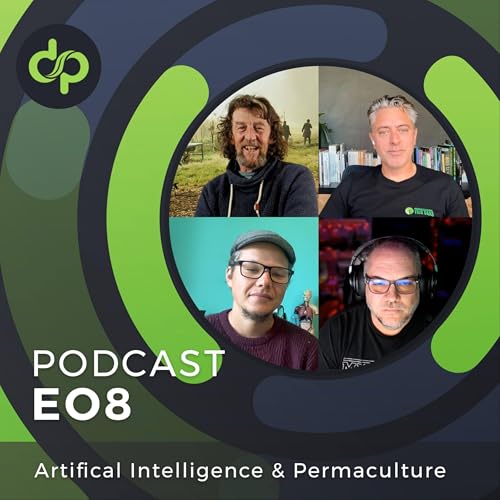
  • Artificial Intelligence and Permaculture
    Dec 20 2025

    Artificial intelligence is being called the biggest change in human history—bigger than the wheel. But what does it mean for those of us designing resilient futures? In this conversation, Host Geoff Lawton and regular guests Eric, Ben, and Sam wrestle with the knife’s edge of AI: its potential for abundance versus its risk of deepening inequality, war and ecological destruction. Along the way, they explore how permaculture design could harness AI to spread knowledge, the dangers of living in false realities, the resource drain behind the tech and why true wealth still comes from soil, water, and community. With stories ranging from Silicon Valley to Zaytuna Farm, this episode is both a warning and a call to embed ourselves more deeply in nature while the world hurtles toward uncertainty.

    Watch the video episode here.

    Key Takeaways:

    00:00:32 – 00:01:04: AI is being called a change bigger than the wheel—possibly the biggest shift in human history.

    00:05:28 – 00:06:49: AI is already used in war; leadership failures make its misuse likely, but a global permaculture network could use it for good.

    00:14:26 – 00:15:46: AI risks creating a false natural world, blurring reality and deepening disconnection from the Earth.

    00:16:33 – 00:18:01: Over-reliance on AI makes humans vulnerable; true security comes from being multi-skilled and fulfilled in diverse, hands-on work.

    00:20:01 – 00:21:19: The hyper-wealthy are driving AI development—raising the question: who really benefits?

    00:29:49 – 00:33:37: Permaculture offers a population solution: real wealth in clean air, water, food, and community naturally stabilizes human numbers.

    00:35:28 – 00:36:52: AI is resource-hungry—requiring vast amounts of energy, lithium, cobalt, and water—risking ecological collapse if unchecked.

    00:43:00 – 00:44:22: If AI learns from the natural world, it could be beautiful; if from artificial systems, its conclusions could be dangerously flawed.

    00:55:03 – 00:57:41: Religious and prophetic parallels warn of giving AI godlike power, raising existential questions of faith, ethics, and responsibility.

    01:17:09 – 01:19:42: Geoff’s closing directive: decouple from fragile global systems, embed in landscape, and trust in nature and spirit to stay sane.

    Mostra di più Mostra meno
    1 ora e 23 min
  • Greening the Desert Project
    Dec 12 2025

    Host Geoff Lawton and guests Sam, Eric, and Ben sit down to unpack the evolution of the Greening the Desert project, Jordan — from the early days of dust, salt, and heat to the cool, shaded food forest it became. Together they share field stories, design insights, and the lessons learned while turning a degraded desert site into a living demonstration of regeneration. It’s a roundtable tour through one of the most iconic permaculture projects ever built.

    Watch the video episode here.

    Key Takeaways:

    00:00 – 03:12: The project begins in the hardest conditions: Conflict, heat and barren soil set the stage for a bold restoration experiment.

    03:12 – 07:10: Evaporation is the real enemy in drylands: Shade, wind buffering and hardy pioneers must come first.

    07:10 – 12:20: From spiky pioneers to cooperative legumes: Mesquite held the line early, but gentler support species took over as soil improved.

    12:20 – 15:24: Water scarcity shapes every design decision: Swales, mapping and strict budgeting kept the system alive with only hours of weekly water.

    15:24 – 18:21: A 70-hectare project reveals costly surveying mistakes: Swales accidentally built uphill had to be torn out and rebuilt.

    18:21 – 21:11: A plastic bottle becomes the ultimate teaching tool: Geoff uses simple props to show how contour and water movement actually work.

    21:11 – 24:01: Eric arrives in 2009 to a Mars-like landscape: Harsh climate, cultural shock and nearby conflict defined his first days.

    24:01 – 27:01: Reality challenges the media narrative: Eric finds Jordan welcoming, safe and nothing like he’d been told.

    27:01 – 28:31: Hardship resets Eric’s understanding of difficulty: The desert strips away excuses and sharpens purpose.

    28:31 – 33:24: Sam’s journey leads to a thriving 2019 site: He arrives to find the project lush, stable and full of students.

    33:24 – 36:00: Proof deserts everywhere can be restored: If this site healed, better landscapes can rebound even faster.

    36:00 – 40:32: A 'peace army' replaces the military approach: They contrast permaculture’s healing work with systems that fail to make lasting change.

    40:32 – 47:27: Ben’s military experience fuels his restoration drive: War showed him the cost of destruction and the need for repair.

    47:27 – 50:48: Aid agencies often miss the point: Sam sees operations focused on extraction rather than regeneration.

    50:48 – 53:12: Forest systems beat vegetable beds in the long game: True resilience comes from canopy, soil life and structure.

    53:12 – 56:46: ‘Invasives’ become vital allies in dead landscapes: Fast pioneers rebuild soil where delicate natives can’t survive yet.

    56:46 – 01:00:25: You can’t recreate past ecosystems on degraded land: Regeneration needs a forward path, not nostalgia.

    01:02:23 – 01:04:21: Spain’s Almería shows the industrial opposite: A sea of plastic greenhouses reveals the cost of synthetic agriculture.

    01:04:21 – 01:05:30: Reed beds close the loop with elegance: Wastewater becomes irrigation and inspires nearby villages.

    Mostra di più Mostra meno
    1 ora e 13 min
  • Permaculture vs Glyphosate
    Dec 12 2025

    In this conversation, host Geoff Lawton along with regular guests Eric, Ben, and Sam trace the rise of chemical agriculture and how permaculture offers a healthier, sustainable alternative. From Geoff’s childhood revelations about farming in England to real-world examples in Australia, Mississippi, and California, this conversation explores the ecological, human, and social impacts of chemicals, and how thoughtful design can create abundance without them.

    Watch the video episode here.

    Key Takeaways:

    00:00:00 – 00:00:12 – Geoff introduces the podcast and sets the topic: permaculture versus glyphosate, framing it as a contentious issue.

    00:01:36 – 00:04:18 – Geoff shares a childhood insight from the late 1950s, observing organic vs chemical farming on TV. Key point: using unnatural chemicals felt inherently wrong to him, even as a child.

    00:04:18 – 00:09:58 – Historical progression from DDT and paraquat to glyphosate.

    00:09:58 – 00:13:22 – Damaging Effects of Herbicides. Global scale: over 800,000 tonnes of glyphosate used annually, widespread exposure.

    00:13:22 – 00:17:54 – Examples from Sacramento and the San Joaquin Valley, highlighting correlation of high pesticide use and cancer rates.

    00:17:54 – 00:26:38 – Geoff stresses that permaculture provides practical, sustainable alternatives.

    00:26:38 – 00:33:46 – Permaculture empowers local communities, offers chemical-free options.

    00:33:46 – 00:44:58 – Designing crops and weeds for natural fertility, rather than relying on chemicals.

    00:44:58 – 00:46:48 – Critical need: rethink reliance on chemical agriculture. Encourage listeners to explore permaculture principles in their own lives.

    Mostra di più Mostra meno
    47 min