Directionally Correct, A People Intelligence Podcast copertina

Directionally Correct, A People Intelligence Podcast

Directionally Correct, A People Intelligence Podcast

Di: WRKdefined Podcast Network
Ascolta gratuitamente

Offerte di stagione | 0,99 €/mese per i primi 3 mesi

A seguire 9,99 €/mese – si applicano condizioni. Puoi disdire mensilmente.
Directionally Correct is the #1 people intelligence podcast in the world. Hosted by Cole Napper, the podcast dives into people intelligence, workforce planning, behavioral science, and talent analytics, helping leaders navigate the future of AI in the workplace with insight and a dash of fun. To find out more, check out colenapper.comAll rights reserved by WRKdefined Economia Gestione e leadership Management Scienza
  • Should You Become an HRBP to Advance? A Microsoft HRBP Perspective - Ann-Marie Johnson - #193
    Oct 5 2026
    Thanks to HRBench for powering this episode. To find out more about the company building the future of people intelligence, reach out to book a demo at hrbench.com/directionallycorrect! Check out this episode of the #1 people intelligence podcast with special guest, ⁠Ann-Marie Clayton Johnson⁠, Senior Director, Human Resource Business Partner at Microsoft & Former Salesforce People Analytics Leader! Cole has known Ann-Marie since she was a Salesforce people analytics leader he looked up to. Then she became an HR business partner at Microsoft, and this episode asks why. Analytics was the highlight of her last decade: curiosity, access, and a team that shaped strategy by defining the metrics, work she credits in part to Ernestine. She left before seniority locked the door. Companies hesitate to trust a senior analytics person in a role they have never held, even though she would take that risk herself. Cole ties the move to advice from the CHRO practice at Heidrick & Struggles: business partner experience is often the barrier between people analytics and the top job. What an HRBP does depends on the company. Smaller firms fold in operations. At Salesforce, partners did communications and employee experience. At Microsoft, Ann-Marie supports senior leaders in SMB and channel, a high-growth business whose sellers carry hundreds of accounts rather than enterprise’s one-to-one model. Her weeks are leadership development, off-sites, talent walks, succession, and org design, including SMB-specific roles inside functions built for enterprise. The sharper turn is producer to consumer. Any partner worth their salt should use analytics. Her background helps her see the system of data. On a low-performance steerco she pushed upstream: what predicts low performance, where the hot spots are, which managers deserve a double click, before a case opens. Connect the points so the story is visible. An agent or a dashboard does not change the world. She has been at Microsoft only since February. People analytics had gone tools-forward and help-yourself. It did not work, and consulting is coming back. Nate Schultz joined from Salesforce, aligned to her skip level, with a team supporting sales. She wants those consultants senior enough to know statistics and the business. A leader who wanted people back in the office became the test. About 19 people were going in, not enough to know whether attendance helped. The answer came back as not statistically significant. She needed practical significance, and a partner who will say the variables are wrong. Embedding fails unless people are held accountable in writing. If data use is not in Connects goals, it will not show up. She wants a culture that still asks how do you know. People analytics is not dead, but the hypothesis work she loved is fading, while the technical layer stays because AI needs people who can structure and choose data. Anyone too far from the business will not last. Cole’s inquisitor and change agent frame matches: ask, analyze, act. The field over-indexed on the automatable middle, and people intelligence flattens the rest into a data layer and an intelligence layer. I-O training let her skip years across centers of excellence. She shares the resume-bullet framework and the S-curve: leave while the work is energizing and build breadth instead of waiting on a pyramid of junior analysts. She is a military spouse. Ryan went to West Point and deploys often. She helps transitioning service members and is PTA president for a year. Cole’s Corner covers teaching, a Texas shore, and Harry Potter. As a future CHRO she would not lose the employee experience that pulled her in after Cisco. They take on Andreessen on talent and workplace bullshit versus lying. Change comes from winning companies. Find her on LinkedIn as Ann Marie Clayton Johnson. If you like this episode, you’d also love exploring prior episodes—visit colenapper.com for the full archive and show links.
    Mostra di più Mostra meno
    1 ora e 15 min
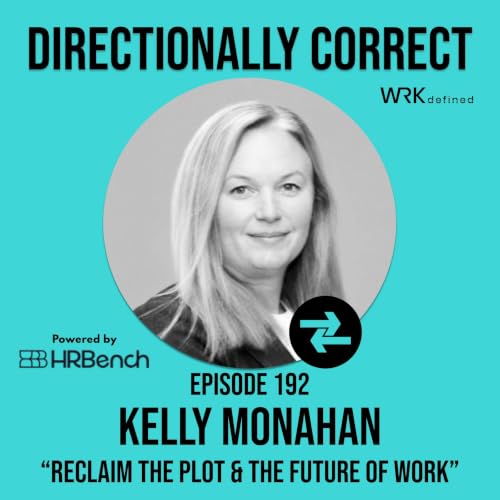
  • AI Impacts, Gig Work, Upwork, Reclaim the Plot & Futurists - Kelly Monahan - #192
    Sep 28 2026
    Thanks to HRBench for powering this episode. To find out more about the company building the future of people intelligence, reach out to book a demo at hrbench.com/directionallycorrect! Check out this episode of the #1 people intelligence podcast with special guest, ⁠Kelly Monahan⁠, Future of Work & AI Advisor and recent Author of “Reclaim the Plot”! Cole Napper sits down with Kelly for a wide-ranging conversation that moves from the uncanny to the practical and back again. Kelly recounts spending six hours in a recording studio so an AI digital avatar could learn her likeness, then months training it, only to watch that digital twin land in the Wall Street Journal. Her first reaction was that it was creepy: a likeness that was her and yet not her. Over time she began using it to open keynotes and to show that the AI conversation is larger than large language models, though she is candid that it is still more novelty than something she would send into a meeting the way Reed Hoffman does. That experiment sits inside a larger argument. After years in tech, Kelly concluded we have lost the plot on the pursuit of AI. The technology has existed since the 1950s; the current wave is real and transformative, especially agentic systems, but treating early ChatGPT as an excuse to hollow out knowledge work without redesigning the work itself is a mistake. Productivity gains show up, she says, citing McKinsey and BCG, only when work redesign accompanies the tools. Only about 21 percent of companies have done that redesign. Without it, people simply send more email and sit in more meetings. AI becomes an expensive way to illuminate how poorly designed the work was in the first place. Kelly walks through a simulation she built in hours for her forthcoming book’s fictional company, Driftwell—work that would once have taken a team ninety days and tens of thousands of dollars. A parent agent spun up specialists, connected to HubSpot, and orchestrated the whole thing. She defines an agent as a system that takes action toward a goal rather than merely chatting. The same pattern appeared in her four years at Upwork around the November 2022 “D-Day” of ChatGPT: the freelancer market entered an existential crisis, disruption arrived slowly rather than overnight, early AI users earned more and bid on larger projects, and inequity widened along a power-law distribution. The lasting finding was that this is a massive skilling moment, especially for transactional content work. The conversation turns to leadership. Most senior leaders mandate AI without using it themselves, either because they believe strategy is too elevated for tools or because they fear the C-suite itself will shrink. Intelligence and expertise are being commoditized; what remains is change management and the messy human middle that agents cannot yet own. Accountability becomes the billion-dollar question: if two hundred agents gather the inputs, can an executive still be accountable for a decision they cannot fully verify? Span of control, entry-level learning-by-doing pathways in consulting, and the dignity of physical work all get examined. Kelly worries we told a generation to abandon the physical world even though those jobs often carry meaning, community, and contribution that leisure-only futures may not replace. In Cole’s Corner they cover growth mindset (Kelly argues the label matters less than accompanying behavioral interventions and human relating), the 1975 “folly of rewarding A while hoping for B,” broken performance management, and eye-watering revenue-per-employee figures that raise questions about reinvestment, customers, and long-term social consequences. Kelly points listeners to LinkedIn and reclaimtheplotbook.com. If you like this episode, you’d also love exploring prior episodes—visit colenapper.com for the full archive and show links.
    Mostra di più Mostra meno
    1 ora e 16 min
  • Compensation, HRIS, Analytics, & Blue Collar Work at Kimray - Kevin Trowbridge - #191
    Sep 21 2026
    Thanks to HRBench for powering this episode. To find out more about the company building the future of people intelligence, reach out to book a demo at hrbench.com/directionallycorrect! Check out this episode of the #1 people intelligence podcast with special guest, Kevin Trowbridge, Director of Compensation and HRIS at Kimray! In this conversation Cole Napper sits down with Kevin to unpack what it means to lead compensation and HRIS as one combined function at a 78-year-old Oklahoma manufacturer that had no dedicated role for either until 2024. Kevin landed in the work almost by accident: a math degree, a banking career that burned him out, and a friend who spotted a utility job that wanted someone who could handle numbers. That first administrator seat taught the unglamorous truth. You run the reports, match the jobs, build the structures, and learn that compensation is finance with a human being on the other side of every figure. The work still looks more like an apprenticeship than something you can absorb from a book. WorldatWork’s CCP typically takes three to five years because the classroom only sticks if you are already living the messy decisions. Comp ratios, percentiles, internal equity, and survey matching all sound like people-analytics language, so Cole asks why compensation and people analytics so rarely sit in the same room. Kevin’s answer is blunt. Pay makes people nervous. Companies that lag the market do not want that exposed. Culture can offset dollars, and at Kimray it often does. Tenure of 40-plus years is still common. Leaders teach culture to other businesses through a foundation. Frontline supervisors get executive-level leadership training. People stay because the values match, not because every offer sits at the 75th percentile. Kimray manufactures pressure regulators, valves, sensors, and level controllers for oil and gas, made in the USA. Until May 1 of this year it was family owned. It is now an ESOP, so employees become beneficial owners through a company-funded retirement plan that sits on top of the 401(k). That ownership story collides with another unusual design choice: the CEO refuses traditional sales commissions. He does not want credit-stealing or split-store fights. Sales grew from roughly 100 million to the 230–250 million range with a company-wide EBITDA bonus instead. The team is now testing a group accelerator so everyone rows toward the same outcome. AI is the thread that keeps Kevin up at night. Tools like Claude already save his analyst hours and even teach him Python. HRBench turned a ten-minute request for three years of departmental turnover into a clean, trusted slide. Workforce planning lets finance and leaders add, subtract, and cost positions in the same conversation. Kevin still asks the moral question: if AI swallows the entry-level report running and employee-relations grunt work, who develops the next generation of compensation and HRIS professionals? In ten years the seniors will retire unless companies keep the apprenticeship intact. The episode also lands in a 60–65 percent blue-collar workforce. Extreme heat changes time spent at work not working. Air conditioning in a machine shop is a retention variable, not a perk. Kevin lives that contrast personally: diesel truck, red Oklahoma dirt, 11 acres, pond, chickens, a log-cabin house next to the in-laws, and a history nerd’s dream of Trowbridge, England. Rapid-fire Cole’s Corner covers banking as the road not taken, Neo from The Matrix, and a three-year forecast in which agentic tools run basic analysis in the background while compensation, analytics, and core HR finally stop living in separate Excel dumps. Attract, reward, and retain only work if the numbers, the culture, the systems, and the next generation of talent are treated as one problem. This episode is the field notes. If you like this episode, you’d also love exploring prior episodes—visit colenapper.com for the full archive and show links.
    Mostra di più Mostra meno
    1 ora e 8 min
adbl_web_anon_alc_button_suppression_t1
Ancora nessuna recensione