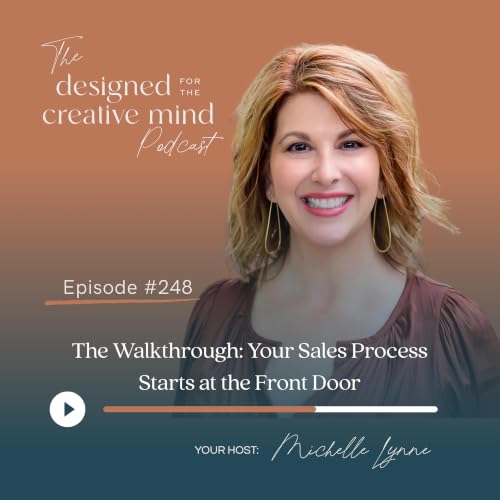
Designed for the Creative Mind™ copertina

Designed for the Creative Mind™

Designed for the Creative Mind™

Di: Michelle Lynne
Ascolta gratuitamente

Offerte di stagione | 0,99 €/mese per i primi 3 mesi

A seguire 9,99 €/mese – si applicano condizioni. Puoi disdire mensilmente.
Your designs are beautiful, but you're struggling with the business of your interior design business. Join successful interior design business owner, Michelle Lynne, of ML Interiors Group each Monday morning as she shares the processes she has found useful in growing her own 7-figure design firm, interviews industry related guests, and brings her own team of designers on for lively conversations. If you aren't happy with the performance of your interior design business, are tired of trading your time for money, and know you were made for more, this show is for you. Arte
  • Ep 248: The Walkthrough: Your Sales Process Starts at the Front Door
    Oct 26 2026

    An inquiry comes in. You're in the middle of an installation, juggling procurement, answering client questions, and managing a dozen other things. You tell yourself you'll respond when you have a minute to give that potential client the attention they deserve.

    And suddenly, a day or two has passed.

    Sound familiar?

    In this episode of Designed for the Creative Mind, Michelle Lynne continues The Walkthrough, a series that takes interior designers through their businesses just as they would walk through a client's home. This time, she's looking at what happens after a potential client knocks on your door.

    Michelle shares why getting from inquiry to first appointment seems to be taking longer in today's market, why a slow response can cost you a client, and how a thoughtful sales process can help you turn more inquiries into actual projects.

    Because here's the thing: your clients shouldn't have to figure out how to hire you. It's your job to lead them through the process.

    Michelle walks through the importance of responding promptly, assigning clear ownership of incoming inquiries, following up consistently, and using a CRM and email automation to keep potential clients engaged. She also explains how email marketing can nurture relationships with people who aren't quite ready to hire you yet.

    Whether you're a solo designer wearing every hat or leading a growing team, this episode will help you identify where potential clients might be slipping through the cracks—and how to create a process that works even when you're busy.

    In This Episode, You'll Learn:
    • Why potential clients may need more reassurance and connection before booking their first appointment.

    • How a slow response to an inquiry can influence a client's perception of your firm.

    • Why a prompt, thoughtful reply is better than waiting for the perfect response.

    • How assigning clear ownership of inquiries prevents potential clients from falling through the cracks.

    • Why having someone screen inquiries can protect your time and help you avoid taking on projects that aren't the right fit.

    • How to follow up without feeling pushy or salesy.

    • Why a CRM is essential for tracking conversations and managing your sales pipeline.

    • How email automation can help you stay connected with prospects when they're not ready to hire you.

    • Why a consistent sales process is a service to both your clients and your business.

    Key Takeaway

    Follow-up is a service. When someone reaches out to your firm, they're expressing interest in working with you. It's your job to make the next step clear, easy, and welcoming.

    A well-designed sales process doesn't pressure clients into making decisions. It helps them feel supported while ensuring that good opportunities don't disappear simply because you're busy.

    Ready to Walk Through Your Business?

    Are potential clients getting lost between their first inquiry and their first appointment? Or are you spending too much time trying to keep your sales process organized?

    Michelle offers Sidemark Business Walkthroughs to help interior design firm owners identify gaps in their sales, marketing, operations, and processes. Together, you'll look at what's working, where things are getting stuck, and where you could use additional support.

    Schedule your Sidemark Business Walkthrough using this link: https://api.mysidemark.com/widget/bookings/sidemark-business-walkthrough

    Coming Up Next

    In the next episode of The Walkthrough, Michelle takes a closer look at the interior design sales process, including the qualifying call, meet and greet, initial visit, scope of work presentation, and contract signature.

    Enjoying Designed for the Creative Mind? Follow or subscribe to the podcast so you don't miss the next episode.

    Mostra di più Mostra meno
    37 min
  • Ep 247: The Walkthrough: Is Your Marketing Front Door Open?
    Oct 19 2026

    Your interior design business might be doing beautiful work, but are the right clients finding their way to you?

    In this episode of Designed for the Creative Mind, Michelle Lynne kicks off The Walkthrough, a series that takes you through every room of your interior design business, from marketing and sales to operations, procurement, installation, and project closeout.

    First up is the front door: marketing.

    Michelle shares why referrals alone aren't a marketing strategy, how the busy-season blackout can leave your pipeline empty, and why consistent marketing doesn't have to mean posting every single day. She also explores how to make your marketing sound like you, why handing marketing off isn't always as simple as hiring someone, and how marketing connects to every other part of your business.

    If you've ever let marketing slide because client projects took over, only to find yourself scrambling for new leads a few months later, this episode is for you.

    In This Episode, You'll Learn:
    • Why referrals aren't the whole story. Clients often discover you through a referral but research your website, portfolio, and social media before deciding to reach out.

    • How to break the busy-season blackout cycle. Marketing takes time to produce results, so stopping when you're busy can create a pipeline problem months later.

    • What consistent marketing really looks like. A current website, a monthly blog, regular email communication, and a manageable social media presence can go a long way.

    • Why your marketing needs to sound like you. Clients are hiring your perspective, expertise, and approach to design—not just your portfolio photos.

    • How to delegate marketing without losing your voice. A good content partner needs to learn how you think and communicate, not just follow a list of instructions.

    • Who should own marketing in your firm. If marketing is everyone's secondary responsibility, it can quickly become nobody's responsibility.

    • How marketing connects to the rest of your business. Your marketing efforts influence sales, capacity planning, client experience, reviews, and referrals.

    Your Action Steps

    Before you overhaul your marketing, take a closer look at what's already working.

    1. Review your last 10 signed clients and trace how each one actually found you.

    2. Ask past clients what led them to your business and which channels they explored before reaching out.

    3. Look at your website and social media through the eyes of a potential client. Does your content feel current, relevant, and reflective of your firm?

    4. Identify who owns marketing in your business—and who is accountable for keeping it consistent.

    5. Choose a manageable marketing rhythm you can maintain even when your project calendar is full.

    Remember: Marketing isn't something you do when you have time. It's an essential part of running your business.

    Ready to Walk Through Your Own Business?

    Wondering where your business is working well and where things might be held together by you?

    Schedule a free Business Walkthrough with Michelle and the Sidemark team. Together, you'll look at how clients find you, what happens when they inquire, and where your systems may need attention. Depending on your needs, the walkthrough can extend into sales, operations, design development, sourcing, procurement, installation, and project closeout.

    You'll leave with a clearer picture of your business and actionable next steps.

    Schedule your Business Walkthrough:

    https://api.mysidemark.com/widget/bookings/sidemark-business-walkthrough

    Coming Up Next

    In the next episode of The Walkthrough, Michelle heads into the sales room. A potential client has found your firm and filled out your contact form—but what happens next? Follow the inquiry from the first message to the signed agreement and discover where good marketing can quietly go to waste.

    Thanks for listening to Designed for the Creative Mind with Michelle Lynne!

    Mostra di più Mostra meno
    33 min
  • Ep 246: Nobody Warned Me About This Part: Hiring Would Expose My Own Weaknesses
    Oct 5 2026
    Hiring people is supposed to create capacity. But what happens when bringing someone onto your team actually makes your business feel more complicated? In this episode, Michelle Lynne gets honest about one of the parts of business ownership nobody warned her about: hiring people would force her to confront how much of her business was living inside her own head. When you've built a business around your own instincts, experience, and standards, it's easy to assume that what feels obvious to you will be obvious to everyone else. But your team can't read your mind—and they shouldn't have to. Michelle shares the lessons she learned as her design firm grew, including why hiring initially created more work instead of less, how recurring team problems can reveal weaknesses in the business itself, and why delegation requires more than simply handing someone a list of responsibilities. She also explores the uncomfortable reality that sometimes the problem really is the employee—but you can't fairly determine that until you've looked at the role, the process, your leadership, and the support you've provided. In this episode, Michelle talks about: Why hiring often begins with addition before it creates subtraction How a team exposes the parts of your business that have been running on your memory, instinct, and unwritten standards The difference between describing a task and actually defining what "good" looks like Why "be more proactive," "use your judgment," and "take care of the client" aren't actually clear standards The principle: "Every project is different, but the process should be the same." How undocumented processes turn the owner into the answer to every routine question Why capable owners can accidentally create dependent employees by solving problems too quickly The difference between giving someone responsibility and giving them the authority to actually own it Why offering your perspective is different from taking the work back How delayed feedback can turn a simple conversation into a much bigger problem Why caring about your team can sometimes become an excuse for avoiding difficult conversations How to determine whether you're dealing with a people problem, a role problem, or a leadership/process problem When you have to accept that someone simply isn't the right fit for the role Why examining your own leadership doesn't mean taking responsibility for every failed hire What Michelle does differently today as she leads her design firm A question to ask yourself If you're frustrated with someone on your team right now, don't start with: "Is she a good employee or a bad employee?" Instead, look at the role. Ask yourself: What has actually been made clear? What authority does she have? What feedback has she received? What support has been provided? Does the process actually support the work? Have I communicated what needs to be communicated? Have I given her enough room to make decisions? If you've done those things and the same problem continues, you may finally have the information you need to address the person or the fit with confidence. Because sometimes the answer is better direction. Sometimes it's a better role. And sometimes, uncomfortable as it may be, it's a different person. The bigger lesson Hiring isn't simply a way to purchase more capacity. Hiring is a commitment to lead. When someone joins your company, they're stepping into your clients, your history, your standards, your processes—and all of the assumptions you may not even realize you've made. Your job as the owner is to make as much of that invisible information visible as you reasonably can. Standards need to be stated. Responsibilities need to be clear. Processes need to be documented. Feedback needs to happen while it can still be useful. And authority needs to accompany responsibility. Because the goal isn't to create a team that thinks exactly like you. It's to create a business where talented people can make good decisions without needing the owner to be the answer to everything. Work With Michelle If you're in the middle of a team situation and you're too close to it to tell whether you have a people problem, a role problem, or a leadership problem, private coaching can help you step back, separate the facts from the frustration, and determine what needs to change. Learn more about working with Michelle here: https://thedesignbakehouse.com/private-coaching Keep Listening This episode is part of Michelle's series about the parts of business ownership nobody warned us about—the messy, uncomfortable, and surprisingly valuable lessons that come with growing a company. Because sometimes you don't need another business strategy. You need to be willing to look at what your business is showing you.
    Mostra di più Mostra meno
    42 min
adbl_web_anon_alc_button_suppression_t1
Ancora nessuna recensione