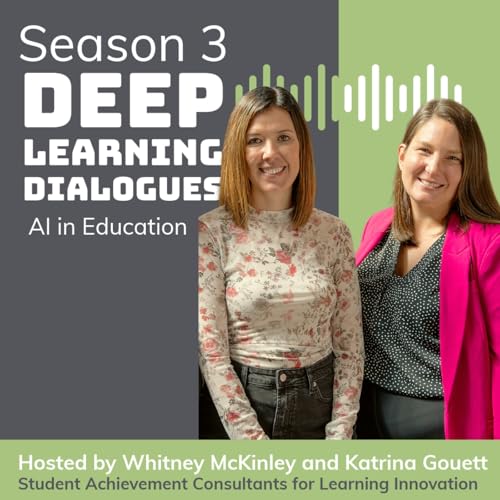
Deep Learning Dialogues copertina

Deep Learning Dialogues

Deep Learning Dialogues

Di: Katrina Gouett and Whitney McKinley
Ascolta gratuitamente

Welcome to "Deep Learning Dialogues," the essential podcast for K-12 educators diving into the transformative world of generative AI. In each episode, we bring you insights from experts at the forefront of this innovative technology. We will explore how GenAI can be used in a human-centered way to foster equity, inclusion, and belonging in the classroom.

Follow us on Instagram @WCDSBInnovates or head over to https://innovate.wcdsb.ca/ for all things Innovation.

This is a Waterloo Catholic District School Board podcast

Hosted on Acast. See acast.com/privacy for more information.

Katrina Gouett and Whitney McKinley
  • Beyond the Trap: Why Hidden AI Prompts Fail Educators and Students
    Jun 18 2026

    In this episode of Deep Learning Dialogues, hosts Whitney McKinlay and Katrina Gouett sit down with Dr. Adam Pacton to unpack the controversial practice of "prompt injection" or hiding invisible text in assignments to catch students using generative AI. Moving past the initial "ick" factor or ethical intuition that such tactics turn classrooms into policing environments rather than spaces of mutual trust, the conversation explores the concrete legal, technical, and pedagogical failures of these traps. Dr. Pacton explains how hidden instructions act as an accessibility nightmare under regulations like the ADA Title II and Ontario's AODA, because screen readers accidentally surface the invisible text, confusing students who rely on assistive technology. Rather than relying on flawed detection mechanisms, the episode advocates for a systemic paradigm shift toward "process over product," urging institutions to provide teachers with the cover and resources needed to meaningfully redesign assessments and foster relational intelligence. You can read the episode summary here.


    Dr. Adam Pacton is an associate teaching professor and Dean's fellow for AI literacy and integration at the College of Integrative Sciences and Arts at Arizona State University. Working at the intersection of pedagogy, ethics, and emerging technology, he focuses on institutional AI governance while helping educators move away from fear-based compliance toward thoughtful, human-centered classroom integration. With a PhD in rhetoric and composition, Dr. Pacton brings a deeply grounded perspective to language practices, change management, and student agency in the age of artificial intelligence. Outside of his academic and administrative leadership roles, he rounds out his human perspective as a father, an avid video game player, and a passionate fan of fantasy and sci-fi literature.


    Episode Link:

    -ASU Guidance on Hidden-Text/Prompt Injection Techniques in Assignments

    Want to know more?

    You can check out our: WCDSB GenAI Guidelines, infographics, and Innovation website: https://innovate.wcdsb.ca/

    Feedback? You can ask your questions or give us feedback on the show here

    Want to get in touch? Contact Katrina & Whitney by email at: katrina.gouett@wcdsb.ca and whitney.mckinley@wcdsb.ca or on LinkedIn

    Hosted on Acast. See acast.com/privacy for more information.

    Mostra di più Mostra meno
    46 min
  • The Messy Middle: Navigating Artificial Intelligence in the Classroom
    Jun 11 2026

    In this episode of Deep Learning Dialogues, explore the "messy middle" of artificial intelligence in education with guest Jessica Rizk, PhD, OCT. Moving past the polarizing narratives of absolute tech adoption versus complete avoidance, the conversation examines how generative AI is actively reshaping the classroom from the ground up. Rizk highlights the urgent need for foundational AI literacy beginning in kindergarten, illustrating through personal anecdotes how young children form implicit relationships with technology long before formal instructions begin. Together, they explore the critical shift from viewing AI merely as a baseline productivity tool to utilizing it as a human springboard for deeper critical thinking, assessment restructuring, and meaningful conversation. The discussion culminates in a powerful look at public policy, evaluating Canada’s current ranking in AI literacy training and addressing the crucial systemic tension between maintaining agile institutional structures and empowering educators with a coherent, standardized, and supportive framework.

    Dr. Jessica Rizk is a senior research associate at Signal 49 Research, a pan-Canadian nonprofit applied research organization dedicated to tackling some of Canada’s largest systemic challenges. Deeply rooted in the education sector, she serves as an instructor at both Wilfrid Laurier University and the University of Waterloo, and previously a former K–8 elementary classroom teacher. Jessica is a prominent voice in educational policy and tech literacy, authoring the impactful January op-ed, "Canada’s AI Strategy is missing kids," which champions the creation of a national, comprehensive AI education strategy. Melding her extensive academic research with her firsthand experience as an educator and a parent, she provides a uniquely well-rounded perspective on what it truly means to build sustainable human agency and foundational skills in an AI-driven world. You can follow and learn more about Jessica on LinkedIn.

    Want to know more?

    You can check out our: WCDSB GenAI Guidelines, infographics, and Innovation website: https://innovate.wcdsb.ca/

    Feedback? You can ask your questions or give us feedback on the show here

    Want to get in touch? Contact Katrina & Whitney by email at: katrina.gouett@wcdsb.ca and whitney.mckinley@wcdsb.ca or on LinkedIn

    Hosted on Acast. See acast.com/privacy for more information.

    Mostra di più Mostra meno
    45 min
  • Critical Thinking, AI Co-Authorship, and the Future of Academic Writing
    Jun 4 2026
    In this episode of Deep Learning Dialogues, hosts Whitney McKinley and Katrina Gouett sit down with Dr. Christin Wright-Taylor, Manager of Writing Services at Wilfrid Laurier University, to explore the intersection of generative AI, academic writing, and the human voice. Shifting the conversation away from fear and toward hope, Dr. Wright-Taylor discusses why generative AI should be viewed as a "calculator for language" and argues that foundational writing skills are more critical than ever for guiding and assessing AI outputs. The conversation explores the necessity of protecting the "incubator of thinking" by encouraging students to embrace messy, authentic first drafts before turning to digital tools. By reframing writing as an iterative process rather than a transactional product, this episode challenges educators to evaluate their own implicit biases regarding academic tone and explore how rubrics can evolve to celebrate diverse cultural capital and unique student voices.Dr. Christin Wright-Taylor is the Manager of Writing Services at Wilfrid Laurier University, where she and her team specialize in helping students build self-efficacy and critical thinking through the writing process. She holds a PhD in Composition and Rhetoric from the University of Waterloo, as well as an MFA in Creative Writing. Over her 25-year career as an educator, writer, and scholar, Dr. Wright-Taylor has written books and contributed to national publications including The New York Times and The Washington Post. Dedicated to helping students cultivate a "writing state of mind," she is a passionate advocate for preserving human curiosity and individual voice in an increasingly automated landscape. You can find Christin on LinkedIn.Resources Mentioned in This Episode:Bad Ideas About Writing edited by Cheryl E. Ball and Drew M. Loewe: https://textbooks.lib.wvu.edu/badideas/badideasaboutwriting-book.pdf"Should Writers Use They Own English" by Vershawn Ashanti Young: https://artsci.tamu.edu/english/_files/_documents/research/use-they-own.pdfAntiracist Writing Assessment Ecologies: Teaching and Assessing Writin for a Socially Just Future by Asao B. Inoue: https://open.umn.edu/opentextbooks/textbooks/antiracist-writing-assessment-ecologies-teaching-and-assessing-writing-for-a-socially-just-futureWant to know more?You can check out our: WCDSB GenAI Guidelines, infographics, and Innovation website: https://innovate.wcdsb.ca/Feedback? You can ask your questions or give us feedback on the show here Want to get in touch? Contact Katrina & Whitney by email at: katrina.gouett@wcdsb.ca and whitney.mckinley@wcdsb.ca or on LinkedIn Hosted on Acast. See acast.com/privacy for more information.
    Mostra di più Mostra meno
    49 min
adbl_web_anon_alc_button_suppression_t1
Ancora nessuna recensione