Episodi

  • Grabby Aliens & The Sleepers: The Fermi Paradox Series
    Jan 20 2026

    The universe is 13.8 billion years old and teeming with the ingredients for life, yet our sky remains hauntingly silent. In this three-part series, we confront the Fermi Paradox—the single most disturbing anomaly in science. We move beyond the pop-culture aliens to explore the cold, hard math of galactic colonization, the terrifying implications of the "Great Filter," and the mind-bending physics that might explain why we seem so alone.

    What if they aren't dead? What if they are just... operating on a level we can't perceive? We examine the "Grabby Aliens" model, which uses selection bias to predict that aggressive, expanding civilizations are out there, and we are simply in a "quiet" bubble that will eventually pop. We also debate the "Aestivation Hypothesis," which suggests ancient civilizations are hibernating until the universe cools down for thermodynamically efficient computing, and the "Bulk Beings" theory, where advanced life exists in higher dimensions or within Dark Matter, rendering them invisible to our primitive 3D senses.

    #GrabbyAliens #Aestivation #DarkMatter #Futurism #TheoreticalPhysics #podcast #sciencepodcast #spacepodcast #astronomy #cosmology #astrophysics #physics #spacemysteries #extraterrestriallife #quantumgravity #deeppodcast #newpodcast #newepisode #learnonsound #interstellarpodcast #universe #curiosity #spaceexploration #futureofscience #DeepDiveSpace


    Mostra di più Mostra meno
    24 min
  • The Great Filter : The Fermi Paradox Series:
    Jan 13 2026

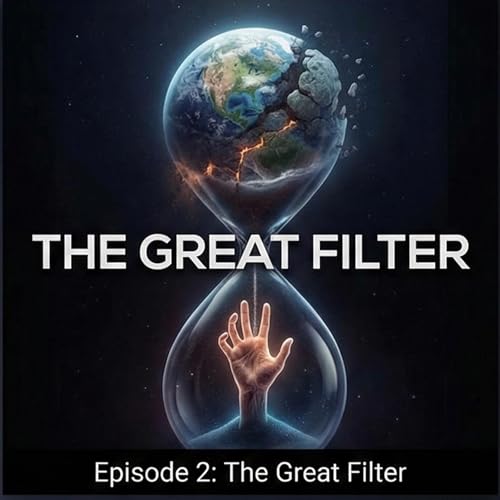
    The universe is 13.8 billion years old and teeming with the ingredients for life, yet our sky remains hauntingly silent. In this three-part series, we confront the Fermi Paradox—the single most disturbing anomaly in science. We move beyond the pop-culture aliens to explore the cold, hard math of galactic colonization, the terrifying implications of the "Great Filter," and the mind-bending physics that might explain why we seem so alone.

    There is a barrier to life in the universe—a "Great Filter" that stops dead matter from becoming a star-faring civilization. The terrifying question is: Did we pass it, or is it waiting for us? We explore the "Rare Earth" hypothesis, arguing that our large Moon and the freak accident of complex cells (Eukaryogenesis) make us unique. But we also face the alternative: if life is easy to start—as suggested by "Rapid Start" theories—then the filter lies ahead. We discuss why finding life on Mars would be the "worst news ever" and how emerging technologies like Artificial Superintelligence might be the universal bottleneck that wipes civilizations out before they can leave their home rock.

    #TheGreatFilter #RareEarth #ArtificialIntelligence #Evolution #CosmicHorror #podcast #sciencepodcast #spacepodcast #astronomy #cosmology #astrophysics #physics #spacemysteries #extraterrestriallife #quantumgravity #deeppodcast #newpodcast #newepisode #learnonsound #interstellarpodcast #universe #curiosity #spaceexploration #futureofscience #DeepDiveSpace


    Mostra di più Mostra meno
    27 min
  • The Great Silence: The Fermi Paradox Series
    Jan 6 2026

    The universe is 13.8 billion years old and teeming with the ingredients for life, yet our sky remains hauntingly silent. In this three-part series, we confront the Fermi Paradox—the single most disturbing anomaly in science. We move beyond the pop-culture aliens to explore the cold, hard math of galactic colonization, the terrifying implications of the "Great Filter," and the mind-bending physics that might explain why we seem so alone.

    It started with a casual lunch at Los Alamos in 1950 and ended with a question that haunts astrophysics: "Where is everybody?" In this episode, we break down the architecture of the "Great Silence." We look at the sheer scale of the galaxy—billions of potential habitable worlds—and the "Hart-Tipler" argument which mathematically proves that a single civilization could colonize the Milky Way in a blink of cosmic time. We also discuss why recent hopes, like the 2024 "Dyson Sphere" candidates, crumbled into dust (Hot DOGs), and why the darkness of space measured by the New Horizons probe makes the paradox deeper than we imagined.

    #FermiParadox #TheGreatSilence #Astrophysics #Space #ExistentialRisk #podcast #sciencepodcast #spacepodcast #astronomy #cosmology #astrophysics #physics #spacemysteries #extraterrestriallife #quantumgravity #deeppodcast #newpodcast #newepisode #learnonsound #interstellarpodcast #universe #curiosity #spaceexploration #futureofscience #DeepDiveSpace


    Mostra di più Mostra meno
    31 min
  • Are We a Projection? Investigating the Holographic Universe
    Dec 16 2025

    What if our three-dimensional world, including the force of gravity, is just a hologram? We dive deep into the evidence: the AdS/CFT correspondence. This mind-bending theory mathematically links a universe with gravity to a gravity-free quantum theory on its boundary.

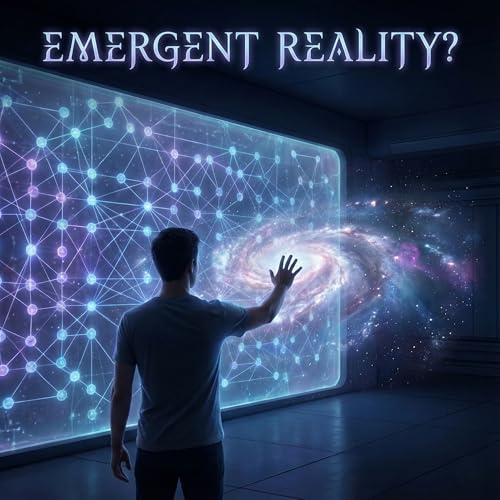
    We'll trace the clues from Juan Maldacena's groundbreaking insight to modern ideas like the Ryu-Takayanagi formula, which suggests that the very fabric of space is stitched together by quantum entanglement. Is spacetime an elemental part of nature, or an emergent phenomenon bubbling up from a deeper quantum reality? Join the investigation as we push the boundaries of what we think we know.

    #podcast #sciencepodcast #spacepodcast #astronomy #cosmology #astrophysics #physics #spacemysteries #extraterrestriallife #quantumgravity #deeppodcast #newpodcast #newepisode #learnonsound #interstellarpodcast #universe #curiosity #spaceexploration #futureofscience #DeepDiveSpace

    Mostra di più Mostra meno
    33 min
  • Incident at the Event Horizon: The Firewall Paradox
    Dec 9 2025

    Stephen Hawking threw a bomb into the world of physics when he declared that black holes aren't truly black—they radiate energy and eventually evaporate, taking everything that ever fell inside with them. This idea of "information loss" violated a core tenet of quantum mechanics and ignited a decades-long intellectual war. Join us as we dive into the trenches of this battle, led by physicists Leonard Susskind and Kip Thorne against Hawking's terrifying conclusion. We'll explain the bizarre concepts forged in the heat of this conflict, like the idea that a 3D world is just a hologram, the mind-twisting logic of "Black Hole Complementarity," and the shocking realization that trying to solve the paradox might create a "firewall"—a literal wall of energy at the black hole's edge that burns up any observer. It's a story of high stakes, big egos, and the quest to understand the deepest secrets of the universe.

    #podcast #sciencepodcast #spacepodcast #astronomy #cosmology #astrophysics #physics #spacemysteries #extraterrestriallife #quantumgravity #deeppodcast #newpodcast #newepisode #learnonsound #interstellarpodcast #universe #curiosity #spaceexploration #futureofscience #DeepDiveSpace


    Mostra di più Mostra meno
    33 min
  • The End of Spacetime: How Entanglement Proves Reality is a Hologram
    Dec 2 2025

    This report concludes the investigation into the “titanic struggle” between General Relativity and Quantum Mechanics. The resolution is the Holographic Principle, which proves that the three-dimensional universe we experience is an illusion—a projection where the total information content is limited by the area of its boundary, implying reality is fundamentally “pixelated.”

    Gravity is not a fundamental force, but an emergent phenomenon. The smooth fabric of spacetime is literally stitched together by quantum entanglement; geometry and distance are merely physical manifestations of quantum correlations.

    Because measuring distances at the Planck scale is physically impossible (it creates a black hole), the sources conclude that "Spacetime is Doomed." It must be replaced by a timeless structure, such as the Amplituhedron, a geometric object that calculates all of physics without reference to time or location. Our perception of space and time is merely an emergent "user interface" for a deeper, unified mathematical reality.


    #podcast #sciencepodcast #spacepodcast #astronomy #cosmology #astrophysics #physics #spacemysteries #extraterrestriallife #quantumgravity #deeppodcast #newpodcast #newepisode #learnonsound #interstellarpodcast #universe #curiosity #spaceexploration #futureofscience #DeepDiveSpace

    Mostra di più Mostra meno
    41 min
  • The 1:61,320 Ratio: Deconstructing Time Dilation, Tidal Solitons, and the Near-Extremal Black Hole of Interstellar
    Nov 25 2025
    The $1:61,320$ Ratio: Deconstructing Time Dilation, Tidal Solitons, and the Near-Black Hole of InterstellarDescription

    The 2014 motion picture Interstellar, directed by Christopher Nolan with lead scientific consultation from Nobel Laureate Kip Thorne, presents a unique case study in the intersection of narrative fiction and high-fidelity astrophysical simulation. The sequence depicting Miller's Planet—a water-covered terrestrial world orbiting the supermassive black hole Gargantua—serves as the film's primary crucible for exploring gravitational time dilation and orbital dynamics in curved spacetime.

    The narrative premise defines the relativistic cost of exploration: one hour on the planetary surface equates to seven Earth-years, implying a massive time dilation factor of approximately 61,320:1. This episode provides an exhaustive deconstruction of the physics required to sustain such a scenario, synthesizing general relativistic geometry, orbital mechanics, and fluid dynamics.

    Key topics we explore:
    • The Near-Extremal Kerr Solution: Initial critiques were grounded in the physics of non-rotating (Schwarzschild) black holes, where stable orbits cannot produce such extreme time dilation (maximum factor is ~1.22). We explain how the film’s premise is validated by specifying **Gargantua** as a **supermassive Kerr black hole** ($10^8 M_\odot$) with a necessary **near-extremal dimensionless spin parameter ($a_*$) of $1 - 1.3 \times 10^{-14}$**. This nearly maximal rotation fundamentally alters the structure of spacetime, allowing the Innermost Stable Circular Orbit (ISCO) to approach the event horizon.
    • Frame Dragging and Orbital Stability: The planet's stability is maintained because it orbits just slightly outside the event horizon, a position Thorne describes as "a pinch from the event horizon". This stable orbit is made possible by the centrifugal force imparted by **frame dragging** (or the "space whirl"). The rotation of space itself carries the planet along, stabilizing its position against the immense gravitational pull.
    • Tidal Survival and Density Requirements: We analyze the "Roche Limit Violation" critique and explain the pivotal counter-intuitive result: the tidal forces exerted at the event horizon are inversely proportional to the square of the black hole’s mass ($a_{tidal} \propto 1/M^2$). The supermassive nature of Gargantua ($10^8 M_\odot$) makes the tidal gradient across a planetary body gentler compared to a stellar-mass black hole. For Miller's Planet to survive tidal stretching, the calculation indicates it must possess a high density of approximately **10,000 kg/m³**.
    • Visualizing Spacetime Geometry: We examine the advanced visualization methodology developed for the film. The Double Negative (DNEG) visual effects team created the **Double Negative Gravitational Renderer (DNGR)**. This bespoke ray-tracing software solved the geodesic equations for photons in the Kerr metric, allowing for the accurate simulation of phenomena like gravitational lensing, the **Einstein Ring**, and the relativistic Doppler beaming observed in the black hole's accretion disk.
    Mostra di più Mostra meno
    25 min
  • The Black Hole Information Paradox: Conflict, Crisis, and the Unification of Gravity and Quantum Mechanics
    Nov 11 2025
    The Black Hole Information Paradox

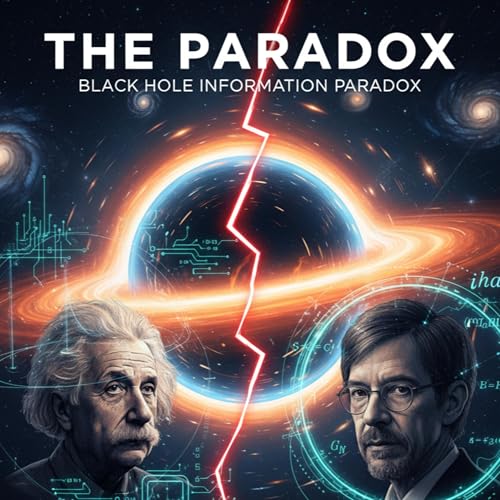
    The Black Hole Information Paradox exists at the catastrophic intersection of Albert Einstein’s General Theory of Relativity (GR) and the laws of quantum mechanics (QM). GR predicts the black hole, defined by its event horizon (the "point of no return") and governed by the "no-hair theorem" which suggests complex information is rendered permanently inaccessible to the outside universe. Conversely, QM is built upon the mathematical principle of unitarity, which dictates that the complete quantum state (information) of a closed system can never be truly created or destroyed; it can only be transformed. Violation of unitarity is considered a collapse of physics, implying a breakdown of the conservation of energy.

    The paradox was catalyzed by Stephen Hawking's 1974 discovery that black holes must emit Hawking radiation and therefore evaporate completely over vast timescales. His calculations suggested this radiation was purely thermal, meaning it was a random, high-entropy "mixed state". The core problem—the "pure-to-mixed" problem—is that a complex, ordered object (a "pure state") falling in and subsequently evaporating into only featureless, thermal radiation fundamentally violates the law of unitarity.

    The conflict developed into a four-decade intellectual debate, known as "The Black Hole War". The paradox was sharpened by the work of Don Page, who showed that the conflict between Hawking's calculation and unitarity occurs when the black hole is still enormous (at the Page Time). This led to the 2012 AMPS Firewall paradox, which demonstrated that assuming unitarity requires sacrificing the "smooth" event horizon mandated by Einstein's Equivalence Principle, due to a violation of the "monogamy of entanglement".

    The overwhelming modern consensus is that information is conserved, asserting that unitarity is victorious. This resolution emerged from breakthroughs like the Holographic Principle (which posits that information describing a 3D volume is encoded on its 2D boundary) and the 2019 successful calculation of the Page Curve using semiclassical gravity. This calculation required introducing new spacetime configurations called "replica wormholes" and their associated "islands"—regions inside the black hole that are mathematically considered part of the distant radiation system. The result not only reproduces the required entropy curve but also resolves the firewall paradox by saving the Equivalence Principle. The resolution suggests a profound synthesis, where the geometry of spacetime (GR) is- fundamentally built from the non-local threads of quantum entanglement (QM).

    #podcast #sciencepodcast #spacepodcast #astronomy #cosmology #astrophysics #physics #spacemysteries #extraterrestriallife #quantumgravity #deeppodcast #newpodcast #newepisode #learnonsound #interstellarpodcast #universe #curiosity #spaceexploration #futureofscience #DeepDiveSpace

    Mostra di più Mostra meno
    46 min