Episodi

  • The Giraffe in Easy French
    Oct 17 2026
    Transcription: https://dailyfactsineasyfrench.substack.com/p/the-giraffe-in-easy-french?showTranscript=true

    Discover "The Giraffe" in clear, natural French!

    Reach for the treetops with the Giraffe, the tallest animal walking the Earth! With necks over two meters long, their bodies boast miraculous adaptations, including giant hearts pumping blood at double human pressure.

    Learn how giraffes hum to each other in deep, inaudible infrasound at night, why zebras use them as living watchtowers, and how their long, dark purple tongues protect them from harsh African sun and thorny acacia bushes.

    Key Topics & Highlights:
    • A giraffe's neck has only seven vertebrae—the exact same number as humans, but each bone can be 25 cm long.
    • To pump blood two meters up to the brain, a giraffe's heart weighs over 11 kilograms with extremely high blood pressure.
    • Recent studies revealed that giraffes hum quietly to each other at night using deep low-frequency sound vibrations.
    • Their 45-centimeter prehensile tongues are blue-black to prevent sunburn while browsing thorny acacia trees.

    Key French Vocabulary:
    • la girafe (giraffe)
    • le cou (neck)
    • le cœur (heart)
    • la savane (savanna)

    Chapters:
    00:00 - Introduction & The Skyscraper of the Savanna
    02:04 - Extreme Anatomy & High-Pressure Circulation
    04:40 - Sleeping Standing Up & Defense Against Predators
    07:15 - Social Herds & The "Silent Extinction"
    09:07 - Protecting Africa's Gentle Giants

    Audio: 100% French • Spoken slowly and clearly (0.8x speed)

    This is a public episode. If you would like to discuss this with other subscribers or get access to bonus episodes, visit dailyfactsineasyfrench.substack.com
    Mostra di più Mostra meno
    10 min
  • The South Pole Expedition in Easy French
    Oct 16 2026
    Transcription: https://dailyfactsineasyfrench.substack.com/p/the-south-pole-expedition-in-easy?showTranscript=true

    Discover "The South Pole Expedition" in clear, natural French!

    Brave the unforgiving Antarctic whiteout of 1911 in the legendary race to the South Pole! Norwegian explorer Roald Amundsen and his team endured sub-zero blizzards across uncharted glaciers to become the first humans in history to reach 90 degrees south.

    Discover Amundsen's brilliant survival strategies—mastering Arctic ski techniques, learning Inuit clothing traditions, and using sturdy sled dogs to triumph over the frozen continent.

    Key Topics & Highlights:
    • Roald Amundsen and four companions reached the South Pole on December 14, 1911.
    • They traveled over 3,000 kilometers across the highest, coldest, and windiest continent on Earth.
    • Amundsen adopted Inuit fur clothing and trained sled dogs, ensuring his team returned safely.
    • At the Pole, they planted the Norwegian flag and left a tent named 'Polheim' for rival explorer Robert Falcon Scott.

    Key French Vocabulary:
    • le pôle (pole)
    • la neige (snow)
    • le traîneau (sled)
    • le chien (dog)

    Chapters:
    00:00 - Introduction & The Race for the South Pole
    01:13 - Amundsen vs Scott: Two Contrasting Approaches
    03:29 - Dogs, Skis, and the Norwegian Triumph (1911)
    05:25 - The Tragic Fate of Scott's Team
    06:49 - The Frozen Continent's Legacy & Lessons

    Audio: 100% French • Spoken slowly and clearly (0.8x speed)

    This is a public episode. If you would like to discuss this with other subscribers or get access to bonus episodes, visit dailyfactsineasyfrench.substack.com
    Mostra di più Mostra meno
    8 min
  • Elephants in Easy French
    Oct 15 2026
    Transcription: https://dailyfactsineasyfrench.substack.com/p/elephants-in-easy-french?showTranscript=true

    Discover "Elephants" in clear, natural French!

    Elephants are the largest living land animals on Earth, roaming gracefully across parts of Africa and Asia. With their versatile long trunks and gentle nature, these magnificent creatures fascinate nature lovers worldwide.

    From cooling down with their giant ears to using their tusks as clever tools, elephants show incredible survival skills and deep social bonds. Join us today as we discover the wonderful world of these gentle giants in simple, everyday language!

    Key Topics & Highlights:
    • Elephants are the largest living land animals, with three distinct species found in Africa and Asia.
    • An elephant's versatile trunk contains thousands of muscles and can grasp food, drink water, and smell.
    • Their large ears act as natural radiators to help maintain a cool body temperature in hot climates.
    • Elephant tusks are actually modified incisor teeth used for digging, lifting heavy objects, and defense.

    Key French Vocabulary:
    • l'éléphant (elephant)
    • la trompe (trunk)
    • la défense (tusk)
    • l'oreille (ear)

    Chapters:
    00:00 - Introduction & The World's Largest Land Animal
    03:00 - The Marvel of the Trunk and Tusks
    06:45 - African vs. Asian Elephants: Spotting the Differences
    10:30 - Family Life, Communication, and Memory
    13:12 - Conclusion & Protecting Our Gentle Giants

    Audio: 100% French • Spoken slowly and clearly (0.8x speed)

    This is a public episode. If you would like to discuss this with other subscribers or get access to bonus episodes, visit dailyfactsineasyfrench.substack.com
    Mostra di più Mostra meno
    7 min
  • The Bald Eagle in Easy French
    Oct 14 2026
    Transcription: https://dailyfactsineasyfrench.substack.com/p/the-bald-eagle-in-easy-french?showTranscript=true

    Discover "The Bald Eagle" in clear, natural French!

    Soar high into the North American skies to meet the majestic Bald Eagle, the fierce and iconic national bird of the United States. With a wingspan of over two meters and piercing yellow eyes, this master of the air commands respect.

    Discover how bald eagles build colossal nests weighing up to a ton, perform breathtaking aerial cartwheel dances, and made a miraculous comeback from the brink of extinction after DDT pesticide bans in 1972.

    Key Topics & Highlights:
    • The Bald Eagle has been the national bird and symbol of the United States since 1782.
    • They build the largest tree nests of any animal on Earth—some weighing over 1,000 kilograms.
    • Pairs perform dramatic 'cartwheel displays', locking talons in midair and spinning toward Earth before breaking apart.
    • Strict conservation laws and bans on toxic pesticides helped the species recover from fewer than 500 nesting pairs.

    Key French Vocabulary:
    • l'aigle (eagle)
    • le nid (nest)
    • les ailes (wings)
    • chasser (to hunt)

    Chapters:
    00:00 - Introduction & The American Icon
    01:59 - Physical Traits & Size
    03:58 - Giant Nests & Habitat
    06:03 - Hunting & Flight Tactics
    08:08 - The Threat of Extinction & DDT
    09:47 - Conservation Victory & Conclusion

    Audio: 100% French • Spoken slowly and clearly (0.8x speed)

    This is a public episode. If you would like to discuss this with other subscribers or get access to bonus episodes, visit dailyfactsineasyfrench.substack.com
    Mostra di più Mostra meno
    11 min
  • The British Empire in Easy French
    Oct 13 2026
    Transcription: https://dailyfactsineasyfrench.substack.com/p/the-british-empire-in-easy-french?showTranscript=true

    Discover "The British Empire" in clear, natural French!

    Examine the rise, reach, and profound global legacy of the British Empire, the largest empire in human history. At its peak in the early 20th century, it spanned nearly a quarter of Earth's landmass and population.

    Explore the economic machinery of the East India Company, the sugar plantations of the Caribbean, the spread of the English language, and the complex movements for independence and decolonization.

    Key Topics & Highlights:
    • At its height, the British Empire ruled over approximately 450 million people—one fifth of humanity.
    • The phrase 'the empire on which the sun never sets' was coined because it had territories in every global time zone.
    • Maritime naval power and global trade networks like the East India Company drove its imperial expansion.
    • Decolonization accelerated rapidly following World War II, culminating in the modern Commonwealth of Nations.

    Key French Vocabulary:
    • l'empire (empire)
    • le commerce (trade / commerce)
    • la colonie (colony)
    • le pouvoir (power)

    Audio: 100% French • Spoken slowly and clearly (0.8x speed)

    This is a public episode. If you would like to discuss this with other subscribers or get access to bonus episodes, visit dailyfactsineasyfrench.substack.com
    Mostra di più Mostra meno
    17 min
  • The History of Timekeeping in Easy French
    Oct 12 2026
    Transcription: https://dailyfactsineasyfrench.substack.com/p/the-history-of-timekeeping-in-easy?showTranscript=true

    Discover "The History of Timekeeping" in clear, natural French!

    Look at your wrist and wonder: why do we divide our days into 24 hours and 60 minutes? Trace the evolution of human timekeeping from ancient sky-watchers to atomic precision.

    Discover how ancient Egyptians used shadow sundials and the stars, how Babylonians gave us the base-60 system, and how mechanical pendulum clocks and modern quartz crystals transformed time into the heartbeat of civilization.

    Key Topics & Highlights:
    • Ancient Egyptians divided day and night into 12 hours each based on shadow sticks and star constellations.
    • The 60-minute and 60-second divisions originate from the ancient Babylonian base-60 numbering system.
    • Mechanical clocks with pendulums, invented by Christiaan Huygens in 1656, increased accuracy to seconds per day.
    • Today's global time is synchronized using atomic clocks measuring the vibrations of cesium atoms.

    Key French Vocabulary:
    • le temps (time)
    • l'horloge (clock / watch)
    • l'heure (hour)
    • la minute (minute)

    Audio: 100% French • Spoken slowly and clearly (0.8x speed)

    This is a public episode. If you would like to discuss this with other subscribers or get access to bonus episodes, visit dailyfactsineasyfrench.substack.com
    Mostra di più Mostra meno
    30 min
  • The Construction of the Panama Canal in Easy French
    Oct 12 2026
    Transcription: https://dailyfactsineasyfrench.substack.com/p/the-construction-of-the-panama-canal?showTranscript=true

    Discover "The Construction of the Panama Canal" in clear, natural French!

    Dive deep into the colossal engineering struggle to build the Panama Canal. Carving a waterway through dense mountainous jungle and unstable volcanic rock required moving over 200 million cubic meters of earth.

    Explore how chief engineer John Stevens and army doctor William Gorgas defeated deadly mosquito epidemics, enabling the construction of the mammoth Gatun Dam and electric lock gates that still lift ocean giants today.

    Key Topics & Highlights:
    • Over 75,000 workers laboured on the American construction effort between 1904 and 1914.
    • Controlling mosquitoes through fumigation and drainage eliminated yellow fever and drastically reduced malaria.
    • The Culebra Cut required excavating a 14-kilometer trench through the continental mountain divide.
    • The canal uses gravity-fed water from Gatun Lake to operate its massive locks without water pumps.

    Key French Vocabulary:
    • la construction (construction)
    • le moustique (mosquito)
    • la montagne (mountain)
    • le travail (work / labor)

    Audio: 100% French • Spoken slowly and clearly (0.8x speed)

    This is a public episode. If you would like to discuss this with other subscribers or get access to bonus episodes, visit dailyfactsineasyfrench.substack.com
    Mostra di più Mostra meno
    11 min
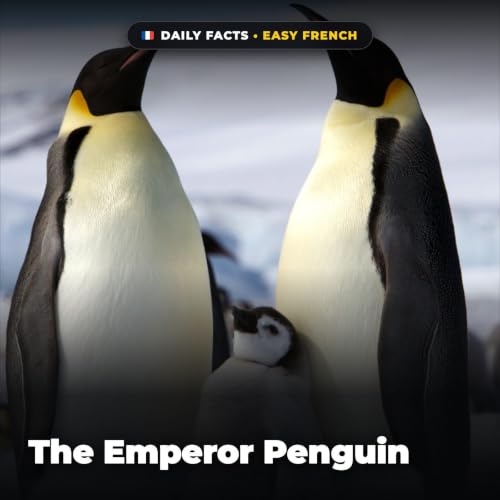
  • The Emperor Penguin in Easy French
    Oct 10 2026
    Transcription: https://dailyfactsineasyfrench.substack.com/p/the-emperor-penguin-in-easy-french?showTranscript=true

    Discover "The Emperor Penguin" in clear, natural French!

    Brave the harshest environment on planet Earth alongside Emperor Penguins in the Antarctic winter. Standing against minus 50-degree blizzards and fierce polar winds, these incredible birds demonstrate supreme survival.

    Learn how male penguins balance a single precious egg on their feet for two months without eating, huddling together in giant rotating circles to share body warmth while the mothers hunt at sea.

    Key Topics & Highlights:
    • Emperor Penguins are the largest penguin species, standing over 1 meter tall and weighing up to 40 kg.
    • They breed during the brutal Antarctic winter, enduring temperatures of -50°C and 200 km/h winds.
    • Male penguins incubate the egg for 65 consecutive days on their feet under a warm brood pouch without eating.
    • To survive the freezing cold, thousands of males form giant huddles, constantly rotating positions so everyone shares warmth.

    Key French Vocabulary:
    • le manchot (penguin)
    • l'œuf (egg)
    • la tempête (storm / blizzard)
    • la chaleur (warmth)

    Audio: 100% French • Spoken slowly and clearly (0.8x speed)

    This is a public episode. If you would like to discuss this with other subscribers or get access to bonus episodes, visit dailyfactsineasyfrench.substack.com
    Mostra di più Mostra meno
    19 min