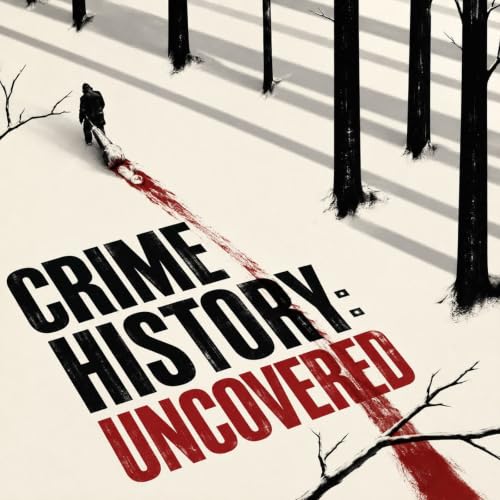
Crime History: Uncovered copertina

Crime History: Uncovered

Crime History: Uncovered

Di: Creator at Obomedia
Ascolta gratuitamente

Hook: What really happened behind history’s darkest headlines? Crime History: Uncovered investigates the cases that reshaped societies and still echo today.

Proposition of value: Each episode combines forensic detail, archival research, and narrative clarity to reconstruct real crimes from the past—with context that explains motive, method, and consequence. This show focuses on historical true crime, cold cases, and notorious criminal figures, separating myth from evidence so listeners can understand how these events influenced law, culture, and everyday life. Expect careful sourcing, timeline-driven storytelling, and a voice that balances suspense with historical rigor.

Frequency and format: New episodes drop every day—Monday through Sunday—at 9:00 AM. Episodes vary between concise case studies and deeper multi-part investigations, always grounded in primary sources and forensic analysis.

Who it’s for: For listeners who crave true crime with a historian’s eye—those who want dates, documents, and the bigger picture behind sensational headlines. Ideal for history buffs, criminology students, and true crime fans who prefer evidence over conjecture.

Call to action: Subscribe now to get a clearer view of the crimes that shaped history and tune in every day at 9:00 AM.

keywords SEO: Crime History Uncovered, historical true crime, cold cases, forensic history, notorious criminals© 2026 OBOMEDIA Creators
Crimini reali
  • The Glove on Brennan Street: How a Button Began a Murder Trial
    Aug 19 2026
    The Glove on Brennan Street: How a Button Began a Murder Trial

    Cold metal and a buttoned jacket forty feet in the air-nothing else-and a man found dead nine-tenths of a mile away with a single iron pipe blow to the skull. The jacket carried a laundry mark “W.B. 14” that led investigators to Wayne Bishop, chief transmission engineer at WOHL, but the scene held contradictions that refused an easy answer: who climbed the tower in a Wisconsin winter night and why was the station’s carrier off for seventeen minutes? What single decision turned a routine engineer’s disappearance into a staged message?

    In this episode, we walk through the timeline and physical evidence that tied Bishop’s disappearance to the WOHL transmitter and its external reset, following detectives from the jacket on the tower to the drainage easement where his body was found. How did a seventeen-minute carrier gap, two keys to the external reset, and a deliberate placement of clothing above the ground point investigators toward the person responsible?

    Person: Wayne Bishop
    Date: March 6-10, 1937
    Location: Tallow Hill Road and WOHL transmission tower, Winnebago County, Wisconsin
    Cause of death: Single blunt-force trauma to the back of the skull from an 18-inch, 3/4-inch iron pipe
    Item recovered: Brown herringbone jacket with laundry mark “W.B. 14”

    - At 5:45 a.m. on March 9, 1937, Bruce Green found Bishop’s jacket buttoned to the second service platform 40 feet above ground.
    - Bishop had been missing since the evening of Saturday, March 6; medical examiner placed time of death that evening.
    - A smeared, compressed channel roughly 18 inches wide led away from the tower base, consistent with something heavy being dragged.
    - The station’s transmission log showed a 17-minute gap between 11:41 and 11:58 p.m. on March 6 when the carrier went silent.
    - Bishop’s notebooks recorded that the transmitter had no internal reset and that the external reset required a key; two keys existed-one belonging to Bishop, the other to Albert Tice.

    To listen to this podcast ad-free and access premium episodes, try our subscription with a 14-day free trial at obomedia.com.

    © 2026 OBOMEDIA. All rights reserved.
    This episode and its content (audio, text, and related materials) are the exclusive property of OBOMEDIA and are protected by applicable copyright laws. Reproduction, distribution, editing, or commercial use, in whole or in part, without prior written permission from OBOMEDIA is prohibited. For permissions, licensing, and business inquiries: business@obomedia.com.
    Mostra di più Mostra meno
    23 min
  • The Twice-Stamped Passport: Who Stamped Jennifer Vaughn Dead?
    Aug 18 2026
    The Twice-Stamped Passport: Who Stamped Jennifer Vaughn Dead?

    A woman's body was found with a canvas bag placed upright beside her hand and a passport inside that bore the same border crossing, date and time stamped twice - one faded gray-purple, one fresh deep violet. That impossible duplication of an eleven-forty-seven entry on February 4, 1943, became the single anomaly that refused to fit the ledger: who manufactured the second stamp, and why did it cost Jennifer Vaughn her life?

    In this episode, we follow the discovery, the paperwork, and the first steps of the federal inquiry as investigators trace a deliberately altered passport back through a border processing ledger, a freight-yard cabinet, and eleven minutes of interrogation to uncover what the two stamps meant.

    Person: Jennifer Vaughn
    Date: February 4, 1943 (passport stamps), death between January 25-28, 1943
    Location: Harwick Road border crossing; body found ~14 miles east of Harwick Road near a utility pole
    Investigator: Rebecca Harrison
    Discovery: Body found by Southwestern Bell line technician Sandra Christensen on February 9, 1943

    - The passport contained two stamps for the same crossing at 11:47 AM on February 4, 1943, one gray-purple and faded, one deep violet and fresh.
    - Jennifer Vaughn was 29 years old, had worked as an archive clerk on Montana Avenue, and had not missed her weekly Wednesday 10:15 PM call to her sister for nearly two years.
    - Her body was found face-down thirty feet east of a utility pole in pale caliche soil, with a canvas bag upright beside her left hand containing a folded wool skirt and a rubber toiletry bag.
    - The ledger from Harwick Road showed a single crossing entry at 11:47 AM for the same date, recorded by the processing officer as one woman crossing.
    - The passport was examined at the El Paso FBI field office by investigator Rebecca Harrison, who noted the mismatch between one ledger entry and two different ink stamps.

    To listen to this podcast ad-free and access premium episodes, try our subscription with a 14-day free trial at obomedia.com.

    © 2026 OBOMEDIA. All rights reserved.
    This episode and its content (audio, text, and related materials) are the exclusive property of OBOMEDIA and are protected by applicable copyright laws. Reproduction, distribution, editing, or commercial use, in whole or in part, without prior written permission from OBOMEDIA is prohibited. For permissions, licensing, and business inquiries: business@obomedia.com.
    Mostra di più Mostra meno
    22 min
  • The Jacket on Tallow Hill: Why a Tower Became a Crime Scene
    Aug 17 2026
    The Jacket on Tallow Hill: Why a Tower Became a Crime Scene

    Cold proof of murder hid in eight inches of creek ice: a brand iron with the initials A.L. frozen upright, surrounded by unbroken ice for thirty feet, and a land transfer filed days before Amanda Lewis’s body was found-so who forged her sale and why did the county physician call her death an accident? What did one clerk’s eye for a misplaced crossbar and a harness-maker’s pre-dawn walk reveal about a plot to steal three hundred and twelve acres?

    In this episode, we follow the sequence of events from the filed brand transfer to the discovery in the creek and the clerk’s handwritten comparison that raised the alarm, asking whether Amanda Lewis’s death was truly accidental or part of a scheme to take her land.

    Person: Amanda Lewis
    Date of death discovery: January 5, 1884
    Location: creek outside Tallow Fork, Kansas
    Document filed: January 3, 1884
    Accused purchaser: James Sanders

    - Amanda Lewis owned 312 acres east of Tallow Fork and registered the cattle brand A.L. in 1871.
    - A brand transfer filed by James Sanders on January 3, 1884, claimed a sale dated December 28, 1883 for $1,100.
    - Amanda was seen alive at choir practice through early January despite the transfer’s December 28 date.
    - The brand iron found January 9 was encased eight inches deep in ice with initials A.L., the ice unbroken for 30 feet in every direction.
    - County recorder’s clerk Laura Meyer compared five years of Amanda’s signatures and noted Amanda’s capital A always had a low crossbar, while the transfer’s A had a centered crossbar.

    To listen to this podcast ad-free and access premium episodes, try our subscription with a 14-day free trial at obomedia.com.

    © 2026 OBOMEDIA. All rights reserved.
    This episode and its content (audio, text, and related materials) are the exclusive property of OBOMEDIA and are protected by applicable copyright laws. Reproduction, distribution, editing, or commercial use, in whole or in part, without prior written permission from OBOMEDIA is prohibited. For permissions, licensing, and business inquiries: business@obomedia.com.
    Mostra di più Mostra meno
    22 min
adbl_web_anon_alc_button_suppression_t1
Ancora nessuna recensione