Episodi

  • Science news – 2026 Nobel Prizes for science
    Oct 15 2026

    It’s time for a small episode about some big prizes in science, with five fun and fascinating fast facts about the 2026 Nobel Prizes for Physics, Chemistry, and Physiology or Medicine, a deep dive into optogenetics, and a mirror image molecule activity for you to try yourself at home.

    Presented by Jenny Lynch and Matilda. Written and produced by Jenny Lynch. Music by Purple Planet Music. Sound effects by Pixabay.

    Support the podcast to keep it ad-free! https://buymeacoffee.com/creativescience

    Join the email list: https://www.creativescience.com.au/contact/

    Creative Science: https://www.creativescience.com.au

    Facebook: @creativescienceaustralia

    Instagram: @creative_science_australia

    Episode content:

    00:00 Buy a virtual test tube to support the Creative Science for Kids podcast

    00:23 Introduction and fast facts

    04:31 Deep dive into optogenetics

    06:33 Mirror image molecule activity

    Nobel Prize: https://www.nobelprize.org/

    Mirror image molecule activity

    You will need: your two hands and a mirror.

    1. Stand in front of a mirror and hold up your left hand. If you wiggle your fingers, you will see the mirror image of your wiggly fingers on the hand you can see in the mirror. Your real hand, and the hand in the mirror, have all the same parts (four fingers, one thumb, fingernails, and a palm) but their three-dimensional shapes are not exactly the same.
    2. Hold up your left hand and your right hand and do a thumbs up with both hands. Notice that your right hand is a mirror image of your left hand.
    3. Hold your hands together so the palms are touching and all of your fingers line up and it seems like your two hands are a matching pair.
    4. Put your hands flat on a table top, with the palms facing down, and then stack your hands on top of each other. The fingers don’t line up anymore and there is no way of matching up your left and right hands in this position.

    What’s happening?

    The 2026 Nobel Prize for Chemistry was awarded for discoveries about mirror image molecules. These molecules are called ‘chiral molecules’ and the different mirror image molecules are called ‘left-handed’ and ‘right-handed’. There are a lot of molecules in the human body that are chiral molecules. For example, DNA is a chiral molecule, and our bodies only have one of the two mirror image shapes of DNA. We only have right-handed DNA, and the DNA in all living things is always right-handed.

    Mostra di più Mostra meno
    9 min
  • Amazing animals – native bees with Dr Elise Oakman
    Sep 17 2026

    It’s time to get buzzing, with five fun and fascinating fast facts about Australian native bees, an interview with Dr Elise Oakman, a scientist who knows a lot about Australian insects, and a cosy insect hotel activity for you to try yourself at home.

    Presented by Jenny Lynch and Matilda. Written and produced by Jenny Lynch. Music by Purple Planet Music. Sound effects by Pixabay.

    Buy tickets for ‘Creative Science: Mind Blown’ at Sydney Fringe 2026: https://sydneyfringe.com/events/creative-science-mind-blown/

    Support the podcast to keep it ad-free! https://buymeacoffee.com/creativescience

    Join the email list: https://www.creativescience.com.au/contact/

    Creative Science: https://www.creativescience.com.au

    Facebook: @creativescienceaustralia

    Instagram: @creative_science_australia

    Episode content:

    00:00 2026 Sydney Fringe Festival show ‘Creative Science: Mind Blown’

    00:17 Introduction and fast facts

    05:55 Interview with Dr Elise Oakman

    09:25 Insect hotel activity

    Bug Hunt Australia: https://bughunt.org.au/

    Insect hotel activity

    You will need:

    • an empty milk carton or juice carton;
    • lots of thick and thin paper straws to fill the empty carton;
    • some sticks, leaves, and bark from a garden or park;
    • cotton string or jute twine
    1. Ask an adult to help you open one end or cut off one end of the carton. Make sure you keep the other end of the carton closed.
    2. Stand the straws up in the carton and use leaves, sticks, and bark to fill in any gaps between the straws. Make sure the straws are pushing against the closed end of the carton and pack the other things tightly, so the straws won’t fall out of the carton.
    3. Choose a place to hang your insect hotel. The open ends of the straws should face North or North-East so they get some morning sun, but make sure the insect hotel is protected from direct sunlight in the middle of the day.
    4. Tie the string or twine around the insect hotel and tie it to a tree, fence, or post. Make sure the open ends of the straws are angled down a little bit so they don’t fill with rain, or you can try making a little roof to stop rain and dew going into the straws.

    What’s happening?

    Female solitary bees can make nests in closed tubes like the straws in this insect hotel. They make the first cell in the closed end of the tube, laying an egg and leaving food for the hatching lava, before sealing the cell with some wax. The bee can then add more cells along the length of the tube.

    Mostra di più Mostra meno
    12 min
  • Seeds of science – National Science Week with A/Prof Corey Tutt
    Aug 13 2026

    Saturday the 15th of August to Sunday the 23rd of August is National Science Week in Australia, so it’s time to sow some seeds of excitement with five fun and fascinating fast facts about National Science Week; six scientists sharing what sowed the seed of their interest in science; an interview with Associate Professor Corey Tutt OAM about Aboriginal and Torres Strait Islander Science Day; and a slimy psyllium seed activity for you to try yourself at home.

    This episode is an Inspiring Australia NSW initiative and is supported by the NSW and Australian Governments.

    Presented by Jenny Lynch and Matilda. Written and produced by Jenny Lynch. Music by Purple Planet Music. Sound effects by Pixabay.

    Buy tickets for ‘Creative Science: Mind Blown’ at Sydney Fringe 2026: https://sydneyfringe.com/events/creative-science-mind-blown/

    Support the podcast to keep it ad-free! https://buymeacoffee.com/creativescience

    Join the email list: https://www.creativescience.com.au/contact/

    Creative Science: https://www.creativescience.com.au

    Facebook: @creativescienceaustralia

    Instagram: @creative_science_australia

    Episode content:

    00:00 2026 Sydney Fringe Festival show ‘Creative Science: Mind Blown’

    00:17 Introduction and fast facts

    03:07 What’s a PhD?

    03:36 Six scientists share what sowed the seed of their interest in science

    07:32 Interview with A/Prof Corey Tutt OAM

    12:10 Slimy psyllium seed activity

    Special Guests:

    Riley Easton, University of Technology Sydney

    Sinali Weerasekara, Deakin University

    Dr. Olivia R. Maurice, Western Sydney University

    Lily Kenchington-Evans, University of Queensland

    Shervin Zabeti Targhi, Western Sydney University

    Dr Sara Chiaretti, Red Cross Lifeblood

    A/Prof Corey Tutt OAM

    Deadly Science: https://deadlyscience.org.au

    Aboriginal and Torres Straight Islander Science Day: https://deadlyscience.org.au/pages/national-science-week

    National Science Week DIY Science activities: https://www.scienceweek.net.au/diy-science/

    Slimy psyllium seed activity

    You will need: Boiling hot water, a heat-proof cup, two tablespoons of psyllium husk powder, a measuring cup, and a metal spoon for stirring.

    Note: Psyllium husk powder can be found at chemists and in some supermarkets.

    1. Ask an adult to help boil some water.
    2. Add two tablespoons of psyllium husk powder to the heat-proof cup and ask the adult to add half a cup of boiling hot water to the cup.
    3. Use the metal spoon to stir the psyllium husk powder with the water, and keep stirring until the powder soaks up all of the water and it turns into a gooey slime.
    4. Wait for the plant slime to cool down and then you can play with it. It might be a bit sticky so make sure you a close to a sink so you can wash your hands.

    What’s happening?

    Plant slime is also called ‘mucilage’. By soaking up water and forming gooey mucilage, a seed can stay moist until it has time to grow. Mucilage also helps plant roots to push through soil and it’s used by carnivorous plants to trap insects. Some people use psyllium husk powder as a treatment for constipation. The psyllium husk powder works by causing a person’s poo to become larger and softer and easier to poop out.

    Mostra di più Mostra meno
    15 min
  • A.I. update - high tech learning with Dr Lucy Andrew
    Jul 16 2026

    It’s time to get high-tech with five fun and fascinating fast facts about artificial intelligence, an interview with Dr Lucy Andrew, a university lecturer who knows a lot about A.I. in education, and a short-term memory activity for you to try yourself at home.

    Presented by Jenny Lynch and Matilda. Written and produced by Jenny Lynch. Music by Purple Planet Music. Sound effects by Pixabay.

    Buy tickets for ‘Creative Science: Mind Blown’ at Sydney Fringe 2026: https://sydneyfringe.com/events/creative-science-mind-blown/

    Support the podcast to keep it ad-free! https://buymeacoffee.com/creativescience

    Join the email list: https://www.creativescience.com.au/contact/

    Creative Science website: https://www.creativescience.com.au

    Facebook: @creativescienceaustralia

    Instagram: @creative_science_australia

    Episode content:

    00:00 Sydney Fringe Festival 2026 show ‘Creative Science: Mind Blown’

    00:23 Introduction and fast facts

    05:55 Interview with Dr Lucy Andrew

    11:20 Short-term memory activity

    Dr Lucy Andrew: https://adelaide.edu.au/people/lucy.andrew

    Lucy talking with her deep fake digital twin: https://adelaide.au.panopto.com/Panopto/Pages/Viewer.aspx?id=0c79267c-6da0-4a6d-89f9-b3d100452cc1

    Short-term memory activity

    You will need: A friend or family member to test, some paper and a pencil.

    1. Explain to your friend or family member that you are going to read out a list of ten words and they need to try to remember the list of words, in order, without writing them down.
    2. Read out this list of words (or make up your own list of ten words): Apple, Monkey, Pencil, Bike, Clock, Cake, Tractor, Oven, Shoe, Tree
    3. Challenge your friend or family member to write down the words in order. If they have any trouble writing or spelling the words, they can draw pictures instead.

    How many words did they remember?

    What’s happening?

    This activity tests short-term memory and there is a limit to the number of words people can remember. For most people, the limit is between 6 and 8 words. If someone was to do this activity over and over again, they would probably get better at remembering the list of words, until they could write all ten words correctly. After enough practice, the list of words might even stay in their long-term memory.

    Learning is an active process that takes some effort and it usually involves using our past experiences to make sense of new information. If someone needed to learn the list of ten words (for some strange reason) they could try using those words to write a story or maybe come up with a pattern or a poem to help them remember the order of the words. Doing this would help use their existing knowledge of what the words mean to make some sort of sense of an otherwise random order of the words.

    Mostra di più Mostra meno
    15 min
  • Extreme energy - renewables with Lee Constable
    Jun 11 2026

    It’s time to get to work with five fun and fascinating fast facts about energy, an interview with Lee Constable, a presenter and author of books about sustainability, and an energy transformation activity for you to try yourself at home.

    Presented by Jenny Lynch and Matilda. Written and produced by Jenny Lynch. Music by Purple Planet Music. Sound effects by Pixabay.

    Support the podcast to keep it ad-free! https://buymeacoffee.com/creativescience

    Join the email list: https://www.creativescience.com.au/contact/

    Creative Science: https://www.creativescience.com.au

    Facebook: @creativescienceaustralia

    Instagram: @creative_science_australia

    Episode content:

    00:24 Introduction and fast facts

    05:37 Interview with Lee Constable

    13:14 Energy transformation activity

    Lee Constable: https://leeconstable.com

    Energy transformation activity

    You will need: an object you can drop, such as a ball or a rolled-up pair of socks, and a rubber band.

    Energy cannot be created nor destroyed. This is called the ‘Law of Conservation of Energy’. However, energy can change into different forms. How many energy transformations can you observe in about a minute?

    1. Rub your hands together as fast as you can. You are turning moving energy into heat energy, with help from the force of friction.
    2. Hold the ball or socks high above the floor. What you are holding now has gravitational potential energy, otherwise known as stored energy, let go and the gravitational potential energy turns into moving energy as the object falls to the floor, because of the force of gravity.
    3. Feel the rubber band and notice if it feels cold or hot. Use both hands to stretch out the rubber band over and over again for a few seconds and then feel if the rubber band has heated up. If it has, some of the moving energy has turned into heat energy.
    4. Stretch out the rubber band again so it has lots of stored elastic energy and then aim the rubber band away from you and anyone who is with you. Let go, so the rubber band flings through the air, turning the elastic energy into moving energy.

    Look around you and see what other energy transformations you can see, for example, turning on a light.

    Mostra di più Mostra meno
    15 min
  • Human body - blood science with Dr Patrick Capon
    May 14 2026

    It’s time for a heart-to-heart with five fun and fascinating fast facts about blood, an interview with Dr Patrick Capon, a science communicator who knows a lot about blood, and a heart pumping activity for you to try yourself at home.

    Presented by Jenny Lynch and Matilda. Written and produced by Jenny Lynch. Music by Purple Planet Music. Sound effects by Pixabay.

    Support the podcast to keep it ad-free! https://buymeacoffee.com/creativescience

    Join the email list: https://www.creativescience.com.au/contact/

    Creative Science: https://www.creativescience.com.au

    Facebook: @creativescienceaustralia

    Instagram: @creative_science_australia

    Episode content:

    00:19 Introduction and fast facts

    04:51 Interview with Dr Patrick Capon

    12:34 Heart rate activity

    Australian Redcross Lifeblood: https://www.lifeblood.com.au

    Heart rate activity

    You will need something that can measure 30 seconds, for example a clock with a second hand, a stopwatch, or the timer on a smartphone.

    1. Feel the pulse in your wrist by holding two fingers gently on the inside of your wrist. If you can’t feel the pulse, change the position of your fingers and rest them gently until you feel the pulse.

    The pulse beats in time with your heart pumping blood around your body, so it can be used to measure your heart rate.

    1. Set the timer to measure 30 seconds and count the number of beats you feel in 30 seconds. If you double this number, that number is your heart rate in ‘beats per minute’. For example, if you count 40 beats in 30 seconds, your heart rate is 80 beats per minute.
    2. Do some energetic exercise, like star jumps or running around, for about one minute.
    3. Find your pulse again, set the timer for 30 seconds, and count the number of beats you feel in 30 seconds. Double this number and you will probably have a higher heart rate this time.

    When you exercise, your muscles use more oxygen. A faster heart rate means the blood moves faster around your body and more oxygen can be delivered to your muscles.

    Mostra di più Mostra meno
    15 min
  • Sustainable science – wonderful water with Kelly Osterberg
    Apr 16 2026

    Let’s go with the flow with five fun and fascinating fast facts about water, an interview with Kelly Osterberg, an educator who knows a lot about water catchments, and a watery activity for you to try yourself at home.

    Presented by Jenny Lynch and Matilda. Written and produced by Jenny Lynch. Music by Purple Planet Music. Sound effects by Pixabay.

    Support the podcast to keep it ad-free! https://buymeacoffee.com/creativescience

    Join the email list: https://www.creativescience.com.au/contact/

    Creative Science: https://www.creativescience.com.au

    Facebook: @creativescienceaustralia

    Instagram: @creative_science_australia

    Episode content:

    00:20 Introduction and fast facts

    04:45 Interview with Kelly Osterberg

    11:08 Water from leaves activity

    WaterNSW https://www.waternsw.com.au

    WaterNSW Education https://www.waternsw.com.au/education

    WaterNSW on YouTube https://www.youtube.com/@WaterNSWvideos

    Water from leaves activity

    You will need: a large clear plastic bag, some string, and a healthy tree with lots of leaves that is in a sunny place.

    1. Choose a leafy branch hanging down low and bending towards the ground.
    2. Place the plastic bag over the branch so there are lots of leaves inside the bag.
    3. Gather the edges of the bag and hold the edges firmly around the branch. Tie some string around the bag to hold it in place on the branch. Try to position the bag so water will collect in the bottom of the bag without leaking out.
    4. Leave the bag in place for several hours or overnight. After a few hours, you should start to see water collecting in the bottom of the bag.

    What’s happening?

    The water vapour made by the leaves condenses on the inside of the plastic bag to form liquid water which then flows down and collects at the bottom of the bag. This method for collecting the ‘transpiration’ water from plants is a bush survival skill people can use if they are stranded in the bush with no fresh water to drink, however, you should not drink the water you collected in this activity because it might not be very clean. Maybe you can pour the water back around the bottom of the tree so the roots can soak it up for more transpiration.

    Mostra di più Mostra meno
    13 min
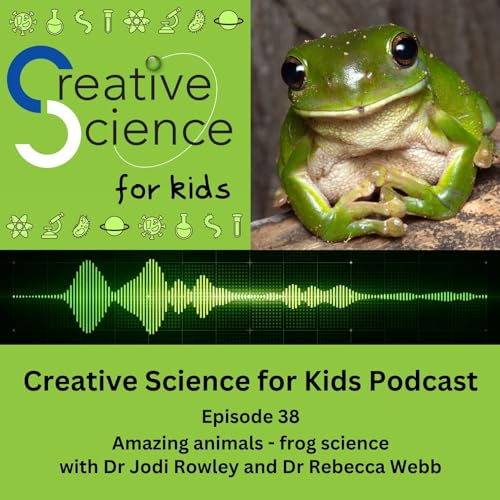
  • Amazing animals – frog science with Dr Jodi Rowley and Dr Rebecca Webb
    Mar 19 2026

    Let’s celebrate World Frog Day with five fun and fascinating fast facts about frogs, a chat with some froggy scientists, Dr Jodi Rowley and Dr Rebecca Webb, and a gooey chia seed frog spawn activity for you to try yourself at home.

    Presented by Jenny Lynch and Matilda. Written and produced by Jenny Lynch. Music by Purple Planet Music. Sound effects by Pixabay.

    Image: Green Tree Frog Litoria caerulea (Photo credit: Dr Jodi Rowley)

    Support the podcast to keep it ad-free! https://buymeacoffee.com/creativescience

    Join the email list: https://www.creativescience.com.au/contact/

    Creative Science: https://www.creativescience.com.au

    Facebook: @creativescienceaustralia

    Instagram: @creative_science_australia

    Episode content:

    00:00 Introduction and fast facts

    03:33 Interview with Dr Jodi Rowley

    11:19 Interview with Dr Rebecca Webb

    14:51 Chia seed frog spawn activity

    FrogID citizen science project led by Dr Jodi Rowley at the Australian Museum: https://www.frogid.net.au/

    Dr Rebecca Webb at the University of Melbourne: https://findanexpert.unimelb.edu.au/profile/962839-rebecca-webb

    Chia seed frog spawn activity

    You will need: cold water, a measuring cup, a tablespoon, 2 tablespoons of black chia seeds, and a spoon for stirring. Chia seeds are small seeds that you might be able to buy at a supermarket, a fruit and vegetable shop, or a health food store.

    1. Wash your hands with soap and warm water.
    2. Add half a cup of cold water to the measuring cup.
    3. Add two tablespoons of black chia seeds to the water.
    4. Stir the mixture and leave it to sit for about 5 minutes.
    5. Stir it again and then leave the mixture to cool down in the fridge for 2 hours.
    6. After 2 hours, take it out of the fridge and stir the mixture one more time.
    7. Make sure your hands are clean before picking up the mixture to play with it.

    When you take it out of the fridge, you will have a cup of gooey chia seed frog spawn.

    You can also try adding honey or maple syrup to the chia seed mixture to make a tasty snack!

    What’s happening?

    Chia seeds are the seeds of the plant Salvia hispanica which is native to Mexico and Guatemala. When the seeds are mixed with water, a slimy coating forms to protect the seeds until they have time to grow. The slimy coating on the seeds looks a lot like the gooey jelly in frog spawn that protects frog’s eggs until they are ready to hatch.

    Mostra di più Mostra meno
    17 min