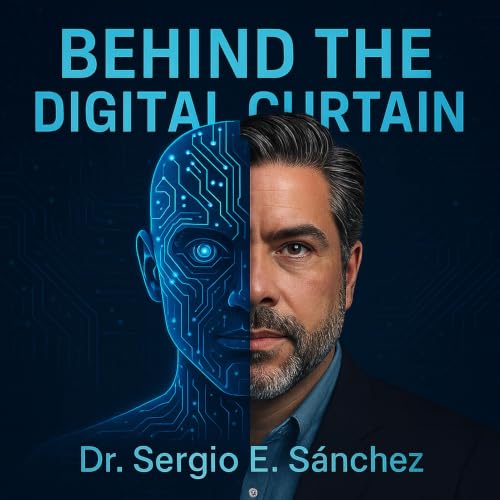
Behind the digital curtain copertina

Behind the digital curtain

Behind the digital curtain

Di: Sergio Sanchez
Ascolta gratuitamente

Offerte di stagione | 0,99 €/mese per i primi 3 mesi

A seguire 9,99 €/mese – si applicano condizioni. Puoi disdire mensilmente.
Welcome to Behind the digital curtain, the podcast where we unravel digital deception and fight back against AI-generated misinformation. I'm Dr. Sergio Sánchez, but around here they call me Dr. Qubit, your guide through this world of technological shadows. Today, we dive into dangerous territory: the mind of the manipulator. Who are the hackers? How do they think? And how do they use AI to deceive you? Get ready—because this episode will open your eyes.Sergio Sanchez
  • The black box judge
    Oct 25 2026

    In 2015, the president of a small Catholic university in Maryland, Mount St. Mary's, wanted to improve what schools call the "retention rate," meaning the share of incoming students who stay. He had freshmen fill out a survey to find the ones who were struggling. Sweet, right? Find them so you can help them. Not quite. The plan, according to what professors said in the meeting and what was later published, was to nudge the most fragile students out in the first few weeks, before the date when they officially count as "enrolled." That way, the statistic would look gorgeous. When professors objected, the president told them they thought of the students as cuddly bunnies, and that you just had to drown the bunnies. His words. He resigned in February 2016.

    Now, that president was not using artificial intelligence. But think about what happens when you hand somebody like that a tool that says "I predict who will fail." He does not have to say it in a faculty meeting, where somebody can leak it to the student paper. A screen does it, quietly, with a number, and nobody knows why. And the screen never resigns.

    Today we are going to talk about that character. The machine that hands down a sentence without explaining, without an appeal, and without blushing. Five ways predictive AI fails. Five. With real cases, real dates, and a bit of good news at the end.

    A number with no explanation is a sentence with no trial.


    Mostra di più Mostra meno
    37 min
  • Snake Oil AI
    Oct 17 2026

    Every good episode needs a villain with a name and a face. Vague villains do not work. If I tell you "technology is bad," you shrug and go back to watching videos of cats falling off couches. So today's villain has a name: Sake Oil AI, the Digital Medicine Show.

    Who is it? It is any person, company, or headline that uses the label "artificial intelligence" as a giant umbrella to cover things that have nothing to do with each other. Under that one umbrella you find wonderful things, like the autocorrect on your phone, and things that do not work and never will, like the software that claims to guess whether you will be a good employee by watching you talk for thirty seconds. Same umbrella. Same sales pitch. Very different reality.

    In this first episode I am not going to scare you or sell you the apocalypse. I am going to give you something more useful: a dictionary. By the end, when somebody says "an AI did this," you will be able to squint like a building inspector and ask, "Which one?" That question, honestly, is worth gold.

    And since this is a show for people who say "tech just isn't my thing," here is the good news. You will not need a single equation. You will need exactly what you need when you buy a used pickup truck: healthy distrust, good questions, and a firm decision not to fall in love with the salesman.


    Mostra di più Mostra meno
    37 min
  • Social Engineering
    Oct 8 2026

    In nineteen twenty five, a man sold the Eiffel Tower. Twice. No laptop, no phone, not even a Wi-Fi password taped to a router.

    And here is the part that should keep you up tonight: his descendants have your phone number.

    Last year, Americans filed more than one million complaints with the FBI about crime on the internet. A million. First time in history. Nearly twenty-one billion dollars gone. And the most reported crime of all was not some genius cracking a government vault. It was phishing. Somebody pretending to be somebody else. That is it. That is the whole crime wave. A bunch of people doing bad improv.

    Think about that. Nobody picked a lock. Nobody cut a wire. There were no green characters raining down a screen like in the Matrix movies. We opened the door, offered them a cold drink, asked if they wanted to see the basement, and then helped them carry out the TV, the silverware and the jewelry.

    The thief of the future does not need a crowbar. He just needs you to be polite.

    I am Dr. Qubit, and this is Behind the digital curtain, the only show where technology gets explained without making you feel like you skipped a class everyone else attended. And since it is October, my birthday month, which happens to be Cybersecurity Awareness Month in the United States, today we are talking about the oldest trick in the book with the most expensive name in the world: social engineering.


    Mostra di più Mostra meno
    57 min
adbl_web_anon_alc_button_suppression_t1
Ancora nessuna recensione