• #5 The Invisible Police: Why Laptops and Kids are Safe in Japan
    Jan 20 2026

    [Introduction] Leave a MacBook on a Starbucks table and go to the bathroom. In most countries, it vanishes in seconds. In Tokyo, it stays right there. Why? Is it honesty, or something else? From six-year-olds riding subways alone (like in Netflix's "Old Enough!") to orderly queues during disasters, Dr. Fujita decodes the invisible "OS" that controls Japanese behavior. Discover why Japan's safety is actually a calculated survival strategy based on Game Theory.


    [What You'll Learn]

    • The Starbucks Anomaly: Why a laptop acts as a "reservation token" rather than an expensive device.
    • Distributed Security: How society functions as a massive incubator for children commuting alone.
    • "Guilt" vs. "Shame": The difference between Western conscience and the Japanese concept of "Seken" (The Public Eye).
    • Game Theory of Disasters: Why looting is mathematically a "losing strategy" in Japan.
    • The Social Contract: The hidden trade-off between absolute safety and individual freedom.


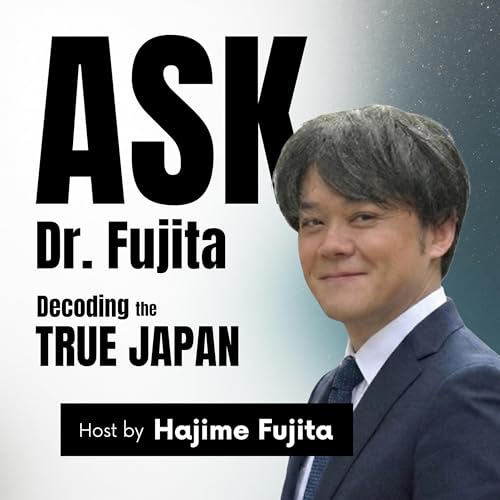
    [About the Podcast] Dr. Fujita, an AI Consultant based in Tokyo, analyzes the logic behind Japanese business and culture. This isn't a sightseeing guide—it's an intellectual journey to decode the "True Japan."


    [Topics] Japan Safety, Crime Rate, Seken, Shame Culture, Game Theory, Old Enough, Disaster Response, Looting, Social Psychology, Tokyo Life, Murahachibu

    Mostra di più Mostra meno
    8 min
  • #4 Robots, Toilets, and Fax Machines: The High-Tech Paradox of Japan
    Jan 16 2026

    [Introduction] Is Japan living in the future or the past? Travelers are often baffled by the "Japan Paradox." You encounter spaceship-like toilets with heated seats and washlets, yet walk into a corporate office to find fax machines buzzing and people stamping documents with red ink (Hanko). Why does a nation famous for robotics and efficiency cling to 1980s technology? Dr. Fujita decodes this mystery from an engineering perspective, explaining why excellent analog systems became a trap and how a new crisis is finally forcing a system reboot.


    [What You'll Learn]

    • The "Over-optimization" Trap: Why Japan's analog systems (trains, mail) were too perfect to justify a digital upgrade.
    • Galapagos Syndrome: Why Japan excels at isolated hardware evolution (like toilets and flip phones) but struggles with global software platforms.
    • The Hanko Logic: Viewing the personal seal not as a relic, but as a "physical authentication token" for responsibility.
    • The Fatal Bug: How the severe labor shortage and population decline are making manual analog systems impossible to maintain.
    • The Forced Update: Why the death of the fax machine is a survival strategy, not just a trend.


    [About the Podcast] Dr. Fujita, an AI Consultant based in Tokyo, analyzes the logic behind Japanese business and culture. This isn't a sightseeing guide—it's an intellectual journey to decode the "True Japan."


    [Topics] Japan Technology, High-Tech Paradox, Digital Transformation, DX, Fax Machine, Hanko, Galapagos Syndrome, Population Decline, Japanese Business Culture, Innovation, Robotics

    Mostra di più Mostra meno
    7 min
  • #3 The Real Estate Paradox: Why Japan Has $0 Houses and Booming Tokyo
    Jan 13 2026

    [Introduction] Have you seen the viral videos claiming you can buy a house in Japan for $500, or even get one for free? It sounds too good to be true, but in rural Japan, the "Akiya" (abandoned house) phenomenon is real. Meanwhile, in central Tokyo, apartment prices are breaking historical records. Why does this extreme contrast exist? Dr. Fujita decodes the unique "algorithms" of Japanese real estate, explaining why a home in Japan is often treated not as an asset, but as a depreciating consumable like a car.


    [What You'll Learn]

    • The "22-Year Rule": How Japanese tax laws calculate the lifespan of wooden houses and drive values to zero.
    • Disposable Homes: Why earthquakes and a culture of "newness" make Japanese people prefer rebuilding over renovating.
    • The "Negative Price" Phenomenon: Why some owners will pay you to take their house.
    • The Tokyo Exception: Why the capital's real estate is booming despite the national population decline (Weak Yen & Concentration).
    • Two Operating Systems: Understanding the split between the "Depreciation OS" in the countryside and the "Financial Asset OS" in the city.


    [About the Podcast] Dr. Fujita, an AI Consultant based in Tokyo, analyzes the logic behind Japanese business and culture. This isn't a sightseeing guide—it's an intellectual journey to decode the "True Japan."


    [Topics] Akiya, Japan Real Estate, Tokyo Housing Market, Abandoned Houses, Japanese Economy, Depreciation, Weak Yen, Property Investment, Rural Japan, DIY Renovation

    Mostra di più Mostra meno
    8 min
  • #2 Category 4: Why the US Government Says Japanese is the Hardest
    Jan 9 2026

    [Introduction] Are you struggling to learn Japanese? You are not alone. According to the US government, Japanese is classified as a "Category 4" language—the most difficult for English speakers to master, requiring over 2,200 hours of study. But why is it so hard? In this episode, Dr. Fujita breaks down the four massive walls that learners face: the chaotic writing system, the backward word order, the social minefield of Honorifics (Keigo), and the high-context culture where "No" is rarely said out loud.


    [What You'll Learn]

    • The "Egyptian" Code: Why Japan uses three mixed writing systems (Kanji, Hiragana, Katakana) and how Kanji acts as a high-speed visual scanner.
    • The Suspense of Grammar: Why the verb comes at the very end and how this structure demands patience and prevents interruptions.
    • Keigo (Honorifics): Understanding the complex rituals where words change completely to measure social distance and status.
    • Reading the Air: How to decode silence and vague answers like "I'll think about it" (which usually means "No").


    [About the Podcast] Dr. Fujita, an AI Consultant based in Tokyo, analyzes the logic behind Japanese business and culture. This isn't a sightseeing guide—it's an intellectual journey to decode the "True Japan."


    [Topics] Japanese Language, Learning Japanese, Kanji, Keigo, Honorifics, High Context Culture, Reading the Air, Linguistics, Japanese Culture, Category 4 Language

    Mostra di più Mostra meno
    7 min
  • #1 Welcome to my Podcast! - an Introduction
    Jan 3 2026

    Hello everyone, I’m Fujita. Nice to meet you!

    Why would a Ph.D. in Machine Learning start a podcast about Japanese culture? Because I believe there is a "True Japan" that is often misunderstood or overlooked by standard guidebooks.

    In this debut episode, I share my personal story - from my hometown of Nishinomiya (a hidden gem for Sake lovers) to my career in Tokyo as an AI Consultant.

    This podcast is designed for those who have intellectual curiosity and want to understand the "Why" and "How" of Japan. I may have a strong Japanese accent, but I promise to deliver valuable insights that you won't find elsewhere.


    Topics:

    Self-Introduction: Hajime Fujita (Ph.D.)

    About Nishinomiya: The quiet city between Osaka and Kobe.

    My Professional Background: From Data Science to AI Consulting.

    What to expect from this channel.

    Mostra di più Mostra meno
    4 min