Episodi

  • The Art of the (Deal) 1 to 1 - Beyond the Status Update. Mastering the 1 to 1 Meeting
    Jan 25 2026

    In this episode of The Agile Engineering Deep Dive, Alessandro Guida explores why recurring 1 to 1s are one of the most important - and most misunderstood - practices in engineering leadership.

    While most managers agree that 1 to 1s matter, they often drift into polite status meetings focused on tasks, tickets, and delivery details. This may feel efficient, but it frequently leaves motivation, growth, and trust unspoken.

    This episode reflects on a simple, experience-based way of structuring 1 to 1s around four human dimensions to motivation, achievement, power, and belonging. Not as an HR model or framework, but as a practical approach shaped by years of leadership and thousands of conversations.

    The goal is not to turn 1 to 1s into performance reviews or therapy sessions, but to show how consistent, well-structured conversations help small issues surface early, build trust over time, and support long-term team health.

    Please subscribe to this podcast. It’s the best way to support it.
    If you’re interested in the original article behind this episode, make sure to subscribe to the Agile Software Engineering newsletter.

    Mostra di più Mostra meno
    19 min
  • Why SOLID Still Matters: Timeless Principles in a Modern Software World
    Jan 19 2026

    In this episode of The Agile Engineering Deep Dive, Alessandro Guida revisits the SOLID principles and explores why they still matter in modern software engineering.

    In a world of microservices, cloud platforms, and AI-assisted development, SOLID is sometimes seen as outdated or overly focused on code-level concerns. Yet the underlying challenges of software engineering have not changed: managing complexity, reducing coupling, and enabling systems to evolve safely over time.

    This episode reflects on how principles like Single Responsibility, Open/Closed, Liskov Substitution, Interface Segregation, and Dependency Inversion extend far beyond classes and objects - shaping APIs, services, architecture, and organizational resilience.

    The goal is not to promote dogma or rigid rules, but to show how timeless design principles help teams build software that remains understandable, testable, and adaptable long after tools, frameworks, and original developers have changed.

    Please subscribe to this podcast. It’s the best way to support it.
    If you’re interested in the original article behind this episode, make sure to subscribe to the Agile Software Engineering newsletter.

    Mostra di più Mostra meno
    22 min
  • Hiring and Onboarding Talented Engineers Is a Leadership Responsibility
    Jan 15 2026

    In this episode of The Agile Engineering Deep Dive, Alessandro Guida explores why hiring should be treated as a long-term leadership investment rather than a short-term operational task.

    Many organizations focus on speed, cost, and visible output when hiring engineers. But these signals often hide the real risks: poor role definition, mismatched expectations, underinvestment in onboarding, and decisions that optimize for the next quarter rather than the next decade.

    This episode reflects on how different problems require different hiring strategies, why the number of applicants is a misleading success metric, and how leadership choices during hiring quietly shape culture, capability, and resilience over time.

    The goal is not to slow organizations down, but to make hiring decisions more deliberate, responsible, and sustainable - especially in engineering environments where long-term value depends on people, not just processes or tools.

    Please subscribe to this podcast. It’s the best way to support it.

    If you’re interested in the original article behind this episode, make sure to subscribe to the Agile Software Engineering newsletter.

    Mostra di più Mostra meno
    18 min
  • Rethinking Legacy Software: A Strategic Leadership Challenge
    Jan 13 2026

    Do legacy systems really slow organizations down - or are they quietly holding everything together?

    In this episode of The Agile Engineering Deep Dive, Alessandro Guida challenges a belief many organizations take for granted: that legacy software is something to avoid, escape, or replace as quickly as possible.

    When legacy systems are neglected or treated as second-class citizens, risk accumulates quietly. Knowledge concentrates, change becomes expensive, and business-critical value is taken for granted - until something breaks and the impact suddenly becomes visible.

    This episode explores:
    • The many faces of legacy - from missing documentation to compliance constraints
    • Why legacy systems often represent core business value
    • Lessons from Y2K and other “invisible until critical” moments
    • How incremental modernization reduces risk without stopping the business
    • Why stability is a prerequisite for sustainable innovation

    Not an argument against innovation.
    Not nostalgia for old technology.
    A challenge to how leaders think about responsibility, risk, and long-term value.

    If you care about building organizations that can innovate without sacrificing stability - and that treat legacy as a managed asset rather than an unmanaged risk - this episode is for you.

    Please subscribe to this podcast. It’s the best way to support it.
    If you’re interested in the original article behind this episode, make sure to subscribe to the Agile Software Engineering newsletter.

    Mostra di più Mostra meno
    18 min
  • Why Hero Cultures Fail (and Professional Engineering Succeeds)
    Jan 7 2026

    Do hero cultures really make organizations strong - or do they quietly make them fragile?

    In this episode of The Agile Engineering Deep Dive, Alessandro Guida challenges a belief many organizations take for granted: that relying on heroes is a sign of strength.

    When systems depend on exceptional individuals to keep things running, knowledge concentrates, ownership blurs, and resilience suffers. What looks like efficiency in the short term often turns into risk, technical debt, and organizational fragility over time.

    This episode explores:
    • Why hero cultures emerge - and why they don’t scale
    • The hidden risks of knowledge silos and low bus factor
    • How professional engineering practices enable shared ownership and resilience
    • Why legacy systems can be growth opportunities, not career dead ends
    • What leaders can do to replace heroics with sustainable capability

    Not an attack on talented individuals.
    Not a call for more process.

    A challenge to the systems and incentives that turn professionalism into heroics.

    If you care about building organizations that scale beyond individuals - and remain resilient when people change - this episode is for you.

    Please subscribe to this podcast. It’s the best way to support it.
    If you’re interested in the original article behind this episode, make sure to subscribe to the Agile Engineering newsletter.

    Mostra di più Mostra meno
    16 min
  • Do we really put users first in Agile — or do we just ask them to debug our assumptions?
    Jan 3 2026

    Do we really put users first in Agile - or do we just ask them to debug our assumptions?

    In this episode of The Agile Engineering Deep Dive, Alessandro Guida challenges a common Agile belief: that frequent feedback automatically means meaningful user involvement.

    When users are shown isolated features instead of full interaction flows, feedback becomes guesswork. User stories describe intent, but without UX context, interaction design, or storyboards, teams often build correct functionality into the wrong experience.

    This episode explores:

    • Why user stories alone are often not enough
    • How storyboards help validate understanding before code is written
    • The role of UX and interaction design in reducing rework and uncertainty
    • How to involve users in shaping experiences, not just approving backlog items

    Not anti-Agile.
    Not anti-user stories.
    A challenge to how we use them.

    If you care about building the right thing - not just building fast - this episode is for you.

    Please subscribe to this Podcast. It is the best way to support it.
    Also, if you are interested in the original article for this podcast make sure to subscribe the Agile Engineering newsletter 👉 here.

    Mostra di più Mostra meno
    17 min
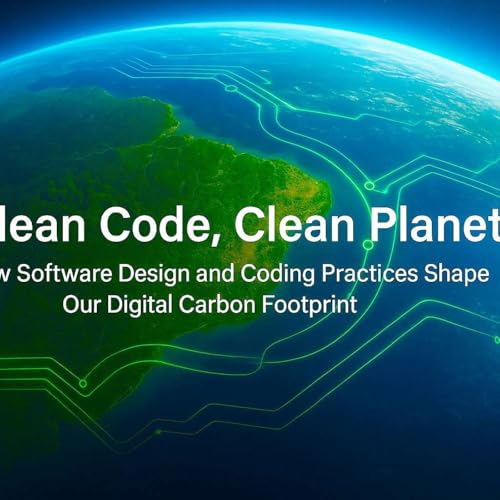
  • Clean Code, Clean Planet – How Software Design and Coding Practices Shape Our Digital Carbon Footprint
    Dec 29 2025

    New podcast episode:
    “Clean Code, Clean Planet – How Software Design and Coding Practices Shape Our Digital Carbon Footprint”

    In it, I explore a simple idea that often goes unnoticed: software may be virtual, but its impact is physical.

    Everyday engineering decisions — from algorithms and design choices to architecture, usability, and team culture — quietly consume real energy and scale globally.

    The episode looks at this through six familiar engineering lenses:

    🔹 Clean Code
    🔹 Clean Design
    🔹 Clean Architecture
    🔹 Clean Usability
    🔹 Clean Responsibility
    🔹 Clean Thinking

    This is not about green rules or guilt. It’s about awareness — and seeing good engineering not only as a quality practice, but as a contributor to a more sustainable digital world.

    💡 Clean engineering isn’t about doing more. It’s about doing only what truly matters — clearly, efficiently, and consciously.

    👉 Read the full article here: “Clean Code, Clean Planet”

    Mostra di più Mostra meno
    14 min
  • From Toyota to Agile: Using Lean Tools in Agile Engineering
    Dec 27 2025

    I just published an improved version of my article:
    “From Toyota to Agile: Using Lean Tools in Engineering”

    In it, I share how a few Lean tools I first learned from “The Toyota way” have followed me throughout my career - and how they fit beautifully into Agile engineering to make it more powerful and effective.

    Some of my favorites include:
    🔹 Value Stream Mapping
    🔹 Visual Management
    🔹 Kanban
    🔹 Kaizen
    🔹 5 Whys

    They may sound simple, but when applied consistently they can transform how teams collaborate, focus, and deliver.

    💡 Agile brings adaptability. Lean brings clarity and discipline. Together, they make engineering teams unstoppable.

    👉 Read the full article here: “From Toyota to Agile: Using Lean Tools in Engineering”

    Mostra di più Mostra meno
    18 min