Afterlives of Ancient Egypt with Kara Cooney copertina

Afterlives of Ancient Egypt with Kara Cooney

Afterlives of Ancient Egypt with Kara Cooney

Di: Kara Cooney
Ascolta gratuitamente

A proposito di questo titolo

History isn’t repeating itself; history is now

ancientnow.substack.comPatina Productions
Mondiale
  • Anatomy of the Ancient Egyptian soul: The Ba
    Feb 27 2026

    What, exactly, makes a person a person? In this episode, Kara and Amber launch a new series exploring the anatomy of the ancient Egyptian soul. They begin with the ba—often translated as “soul,” but far stranger and more powerful than that simple word suggests. The ba is the part of you that moves, that transforms, that survives death. Drawing from art, funerary texts, and literary works like The Dialogue of a Man with His Ba, the Egyptians unpack how the ba functioned as a mobile, solar, and deeply dynamic aspect of the individual.

    What emerges is an understanding that the ancient Egyptians did not view the self as singular. They saw it as layered and multifaceted—existing everywhere all at once: still and enduring, yet constantly in motion.

    This episode begins a multipart exploration of the ancient Egyptian individual—from the ba to the ka, the name, the heart, and beyond—asking how this ancient civilization imagined identity, survival, and how the Egyptians sought eternal existence in a world where death is inevitable.

    Notes

    Allen, James P. 2011. The debate between a man and his soul: a masterpiece of ancient Egyptian literature. Culture and History of the Ancient Near East 44. Leiden: Brill.

    Janák, Jiří. 2016. Ba. In Jacco Dieleman, Willeke Wendrich (eds.), UCLA Encyclopedia of Egyptology, Los Angeles. http://digital2.library.ucla.edu/viewItem.do?ark=21198/zz002k7g85

    Lichtheim, Miriam. 1973. Ancient Egyptian literature. A book of readings, volume I: The Old and Middle Kingdoms. Los Angeles, CA: University of California Press.


    Get full access to Ancient/Now at ancientnow.substack.com/subscribe
    Mostra di più Mostra meno
    1 ora
  • The Old Man and the Sun: Sex, Death, and the Turin Erotic Papyrus
    Jan 30 2026

    **Content and trigger warning: This episode contains images of sex and discussion of sexual themes, sexual abuse and exploitation, incest, and other related topics that might be inappropriate or upsetting to some listeners.

    Kara and Amber discuss one of the most debated objects from ancient Egypt: the so-called Turin Erotic Papyrus (Turin P. 55001). Often viewed as an example of ancient Egyptian pornography or crass entertainment, this papyrus reveals far more about elite anxiety, dynastic survival, and the ideological machinery of patriarchy. Through close visual analysis and discussion, they explore what is behind the exaggerated and sexualized depictions of bodies and scenes of sexual dominance and performance—not simply as humor, but as expressions of a system of power struggling to reproduce itself and maintain dominance. These images expose an obsession with regeneration, haunted by aging and mortality, and shaped by fear of failing masculinity, in which an aging sun god—and an aging king—must be sexually reborn to keep the cosmos intact.

    This episode connects sex, death, pornography, religion, ancient harems, and power structures both ancient and modern, asking why patriarchal societies so often turn to sexual control as ideology—and why these ancient images still feel disturbingly familiar today.

    Show notes

    More about the Turin Erotic Papyrus (Museo Egizio)

    Selected Bibliography

    Babcock, Jennifer Miyuki , Ancient Egyptian animal fables: tree climbing hippos and ennobled mice (Culture and History of the Ancient Near East 128), Leiden; Boston 2022, p. 49–54, 107 e passim.

    Bresciani, Edda, Sulle rive del Nilo : l’Egitto al tempo dei faraoni(Grandi Opere), Roma 2000, pp. 122–127, 139–141, fig. 13 p. 124-5; fig. 5-6 p. 140.

    Flores Diane, “The topsy-turvy world”, in Egypt, Israel, and the ancient Mediterranean world. Studies in Honor of Donald B.Redford., 2004, pp. 234–235, 239, 246, 249, fig. pp. [21], [27], [37], [42].

    Houlihan, Patrick F., Wit & humour in ancient Egypt, London 2001, pp. 67–72, 132–136, fig.. 57, 66, 67, 68, 136, 141-6.

    Janák, J. And H. Navrátilová, 2008, “People v. P. Turin 55001,” in C. Graves-Brown (ed.) Sex and Gender in Ancient Egypt, ‘Don your wig for a joyful hour,’ The Classical Press of Wales.

    Manniche, Lise, Sexual life in Ancient Egypt, in -, London 1997, pp. 106–115.

    Omlin, Joseph A., Der Papyrus 55001 und seine satirisch-erotischen Zeichnungen und Inschriften (Catalogo del Museo Eg. di Torino - Serie I. - Monumenti e testi 3), Torino 1973.

    Skumsnes, Reinert. 2025. A case study of the Turin Satirical-Erotic papyrus: historical bodies, mundane resistance, and alternative body worlds. In Pedersen, Unn, Marianne Moen, and Lisbeth Skogstrand (eds), Gendering the Nordic past: dialogues between perspectives, 235-250. Turnhout: Brepols. DOI: 10.1484/M.WOP-EB.5.144367.

    Toivari-Viitala, Jaana-Toivari-Viitala, Jaana, Women at Deir el-Medina : a study of the status and roles of the female inhabitants in the workmen’s community during the Ramesside Period(Egyptologische Uitgaven 15), Leiden 2001, pp. 146–7.


    Get full access to Ancient/Now at ancientnow.substack.com/subscribe
    Mostra di più Mostra meno
    1 ora e 29 min
  • Finding the 'Elusive' Libyans w/ Jason Silvestri
    Jan 20 2026
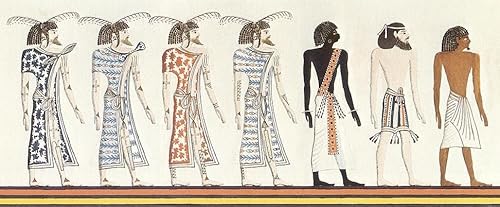
    In this episode of Afterlives of Ancient Egypt, Kara, Jordan, and guest Jason Silvestri delve into the enigmatic history of the Libyans during Egypt’s Third Intermediate Period. Jason shares his academic journey into Egyptology, discusses the discovery of ancient Libyan words in the Qeheq papyrus, and highlights his exciting archeological work at El Hibeh.About our Guest: Jason SilvestriJason Silvestri (BA ’19, Univ. of Toronto; MA ’21 UC Berkeley) is the Lady Wallis Budge Junior Research Fellow at Christ’s College, Cambridge and PhD Candidate in Egyptian Archaeology at UC Berkeley’s Dept. of Middle Eastern Languages and Cultures (MELC), where he is writing a dissertation on the social and political history of the Libyan Period (Dyns. XXI-XXIV). He has also worked extensively on Libyan-Egyptian interconnections, and has published the earliest known evidence of an Ancient Libyan language, the Qeheq Papyrus. In addition to his textual work, he is also an archaeologist, and has worked for several projects in Italy, Greece, and Egypt.Academiahttps://elhibehproject.org/Show Notes* Check out Jason’s article on oldest extant text that possibly preserve the Berber language * Third Intermediate Period * Libyan Period* Egyptian glyph rendering of the term “Libyans”- 𓍿𓅓𓎛𓌙𓀀 or 𓍿𓎛𓈖𓏌𓇋𓇋𓅱* Candelora, Danielle 2019. The eastern Delta as a middle ground for Hyksos identity negotiation. Mitteilungen des Deutschen Archäologischen Instituts, Abteilung Kairo 75, 77-94.* Hubschmann, C., (2010) “Who Inhabited Dakhleh Oasis? Searching for an Oasis Identity in Pharaonic Egypt”, Papers from the Institute of Archaeology 20(1), 51-66. doi: https://doi.org/10.5334/pia.341* Code Shifting * Use of the term “tribe” within anthropological studies * Banishment Stela * The Amazigh Language Family * Afroasiatic Language Family * Cooper, Julien Charles 2021. Beja and Cushitic languages in Middle Egyptian texts: the etymologies of queen Aashayet and her retainers. Lingua Aegyptia 29, 13-36. DOI: 10.37011/lingaeg.29.02.* Cooper, J. (2020). Egyptian Among Neighboring African Languages. UCLA Encyclopedia of Egyptology, 1(1). Retrieved from https://escholarship.org/uc/item/2fb8t2pz* El HibehWant to learn more about the Libyan Period? Suggested Readings:* Ritner, R. K. (2009) The Libyan anarchy : inscriptions from Egypt’s Third Intermediate Period / translated with an introduction and notes by Robert K. Ritner ; edited by Edward Wente. Atlanta: Society of Biblical Literature.* Moreno García, J. C. (2014) Invaders or just herders? Libyans in Egypt in the third and second millennia bce. World archaeology. [Online] 46 (4), 610–623.* Broekman, G. (2011) Theban Priestly and Governmental Offices and Titles in the Libyan Period. Zeitschrift für ägyptische sprache und altertumskunde. [Online] 138 (2), 93–115.Ancient/Now is a reader-supported publication. To receive new posts and support my work, consider becoming a free or paid subscriber. Get full access to Ancient/Now at ancientnow.substack.com/subscribe
    Mostra di più Mostra meno
    1 ora e 21 min
Ancora nessuna recensione