Episodi

  • How Future Physicians Learn and Thrive at the University of Cincinnati College of Medicine [Episode 632]
    Oct 22 2026

    Send us your admissions questions!

    How does a medical school prepare students to care for individual patients while also understanding the communities and health systems surrounding them? In Episode 632 of Accepted’s Admissions Straight Talk, host Dr. Valerie Wherley speaks with Dr. Donald Batisky, associate dean of medical student admissions and special programs at the University of Cincinnati College of Medicine.

    Dr. Batisky explains how Cincinnati Medicine connects foundational science with early clinical learning, teamwork, communication, advocacy, and community engagement. He discusses the school’s Learning Communities program, the “Physician and Society” course, work with community organizations, and the role of standardized patients in helping students practice clinical and communication skills before the stakes become higher.

    The conversation also explores how the physician’s role is changing. Future doctors must be strong diagnosticians, but they must also understand social determinants of health, communicate across different levels of health literacy, work effectively within complex systems, and advocate for patients who face barriers to care.

    For current and future medical students, Dr. Batisky shares advice on moving beyond survival to genuine growth: remember your reason for pursuing medicine, maintain relationships and interests outside school, find a personal approach to wellness, and stay connected to service. He also identifies underused opportunities, including dual-degree programs, and explains what Cincinnati Medicine seeks in applicants: academic readiness, mission alignment, teamwork, service, authenticity, and a cohesive story rather than a collection of checked boxes.

    00:00 Meet Dr. Donald Batisky and Cincinnati College of Medicine

    02:14 The Changing Role of the Physician

    07:33 Early Clinical Learning and Standardized Patients

    12:40 Learning from Cincinnati’s Communities

    20:15 Building Connection and Preventing Burnout

    22:42 Underused Opportunities for Cincinnati College of Medicine Students

    26:27 Moving from Surviving to Thriving

    34:48 What Cincinnati College of Medicine Looks for in Applicants

    Related Resources:

    • Donald Batisky, MD, University of Cincinnati College of Medicine
    • University of Cincinnati College of Medicine Office of Medical Admissions
    • University of Cincinnati College of Medicine Pre-Clerkship Curriculum
    • “Physician and Society” Course Service-Learning Experience
    • Accepted’s Medical School and Healthcare Admissions Consulting

    Follow Us
    YouTube
    Facebook
    LinkedIn

    Contact Us
    www.accepted.com
    support@accepted.com
    +1 (310) 815-9553

    Mostra di più Mostra meno
    40 min
  • Inside UCF College of Medicine: Admissions, Curriculum, and Student Success [Episode 631]
    Oct 8 2026

    Send us your admissions questions!

    What attracts more than 5,300 applicants to a medical school with 120 seats? In Episode 631 of Accepted’s Admissions Straight Talk, Dr. Valerie Wherley speaks with Laurel Poole, director of MD program admissions at the University of Central Florida (UCF) College of Medicine, about the program’s curriculum, student outcomes, and holistic admissions process.

    Poole explains how UCF’s location in Orlando, its Health Sciences Campus, career advising, and strong residency match outcomes have helped this newer medical school build a national reputation. She also takes listeners inside the curriculum. Every student completes the two-year Focused Individualized Research Experience (FIRE), which provides structured research time and faculty mentorship. Through the Community of Practice program, students begin applying clinical and communication skills with patients during the first year.

    The conversation also covers UCF’s student-run free clinics, community service opportunities, and developing discussions about technology and AI in healthcare. Finally, Poole describes what the admissions committee wants to see in a competitive applicant: academic readiness, meaningful clinical exposure, research, shadowing, and sustained volunteerism. UCF seeks students who have both the “head and the heart for medicine”—people whose actions support the qualities they claim in their essays.

    If UCF is on your medical school list, this episode offers a practical look at the program and the preparation needed to demonstrate a strong fit.

    00:00 Introduction to UCF College of Medicine

    00:44 UCF’s Growth in Orlando

    04:02 Student Outcomes Attract a Competitive Applicant Pool

    06:48 The Required FIRE Research Experience

    11:21 Clinical Learning Begins in the First Year

    14:11 Service Through Student Organizations and Free Clinics

    16:13 Technology, AI, and the Human Side of Medicine

    18:48 What UCF Looks for in Medical School Applicants

    Related Resources

    • UCF College of Medicine MD Admission Requirements
    • UCF Contact MD Program Admissions
    • 2026-2027 AMCAS Work and Activities Section: What to Include (with Examples)

    Related Episodes

    • Episode 625: Inside COMP: What the College of Osteopathic Medicine of the Pacific Looks for in Applicants
    • Episode 619: From Street Clinics to Neurosurgery: How TUCOM Trains Physicians Who Stand Out
    • Episode 618: Inside Baylor College of Medicine: Admissions, Curriculum, and What Makes a Strong Applicant

    Follow Us
    YouTube
    Facebook
    LinkedIn

    Contact Us
    www.accepted.com
    support@accepted.com
    +1 (310) 815-9553

    Mostra di più Mostra meno
    24 min
  • Sarah’s Nontraditional Path to DO School: From Humanities Major to Med Student [Episode 630]
    Sep 24 2026

    Send us your admissions questions!

    What does it look like to leave a successful career in book publishing and build a new path to medical school? In this episode of Accepted’s Admissions Straight Talk, Dr. Valerie Wherley speaks with Sarah Shirley, an osteopathic medical student at the Western University of Health Sciences College of Osteopathic Medicine of the Pacific, about her journey from English and comparative literary studies to book publishing, premed coursework, and Doctor of Osteopathic Medicine (DO) school.

    Sarah shares how hospital volunteering helped her test whether medicine was the right fit, why career changers need to take their doubts seriously without letting fear make the decision for them, and how she built a med school application around authentic experiences rather than a “checkbox” list. She also discusses letters of recommendation, the value of staying fully present while shadowing, and the journaling habit that helped her make stronger recommendation requests.

    The conversation also explores osteopathic medicine, including what drew Sarah to the DO philosophy, how osteopathic manipulative medicine shaped her understanding of patient care, and why applicants should learn the tenets of osteopathy before writing their secondary essays. If you are a nontraditional applicant, a humanities major considering medicine, or a premed wondering whether your path is too different, this episode offers practical advice and honest encouragement.

    00:00 Meet Sarah Shirley: From Humanities to DO School

    03:21 Finding Medicine Through Hospital Volunteering

    05:14 Deciding to Pursue the Premed Path

    08:10 Self-Doubt, Failure, and Changing Careers

    14:34 Building a Meaningful Med School Portfolio

    22:29 Asking for Strong Letters of Recommendation

    30:30 Why Osteopathic Medicine Was the Right Fit


    Related Episodes

    • From Med School Reapplicant to Current M1 [Episode 609]
    • Inside COMP: What the College of Osteopathic Medicine of the Pacific Looks for in Applicants [Episode 625]
    • How to Get the Most Out of Your Premed Shadowing Experience [Episode 620]


    Follow Us
    YouTube
    Facebook
    LinkedIn

    Contact Us
    www.accepted.com
    support@accepted.com
    +1 (310) 815-9553

    Mostra di più Mostra meno
    48 min
  • Inside the University of Iowa’s Top-Ranked PA Program [Episode 629]
    Sep 10 2026

    Send us your admissions questions!

    What makes the University of Iowa Physician Assistant (PA) Program one of the country’s top PA programs? In this episode of Accepted’s Admissions Straight Talk, host Dr. Valerie Wherley speaks with Thomas O’Shea, PhD, MEd, director of administrative and student services for the University of Iowa’s PA Program, about the program’s structure, curriculum, clinical training, student support, and admissions priorities.

    The University of Iowa PA Program admits a small cohort of 25 students each August and is housed in the Roy J. and Lucille A. Carver College of Medicine. Dr. O’Shea explains how Iowa’s 28-month program combines close student support with the resources of a major academic medical center, including access to faculty across the Carver College of Medicine and clinical opportunities through the University of Iowa Health Care system, local partners, regional sites, national placements, and international experiences.

    The conversation also explores Iowa’s distinctive integrated curriculum. During the didactic phase, PA students learn alongside MD and MD-PhD students, giving them shared preparation for the team-based clinical environments they will enter after graduation. Dr. O’Shea also describes the “triple helix” curriculum, the Medicine and Society strand of the curriculum, the student learning communities, alumni involvement, and the program’s long history dating back to 1972.

    The episode closes with practical advice for applicants: know the minimum requirements, understand your academic and science GPA trends, build meaningful healthcare experience, reflect on what you have learned, and develop relationships with people who can speak clearly to your readiness for PA school.

    0:00 Welcome, Dr. Tom O’Shea

    00:27 University of Iowa PA Program Basics

    03:18 Why Iowa’s PA Program Stands Out

    08:10 PA and MD Students Learning Together

    12:18 The Triple Helix Curriculum

    14:31 Learning Communities at Carver College of Medicine

    20:11 How Alumni Support Current PA Students

    23:53 What the University of Iowa’s PA Program Looks for in Applicants

    29:17 Why Gap Years Can Strengthen an Application

    31:01 Closing Thoughts and Next Steps

    Related Resources

    • University of Iowa Physician Assistant Program
    • University of Iowa PA Program Admission Requirements
    • University of Iowa PA Program Staff
    • The Ultimate Guide to Becoming a Physician Assistant, a free guide
    • Accepted’s Physician Assistant Application Packages

    Follow Us
    YouTube
    Facebook
    LinkedIn

    Contact Us
    www.accepted.com
    support@accepted.com
    +1 (310) 815-9553

    Mostra di più Mostra meno
    32 min
  • From Military Service to PA School: Advice for Veteran Applicants [Episode 628]
    Aug 27 2026

    Send us your admissions questions!

    How can military veterans translate their service, leadership, and clinical experience into a strong PA school application? In this episode of Admissions Straight Talk, host Dr. Valerie Wherley speaks with Brandon R. Beattie, MMSc, PA-C, assistant professor and program director, about the George Washington University (GW) PA Program, the military roots of the PA profession, and the opportunities and barriers veterans face when applying to PA school.

    Brandon brings both admissions expertise and lived experience to the conversation. Before becoming a PA, he served as a U.S. Army combat medic during multiple overseas tours. He later completed his PA training at Yale and now leads one of the country’s long-standing PA programs, which was founded in 1972 and was ranked sixth (tied with Baylor College of Medicine) in U.S. News & World Report’s 2025 Best Physician Assistant Programs rankings.

    The conversation focuses on how veterans can tell their stories in ways that admissions committees will understand. Brandon explains why military jargon, acronyms, and modesty can sometimes hide the depth of an applicant’s experience. He also shares practical advice for the PA application process, including proofreading, clarifying military roles for civilian readers, choosing recommendation writers strategically, and showing evidence of grit, teamwork, communication, coachability, and mission fit.

    If you are a veteran considering PA school, this episode offers a clear framework for presenting military service as a strength, not a complication.

    0:00 From Military Service to PA School

    01:32 What Sets the GW PA Program Apart

    03:25 Veterans and the Origins of the PA Profession

    05:27 Strengths Veterans Bring to PA School

    07:03 Barriers Veterans Face in the Application Process

    15:06 Strategies for a Strong PA Application

    18:12 Choosing the Right Recommenders

    20:21 What GW Looks for in Competitive Applicants

    Related Resources:

    • Brandon R. Beattie faculty profile
    • George Washington University Physician Assistant Program
    • GW PA Program Admission Requirements
    • GW PA Program How to Apply
    • The Ultimate Guide to Becoming a Physician Assistant, a free guide
    • Accepted’s Physician Assistant Application Packages


    Follow Us
    YouTube
    Facebook
    LinkedIn

    Contact Us
    www.accepted.com
    support@accepted.com
    +1 (310) 815-9553

    Mostra di più Mostra meno
    23 min
  • Inside Wake Forest’s PA Program: Inquiry-Based Learning, Service, and Leadership Training [Episode 627]
    Aug 13 2026

    Send us your admissions questions!

    What makes Wake Forest University’s Physician Assistant Program different from the hundreds of PA programs applicants can choose from?

    In this episode of Accepted’s Admissions Straight Talk, host Dr. Valerie Wherley speaks with Sobia Hussaini, MHA, assistant professor of PA studies and director of admissions and strategic recruitment for PA studies at Wake Forest University School of Medicine, about the program’s curriculum, campuses, culture, and admissions priorities.

    Sobia explains how Wake Forest’s 24-month Master of Medical Science PA Program brings together a large class with a small-group learning environment across two North Carolina campuses: Winston-Salem and Boone. She describes how the program’s inquiry-based learning model asks students to work through patient cases from the beginning of PA school, building clinical reasoning, self-directed learning, and collaborative problem-solving skills before they enter rotations.

    The conversation also explores Wake Forest’s leadership focus, including its Emerging Leaders Program pathways in business and law, and the service-oriented experiences that begin during orientation. Sobia connects those experiences to the PA profession’s responsibility to understand the social drivers of health and serve patients in context.

    The episode closes with practical advice for applicants. Wake Forest looks for academic readiness, meaningful hands-on patient care experience, teamwork, service, leadership, resilience, and a clear answer to one essential question: why do you want to be a PA?

    00:00 Introducing Wake Forest’s PA Program

    03:35 Comparing the Winston-Salem and Boone Campuses

    07:38 Serving Rural and Medically Underserved Communities

    09:12 How Inquiry-Based Learning Works

    14:21 Leadership Development Throughout the Curriculum

    18:21 The Emerging Leaders Program in Business and Law

    22:08 Community Service, Orientation, and Social Drivers of Health

    28:38 What Wake Forest Looks for in PA Applicants

    33:26 Closing Thoughts and Next Steps

    Related Resources:

    • Wake Forest University School of Medicine Physician Assistant Program
    • Wake Forest PA Program Emerging Leaders Programs
    • Inside Wake PA, a digital publication
    • The Ultimate Guide to Becoming a Physician Assistant, an Accepted guide
    • Accepted’s Physician Assistant Application Packages

    Follow Us
    YouTube
    Facebook
    LinkedIn

    Contact Us
    www.accepted.com
    support@accepted.com
    +1 (310) 815-9553

    Mostra di più Mostra meno
    22 min
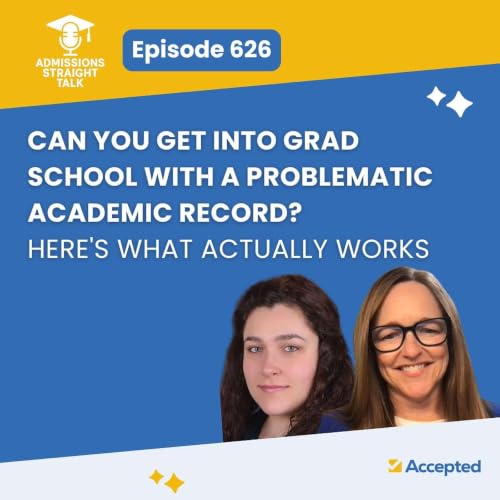
  • Can You Get into Grad School with a Problematic Academic Record? Here’s What Actually Works [Episode 626]
    Jul 30 2026

    Send us your admissions questions!

    What do you do when your transcript tells a story you would rather not tell? In this episode of Accepted’s Admissions Straight Talk podcast, host Dr. Valerie Wherley is joined by Dr. Rachel Slutsky, an Accepted admissions consultant and Harvard PhD, to discuss one of the most common – and most feared – obstacles in the graduate admissions process: a problematic academic record.

    Dr. Slutsky draws on her background as a university writing tutor and professor to reframe how applicants think about academic setbacks. The conversation moves through three categories of challenges she commonly sees in her work: ethical issues, emotional and psychological struggles, and maturity gaps. She also addresses the often-overlooked role of financial hardship in academic performance.

    The episode is practical throughout. Dr. Slutsky and Dr. Wherley discuss where in your application to address your academic record, how much space to give it in a statement of purpose, and why self-awareness – not shame – is the quality that resonates with adcoms. They cover how to demonstrate help-seeking behaviors, professional growth, and determination when the numbers on your transcript do not tell your whole story.

    The conversation closes with an invitation: If you have been avoiding applying to graduate school because of your academic record, Dr. Slutsky wants to hear from you.

    00:00 Welcoming Dr. Rachel Slutsky to the Podcast

    02:53 Defining a Problematic Academic Record

    04:28 Three Sources of Issues: Ethical, Emotional, and Maturity

    07:11 Financial Hardship and the Hidden Story Behind Transcripts

    09:35 Should You Even Apply? Don’t Write Off Grad School Prematurely

    10:43 Addressing Academic Issues in a Statement of Purpose

    13:41 Self-Awareness Over Shame: Own It, Show Growth, Move Forward

    16:05 The Holistic Review Process: Highlighting Your Strengths

    19:27 Demonstrating Help-Seeking Behaviors as Evidence of Growth

    Related Resources:

    • Dr. Rachel Slutsky bio
    • Sign up for a free consultation with Dr. Rachel Slutsky

    Related Episodes:

    • How to Get Selected for a Fulbright and Other Competitive Fellowships [Episode 624]
    • Is There Such a Thing as Too Many Drafts? Writing a Standout Med School Personal Statement [Episode 612]


    Follow Us
    YouTube
    Facebook
    LinkedIn

    Contact Us
    www.accepted.com
    support@accepted.com
    +1 (310) 815-9553

    Mostra di più Mostra meno
    22 min
  • Inside the College of Osteopathic Medicine of the Pacific: A DO School That Trains Holistic Physicians [Episode 625]
    Jul 16 2026

    Send us your admissions questions!

    What exactly is—and isn’t—a DO? And what does it take to get into a Tier 1 primary care medical school that operates across two very different campuses?

    In this episode of Accepted’s Admissions Straight Talk, host Dr. Valerie Wherley sits down with the leadership and a current student from the College of Osteopathic Medicine of the Pacific (COMP) at Western University of Health Sciences. Dr. Lisa Warren, the dean and a COMP graduate; Dr. Marcel Fraix, associate dean for admissions and also a COMP graduate; TJ Pe, assistant director of recruitment; and Sarah Shirley, a rising second-year COMP DO student, walk listeners through what makes this program distinctive.

    The conversation covers the school’s two-campus structure—urban Pomona, California, and rural Lebanon, Oregon—and how the shared curriculum delivers a consistent experience in two very different environments. COMP has now earned U.S. News & World Report’s Tier 1 recognition for primary care training for three consecutive years, and the panel breaks down why that matters for applicants.

    Sarah shares her nontraditional path: a literature degree, a career in book publishing, a mid-20s pivot, and what drew her to osteopathic medicine specifically. The panel also discusses COMP’s longitudinal student tracks (business, rural health, sports medicine, and more), the technology-infused curriculum including simulation and AI exposure, and the robust student wellness infrastructure—from free yoga to open-door faculty.

    For applicants concerned about GPA and MCAT thresholds, Dr. Fraix and TJ offer a candid, encouraging reality check on holistic admissions and the one-year master’s program that creates a pathway for promising candidates who don’t yet meet full admission requirements.

    Related Resources:

    • College of Osteopathic Medicine of the Pacific (COMP) at Western University of Health Sciences
    • Experience WesternU (preview day): August 22, 2026
    • Dr. Lisa Warren, dean, Western University of Health Sciences COMP and COMP-Northwest: lwarren@westernu.edu
    • Dr. Marcel Fraix, associate dean, admissions and enrollment chair, professor of physical medicine and rehabilitation: mfraix@westernu.edu
    • TJ Pe, assistant director of recruitment: pet@westernu.edu


    Follow Us
    YouTube
    Facebook
    LinkedIn

    Contact Us
    www.accepted.com
    support@accepted.com
    +1 (310) 815-9553

    Mostra di più Mostra meno
    40 min